Written by: Matthew Timmins, Founder and Managing Director, Leva Sleep | Last updated: July 10, 2026
Key Takeaways for Couples Considering Adjustable Beds
- Adjustable sleep systems fall into three tiers, from basic manual bases with fixed-firmness mattresses like Serta to premium smart systems with sensor automation, app control, and temperature regulation.
- Couples often compromise sleep because of snoring, different firmness needs, or medical elevation requirements that a standard flat mattress cannot handle.
- Smart adjustable features such as independent per-side firmness control, automatic snore response, and active cooling create real benefits when partners have mismatched sleep preferences or health conditions.
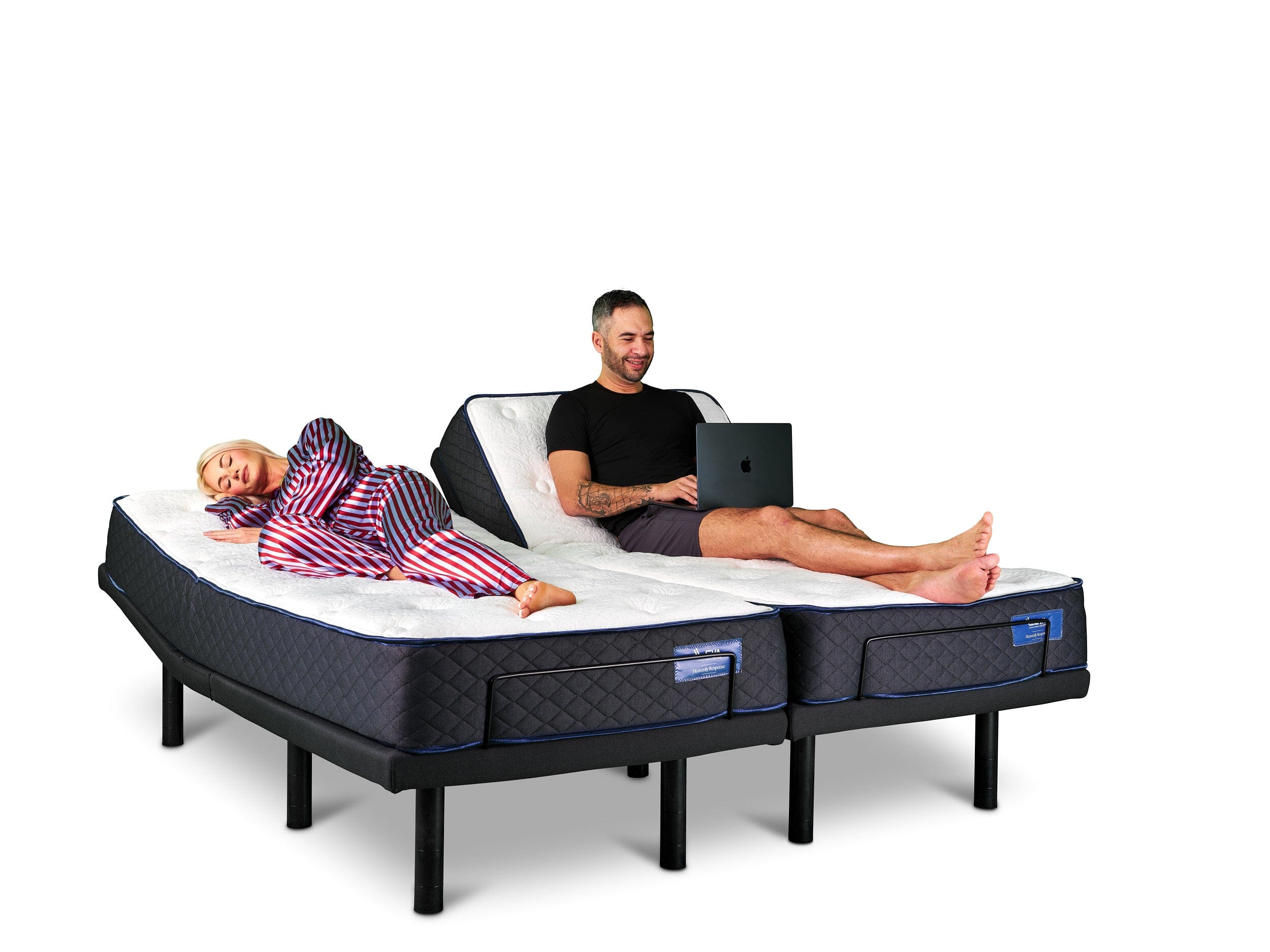
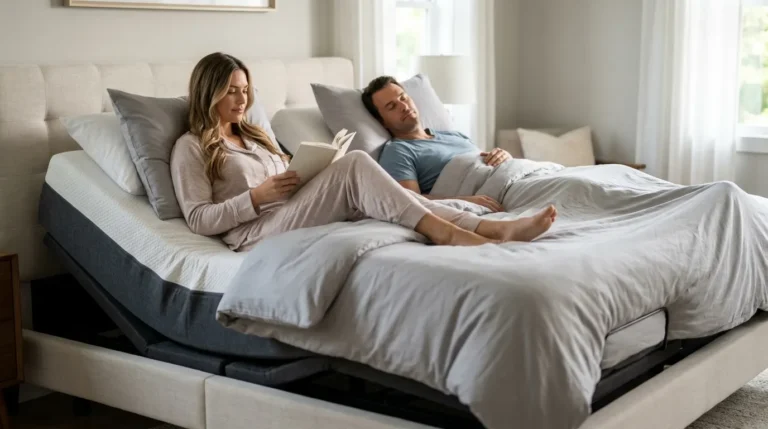
- Split configurations like Split King and the rare Split Queen let each partner adjust elevation and firmness independently without disturbing the other.
- Leva Sleep offers premium smart adjustable bed packages at 30–50% below comparable competitors. Browse Leva Sleep split systems designed for couples and match a package to your specific sleep needs.
Three Tiers of Adjustable Sleep Systems Explained
Adjustable sleep systems fall into three distinct tiers. Basic adjustable systems pair a fixed-firmness mattress, such as a standard Serta foam or hybrid, with a manual power base that offers head and foot elevation via remote. Smart adjustable systems add app control, independent per-side elevation, and limited automation such as programmable positions. Premium smart systems add sensor-driven auto-snore response, active temperature regulation, AI sleep tracking, and real-time micro-adjustments, at a significantly higher price point.
The Problem: Why Many Couples Compromise Sleep or Sleep Apart
Disrupted sleep affects both relationships and long-term health, not just nightly comfort. When one partner snores, the other often loses sleep. When firmness needs diverge, a shared flat mattress forces a compromise that satisfies neither partner.
Physicians recommend elevated sleeping positions for conditions such as sleep apnea, acid reflux, and post-surgical recovery. A traditional flat bed cannot provide sustained elevation without a separate wedge pillow or a dedicated adjustable base, which often feels awkward or unstable.
Orthopedic physical therapist Karena Wu, P.T., D.P.T., notes that adjustable beds help users with chronic back and neck pain, respiratory issues like snoring or asthma, digestive issues like gastric reflux, and circulatory issues by enabling upper-body or leg elevation. Orthopedic spine surgeon Nitin Bhatia, M.D., adds that patients should match their specific condition to the appropriate adjustment: upper-body elevation for GERD or sleep apnea, leg elevation or zero-gravity positioning for swelling or lower-back pain.
A standard Serta mattress paired with a basic power base addresses elevation but not independent firmness control, automated snore response, or temperature regulation. Couples who need all three features from one system must move beyond the basic tier.
How Firmness Control and Sleep Tracking Differ by Tier
A Serta mattress, whether all-foam or hybrid, ships with a fixed firmness level chosen at purchase. Couples who discover their preferences diverge after delivery have no practical remedy on that mattress other than buying a second one. Air-chamber systems and app-adjustable bases in the smart and premium smart tiers let each partner dial firmness independently, often in real time.
Many buyers report that enhanced comfort and better spinal support are the main reasons for choosing higher-priced mattresses, which shows that people now treat sleep quality as a wellness investment. AI-powered smart sleep environments use embedded sensors to monitor breathing patterns, heart rate, and body movement, then adjust temperature, mattress support, lighting, or sound to promote deeper sleep.
To determine whether a system’s firmness control and sleep tracking features will actually solve your specific sleep challenges, focus on these practical criteria instead of marketing test scores:
- Whether each side of the bed can be adjusted independently without waking the other partner
- Whether firmness adjustments require a technician visit or can be made through an app or remote
- Whether sleep tracking data leads to coaching or position suggestions instead of remaining purely informational
- Whether the tracking system requires a subscription fee after purchase
Auto-Snore Response and Temperature Regulation in Real Use
The gap between basic and premium smart tiers appears most clearly in snore response and temperature management. Lower-tier power bases such as the Tempur-Pedic Ease and standard Ergo models offer only manual QuietMode, which requires the user to press a button on the wireless remote to tilt the mattress into an anti-snore position. The snoring partner must either wake themselves or rely on their partner to trigger the adjustment. The TEMPUR-Ergo Smart Base uses sensor technology to detect snoring and raise the head section approximately 12 degrees once, which may reduce snoring in otherwise healthy individuals caused by body positioning.
Leva Sleep’s anti-snore mode follows a comparable sensor-driven approach, detecting snoring and making micro-adjustments to the head of the bed. Whisper-quiet German motors deliver these changes without waking the non-snoring partner.
Beyond snoring, temperature mismatch is another major sleep disruptor for couples, and the difference between passive and active cooling technologies becomes critical here. Passive cooling technologies provide meaningful but time-limited effects.
Gel-infused foam sleeps 1–4°F cooler than standard memory foam, but the cooling effect is most pronounced in the first 30 to 90 minutes and fades once the gel reaches body temperature. Hybrid construction with coil airflow is the most impactful passive feature for sleeping cooler, because pocketed coils create an air reservoir that supports ongoing ventilation and heat dissipation that foam-only mattresses cannot match.
A 2024 three-centre study published in Scientific Reports (72 participants) found that people sleeping on a higher heat-capacity surface got more deep slow-wave sleep and a lower heart rate, with benefits tracking the gap between core and skin temperature. Active cooling systems that use water or air pads provide sustained, adjustable cooling all night but cost $2,000 CAD or more and require continuous power. The Eight Sleep Pod 5 operates at 31–32 dBA from one meter away while delivering rapid temperature adjustments and supports dual-zone control so partners can set different temperatures without affecting each other.
Split-Bed Options for Couples with Different Sleep Needs
A Split King adjustable bed consists of two Twin XL mattresses and two independent adjustable bases placed side-by-side, creating a standard King footprint of 76″ × 80″ where each side can move autonomously. Elevating the head can reduce snoring and mild sleep apnea symptoms by opening airways and can ease acid reflux by using gravity to keep stomach acid down.
A standard Serta mattress cannot be split after purchase. Couples who want independent elevation must either replace the mattress entirely or purchase two separate mattresses from the outset. Leva Sleep offers both Split King and Split Queen configurations, with the Split Queen providing a smaller room footprint while still delivering fully independent per-side controls, which remains rare in Canada.
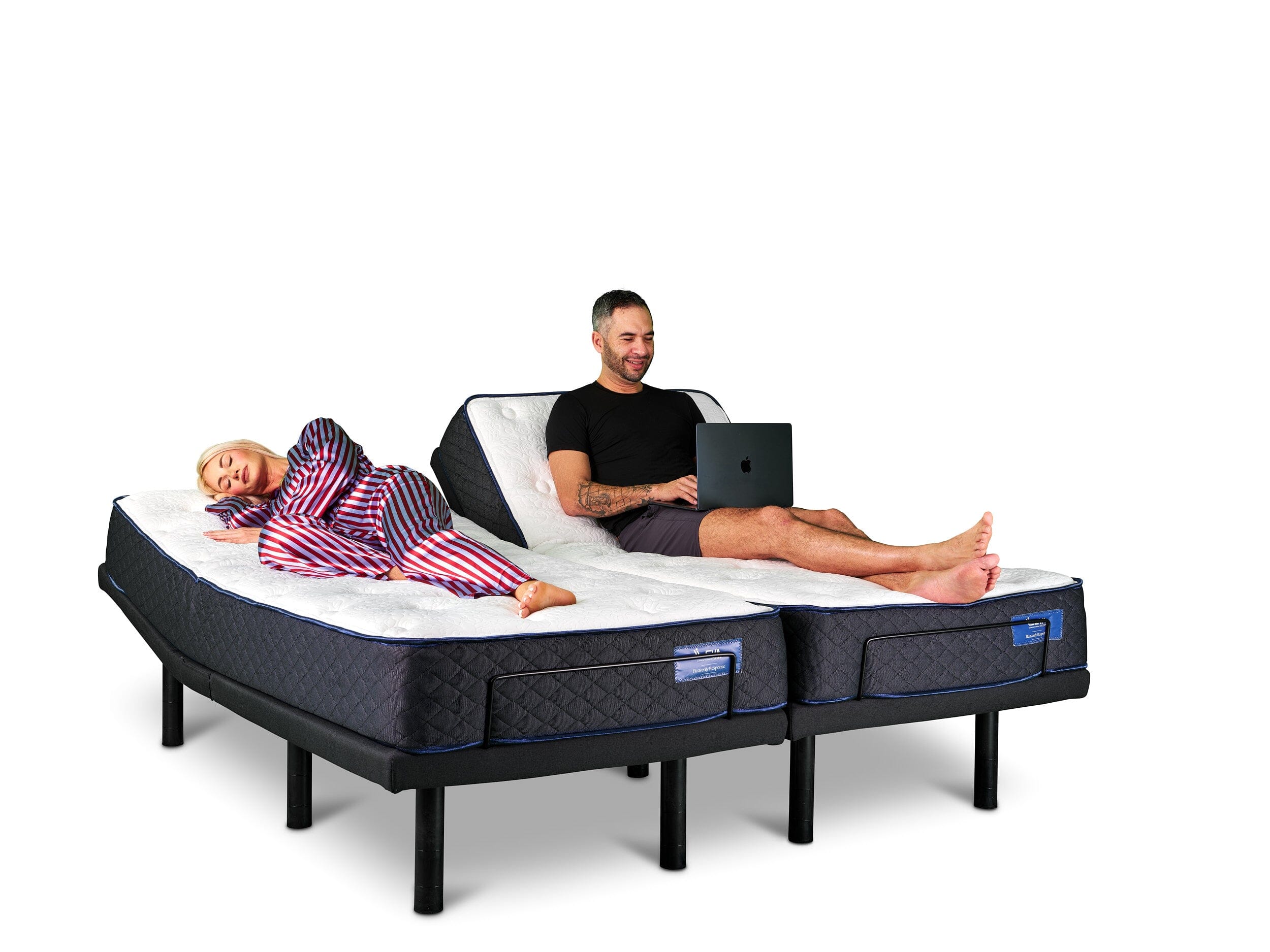
Practical accessories matter in split configurations because standard bedding often fails once bases move independently. Fitted sheets with extra-deep elastic pockets prevent slippage during elevation changes, while duvet clips maintain separation when one side is elevated and the other is flat. Leva Sleep designs these accessories specifically for adjustable bases, solving frustrations that generic bedding cannot address because it is not engineered for moving surfaces.
Canadian delivery realities also differ from U.S. benchmarks. White-glove delivery, where trained professionals bring the base to the bedroom, assemble it, adjust leg heights, provide a product tutorial, and remove the old bed, is available from Leva Sleep in Ontario and Alberta, which are the two provinces where most Canadian adjustable-bed buyers are concentrated.
Total Cost of Ownership for Canadian Couples in 2026
In Canada in 2026, entry-level adjustable bases for a queen start around $700–$800 CAD, with quality options from roughly $995. Canadian prices usually run higher than equivalent U.S. prices because of currency exchange, import duties, and retail markup. Smart mattresses with sleep tracking, temperature control, and adjustable firmness appear at a wide range of price points in Canada.
The table below compares the three tiers on like-for-like metrics using 2026 CAD benchmarks, showing where each tier delivers measurable value and where you mainly pay for automation instead of core functionality. Motor longevity and warranty length use the same units for direct comparison. Automation and split availability are described categorically because no shared numeric scale applies.
| Metric | Basic Adjustable (Serta + Power Base) | Smart Adjustable (Mid-Tier) | Premium Smart (e.g., Tempur-Pedic Ergo Smart / Eight Sleep) |
|---|---|---|---|
| Approx. Queen Price (CAD, 2026) | $700–$1,250 base + mattress cost | $1,399–$1,860 (base only) | $3,500–$5,000+ |
| Snore Response | Manual button only | App-triggered or basic preset | Automatic sensor-driven (~12° head raise) |
| Split / Independent Side Control | Not available on standard Serta mattress | Available on select models | Available; includes lumbar and sleep tracking per side |
| Warranty (Base) | Varies, often 1–5 years on entry models | 10 years (e.g., Douglas) | 25 years (e.g., Tempur-Pedic Ease 4.0) |
Motor quality and warranty coverage are significant long-term cost factors, which makes Leva Sleep’s vertically integrated model relevant for value. By designing, assembling, and delivering systems in-house, Leva removes retail markup and positions its split adjustable systems at 30–50% below comparable premium competitors on a per-feature basis, while maintaining the motor and warranty specifications that shape total cost of ownership.
When a Basic Serta Setup Works and When Smart Systems Pay Off
A Serta mattress paired with a basic power base works well when both partners share the same firmness preference, neither partner snores, no medical elevation is required, and budget sits as the primary constraint. The combination delivers reliable head and foot elevation at the lowest entry cost.
A true smart adjustable system adds measurable value in the following scenarios:
- Snoring with a light-sleeping partner: Automatic snore response adjusts head elevation without either partner waking to press a button, which protects the non-snoring partner’s sleep continuity.
- Firmness mismatch: One partner needs a firm surface for lumbar support while the other needs a softer surface for hip or shoulder pressure relief. Only a split system with independent mattress selection resolves this without compromise.
- Medical elevation requirements: Sleep apnea, GERD, or post-surgical recovery protocols that specify a sustained elevated angle benefit from programmable position memory and quiet motors that hold position through the night.
- Temperature divergence: One partner sleeps hot and the other cold. Active dual-zone cooling or a hybrid mattress with coil airflow on each side addresses this where passive foam technologies fall short.
Couples can map their own pain points against these scenarios before committing to a tier. A split system is not necessary for every couple, but for those with even two of the conditions above, the per-night cost difference between a basic and smart adjustable system narrows considerably over a 10-year ownership period.
Frequently Asked Questions
What is the main automation difference between a basic power base and a smart adjustable bed in 2026?
A basic power base relies on manual input from a remote to change elevation or activate an anti-snore position. A smart adjustable bed uses embedded sensors to detect physiological signals such as snoring or movement and then makes automatic adjustments without waking either partner. Premium smart systems add AI-driven sleep coaching, heart rate and breathing monitoring, and over-the-air software updates that improve performance over time. For couples, the key difference is whether the snoring partner must wake to trigger a position change or whether the bed handles it autonomously.
Does temperature regulation in a mattress actually improve sleep quality?
Passive cooling technologies such as gel foam, phase-change materials, and hybrid coil construction reduce surface heat retention to varying degrees, with hybrid coil systems providing the most sustained airflow benefit. A 2024 three-centre study found that sleeping on a higher heat-capacity surface increased deep slow-wave sleep and lowered heart rate. No mattress technology can fully compensate for a bedroom that is too warm, and the optimal room temperature for sleep is 18–20°C.
Active water- or air-based cooling systems provide the most consistent all-night temperature control but add significant cost and require continuous power. Couples who sleep at very different temperatures benefit most from dual-zone active systems or a split configuration where each side uses a different mattress construction.
Are split adjustable beds effective for couples where one partner snores?
Split adjustable beds allow the snoring partner’s head to be elevated independently without changing the other partner’s sleep surface. Elevating the head opens the airway and can reduce positional snoring and mild sleep apnea symptoms. The non-snoring partner’s side remains flat or at their preferred angle.
For couples where snoring is the primary issue, a split system with an automatic snore-response mode addresses the problem without requiring either partner to wake and manually adjust the base. Couples with diagnosed moderate-to-severe sleep apnea should consult a physician, because elevation alone may not replace CPAP therapy.
What should Canadian couples budget for a split adjustable bed system in 2026?
As noted in the cost section above, entry-level queen bases start around $700–$800 CAD. A Split King configuration, which uses two Twin XL bases, from mid-tier brands is priced around $2,398 CAD for the base alone, before mattresses. Premium smart systems with full sensor automation and active temperature control can reach $5,000 CAD or more for a complete setup.
Leva Sleep’s vertically integrated model, which designs and assembles systems locally and delivers directly to the consumer, positions split adjustable packages at 30–50% below comparable premium competitors. White-glove delivery that includes bedroom setup, leg-height adjustment, product tutorial, and old-bed removal is available in Ontario and Alberta.
Can a standard Serta mattress be used on a split adjustable base?
As explained in the split-bed section, Serta mattresses are single-piece units that cannot be split. The practical consequence is clear. Using one mattress across two independent adjustable bases prevents each side from moving independently, which defeats the purpose of a split system.
Couples who want independent elevation on each side must select mattresses designed for split configurations, typically two separate Twin XL mattresses for a Split King or two custom-width mattresses for a Split Queen. Leva Sleep designs its mattresses, including all-foam and hybrid pocket coil options, specifically to flex with adjustable bases and fit split configurations, including the Split Queen format that most Canadian retailers do not carry.
Decision-Support Takeaway for Canadian Couples
A Serta mattress paired with a basic power base remains a cost-effective entry point for couples with simple, aligned sleep needs. For couples managing snoring, firmness divergence, medical elevation requirements, or temperature differences, the limitations of a fixed-firmness mattress and manual power base create nightly compromises that build over time. Smart adjustable systems close these gaps through automation, independent per-side control, and sustained temperature management, although premium-tier pricing places the best-known brands out of reach for many Canadian households.
Leva Sleep occupies the practical middle ground, with over 8 years in business, 25,000+ customers, and $50M in lifetime sales. Its vertically integrated model achieves the pricing advantage mentioned earlier while adding the rare Split Queen format that most Canadian retailers do not carry. Whisper-quiet German motors, an anti-snore mode, app control, and in-house white-glove delivery in Ontario and Alberta make the complete system accessible without premium-brand markup.
Compare complete split adjustable packages with white-glove delivery in Ontario and Alberta.