Written by: Matthew Timmins, Founder and Managing Director, Leva Sleep | Last updated: August 3, 2026
Key Takeaways for Canadian Couples
- Temperature disagreements affect half of couples and often lead to sleep divorce, and a modular dual-zone system solves this reliably.
- Water-circulating pads cool faster, more quietly, and more evenly than air-based systems on each side of the bed.
- Split Queen or Split King bases with independent cooling pads and Scandinavian-style duvets give each partner true temperature and position control.
- Correct integration, including tubing routing, extra-elastic sheets, and coolant maintenance, keeps cooling pads effective on adjustable bases.
- Leva Sleep offers complete adjustable-bed packages engineered for Canadian couples; shop Leva Sleep’s adjustable beds to start building your system today.
The Problem: How Temperature Fights Push Couples Toward Sleep Divorce
Nearly one-third (29–31%) of U.S. adults have opted for a sleep divorce by sleeping separately from their partner, and about 53% of people who have tried a sleep divorce report that their sleep quality increased after sleeping alone. Sleeping apart improves rest for many couples, but the real goal is staying together without sacrificing sleep.
Single-zone products fail couples because they treat the bed as one thermal unit. A cooling mattress topper set to one temperature rarely suits either partner. A shared duvet becomes a nightly negotiation. Couples experience 50% more sleep disturbances when sharing a bed than when sleeping alone, yet that figure drops sharply when each side of the bed operates independently. The modular system below addresses every layer of this problem.
Creating Two Temperature Zones in One Bed
True dual-zone temperature control depends on three decisions. You choose the active cooling or heating system, the bed configuration, and the budget tier.
Step 1: Pick Water-Circulating or Air-Based Cooling
Water has a thermal conductivity roughly 25 times greater than air and is 800 times denser, so water-based systems remove heat from the sleep surface faster and more evenly. A Loughborough University study found that a water-based cooling mattress topper increased total sleep time by an average of 19 minutes and helped participants fall asleep 10 minutes faster in an overheated bedroom.
Air-based systems such as bed fans and forced-air units create fan noise that rises with power output, form uneven hot and cold spots, and lose effectiveness under heavier blankets. Active water-circulating systems like the ChiliSleep OOLER reach 55°F (13°C) and support independent dual-zone control. These systems give couples with different temperature preferences a practical path to separate comfort on one bed.
| Factor | Water-Circulating | Air-Based |
|---|---|---|
| Thermal conductivity advantage | ~25× greater than air | Baseline |
| Minimum temperature | 55°F (13°C) | Limited by room temp |
| Noise profile | Quiet pump circulation | Fan noise increases with power |
| Maintenance | typically requires coolant replacement annually or every 3-6 months depending on fluid type, with descaling as needed | Filter cleaning |
Step 2: Choose Split Queen or Split King for Your Space
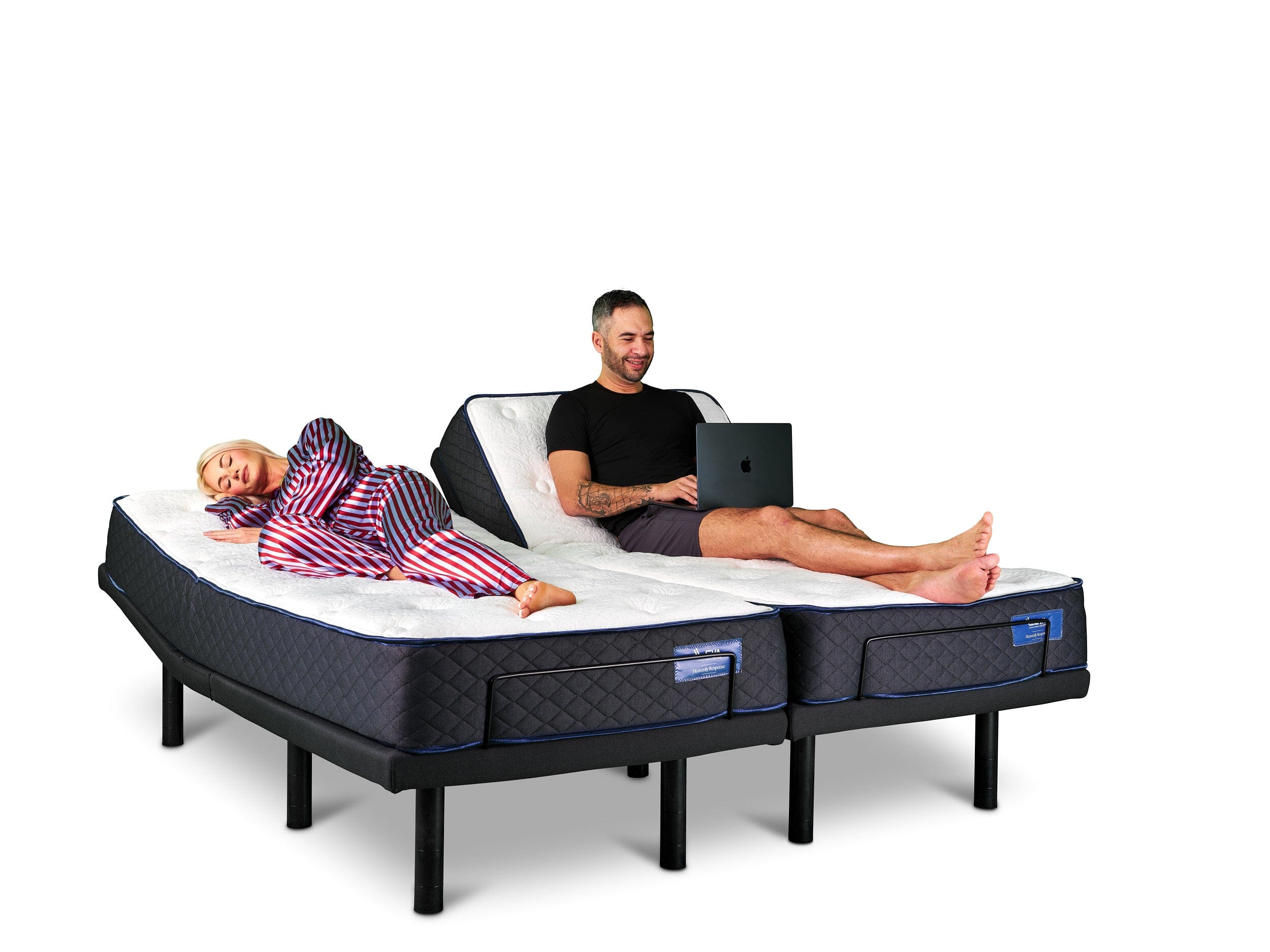
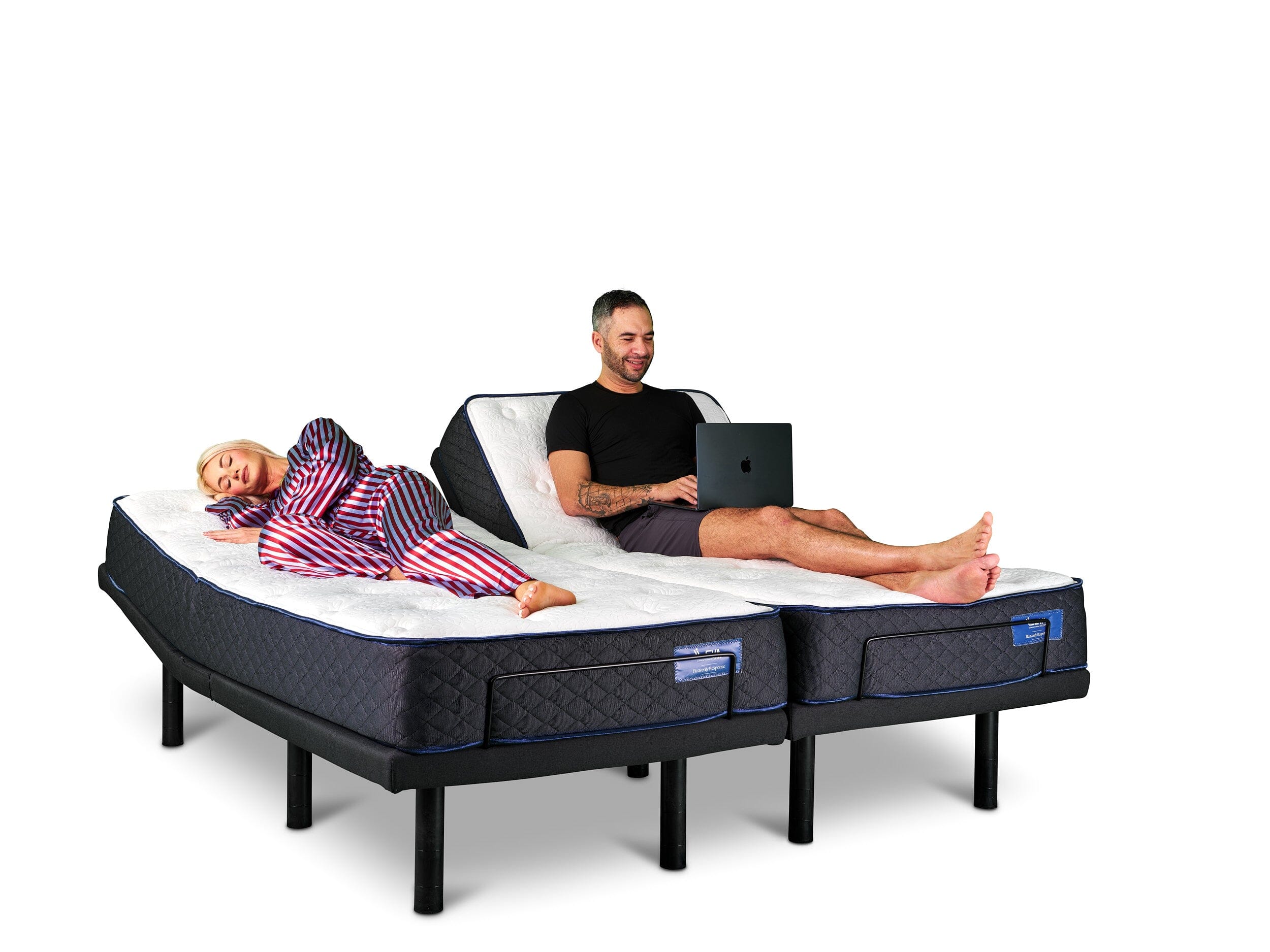
A Split Queen suits couples in smaller bedrooms or those moving up from a standard queen. A Split King, which uses two Twin XL mattresses on independent bases, provides maximum independent adjustability. A split-king adjustable base allows each side to move independently, serving as the positioning counterpart to temperature-specific solutions. Leva Sleep is one of the few Canadian retailers that offers a true Split Queen configuration built to customer specifications.
Step 3: Align Your Budget with a System Tier
- Under $300 CAD (DIY): Separate lightweight and heavyweight duvets plus a basic cooling pillow for the warmer partner. This tier addresses bedding-level thermal differences only.
- $300–$1,500 CAD (Enthusiast): Single-zone water-loop pad on the warmer partner’s side, separate duvets, and moisture-wicking fitted sheets. This configuration delivers partial dual-zone control.
- $1,500+ CAD (Full System): True dual-zone water-circulating pads on a Leva Sleep split adjustable base, Scandinavian-method duvets, purpose-built adjustable-base bedding, and app control. This tier provides complete independent temperature and position control for each partner.
When you build any of these tiers, avoid a common configuration error that undermines the whole system.
Common mistake: Purchasing a single-zone cooling pad and placing it in the centre of the bed. This setup creates one shared thermal zone and does not resolve differing temperature preferences.
Scandinavian Sleep Method for Couples with Different Needs
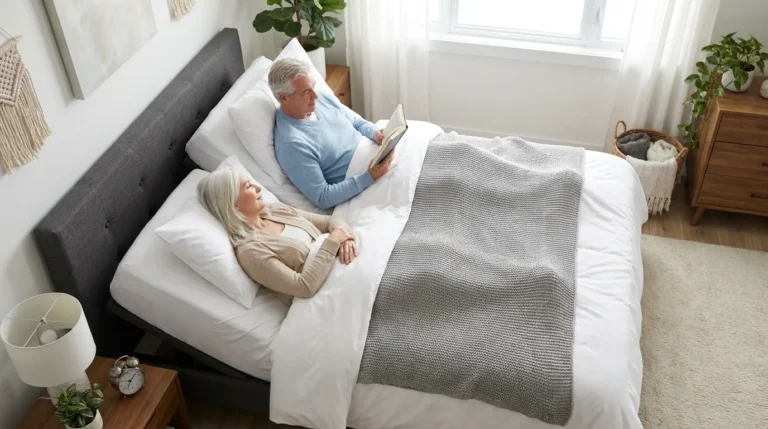
The Scandinavian Sleep Method replaces one shared duvet with two individual duvets, one for each partner. This long-standing Scandinavian practice allows each partner to select a different duvet weight, such as a heavy 12 tog for one sleeper and a lightweight 4.5 tog for the other, without negotiation or compromise.
Tog selection criteria for Canadian climates:
- Warm sleeper: 4.5–7 tog, breathable cotton or bamboo fill
- Cool sleeper: 10.5–13.5 tog, down or high-loft synthetic fill
- Year-round flexibility: All-season dual-tog sets that button together in winter and separate in summer
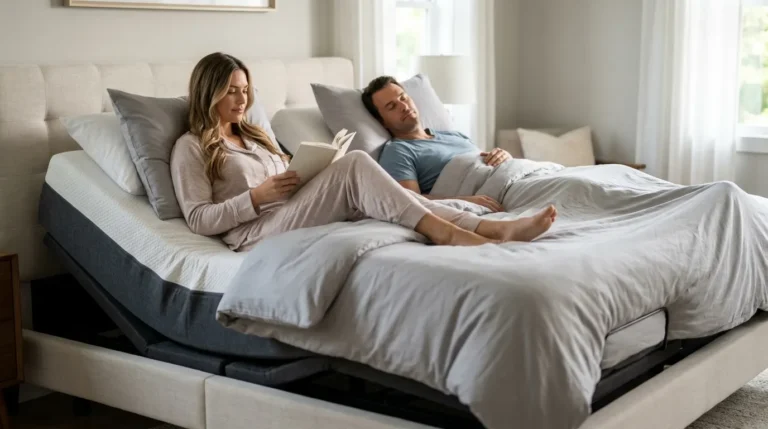
On an adjustable base, standard duvets bunch at the foot when the head section elevates. Leva Sleep’s duvet clips anchor each duvet to its side of the bed, and the extra-elastic fitted sheets grip the mattress through the full range of motion. A breathable mattress protector underneath reduces moisture buildup and preserves the thermal properties of the mattress.
Duvet hogging is a common and frustrating bed-sharing habit. Separate duvets remove that friction completely.
Integrating Cooling Pads with a Split Adjustable Base
Cooling pads and split adjustable bases work well together when you pay attention to routing, safety, and maintenance. Each step supports the next, so follow this sequence.
- Position the control unit: Place each partner’s water-loop control unit on their bedside table. Route tubing along the side of the base, not underneath, to avoid pinching during articulation. Proper routing matters because the next step, securing the tubing, only works when the path is clear and unobstructed.
- Secure tubing at flex points: Use the pad manufacturer’s cable clips at the head-section hinge. Tubing must have enough slack to accommodate full head elevation without tension. This slack requirement influences the layering step, since the fitted sheet must hold the pad in place without pulling on the tubing.
- Layer in order: Mattress → breathable mattress protector → cooling pad → extra-elastic fitted sheet. The fitted sheet holds the pad in place during position changes, which keeps the tubing stable and protects the pad from shifting.
- Electrical separation: Plug each cooling unit and each adjustable base motor into separate circuits where possible. Use individual outlets instead of daisy-chained power bars to reduce overload risk and keep each component running reliably.
- Maintenance schedule: Water reservoirs in cooling systems typically require coolant replacement annually or every 3-6 months depending on fluid type, with descaling performed as needed based on scale buildup. The ChiliSleep OOLER includes a self-cleaning mode that reduces this maintenance burden and keeps performance consistent.
Sheet slippage note: Standard fitted sheets are the leading cause of cooling pad displacement on adjustable bases. Leva Sleep’s fitted sheets include deep pockets and reinforced elastic designed for adjustable-base range of motion.
Tuning Your Bedroom for Dual-Zone Comfort
The National Sleep Foundation recommends a bedroom temperature between 60 and 67°F (approximately 15.6–19.4°C) to promote sleep. Cleveland Clinic sleep specialist Brian Chen, MD, explains that your core body temperature should drop to its minimum during sleep, which aligns with your circadian rhythm.
Room-level tuning steps work together to support that natural drop in core temperature and to help your bed-level system perform efficiently.
- Set the thermostat to 16–19°C as a neutral baseline before bed-level adjustments take effect. This room temperature gives your cooling pads a stable environment so they are not fighting an overheated space.
- Position a quiet ceiling or tower fan to circulate air without directing airflow at either partner’s face. Air circulation prevents hot spots from forming, which would otherwise force your cooling system to work harder on one side of the bed.
- Use blackout curtains in Ontario and Alberta summers to reduce radiant heat gain before bedtime. Blocking afternoon sun keeps the room from storing heat that would later disrupt the baseline temperature you set.
- Consider a smart thermostat with a sleep schedule that drops the room temperature 30 minutes before the target sleep time. This pre-cooling window aligns room conditions with your bedtime routine and supports consistent sleep onset.
During Leva Sleep’s white-glove delivery in Ontario and Alberta, technicians adjust leg height on arrival to match the room’s flooring and the couple’s preferred bed height. This detail affects airflow under the base and overall thermal comfort at the sleep surface.
What Success Looks Like with a Dual-Zone System
A fully built dual-zone couples sleep system produces clear, repeatable outcomes that you can feel every morning.
- Both partners wake without temperature-related disruptions on their side of the bed.
- The bed stays made through the night, with no duvet theft and no sheet displacement.
- Snoring decreases through gentle head elevation, and Leva Sleep’s anti-snore mode detects snoring and makes micro-adjustments to the head of the bed automatically.
- Each partner controls their position, temperature, and massage settings independently through the Leva Sleep app.
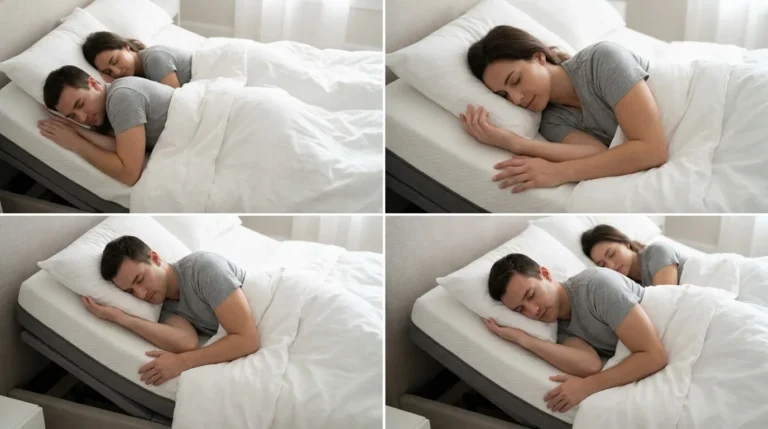
A complete dual-zone system targets the same 37-minute sleep gain reported by couples who sleep separately, while keeping both partners in the same bed.
Planning for Long-Term Comfort and Health
A well-built sleep system should adapt as health needs change over time. Leva Sleep’s selection of 15–20 adjustable base models includes options with features that support long-term comfort.
- Lumbar control: Adjustable lower-back support that addresses hip, knee, and spinal conditions without a full mattress replacement.
- AI sleep tracking: Real-time micro-adjustments based on sleep stage data, available on higher-tier bases.
- Zero Gravity preset: Even weight distribution that reduces pressure on joints, which helps with post-surgical recovery and arthritis management.
- Pillow tilt motor: Independent head and pillow adjustment for precise airway positioning.
Planning for future health changes at the point of purchase, rather than replacing the entire system later, makes Leva Sleep’s vertically integrated model and broad selection especially valuable. Sleep apnea clinics in Ontario and Alberta refer patients to Leva Sleep because adjustable positioning can address mild apnea without a CPAP mask.
Frequently Asked Questions
Are water-circulating and air-based cooling systems compatible with Leva Sleep split bases?
Both water-circulating pads and air-based systems work on Leva Sleep’s split adjustable bases when tubing or airflow channels have enough slack at the head-section hinge to handle full elevation. Water-circulating systems usually fit better because they deliver consistent full-surface temperature control without airflow that can disturb a sleeping partner or lift sheets during base movement. Leva Sleep’s purpose-built fitted sheets with extra-deep elastic pockets help keep either type of pad securely in place through the full range of motion.
What maintenance do dual-zone cooling pads need in Canadian homes?
Water-based cooling pads require coolant replacement annually or every 3-6 months depending on fluid type, with descaling performed as needed based on scale buildup, which matters in Ontario and Alberta where municipal water hardness varies by region. Using distilled water in the reservoir extends the interval between descaling cycles. Some systems include a self-cleaning mode that automates part of this process. Air-based systems require periodic filter cleaning. For both types, checking tubing or vent connections at the hinge point of the adjustable base every few months confirms that nothing has worn or kinked during regular use.
How long do white-glove delivery and old-bed removal take in Ontario and Alberta?
Leva Sleep’s white-glove delivery operates as a scheduled appointment service. The delivery team brings the adjustable base and mattress to the bedroom, assembles the system, adjusts leg height to the couple’s preference, provides a full product tutorial covering the app, remote, and anti-snore features, and removes the old bed, donating or recycling it where possible. The appointment usually takes two to three hours, depending on setup complexity and home size. Delivery is available across Ontario and Alberta, and scheduling is coordinated directly with Leva Sleep at the time of purchase.
How do I calculate total cost of ownership versus luxury brands?
Total cost of ownership for a dual-zone couples sleep system includes the split adjustable base, mattresses, cooling pads, purpose-built bedding, and delivery. Leva Sleep’s direct-to-consumer, vertically integrated model removes retailer markups and middlemen, which allows the company to deliver comparable or superior specifications at 30–50% less than luxury competitors such as Tempur-Pedic. To compare accurately, price out the equivalent configuration at a competing brand, including split base, two mattresses, temperature layer, and white-glove delivery, then compare the totals. Factor in that Leva Sleep’s bedding accessories are engineered for adjustable bases, so you avoid buying generic sheets that fail within months. Over a 10-year ownership horizon, the savings on the initial purchase alone typically exceed the cost of the cooling pad system.
Build Your Dual-Zone System with Leva Sleep
A complete dual-zone couples sleep system functions as a modular stack. You combine a split adjustable base with independent app control, water-circulating cooling pads per side, Scandinavian-method duvets with purpose-built clips, extra-elastic fitted sheets, and a room held at approximately 16–19°C. Each layer addresses a specific failure point that single-product solutions leave unresolved.
Leva Sleep has delivered this system to more than 25,000 Canadian couples over eight years, with local assembly in Ontario and Alberta, white-glove setup, and a 15–20 model selection that general retailers do not match. Pricing remains 30–50% lower than comparable luxury brands. The anti-snore mode launching in spring 2026 adds another layer of automatic intervention for couples where snoring contributes to sleep disruption.
Temperature fights and sleep divorce are solvable problems. The system already exists, and the next step is building it for your bedroom.