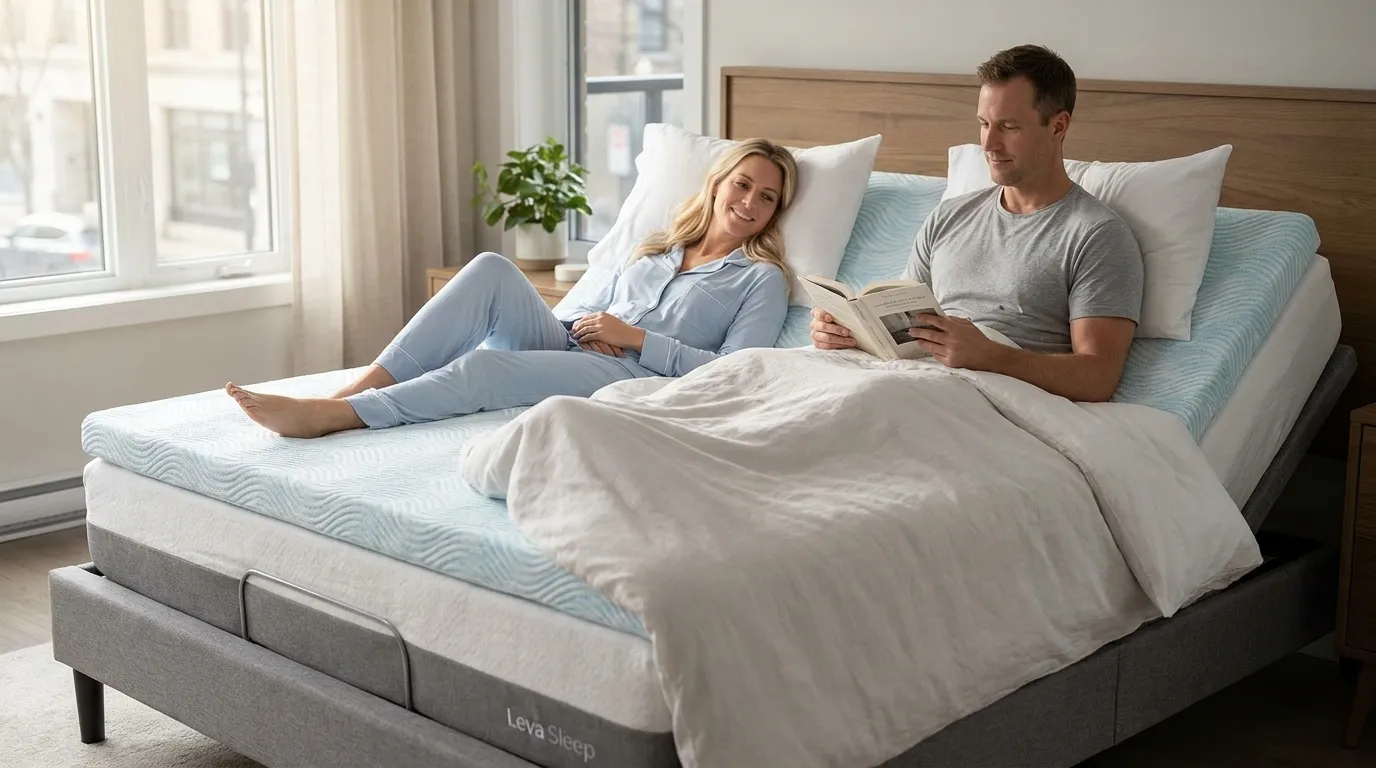
Written by: Matthew Timmins, Founder and Managing Director, Leva Sleep | Last updated: July 1, 2026
Key Takeaways for Overheated Canadian Couples
- Cooling mattress toppers lower surface temperature through conductive or breathable materials. Most users see fewer heat-related wake-ups, even though toppers do not treat medical causes of night sweats.
- Canadian couples often have different temperature needs and struggle with sheet slippage on adjustable bases. Correct material choice and secure bedding keep cooling consistent.
- Graphite, copper, phase-change material (PCM), and natural latex cool in different ways and flex differently on adjustable bases. Latex and thin PCM covers usually perform best on articulating frames.
- Active water- or air-based cooling systems create independent temperature zones for partners with very different preferences. They work well but need more maintenance than passive toppers.
- For a complete cooling and adjustable sleep setup built for Canadian couples, explore Leva Sleep's adjustable bed packages that combine temperature control, secure bedding, and independent zone features.
The Real-World Problem: Night Sweats, Sheet Slippage, and Mismatched Temperatures
Most couples struggle with asymmetry. One partner sleeps cold while the other wakes up damp at 3 a.m. Standard flat mattresses trap heat because their foam or spring cores allow limited airflow. Basic memory foam toppers often make things worse by hugging the body and blocking convective cooling.
Owners of adjustable bases face another layer of frustration. Standard fitted sheets and toppers are not built for elevation. When the head or foot of the bed rises, toppers shift, sheets pop off, and the cooling layer bunches at the fold points. Forum discussions on Reddit's r/Mattress and r/Sleep frequently mention these issues. Users report that even premium toppers slide out of position within a few nights on an adjustable frame, which cancels out much of the cooling benefit.
Effective relief comes from a matched system. You need the right cooling material on the right base, secured with purpose-built bedding. Couples with very different temperature preferences also need independent thermal zones on each side of the bed.
Cooling Materials for Toppers: Graphite, Copper, PCM, and Latex
Four material categories dominate the Canadian cooling topper market in 2026. Each cools through a different physical process and behaves differently on adjustable bases.
Graphite-infused foam uses graphite particles embedded in memory or poly foam to conduct heat away from the skin. Graphite pulls heat sideways through the foam instead of letting it build up at the surface. The trade-off is that graphite foam still behaves like foam. It hugs the body and limits airflow. It suits adjustable bases because it bends easily without cracking.
Copper-infused foam cools through a similar conductive effect but adds antimicrobial benefits. This matters for people who sweat heavily and worry about moisture and odour. Copper foam is usually denser than graphite foam, which can reduce flexibility on aggressive adjustable base angles.
Phase-change material (PCM) uses microencapsulated wax or salt compounds in a fabric cover or foam. PCM absorbs heat as it shifts from solid to liquid, which creates a brief but noticeable cool touch at the surface. PCM has a finite heat-absorption capacity per sleep cycle. Once saturated, it must release heat before it can cool again. In a warm bedroom, this reset can stall. PCM covers are thin and flexible, so they work very well on adjustable bases.
Natural latex cools by allowing air to move through an open-cell structure and pinhole perforations. Latex does not conduct heat as strongly as graphite or copper. It instead keeps air moving around the body throughout the night rather than relying on a limited phase-change cycle. Latex is also durable and resilient, so it performs very well on adjustable bases because it bends repeatedly without degrading.
The table below summarizes how each material's cooling style and base compatibility fit common sleep situations. Use it to match your topper choice to your heat level, flexibility needs, and eco or hygiene priorities.
| Material | Cooling Mechanism | Adjustable Base Compatibility | Best For |
|---|---|---|---|
| Graphite-infused foam | Thermal conduction through graphite particles | High, flexible foam bends without cracking | Moderate heat sleepers wanting pressure relief |
| Copper-infused foam | Thermal conduction plus antimicrobial effect | Moderate, denser foam may resist sharp angles | Hot sleepers with moisture or odour concerns |
| Phase-change material (PCM) | Heat absorption during solid-to-liquid transition | Very high, thin flexible cover layer | Couples who overheat in the first half of the night |
| Natural latex | Continuous airflow through open-cell structure | Very high, resilient and durable under repeated flex | Sustained all-night cooling and eco-conscious buyers |
Electric and Water-Based Cooling Systems for Extreme Heat Differences
Couples with sharply different temperature needs often outgrow passive toppers. One partner may need strong active cooling while the other prefers warmth. In these cases, electric and water-based systems step in by sending temperature-controlled fluid or air to each side of the bed independently.
Water-based systems, such as hydronic mattress pads, circulate temperature-controlled water through micro-tubes inside a thin pad. Each side connects to its own control unit, so one partner can choose 18°C while the other selects 26°C. These systems cool effectively but need regular care. The water reservoir requires refilling and occasional cleaning to prevent mineral buildup or microbial growth. Distilled water and the manufacturer's cleaning schedule handle both issues.
Electric air-based systems use a similar zoned layout but move temperature-regulated air instead of water. They usually run quieter than older hydronic units and remove leak risk. They often provide slightly less precise control at very low or very high temperatures.
Both system types work well with adjustable bases when you place the control units on the floor beside the base instead of on the frame. Route tubing and cabling so they allow full head and foot elevation without pulling or kinking.
Whether you choose a passive topper or an active cooling system, the base plays a major role in keeping performance consistent. The next section explains how to set up your adjustable base so it supports your cooling layer instead of fighting it.
Pairing a Cooling Topper with an Adjustable Base
A cooling topper performs best on an adjustable base when three conditions hold true. The topper material must flex without bunching, the bedding must keep the topper in place at elevation, and the base must support weight evenly across all articulating zones.
Leva Sleep's adjustable bases use whisper-quiet motors and precise articulation that spread weight smoothly across the head and foot sections. This smooth motion protects topper life. Jerky or uneven elevation strains seams and speeds up material breakdown. A base that lifts gradually and holds position without drift keeps the topper flat and effective.
Independent Comfort for Couples with Adjustable Bases
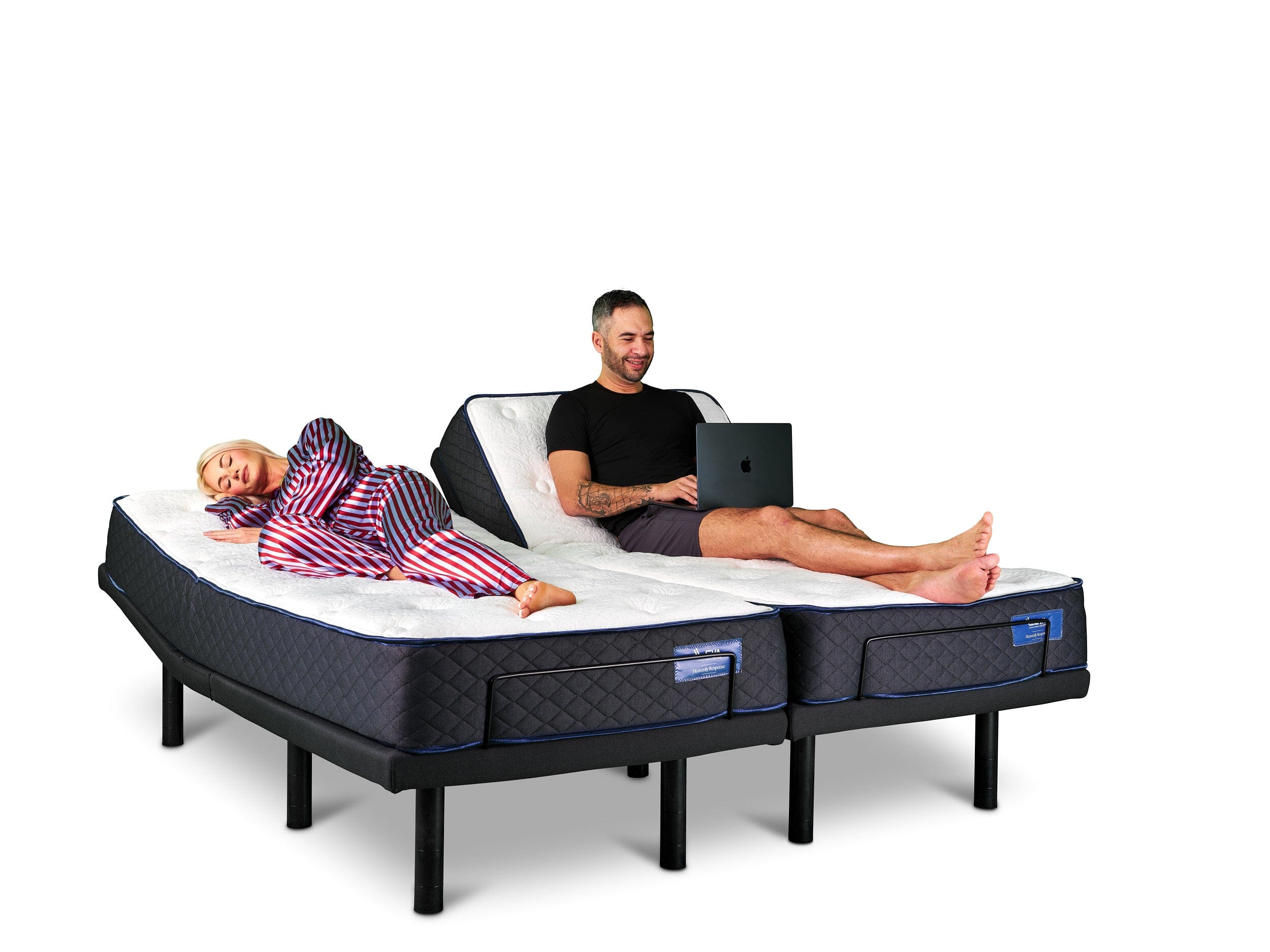
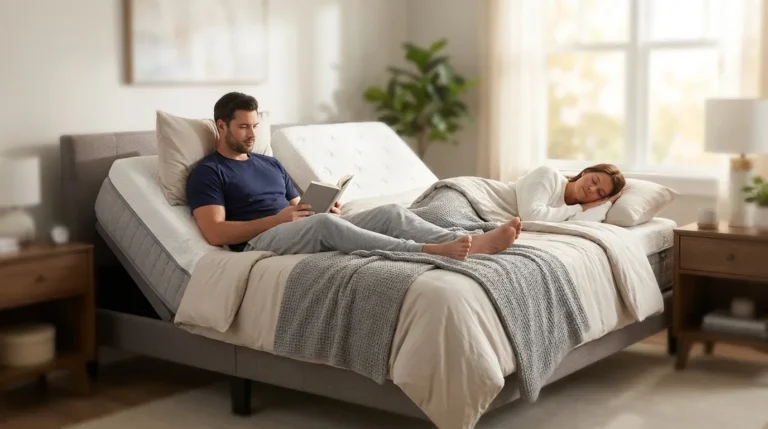
Split King and Split Queen setups give each partner full control over their side. When each side also has its own cooling topper or zoned hydronic pad, the bed becomes two independent sleep environments that still share a frame. One partner can raise the head to reduce snoring while running a cooler surface. The other can lie flat with a warmer setting.
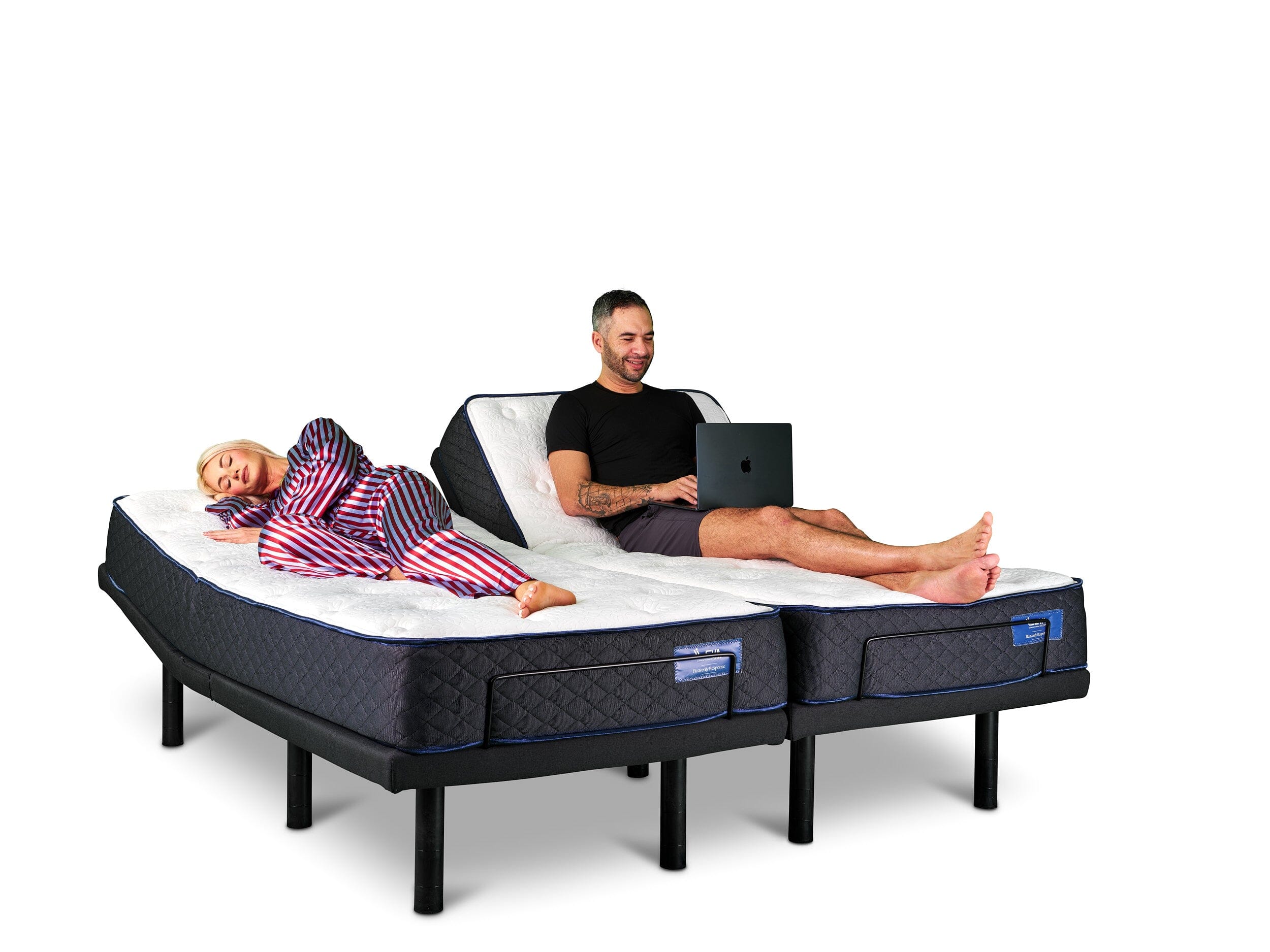
Leva Sleep's app-controlled bases support this style of use with custom position memory and an anti-snore mode that makes small head adjustments when snoring appears.
Stopping Sheet Slippage on Adjustable Bases
Sheet slippage ranks as the most common complaint in adjustable bed forums. The problem grows when a cooling topper increases mattress height. Standard fitted sheets usually fit mattresses up to about 30 cm deep. An adjustable mattress plus topper can exceed 38 cm, and the elastic loses grip at higher elevation angles.
Several practical fixes solve this. Deep-pocket fitted sheets with reinforced elastic wrap fully under the mattress. Topper anchor straps clip to the mattress corners and keep the topper from creeping. Duvet clips hold the duvet in place when one side of a split base rises. Leva Sleep designs bedding accessories specifically for adjustable bases, including extra-deep fitted sheets with side remote pockets and duvet clips built for split setups. These pieces form part of the overall sleep system rather than afterthought add-ons.
Canadian Pricing and Availability in 2026
In Canada, passive cooling toppers made from graphite, copper, PCM, or latex typically range from about CAD $80 for basic foam infusions to around CAD $450 for premium natural latex in queen size. Active water-based systems from luxury brands can exceed CAD $3,300 for dual-zone models.
Adjustable base packages for queen split configurations from Canadian retailers typically range from CAD $1,000 to CAD $3,700 before accessories. Leva Sleep's vertical integration, which covers design, assembly, and delivery in-house without retail markup, places its complete adjustable sleep systems at 30–50% below comparable luxury competitors. These packages also include white-glove delivery, setup, and purpose-built bedding accessories.
How to Choose the Right Cooling Topper for Couples
Choosing a cooling topper starts with a clear diagnosis of your heat problem. If only one partner overheats during the first few hours of sleep, a passive conductive topper may be enough. If both partners struggle with heat throughout the night, a dual-zone active system usually works better because passive materials have limited cooling capacity per cycle.
After you decide between passive and active cooling, confirm that your preferred topper can flex on an adjustable base. Ask the retailer whether the material is rated for articulating frames. This step matters because rigid foam can crack under repeated bending, while latex and thin PCM covers bend cleanly without damage.
Next, measure your current mattress depth and add the topper thickness. Check that your fitted sheets can handle the combined height. A topper that cools well but exceeds your sheet depth will slip and bunch, which reduces comfort and cooling. At the same time, check whether the topper includes anchor straps or whether you need to buy them separately.
Couples with truly opposite temperature preferences should also compare active systems by per-side temperature range, control unit noise, and maintenance demands. These details determine whether the system remains practical for nightly use over many years.
Find your complete cooling solution at Leva Sleep, including adjustable bases, compatible toppers, and purpose-built bedding delivered across Ontario and Alberta.
Frequently Asked Questions
Do cooling mattress toppers work for menopause-related night sweats?
Cooling mattress toppers lower the thermal load at the sleep surface, which can reduce the frequency and intensity of heat-related wake-ups linked to menopause. They do not treat the hormonal cause of night sweats. For moderate to severe menopausal night sweats, an active water-based cooling system that holds a steady surface temperature through the night usually outperforms passive conductive toppers, which can saturate with absorbed heat during intense episodes. Pairing an active cooling pad with an adjustable base that offers independent zone control gives each partner full control over their own sleep temperature.
Will a cooling topper stay in place on an adjustable base?
A standard cooling topper without anchor straps usually shifts on an adjustable base, especially at head elevations above about 30 degrees. A topper with integrated corner straps or a separate anchor strap system that clips around the mattress keeps it in place. Leva Sleep's bedding accessories include deep-pocket fitted sheets with reinforced elastic that hold both the mattress and topper during elevation. Natural latex and thin PCM covers tend to stay put better than thick memory foam toppers because they flex with the base instead of resisting movement.
Can both partners use different cooling settings on a split adjustable base?
Yes. A Split King or Split Queen adjustable base with independent controls lets each partner set their own elevation, massage pattern, and, when paired with a dual-zone active cooling system, their own surface temperature. Each side functions as a separate sleep environment. Leva Sleep's app-controlled split bases support custom position memory and anti-snore adjustments on each side, which suits couples with very different temperature and comfort needs.
How do you clean a cooling mattress topper?
Cleaning steps depend on the material. Most foam-based toppers, including graphite and copper-infused models, are spot-clean only because soaking them damages the foam. Natural latex toppers can be wiped with a damp cloth and mild detergent, then air-dried flat away from direct sunlight. PCM covers are usually removable and machine-washable on a gentle cold cycle. Active water-based cooling pads need periodic flushing of the water reservoir with distilled water and a manufacturer-approved cleaning solution to prevent mineral deposits and microbial growth. Always follow the manufacturer's care instructions for each component.
Is a cooling topper enough, or do I need a full adjustable sleep system?
A cooling topper alone can work when surface temperature is the only issue and both partners share similar thermal preferences. If you also deal with snoring, different firmness needs, back or joint pain, or medical elevation requirements, a topper on a flat bed solves only one part of the problem. A complete adjustable sleep system that includes the base, compatible mattress, cooling layer, and purpose-built bedding addresses all of these factors at once and lets each partner configure their side independently. Couples already considering an adjustable base usually get better long-term value by integrating cooling into the full system rather than retrofitting a topper later.
Conclusion: Building a Cooling Sleep System That Works Night After Night
Night sweats and mismatched temperature preferences disrupt sleep, strain relationships, and often push couples toward separate bedrooms. A cooling mattress topper can help, but real results depend on material choice, adjustable-base compatibility, and secure bedding that keeps everything in place.
Canadian couples who want a complete solution instead of a patchwork of products benefit from an integrated adjustable sleep system. Leva Sleep's approach combines independent temperature zones, quiet elevation, and purpose-built bedding, backed by the value and service advantages outlined earlier in this guide.
Explore Leva Sleep's adjustable sleep systems and choose the cooling topper and base package that supports how you and your partner actually sleep.