Written by: Matthew Timmins, Founder and Managing Director, Leva Sleep | Last updated: July 23, 2026
Key Takeaways
- Head-of-bed elevation on adjustable beds can reduce apnea events for mild-to-moderate and positional obstructive sleep apnea, but it is not a cure and does not replace CPAP for moderate-to-severe cases.
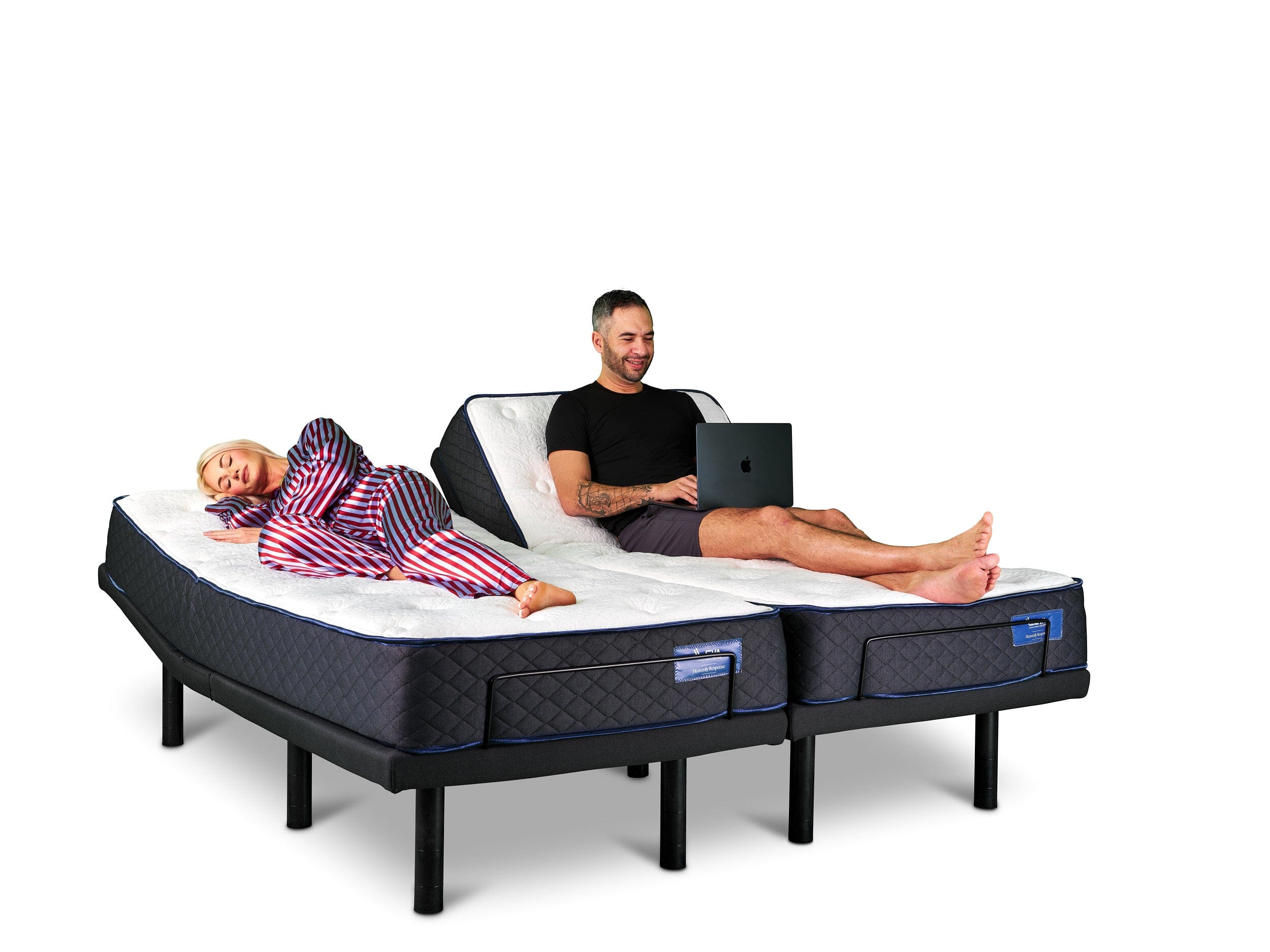
- Flat beds and basic adjustable bases often fail to provide stable, independent elevation, so many couples experience sleep disruption or “sleep divorce.”
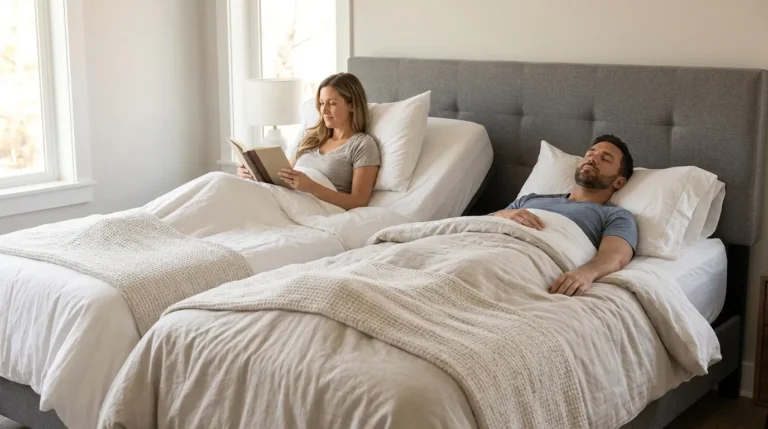
- Split adjustable systems with independent per-side control let one partner use therapeutic elevation (15–30°) while the other remains undisturbed.
- Key evaluation criteria include quiet motors, mattress compatibility, deep-pocket bedding, app-based presets, and white-glove delivery in Ontario and Alberta.
- Canadian couples who want a split adjustable solution that supports both sleep apnea management and relationship needs can explore Leva Sleep’s adjustable bed packages.
The Problem: Why Flat Beds and Basic Bases Fail Sleep Apnea Couples
Obstructive sleep apnea occurs when the tongue and soft tissues of the throat relax and partially or fully block the airway during sleep. Mild OSA is defined as an AHI of 5–15 events per hour. Positional OSA refers to cases where events occur predominantly or exclusively in the supine, flat-back position. Both categories are common among adults aged 35–70 and often go undiagnosed until a bed partner notices disruptive snoring.
Flat beds offer no way to counteract gravity’s role in airway collapse. Basic adjustable bases exist, but many provide limited elevation range, loud motors, and no independent per-side control. One partner’s therapeutic position then forces the other into the same angle or disrupts their sleep entirely. This pattern often leads to “sleep divorce,” where couples move to separate rooms instead of solving the underlying issue. Partners of snorers show measurably worse sleep quality that improves when the snoring is treated, and untreated OSA carries documented cardiovascular and metabolic risk for the snorer.
How Adjustable Sleep Systems Support Mild and Positional OSA
Head-of-bed elevation functions as positional therapy. When the upper body is raised, gravity shifts the tongue and soft palate slightly forward and reduces airway collapse. This mechanism keeps the airway more open compared to lying flat and can reduce breathing disruptions for patients with mild-to-moderate and positional OSA.
Motorized adjustable bases provide this elevation more reliably than pillows or fixed wedges. Patients did not tolerate sleeping on a 20-centimetre wedge because of a sensation of falling. A motorized base instead offers stable, repeatable positioning throughout the night. For moderate-to-severe OSA, with AHI above 15–30, elevation alone is not enough and CPAP remains the clinical standard. Elevation can still complement CPAP by improving positional comfort and mask tolerance.
Explore adjustable bases with therapeutic elevation
Key Evaluation Criteria for Couples Considering Adjustable Beds
Independent Adjustability and True Split Configurations
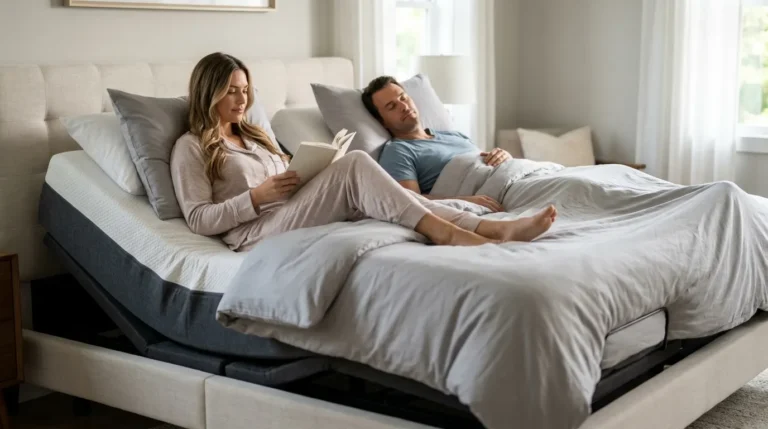
A split adjustable base, either Split King with two Twin XL bases or Split Queen, lets each partner set a different elevation angle independently. The partner with snoring or mild sleep apnea can elevate their head 15–30° while the other remains flat and undisturbed. Confirm that a base offers true per-side motor independence rather than a shared motor with separate presets on one remote.
Finding Practical Elevation Angles for Sleep Apnea Relief
Clinical studies have used angles ranging from 7.5° to 30°, with the 30° mark producing the largest reductions in airway collapse and snoring within that studied range. Researchers consistently see the strongest effect near this upper end. However, angles above 35–40° are often uncomfortable for sustained sleep and can cause the sleeper to slide toward the foot of the bed. These comfort limits explain why practical recommendations focus on a 15–30° window. When you evaluate a base, confirm that it can reach and hold this therapeutic range reliably.
Noise Levels and Motor Quality That Protect Partner Sleep
Motor noise is a primary complaint with basic adjustable bases. Quiet motors, especially those built to German precision standards, let you adjust positions without waking a partner. Review decibel ratings when available, and listen to in-store or video demonstrations before you buy.
Mattress Compatibility and Bedding That Stays Put
Many traditional mattresses do not flex well on an adjustable base. All-foam and hybrid pocket-coil mattresses designed for articulating bases usually perform better than classic innerspring models. Standard fitted sheets often pop off at elevation angles above 15°. Deep-pocket sheets with reinforced elastic, made specifically for adjustable use, stay in place more reliably.
Temperature Control and Easy Nightly Use
Couples often have different temperature preferences. Integrated heating and cooling pads with per-side control solve this without separate bedding setups. App-based control with saved position presets also supports long-term use because it makes the therapeutic position quick to restore each night.
Delivery, Setup, and Canadian Service Coverage
Adjustable bases are heavy, multi-component systems that many households cannot move alone. White-glove delivery, including in-room setup, leg-height adjustment, product tutorial, and old-bed removal, removes the biggest friction point for large-item purchases. Confirm that a retailer services your province, because many U.S.-focused brands lack comparable delivery infrastructure in Ontario or Alberta.
How Elevation Performs by OSA Severity
| OSA Severity | Elevation Angle Studied | AHI Change (Events/Hour) | Notes |
|---|---|---|---|
| Mild–Moderate | 7.5°–30° | Reductions observed | Can help reduce events for some patients with positional OSA |
| Mixed OSA (multicenter) | Variable (head-of-bed) | Reductions observed | Described as low-cost, well-tolerated positional therapy for selected phenotypes |
| Severe OSA (AHI >30) | Any | Not clinically sufficient | CPAP remains the clinical standard of care; elevation alone is not adequate treatment |
Adjustable Beds and CPAP for Mild and Positional OSA
A 2025 meta-analysis of 19 randomized controlled trials with 1,231 participants compared sleep positional therapy to CPAP. CPAP delivers pressurized air that mechanically holds the airway open regardless of body position, so it works across all OSA severities. Head-of-bed elevation relies on gravity alone and is most relevant for positional and mild-to-moderate cases.
The practical difference often comes down to adherence. A Cochrane review of eight RCTs concluded that positional therapy may have better adherence than CPAP, though CPAP produces a greater AHI reduction. For patients with mild positional OSA who cannot tolerate a mask nightly, sleep specialists frequently suggest head-of-bed elevation as a supplemental strategy, particularly for those who cannot tolerate CPAP every night. The two approaches can work together. Elevating the upper body can improve CPAP mask tolerance and consistency by reducing claustrophobia and making the hose easier to manage. Anyone who suspects moderate-to-severe OSA should obtain a formal sleep study and physician guidance before relying on positional therapy alone.
Canadian Buyers: Delivery, Pricing, and Real-World Value
Most adjustable bed content online focuses on U.S. buyers and ignores Canadian delivery realities. GERD affects 13-29% of Canadians, including both children and adults, and OSA prevalence is similarly significant. Demand for elevation-capable sleep systems in Ontario and Alberta is therefore high and often underserved by generalist retailers.
Leva Sleep offers white-glove delivery in Ontario and Alberta, including in-room setup, leg-height adjustment, product tutorial, and old-bed removal. Its direct-to-consumer, vertically integrated model, which covers design, assembly, and delivery in-house, removes middleman markups and often delivers pricing 30–50% below comparable luxury competitors such as Tempur-Pedic or Ghostbed. Split Queen configurations, a format rarely offered by general mattress retailers, are available and built to customer specifications.
Leva Sleep’s Split Adjustable Systems for Couples
Premium split adjustable systems share several core traits: independent per-side motorized bases, app-based control with saved position presets, compatibility with purpose-built mattresses, and specialized bedding accessories. Within this category, the main differences involve motor quality, feature depth, mattress engineering, and the end-to-end purchase experience.
Leva Sleep’s split bases use quiet German motors that allow mid-night position changes without disturbing a partner. The Leva Sleep app provides full Bluetooth control, including custom sleep position presets and a vibrating alarm. An anti-snore mode, launching spring 2026, will detect snoring and make small automatic head-elevation adjustments. Mattresses are engineered specifically for articulating bases in both all-foam and hybrid pocket-coil designs. Bedding accessories, including deep-pocket fitted sheets with reinforced elastic, duvet clips, and remote pockets, are built to stay in place at therapeutic elevation angles. With over 8 years in business, $50M in lifetime sales, and 25,000+ customers, Leva Sleep operates as a specialist adjustable bed authority and offers 15–20 adjustable models, compared to the 3–5 typically found at a standard retailer.
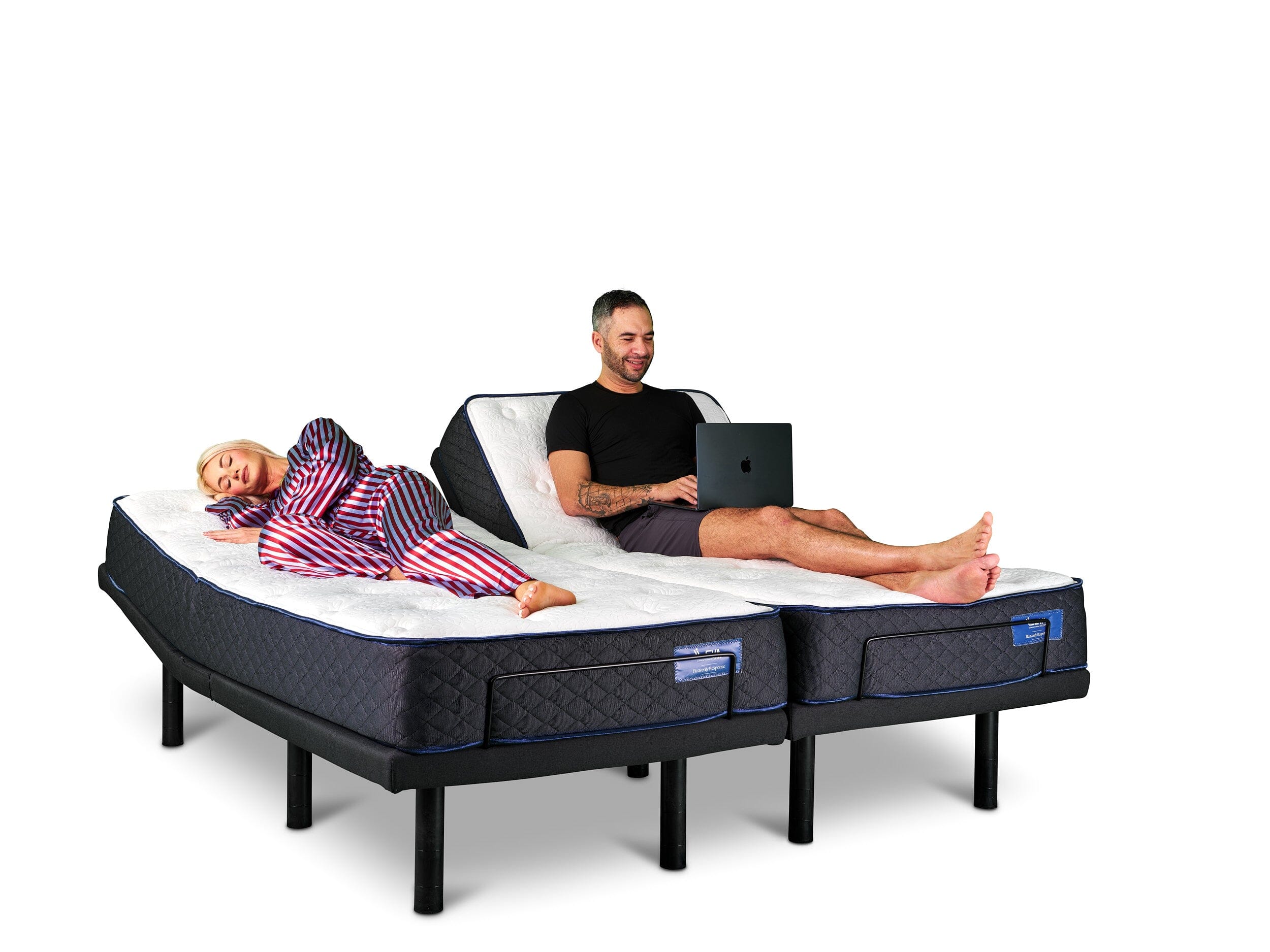
Browse Leva’s split adjustable packages
Frequently Asked Questions
What is the best angle for sleep apnea on an adjustable bed?
Clinical studies have examined angles from 7.5° to 30° for obstructive sleep apnea and have shown AHI reductions in mild-to-moderate OSA. Most sleep specialists recommend 15–30°, which balances airway benefit with sleeping comfort. Angles above 35–40° usually feel uncomfortable for sustained sleep and can cause the sleeper to slide toward the foot of the bed. A zero-gravity position, with the head elevated and a slight knee bend, often works well because it distributes body weight evenly and reduces sliding while maintaining torso elevation. Individual response varies, so personal trial within the 15–30° range makes sense.
Can adjustable beds replace CPAP for moderate sleep apnea?
No. Head-of-bed elevation does not replace CPAP in moderate-to-severe obstructive sleep apnea. CPAP mechanically holds the airway open with pressurized air and works across all severity levels. Elevation relies on gravity and is most relevant for positional and mild cases. For moderate OSA, with AHI 15–30, or severe OSA, with AHI above 30, CPAP remains the clinical standard of care. Anyone with a formal diagnosis of moderate or severe OSA should continue prescribed CPAP therapy. An adjustable base can complement CPAP by improving positional comfort, reducing mask claustrophobia, and making the hose easier to manage, but it does not replicate CPAP’s mechanism. Elevation also does not affect central sleep apnea, which stems from the brain’s failure to signal breathing muscles rather than from airway obstruction. A sleep study and physician consultation are the right starting points for anyone who suspects their OSA is more than mild.
Does head elevation help both sleep apnea and acid reflux?
Head elevation can support both sleep apnea and acid reflux management. For sleep apnea, elevation repositions the tongue and soft palate to reduce airway collapse. For gastroesophageal reflux disease, elevation uses gravity to keep stomach acid from travelling up the esophagus during sleep. Most gastroenterologists recommend elevating the head of the bed approximately 6–8 inches, or roughly 15–20 cm at about a 30° incline, as a first-line non-drug intervention for nighttime GERD. This range overlaps with the angles studied for OSA benefit, so a single elevation setting can address both conditions at once. Given the high GERD prevalence in Canada mentioned earlier, this overlap is particularly relevant for couples where one partner experiences both conditions. Elevation supports, but does not replace, medical treatment for severe GERD that requires prescription medication.
Are split adjustable beds worth it for couples?
Split adjustable beds can be valuable for couples when one partner has snoring, mild sleep apnea, acid reflux, or different firmness and temperature preferences. One partner can use a therapeutic elevated position while the other remains flat and undisturbed, which reduces pressure to sleep in separate rooms. This configuration also supports differing firmness preferences, temperature needs, and massage settings on a per-side basis. Split systems do carry a higher upfront price than a single base, yet the alternative of separate rooms, ongoing sleep disruption, or buying two separate beds often costs more over time. For couples in Ontario or Alberta, Leva Sleep’s Split Queen option provides split adjustability in a more space-conscious format that most general retailers do not carry.
Decision-Support Takeaway for Sleep Apnea and Adjustable Beds
Head-of-bed elevation can produce clinically meaningful AHI reductions for mild-to-moderate and positional obstructive sleep apnea in responsive patients. It is not a cure, does not replace CPAP for moderate-to-severe cases, and does not affect central sleep apnea. For Canadian couples where one partner experiences positional snoring or mild OSA, a split adjustable base with independent per-side control can address both the clinical need and the relationship dynamic. One partner can use therapeutic elevation without disrupting the other. Key evaluation criteria include true per-side motor independence, an elevation range that reaches 15–30°, quiet motors, mattress and bedding compatibility, and white-glove delivery in your province. Anyone who suspects moderate-to-severe OSA should obtain a formal sleep study before relying on positional therapy alone.