
Written by: Matthew Timmins, Founder and Managing Director, Leva Sleep
Key Takeaways
- Zero gravity describes a preset position on an adjustable base. Most memory foam, latex, and pocket-coil hybrids work if they flex safely.
- Compatibility depends on construction, thickness in the 10–14 inch range, and clear warranty approval for adjustable-base use.
- Traditional Bonnell or continuous-coil innersprings, thick rigid pillow-tops, and mattresses with wood or steel inserts are incompatible and risk damage or voided warranties.
- A quick bend test, thickness check, and law-tag review help confirm whether your current mattress is safe for an adjustable base.
- Leva Sleep designs its mattresses and adjustable bases as one integrated system so compatibility and warranty coverage stay straightforward.
Explore Leva Sleep Adjustable Bed Packages
The Problem: How Zero Gravity Marketing Creates Compatibility Confusion
“Zero gravity mattress” appears in searches, yet zero gravity itself is a preset position on an adjustable base. The base elevates the head and feet together to reduce spinal pressure and support circulation. Tempur-Pedic Canada confirms this directly, listing Zero Gravity as a power-base feature across its lineup.
Real compatibility depends on the mattress’s flex, construction, and warranty terms. Marketing labels do not change those fundamentals. A rigid mattress bent on an adjustable base can develop broken wires, deep body impressions at hinge points, and a permanent hump. An incompatible foundation is also a major warranty exclusion at nearly every major brand, so a damaged mattress may end up with no coverage.
Knowing how compatibility works lets you pair your existing or new mattress with an adjustable base and enjoy zero gravity positioning without worrying about damage or warranty loss.
Find Your Compatible Adjustable Bed Package
The Solution: How To Check If Your Mattress Works On An Adjustable Base
A simple two-minute self-check answers the compatibility question for most mattresses. MattressVetted recommends lifting the head end of the mattress about 12 inches off a flat surface. If you hear cracking, feel strong resistance, or see the top layer separating from the core, the mattress should not go on an adjustable base. Use these three steps:
- Bend Test: Gently lift one end of the mattress about 12 inches. A compatible mattress bends without cracking, resisting, or separating at the layers. Construction, not thickness, determines whether a mattress can bend. All-foam mattresses have no internal frame to fight folding. Traditional innersprings with a rigid perimeter wire often refuse to bend safely.
- Thickness Check: Most adjustable bases work best with mattresses up to about 12 inches thick, with heavy-duty models handling up to 14 inches. Mattresses over 14 inches, especially dense pillow-tops, can crease permanently at the lumbar hinge over time.
- Law Tag And Warranty Check: The construction label lists the mattress type. Memory foam, latex, and pocket coil usually work well on adjustable bases. Bonnell coil, continuous coil, and other rigid innerspring builds do not. Check the warranty for phrases like “adjustable base compatible” or “must be used on a flat, solid foundation”. Language that requires a flat, solid foundation signals that the mattress should stay off an adjustable base.
If the mattress fails any of these steps, keep it on a flat foundation instead of an adjustable base.
Mattress Types That Do And Do Not Work On Adjustable Bases
Mattresses fall into two clear groups for adjustable-base use. Compatible mattresses flex at the hinge points without internal damage. Incompatible mattresses resist bending or break down when flexed repeatedly.
Compatible With An Adjustable Base:
- Memory foam (all-foam constructions)
- Latex (natural Talalay and Dunlop)
- Pocket-coil hybrids (individually wrapped coils)
- Hybrids that the manufacturer explicitly approves for adjustable-base use
Incompatible With An Adjustable Base:
- Traditional Bonnell or continuous-coil innerspring. The entire coil grid forms one rigid frame that can warp, snap wires, or exceed the base’s weight rating when bent.
- Thick, stiff pillow-top mattresses over 12–13 inches, especially free-floating Euro-tops that are not sewn down.
- Mattresses with rigid edge support systems or any wood or steel inserts. Rigid inserts cannot bend and will be damaged by the attempt.
- Any mattress whose warranty clearly prohibits adjustable-base use.
See Adjustable-Ready Mattress And Base Combos
Memory Foam, Latex, And Pocket Coil On An Adjustable Base
Memory foam, latex, and pocket-coil hybrids all work on adjustable bases for different structural reasons. Material choice affects feel, cooling, and durability, while thickness and warranty approval matter more for pure compatibility.
| Construction | Adjustable-Base Compatible | Typical Thickness Range | Warranty Notes For Adjustable Bases | Best For |
|---|---|---|---|---|
| Memory Foam | Yes, when built as all-foam without rigid inserts | Commonly 8–13 inches; above 14 inches increases creasing risk at the lumbar hinge | Most modern foam brands permit adjustable-base use, but you should confirm each warranty | Strong motion isolation and pressure relief, with a plusher, contouring feel |
| Latex | Yes, when the model is flex-rated for adjustable bases | Most latex mattresses range from 6 to 13 inches thick. Models between 10 and 13 inches often suit side sleepers. Because latex is dense, confirm your base’s weight capacity. | Typically suitable for adjustable bases when the manufacturer labels the model as compatible | Durability, natural cooling, and a responsive feel with typical lifespans of 12–15 years versus 7–10 for many memory foam models |
| Pocket-Coil Hybrid | Yes, when coils are individually wrapped and the brand approves adjustable use | Premium hybrids usually measure 12–14 inches, with many real hybrids between 10 and 15 inches. Check that your base’s articulation range suits the mattress height. | Many modern bed-in-a-box hybrids ship “adjustable-base ready,” but you should verify each model | Couples who want stronger edge support, easier movement, and better airflow than dense foam alone |
Canadian Brand Reference: How Major Mattresses Pair With Adjustable Bases
This reference section shows how common Canadian brands align with the compatibility rules above. Always confirm your exact model’s construction and warranty before using it on an adjustable base.
- Tempur-Pedic: All-foam memory foam construction. Tempur-Pedic Canada confirms its mattresses work with adjustable power bases as approved support systems. Its warranty excludes indentations caused by an improper or unsupportive adjustable bed base, so the base must provide even support.
- GhostBed: Memory foam and hybrid models. Generally compatible, with model-specific guidance in Leva’s GhostBed compatibility guide. The warranty excludes indentation linked to a sagging foundation or platform.
- Casper: Memory foam and hybrid models. Sleep Country Canada lists the Casper Original Hybrid Firm as “Adjustable Base Compatible: Yes.” Current Casper models are generally warranty-safe on third-party adjustable bases when the base offers flat, solid support when lowered and bends only from head and foot.
- Endy: All-foam memory foam construction. Typically compatible with adjustable bases because of its foam build. Confirm adjustable-base approval in your specific warranty.
- Douglas: All-foam memory foam construction. Generally compatible for the same structural reasons as Endy. Check the warranty for any foundation language.
- Silk & Snow: Offers memory foam and hybrid models. Many models pair well with adjustable bases, but you should confirm each mattress’s construction and warranty wording.
- Novaform: Memory foam construction. Many Novaform mattresses work on adjustable bases when they are flexible foam builds and the warranty permits adjustable use. Check the law tag for an all-foam design and review the warranty for foundation restrictions.
Compare Leva’s Integrated Mattress And Base Systems
Does Using An Adjustable Base Affect My Mattress Warranty?
Foundation and support requirements appear repeatedly as warranty exclusions across major mattress brands. An adjustable base counts as a foundation in this context. Using a mattress on an unapproved base can void coverage from day one, even if the mattress later fails for a different reason.
Tempur-Pedic’s warranty excludes indentations caused by “use of an improper or unsupportive foundation or adjustable bed base” and sets a low sag threshold of 0.75 inches in Yawnder’s 2026 guide. Casper, Bear, Brooklyn Bedding, Leesa, and Nectar use similar language. Their warranties remove coverage for sag that results from an improper or unsupportive foundation or adjustable base.
Before placing any mattress on an adjustable base, contact the manufacturer and ask whether your specific model is approved for use with a third-party adjustable base. Get the answer in writing. The mattress warranty and owner’s manual override general advice, including retailer guidance. When they conflict, the manufacturer’s terms apply.
Leva Sleep designs its mattresses to work with its adjustable bases as one integrated system, so compatibility and warranty coverage stay aligned when you purchase a Leva package.
Review Leva’s Warranty-Friendly Packages
What To Do If Your Mattress Is Not Compatible
Owners whose current mattress fails the self-check still have practical options:
- Add A Flexible Mattress Topper: A thin, flexible foam topper can improve comfort on a flat base. It does not change the mattress’s internal structure, so it cannot make an incompatible mattress safe to bend. Because the structure stays the same, warranty risks and damage risks remain.
- Replace With An Adjustable-Friendly Mattress: A memory foam, latex, or pocket-coil hybrid mattress within the 10–14 inch range offers the cleanest fix. Leva Sleep’s all-foam and hybrid pocket-coil mattresses are built to articulate smoothly with its adjustable bases.
- Repurpose The Existing Mattress: Move the old mattress to a guest room and pair a new compatible mattress with the adjustable base. This approach protects both the base and the new mattress from avoidable damage or warranty issues.
Couples who want independent comfort and zero gravity positioning often choose Leva Sleep’s Split King and Split Queen adjustable base packages. You can read more about the benefits of zero gravity positioning for couples and explore Leva’s adjustable bed mattress compatibility guide for Canadians for deeper selection tips.
Split King And Split Queen Considerations For Couples
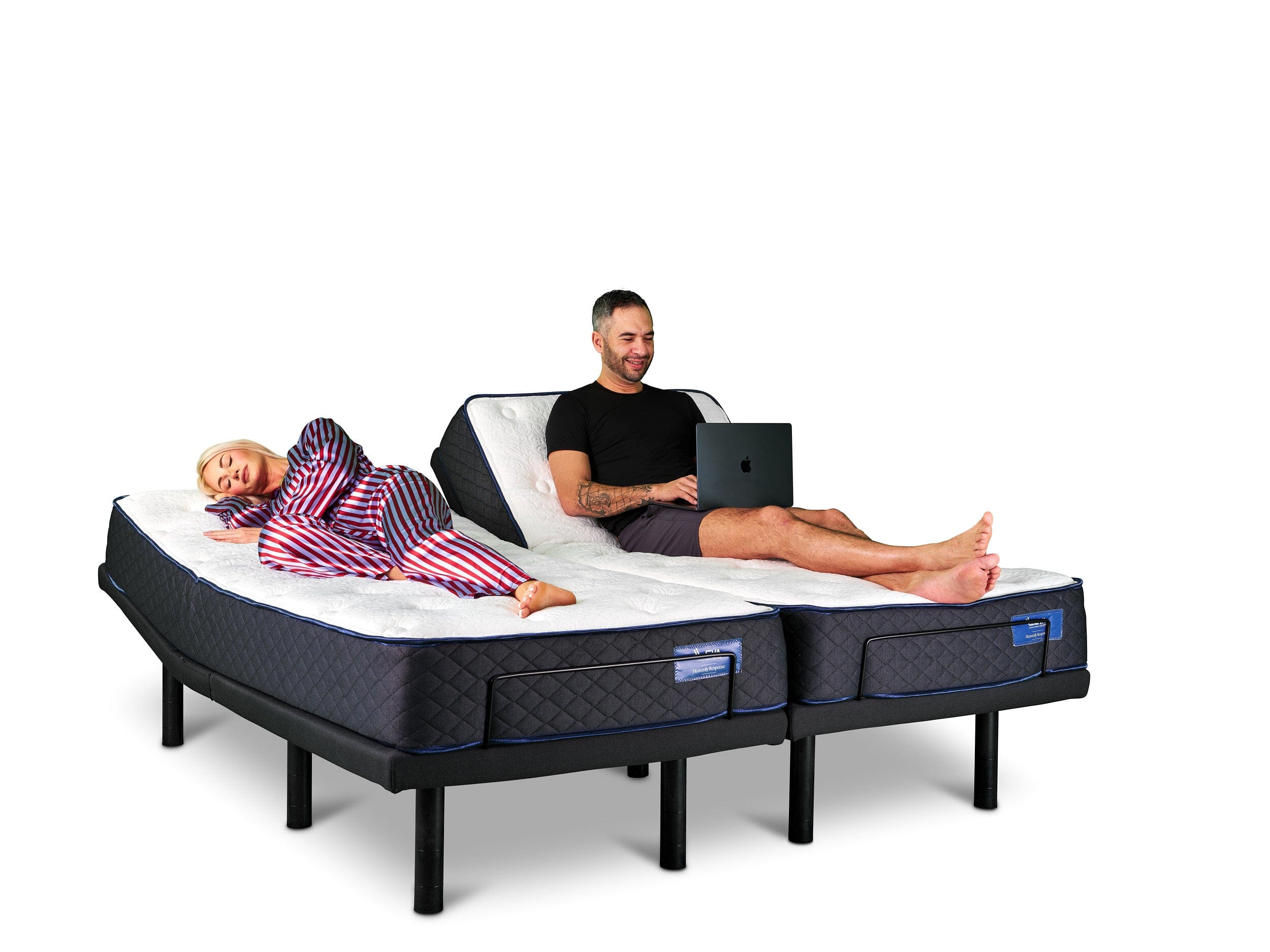
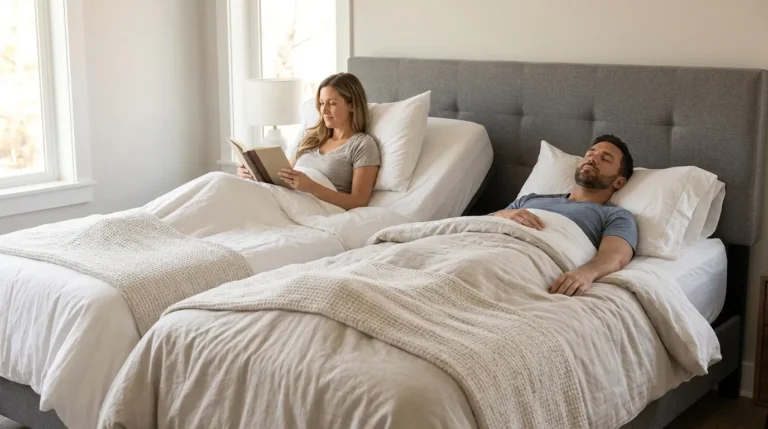
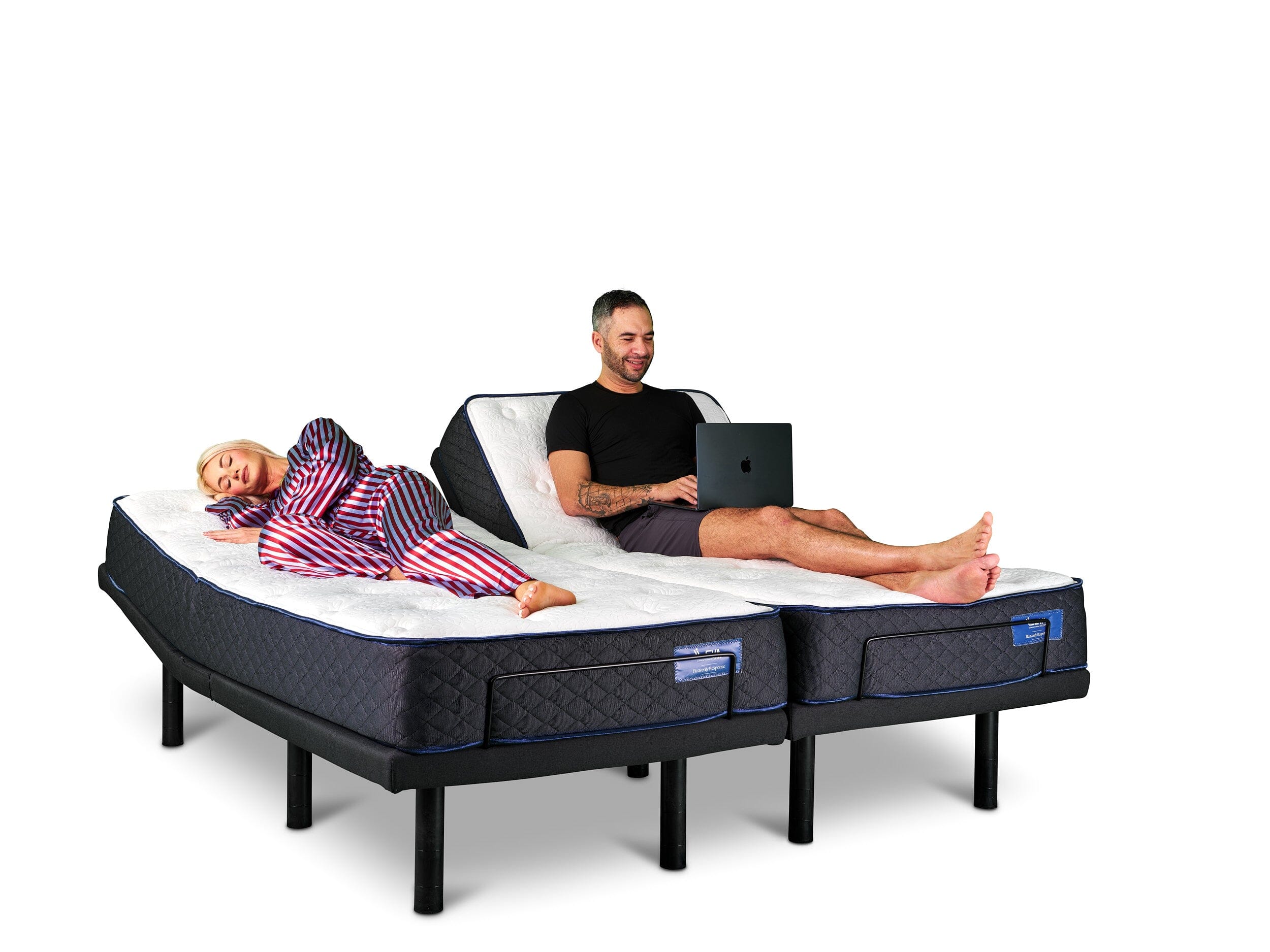
Couples with different comfort needs often prefer Split King or Split Queen adjustable bases for fully independent zero gravity positioning. A split adjustable base uses two Twin XL power bases side by side, so each partner adjusts head and foot elevation without disturbing the other.
Leva Sleep’s Split Queen uses two fully independent bases, each with head and foot articulation, giving both partners complete control. This configuration differs from a “split head queen,” which offers head-only articulation on one side and is not Leva’s standard Split Queen setup. Couples in Ontario and Alberta considering this layout can review Leva’s zero gravity benefits guide for the full health and comfort case.
Frequently Asked Questions
Can I Use My Current Mattress On An Adjustable Base?
It depends on construction. Memory foam, latex, and pocket-coil hybrids usually flex safely at hinge points. Traditional Bonnell or continuous-coil innersprings typically do not. Run the same two-minute check described above: the 12-inch bend test and a thickness check against the 14-inch ceiling. Then confirm the warranty explicitly approves adjustable-base use.
What Mattresses Are Not Compatible With An Adjustable Base?
The incompatible constructions match the list above. These include traditional Bonnell or continuous-coil innersprings, thick pillow-tops over 12–13 inches, and any mattress with a wood or steel insert. The common thread is rigidity. These designs cannot flex at the hinge points without structural damage, so they should stay on flat foundations.
Does An Adjustable Base Void My Mattress Warranty?
It can. As covered earlier, most major mattress warranties include a foundation requirement, and an unapproved base can void coverage even when the failure seems unrelated. Exclusions usually target sag or indentations that result from an improper or unsupportive foundation or adjustable base. Before pairing your mattress with an adjustable base, confirm approval with the manufacturer, get written confirmation, and keep both the original receipt and law tag.
Can A Novaform Mattress Be Used With An Adjustable Base?
Generally yes, with model-specific checks. Novaform mattresses use memory foam, which flexes well on adjustable bases. For details on construction, thickness, and warranty language, follow the Novaform guidance in the Canadian brand reference section above.
Conclusion
Zero gravity is a base position. Compatibility with an adjustable base depends on three factors: the mattress’s ability to flex without internal damage, its total thickness in the 10–14 inch range, and clear warranty approval for adjustable-base use. Memory foam, latex, and pocket-coil hybrids usually meet these criteria. Traditional innersprings, thick rigid pillow-tops, and mattresses with wood or steel inserts usually do not.
For Canadian couples in Ontario and Alberta who want zero gravity positioning, independent comfort controls, and a system where compatibility and warranty stay aligned, Leva Sleep designs its mattresses and Split King and Split Queen adjustable bases as one integrated system. That integration reflects over 8 years of adjustable-base expertise and has earned the trust of more than 25,000 customers, with pricing often 30–50% below comparable luxury competitors.
Build Your Leva Split King Or Split Queen Setup