Written by: Matthew Timmins, Founder and Managing Director, Leva Sleep | Last updated: June 21, 2026
Key Takeaways for Back Pain and Adjustable Beds
- Medium-firm hybrid mattresses often give better lumbar support for back sleepers in the 130–200 lb range than all-foam beds.
- Body weight, sleep position, and whether you share the bed strongly influence which mattress will ease your back pain.
- Very firm and very soft mattresses can both disrupt spinal alignment, so many clinicians recommend medium-firm surfaces with targeted zoning.
- Adjustable beds with separate head, lumbar, and foot elevation let you fine-tune support in real time, which flat mattresses cannot do.
- For back-pain-focused setups and split options for Canadian couples, explore Leva Sleep’s adjustable bed packages.
Clinical Mattress Guidance for Back Pain
Clinical evidence consistently points toward medium-firm surfaces as the baseline recommendation for back pain sufferers. A controlled trial cited in BMJ Evidence-Based Medicine found that participants with chronic low back pain improved after switching to a new mattress, with the medium-firm option outperforming the firm option in reducing disability. A separate 2008 study associated medium-firm mattresses with a 48.9% reduction in back pain, while older mattresses correlated with worse pain severity.
The clinical picture is more nuanced than a single firmness label. A 2015 systematic review in Sleep Health (Radwan et al.) examined controlled mattress trials and found that the evidence does not support a single firmness label for everyone, because individual body characteristics matter. This finding was reinforced by a 2019 biomechanical review in PeerJ (Wong et al.), which showed that mattress stiffness interacts with body form and spinal curvature, so weight and shape directly change which firmness level will keep the spine aligned.
Use these criteria when you evaluate any mattress for back pain:
- Spinal neutrality: The mattress should keep the ears, shoulders, hips, and ankles in a straight line in your usual sleep position.
- Firmness relative to body weight: Heavier participants often show better spinal alignment on firmer mattresses, while lighter participants often align better on softer mattresses, according to a University of Central Lancashire study.
- Construction type: Hybrid pocket-coil mattresses provide stronger edge support and airflow, while all-foam mattresses offer deeper contouring. Board-certified spinal surgeon Gbolahan Okubadejo, MD, FAAOS, notes that memory foam or hybrid mattresses contour to the body’s curves, helping keep the spine in a straight line.
- Morning pain pattern: Stiffness that fades within 15–30 minutes of waking most likely originates from the mattress or sleep position, while pain that persists all day points to posture, ergonomics, or a medical condition.
How Casper Performs for Lower Back Pain
Casper’s flagship mattresses use zoned foam construction, where foam density changes across zones to give firmer support under the lumbar region and softer contouring under the shoulders. This zoning approach addresses a known limitation of uniform-density foam, which can allow the hips to sink and flatten or reverse the lower back’s natural curve.
Casper’s Snow hybrid queen is priced at C$2,399 with a 10-year warranty, which places it in the premium tier of the Canadian market. For back sleepers in the 130–200 lb range, the zoned construction can maintain adequate lumbar support. For sleepers over 200 lb, medium-firm to firm hybrids are generally recommended for back sleeping, so Casper’s softer zoned foam may not provide enough resistance. Side sleepers with hip or shoulder issues should note that sleeping on a too-firm mattress can cause or worsen greater trochanteric bursitis, often mistaken for sciatica, so contouring depth matters regardless of brand.
Mattress Types to Avoid for Back Pain
Both extremes of the firmness spectrum carry documented misalignment risks. As noted earlier, both extremes violate the spinal neutrality principle: too-firm surfaces create pressure points at the hips and shoulders, while too-soft surfaces allow pelvic sag that flattens the lumbar curve.
A Harvard-referenced survey of 268 people with low back pain found that very hard mattresses produced the poorest sleep quality. Mattresses to avoid include:
- Very soft all-foam beds for back sleepers over 130 lb, because weak lumbar resistance causes pelvic sag.
- Very firm surfaces for side sleepers under 200 lb, because limited shoulder and hip contouring creates lateral pressure points.
- Aged mattresses past their durability window, since all-foam mattresses typically last 7–10 years and hybrids 7–12 years, depending on quality and construction, and support layers break down after that.
- Uniform-density foam without zoning for mixed-weight couples, because one firmness level cannot support two very different body profiles on a flat surface.
Browse Leva Sleep adjustable systems to see back-pain-focused layouts for different sleep positions.
Mattress Miracle, Casper, and Leva Sleep: Side-by-Side Comparison
| Criteria | Mattress Miracle (Hybrid) | Casper Snow Hybrid | Leva Sleep Adjustable System |
|---|---|---|---|
| Spinal alignment approach | Pocket-coil hybrid with foam layers for lumbar support | Zoned foam construction targeting lumbar and shoulder zones | Independent head, lumbar, and foot elevation, adjustable in real time |
| Firmness options by weight/position | Mid-range hybrid, with strong value hybrids in the CA$1,000–$1,800 range | Zoned medium, suited to 130–200 lb back sleepers, may under-support 200+ lb sleepers | 15–20 models, all-foam or hybrid pocket-coil, with split configurations for differing partner needs |
| 2026 Queen pricing (CAD) | CA$800–$1,500 for quality hybrid mattresses at Mattress Miracle, with premium/luxury hybrids extending to $2,500 | Premium tier | Contact Leva Sleep for current package pricing, typically 30–50% below comparable luxury competitors |
| Trial length / Warranty | Varies by model, with hybrids typically warranting 7–10 years of durability | 10-year warranty | Inquire directly, with white-glove delivery and setup available for a fee in Ontario and Alberta |
Note: Mattress Miracle pricing reflects the Canadian hybrid market range. Leva Sleep packages include an adjustable base and mattress, so direct comparison on mattress-only pricing is not applicable.
When a Flat Mattress Stops Being Enough
A flat mattress, regardless of construction or firmness, keeps a single static surface angle all night. For adults with persistent lower back pain, sciatica, or acid reflux, or for couples with very different body weights or sleep positions, that static surface often becomes a hard limit. Many older adults experience low-back pain, which is often associated with sleep problems.
Independent head, lumbar, and foot elevation directly addresses this limit. Raising the head reduces pressure on the cervical spine and opens airways for snorers. Elevating the foot reduces lumbar compression by taking load off the lower vertebrae. Lumbar support adjustment, available on bases such as the Tempur-Pedic Tempur-Ergo Power Base, which features a lumbar reinforcement bar that can be raised or lowered to provide more support under the spine, allows real-time tuning that no flat mattress can match.
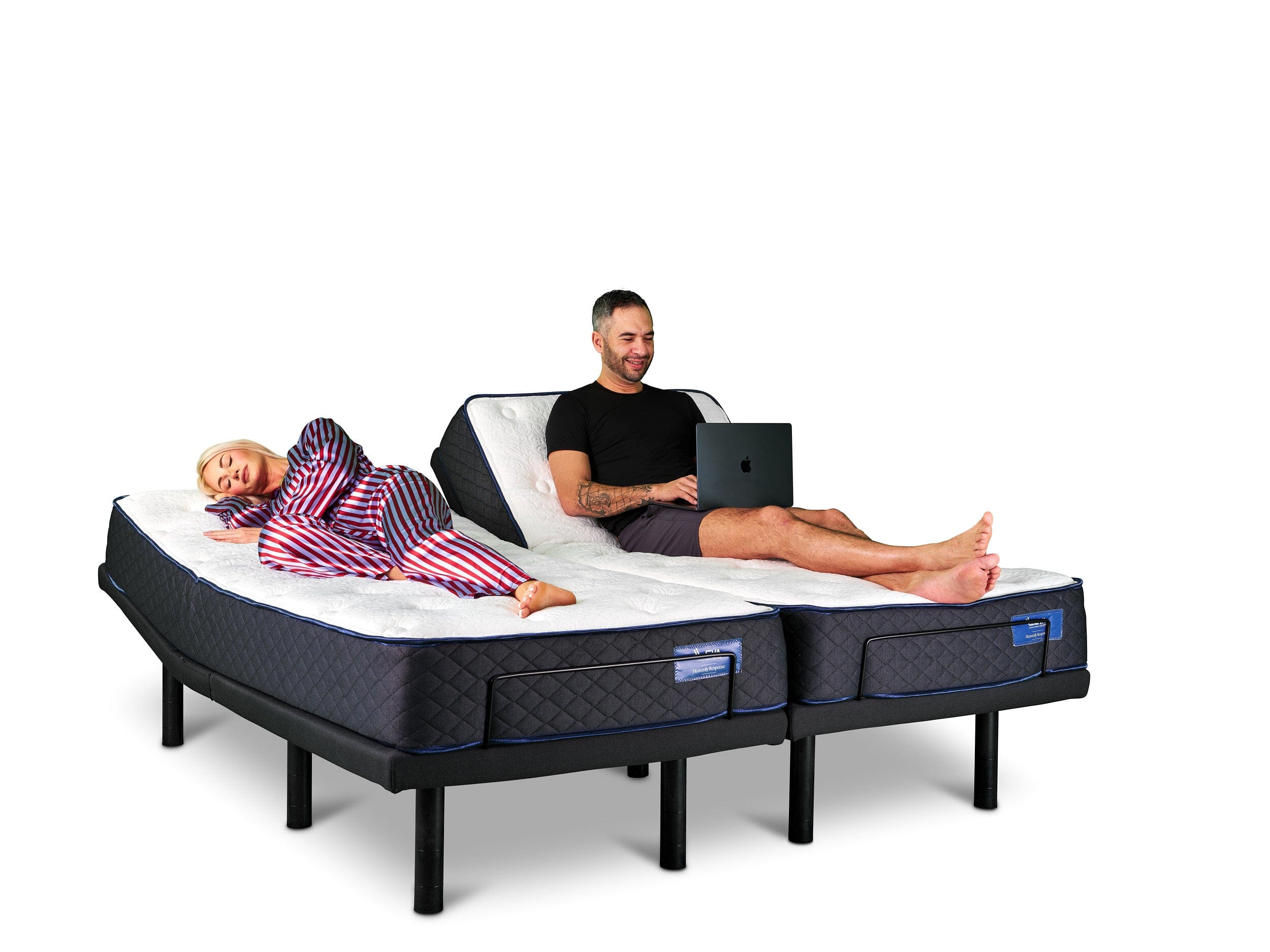
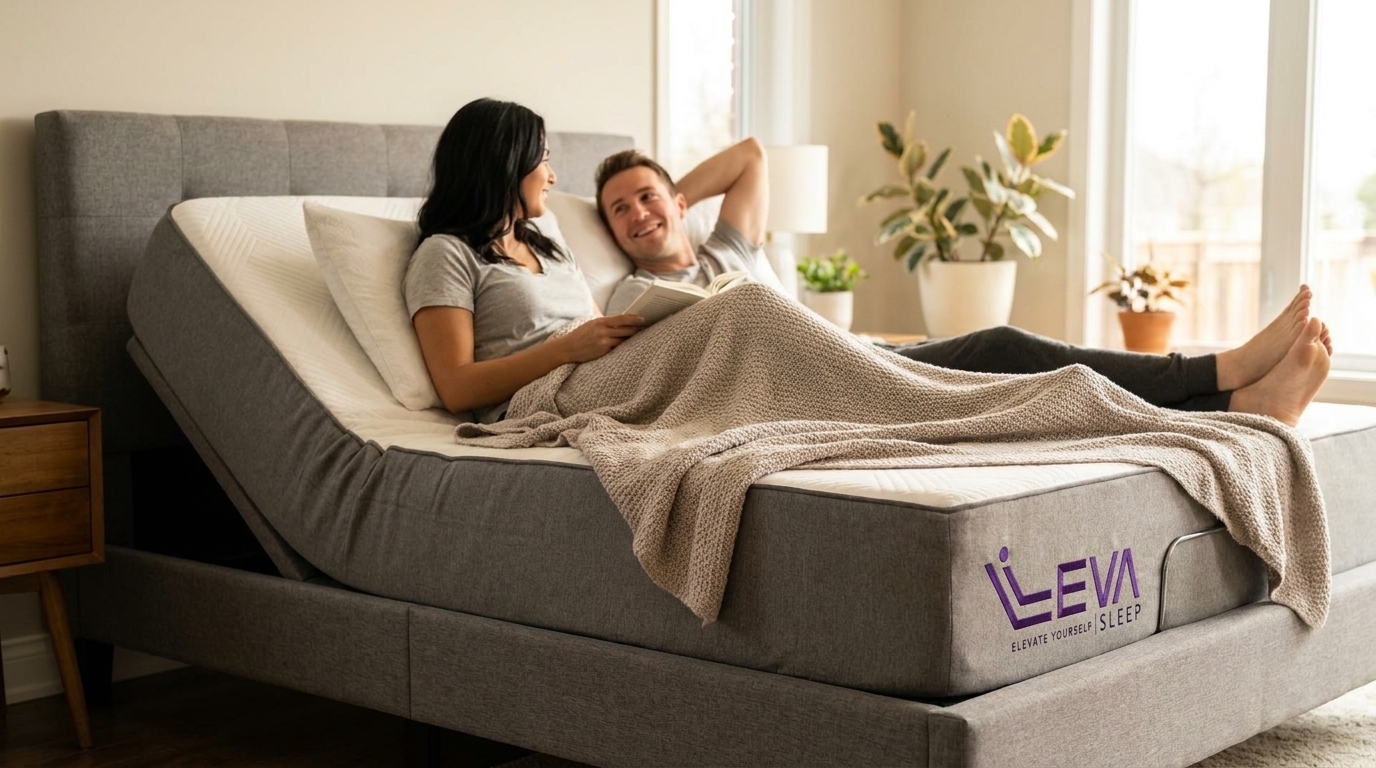
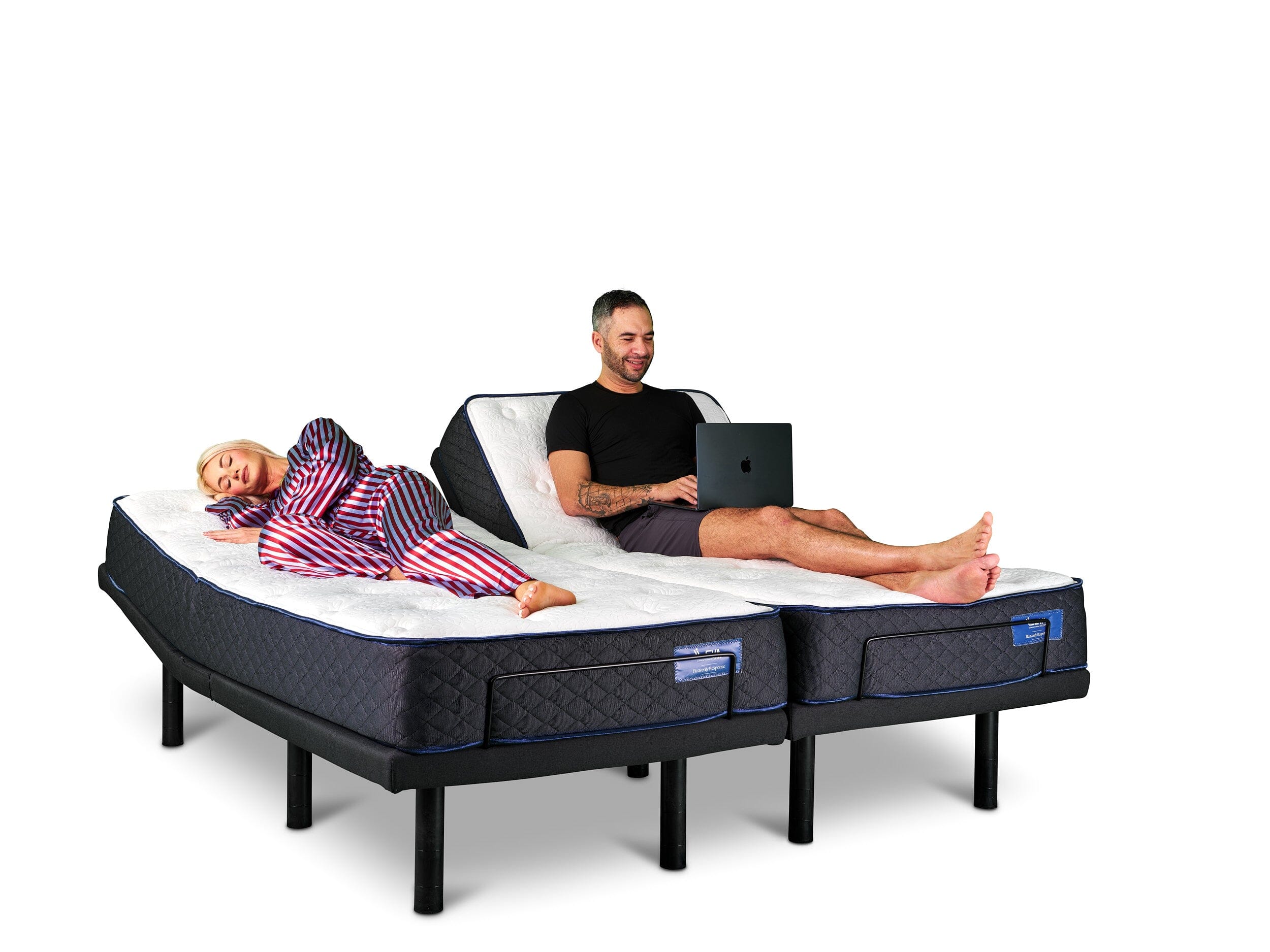
Split configurations solve the core problem of differing comfort needs for couples without requiring separate beds. Split-king adjustable bases accommodate couples who have differing comfort preferences or require independent adjustment on each side of the bed. Leva Sleep extends this idea to Split Queen sizes, which are uncommon among general retailers, so couples in smaller bedrooms can still keep independent controls.
Leva Sleep has operated for over eight years, with $50M in lifetime sales and more than 25,000 customers across Canada. Its catalogue spans 15–20 adjustable models, compared to the 3–5 typically found at general mattress retailers. Whisper-quiet German motors remove the mechanical noise associated with older adjustable bases. White-glove delivery is available in Ontario and Alberta, covering setup, bed-height adjustment, product tutorials, and old-bed removal. Leva’s direct-to-consumer model usually prices its systems 30–50% below comparable luxury competitors.
Decision Matrix: Matching Your Situation to a Sleep System
| Your Situation | Recommended Direction |
|---|---|
| Back sleeper, 130–200 lb, mild occasional pain | Medium-firm hybrid (Mattress Miracle or Casper Snow Hybrid), with zoned lumbar support as a priority |
| Side sleeper, under 130 lb, shoulder or hip sensitivity | Medium-soft to medium hybrid, avoiding very firm surfaces per Dr. Okubadejo’s clinical guidance |
| Back or side sleeper, over 200 lb, chronic lumbar pain | Medium-firm to firm hybrid, with an adjustable base and lumbar elevation for real-time support tuning |
| Couple with differing weights or sleep positions | Split adjustable system (Split Queen or Split King), since a flat mattress cannot support two different profiles at once |
| Persistent pain after a mattress change, or medically advised elevation | Adjustable base with independent head, lumbar, and foot elevation, plus consultation with a spinal specialist |
| Snoring that disrupts partner sleep | Adjustable base with anti-snore elevation or preset, with a split configuration to preserve the partner’s position |
Mattress Miracle and Casper both address spinal alignment within the limits of a flat surface. For most back sleepers in the average weight range with mild or intermittent pain, either brand’s medium-firm hybrid offers a reasonable starting point. When pain persists, when partners have incompatible needs, or when a physician recommends elevated sleeping positions, the flat surface itself becomes the main constraint rather than the foam or coil specification inside it.
Frequently Asked Questions
What firmness level do chiropractors and spinal surgeons most commonly recommend for back pain?
Most clinical evidence and specialist opinion converges on medium-firm mattresses, typically rated 6–7 out of 10 on a standard firmness scale, as the best starting point for back pain sufferers. This range provides enough resistance to prevent the hips from sinking and disrupting lumbar curvature, while still offering sufficient contouring to relieve pressure at the shoulders and hips. Body weight and sleep position modify this guidance, as discussed earlier, so lighter side sleepers often need more softness and heavier back sleepers often need more firmness. For complex or persistent cases, adjustable systems that allow real-time tuning of elevation and lumbar support give more flexibility than a single fixed firmness.
Is a hybrid or all-foam mattress better for chronic lower back pain?
Both constructions can support spinal alignment when the firmness suits the sleeper’s weight and position. Hybrid mattresses, which combine pocket coils with foam comfort layers, usually offer stronger edge support, better airflow to reduce heat retention, and more responsive bounce that makes repositioning easier. All-foam mattresses provide deeper, more uniform contouring that can help lighter sleepers or people with significant pressure-point sensitivity. For back pain, the firmness level and zoning matter more than the construction type alone. Hybrid mattresses also often last about 7–10 years, which gives slightly longer consistent support than many all-foam models. If morning pain continues after you switch to a well-fitted mattress, your sleep position or spinal condition may be the main issue, and elevation-based solutions may be worth exploring.
When should someone with back pain consider an adjustable bed instead of just a new mattress?
An adjustable base becomes the better fit in several clear situations. First, when a physician or specialist recommends sleeping in an elevated position, which is common for sleep apnea, acid reflux, post-surgical recovery, and some forms of lumbar stenosis, a flat mattress cannot meet that requirement. Second, when chronic pain continues after you move to a clinically appropriate medium-firm mattress, the fixed surface angle of a flat bed may be the limiting factor rather than the mattress material. Third, for couples where one partner needs a different firmness, elevation, or temperature setting than the other, a split adjustable system lets each side be configured independently. Finally, when snoring disrupts a partner’s sleep, head elevation on the snoring partner’s side can reduce airway restriction without forcing the other partner to change position.
What should I look for when comparing adjustable bed bases for back pain?
Focus on the range and precision of head, lumbar, and foot elevation, the motor noise level, and whether the base offers a split configuration if you share the bed. Lumbar support adjustment, which raises or lowers a reinforcement zone under the lower back, is especially valuable for back pain because it allows tuning that flat mattresses cannot provide. Zero-gravity positioning, which elevates both the head and feet to reduce spinal compression, is a common preset for back pain relief. For couples, independent controls on each side of the bed are essential, since a single-zone adjustable base still forces compromise. Also check mattress compatibility, because not all mattresses flex well with an adjustable frame, and purpose-built all-foam or flexible hybrid mattresses usually perform better than rigid innerspring designs.
Can an adjustable bed help if my partner and I have completely different sleep needs?
Split adjustable systems are designed specifically for this situation. A Split King or Split Queen configuration places two independently controlled bases side by side within a shared bed frame, so each partner can set their own elevation, lumbar support level, massage intensity, and, with compatible accessories, temperature. This setup removes common sources of compromise, such as one partner needing a firmer surface while the other prefers softer, or one requiring head elevation for snoring or reflux while the other sleeps flat. Sleeping in separate rooms, sometimes called sleep divorce, can stop the disruption but creates its own relationship and health trade-offs. Split adjustable systems aim to keep couples in the same bed while allowing each person to maintain their own ideal sleep environment.