The 10–12 Inch Thickness Sweet Spot for Adjustable Beds
A thickness of 10 to 12 inches works well for most adjustable-base mattresses. Thicker mattresses can fight the movement of the base and strain the motor. Thinner models may let you feel the joints and bars underneath. This range suits all compatible materials, including all-foam, latex, and hybrid pocket-coil designs.
Step 1: Confirm Your Adjustable Base Type and Size
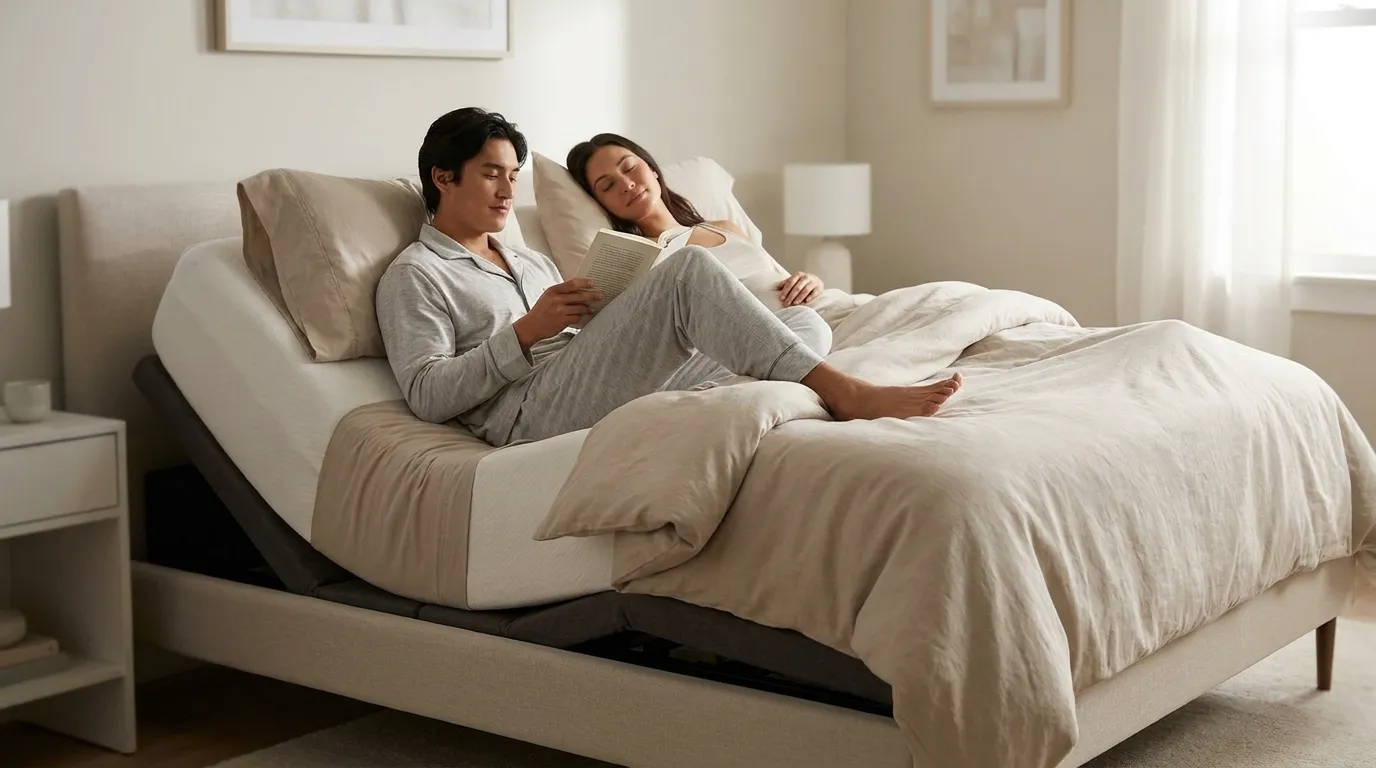
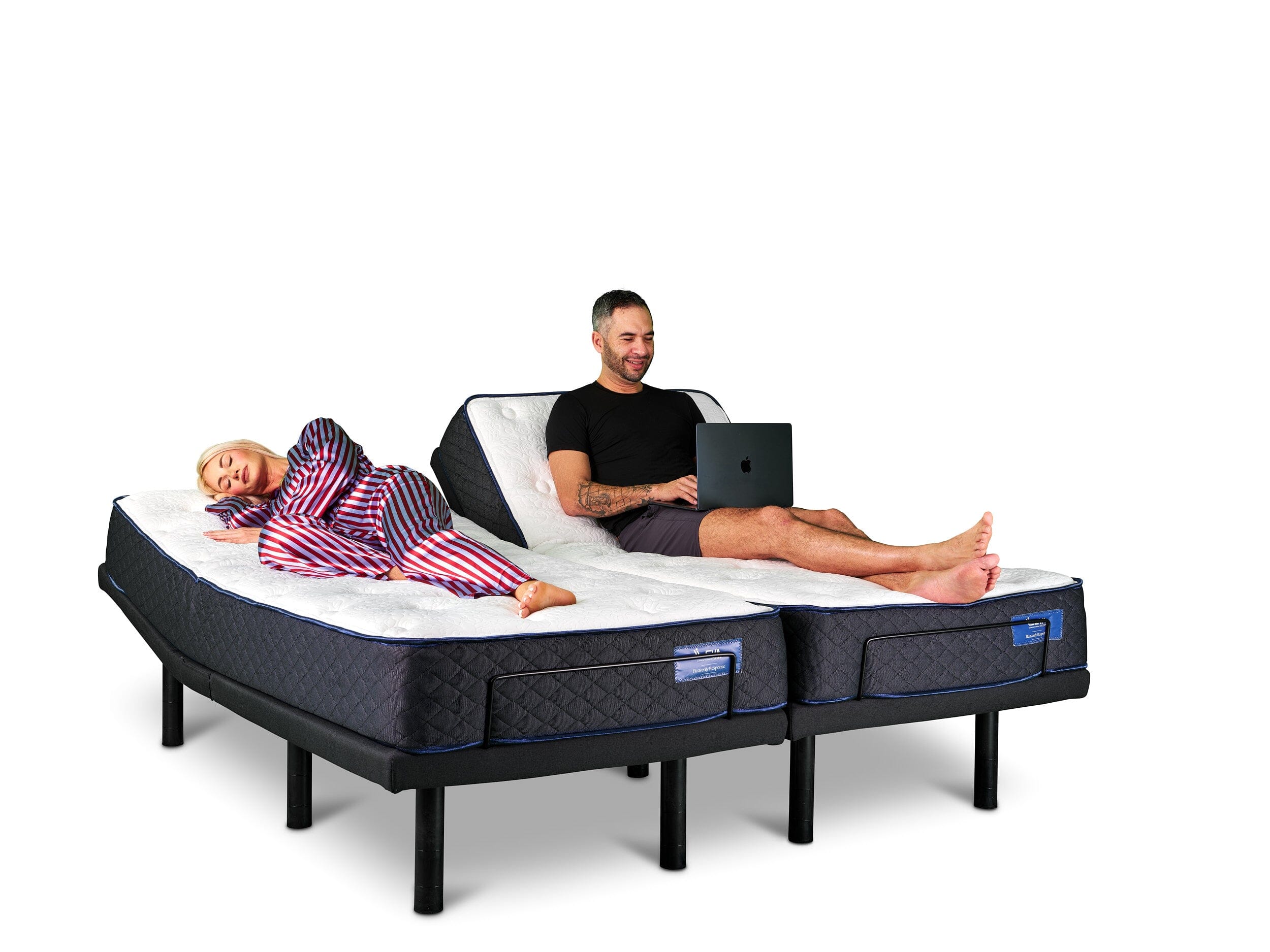
Start by confirming whether your base is a single unit or a split configuration. A Split King setup uses two Twin XL mattresses on separate adjustable bases, so each partner can choose their own position and firmness. A Split Queen follows the same idea in a smaller footprint and is a specialty configuration that Leva Sleep offers, which most Canadian retailers do not.
Independent elevation lets each partner raise the head or foot of their side without disturbing the other. This helps couples manage snoring, sleep apnea, acid reflux, or different firmness preferences. Confirming the split configuration first keeps you focused on thickness and flexibility requirements for each mattress half instead of a single king-sized mattress.
Step 2: Measure Mattress Thickness and Check Motor Clearance
Use a tape measure to record the mattress height from the base to the top surface. This measurement matters because mattresses over 14 inches may resist articulation or behave like a plank on adjustable bases. Once you know the height, check the adjustable base manufacturer’s documentation for the maximum mattress profile the motor is rated to lift and articulate. Exceeding that figure places continuous strain on the motor and can shorten its service life.
Measure the clearance between the base platform and the floor when the base is flat. Account for fitted sheets and mattress protectors, since they add to the overall profile and can push the system beyond the motor’s rated capacity. After you confirm that thickness and clearance are within limits, you can move on to the next key factor, which is how easily the mattress material bends.
Step 3: Check Material Flexibility with the 45-Degree Bend Test
To check mattress flexibility, fold a corner of the mattress up by hand to roughly 45 degrees. Smooth bending with no stiff spots, cracking, or loud creaking suggests it will likely work on an adjustable base. Use this test on any mattress before you buy it or before you place it on an adjustable base.
Mattress Type
Recommended Thickness Range
Adjustable-Base Compatibility
All-Foam (Memory Foam)
Within recommended range
Excellent, because the foam is flexible and conforms easily to base positions
Hybrid (Pocket Coil)
10–12 inch sweet spot, generally staying under 14–15 inches
Good, since pocketed coils flex independently; confirm manufacturer approval for thicker coil units
Latex (Natural or Synthetic)
Within recommended range, with flexibility preferred
Excellent, because latex is elastic and returns to shape after repeated flexing
Traditional Innerspring (Bonnell/Offset Coil)
Not recommended
Incompatible, since rigid borders resist articulation and can cause coil breakage and warranty issues
Common Mistake: Placing a traditional innerspring mattress on an adjustable base. Interconnected coil systems resist bending, which can break coils, deform the mattress, cause creaking, void the mattress warranty, and even damage the base mechanism.
Step 4: Match Thickness to Sleeper Weight and Medical Needs
Sleeper weight affects both firmness and thickness recommendations. Sleepers between 59–104 kg (130–230 lbs) usually do well on medium to medium-firm mattresses. Heavier sleepers often benefit from mattresses that provide extra support depth while still flexing properly.
For medical positioning, such as sleep apnea, acid reflux, hip or knee pain, or post-surgical recovery, head and foot elevation provide the main therapeutic benefit. A mattress that is too thick to bend fully at the hips and knees reduces the elevation angle and weakens that benefit. User body weight is a key factor in thickness selection for adjustable beds, since heavier individuals need enough depth to maintain support and performance. Couples with one heavier partner should choose a thickness that supports that partner’s weight while staying within the motor’s rated capacity.
Step 5: Confirm Canadian Warranty Terms and Sheet Fit
Common Mistake: Buying a 14-inch or thicker mattress and assuming it will flex well. Mattresses over 14 inches often resist bending at articulation points and can strain the motor.
Common Mistake: Using standard fitted sheets on an adjustable base. As the base elevates, standard sheets tend to pull free at the corners. Leva Sleep designs fitted sheets with deep pockets and extra elastic for adjustable bases, which keeps them secure at any elevation angle.
Split King and Split Queen: Avoiding Mattress Bridging
Split configurations introduce a specific concern called mattress bridging. When two separate mattresses sit side by side on independent bases, a gap can appear between them during elevation. Choosing the same thickness on both sides helps minimise this gap. Keeping both mattresses within the recommended thickness range also keeps the motors on each base working under similar load conditions and reduces uneven wear.
Canadian brands such as Endy and Douglas offer all-foam mattresses that fall within the compatible thickness range and pass the 45-degree bend test, so they are candidates for evaluation. Leva Sleep’s all-foam and hybrid pocket-coil lines are built specifically for its adjustable bases, with thickness and density confirmed for motor compatibility. When you evaluate any mattress for a split setup, apply the bend test to a corner of each mattress half and check that the warranty clearly allows adjustable-base use.
Leva Sleep’s Split Queen is a specialty configuration that most Canadian retailers do not offer. It provides the independent elevation and firmness benefits of a Split King in a smaller footprint, which suits Ontario and Alberta couples with rooms that cannot accommodate a standard king frame.
Success Checklist for Adjustable Mattress and Base Pairing
Before you finalise a mattress and adjustable base combination, confirm each of the following points.
Mattress thickness suits the sleeper’s weight and stays within the base’s rated capacity.
Mattress material is all-foam, latex, or hybrid pocket-coil, not a traditional innerspring design.
The 45-degree bend test shows smooth flexion with no stiff resistance or loud creaking.
The mattress warranty clearly permits use on an adjustable base, confirmed in writing.
Fitted sheets have deep pockets and strong elastic so they stay secured at full elevation.
In a split configuration, both mattress halves share the same thickness and material type.
Each partner can adjust head and foot elevation independently without affecting the other side.
Motor clearance specifications from the base manufacturer are not exceeded by the total mattress profile.
Frequently Asked Questions
Can a 14-inch mattress work on an adjustable base?
A 14-inch mattress sits at the upper boundary of what most adjustable bases can move effectively. At this thickness, the mattress may resist bending at the hip and knee zones, which reduces the elevation angle and increases motor load. Compatibility depends on construction. A 14-inch all-foam or thin-coil hybrid with a flexible comfort system may pass the 45-degree bend test. A 14-inch mattress with a rigid euro top or heavy-gauge coil unit is less likely to flex well. Always perform the bend test and confirm motor clearance with the base manufacturer before buying a mattress at this thickness.
Will a regular mattress work on an adjustable base?
A regular mattress works on an adjustable base only when it meets two conditions. It must fall within the base’s rated thickness range, and its construction must flex without resistance. Memory foam, latex, and hybrid pocket-coil mattresses in the recommended range usually meet these requirements. Traditional innerspring mattresses with Bonnell or offset coils do not bend properly and should not be used on adjustable bases. Before placing any existing mattress on an adjustable base, perform the 45-degree bend test and review the warranty to confirm that adjustable-base use is allowed.
Do heavier sleepers need a thicker mattress on an adjustable base?
Heavier sleepers usually benefit from a mattress with enough depth to provide stable support. That extra depth still needs to stay within the adjustable base’s rated motor capacity. For couples where one partner is significantly heavier, a split configuration lets each side carry a mattress thickness matched to that person’s weight. This avoids compromising on a single shared mattress. Leva Sleep’s Split King and Split Queen setups address this directly, since each base and mattress half is selected independently.
Does Leva Sleep offer white-glove delivery in Ontario and Alberta?
Leva Sleep provides in-house white-glove delivery for a fee across Ontario and Alberta. The team delivers the system to the bedroom, assembles the adjustable base and mattress, adjusts leg height, and walks you through app controls and preset positions. They also remove the old bed for donation or recycling. Trained Leva Sleep staff handle this service, which helps ensure the system is set up correctly and that you feel comfortable using it before they leave.
What bedding works best with an adjustable base?
Standard fitted sheets often pull free at the corners when the base elevates, especially at head angles above 30 degrees. Sheets designed for adjustable bases use deeper pockets, typically 40 cm or more, and reinforced elastic around the full perimeter instead of just the corners. Leva Sleep designs fitted sheets, mattress protectors, and duvet accessories specifically for adjustable bases, including duvet clips that keep split sides separate and remote pockets built into the bedding. Purpose-built bedding prevents sheet slippage, which is one of the most common complaints among adjustable-base owners who use standard linen.
Ready for a Complete Adjustable Sleep System?
Choosing the right mattress thickness for an adjustable bed in Canada comes down to five clear checks. Confirm base type and size, measure thickness within motor capacity, verify material flexibility with the bend test, match support depth to body weight, and ensure the warranty allows adjustable-base use. Leva Sleep designs every part of its adjustable systems, including base, mattress, and bedding, to meet all five checks at prices typically 30–50% below comparable luxury competitors. With over 25,000 Canadian customers, eight years of adjustable-bed focus, and in-house white-glove delivery across Ontario and Alberta, Leva Sleep offers a complete, coordinated system instead of a mix of parts that may not work well together.