
Written by: Matthew Timmins, Founder and Managing Director, Leva Sleep | Last updated: July 24, 2026
Key Takeaways for Couples Sharing a Bed
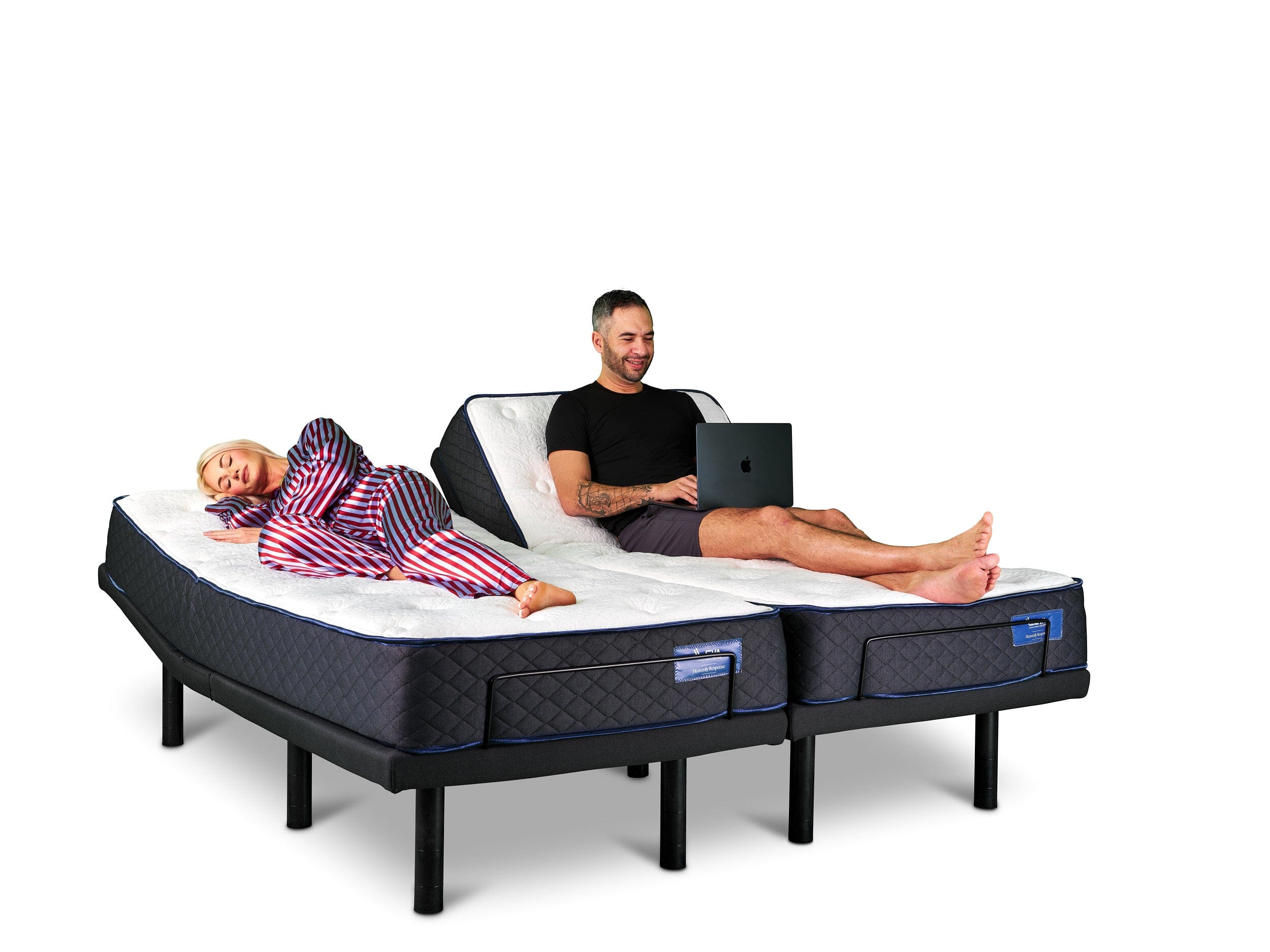
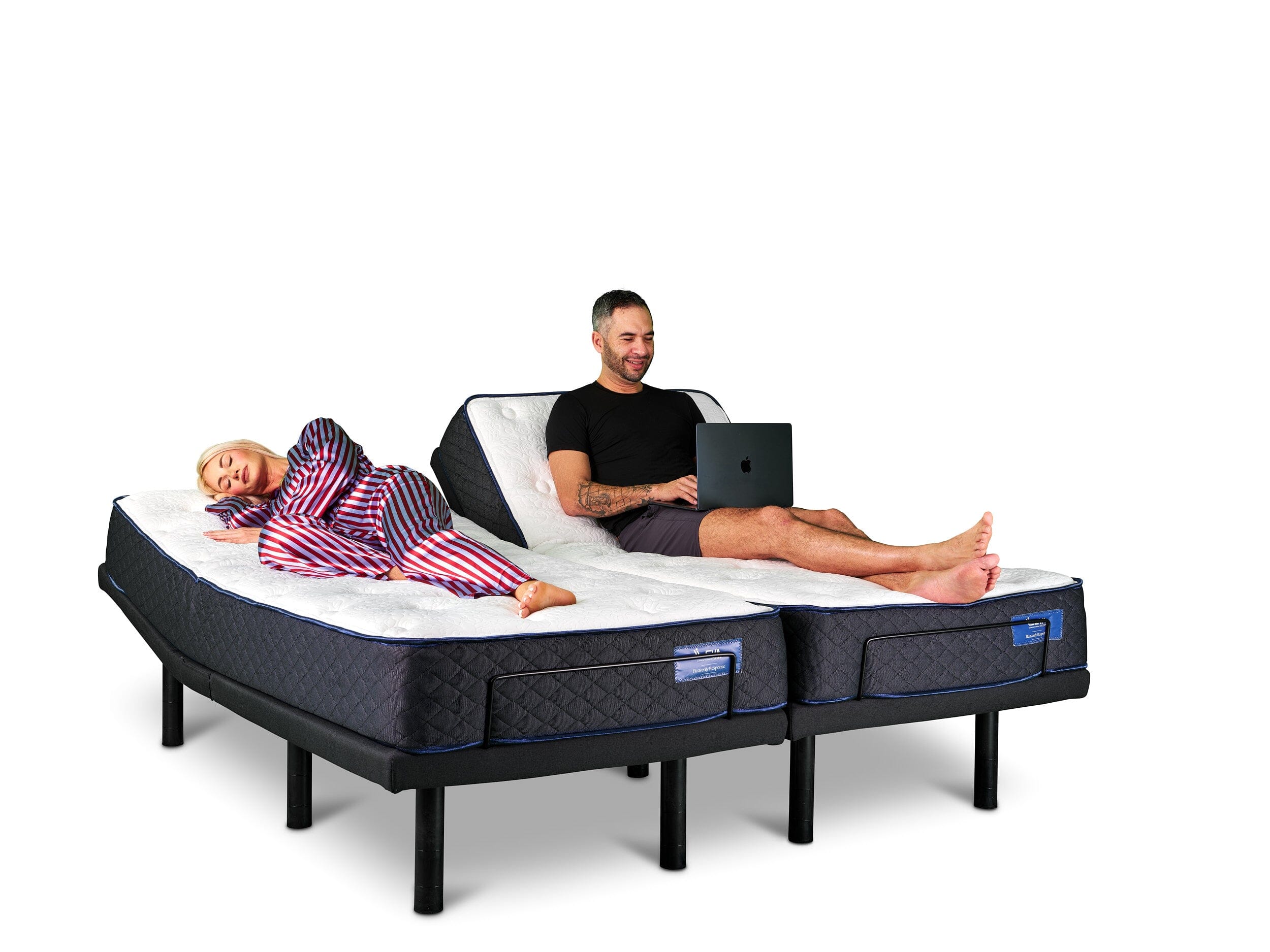
- A split queen adjustable bed uses two independent 30 × 80-inch halves on separate motorized bases, so each partner adjusts head and foot elevation without disturbing the other.
- Independent elevation reduces snoring for one partner while the other sleeps flat, solving motion transfer and sleep conflicts that flat beds and single adjustable bases leave unresolved.
- Physically separate mattresses deliver strong motion isolation, cutting partner-induced awakenings and preserving sleep efficiency for both sleepers.
- Leva Sleep’s quiet German motors, purpose-built bedding, and white-glove delivery in Ontario and Alberta make the split queen configuration realistic for Canadian couples in smaller bedrooms.
- Shop Leva Sleep’s adjustable bed packages to find a split queen solution that ends sleep conflicts without needing a bigger bedroom.
The Problem: Snoring, Motion Transfer, and Sleep Divorce
Snoring disrupts sleep for both partners. A Mayo Clinic Proceedings study found that spouses of snorers lost about one hour of sleep per night and experienced frequent arousals that mirrored the snoring partner’s breathing events.
Motion transfer adds another layer of disruption. A polysomnography study found that bed partners can cause more arousals per hour than sleeping alone, which reduces sleep efficiency when sharing a bed. Research shows that a single night of sleep restriction can reduce positive relationship behaviours and increase negative interactions through heightened hostility and weaker conflict resolution. A 2013 study in Social Psychological and Personality Science found that participants reported more conflict in romantic relationships after poor nights of sleep.
Survey data suggest that 25 to 40% of couples affected by obstructive sleep apnea eventually sleep in different rooms. A 2025 American Academy of Sleep Medicine survey of 2,007 U.S. adults found that 31% have chosen some form of sleep divorce by sleeping in a separate bed or room, with adults aged 35 to 44 the most likely group at 39%.
Why Common Sleep Setups Fail Snoring Couples
Given these stark statistics, couples usually try a few familiar options before considering a split queen. Each common alternative addresses part of the problem while leaving the rest unsolved. The table below compares the four options across the dimensions that matter most to couples.
| Option | Snoring Relief | Motion Isolation | Independent Comfort |
|---|---|---|---|
| Flat traditional bed | None, no elevation possible | Low, innerspring beds transfer motion freely | None, single shared surface |
| Basic single adjustable base | Partial, both sides move together | Moderate, depends on mattress type | None, one elevation setting for both partners |
| Separate rooms | Eliminated for the non-snoring partner | Eliminated | Full, but at the cost of shared sleep |
| Split queen adjustable bed | High, independent elevation targets snoring side only | High, physically separate mattresses isolate motion | Full, each side adjusts independently |
How a Split Queen Adjustable Bed Reduces Snoring
Head-of-bed elevation shifts the tongue and soft palate forward, which reduces the airway collapse that produces snoring. A 2017 study of 52 patients with mild to moderate obstructive sleep apnea found that modest head-of-bed elevation reduced the apnea–hypopnea index. A multicenter observational study of OSA patients also reported that head-of-bed elevation reduced AHI.
A split queen configuration applies that elevation only to the snoring partner’s side. The non-snoring partner sleeps flat, reads at an incline, or elevates their legs without feeling the other side move, which a single shared adjustable base cannot provide.
Shop Leva Sleep’s adjustable beds and explore the full range of split queen configurations designed specifically for Canadian couples.
Independent Elevation and Smart Anti-Snore Features
On a split queen adjustable bed, each 30 × 80-inch base runs on its own motor and controller. One partner can raise their head to the therapeutic incline established in clinical research while the other remains flat, reads at an incline, or elevates their legs for circulation support. A peer-reviewed in-home study published in PMC found that participants sleeping at a 12° incline for four weeks showed a 7% relative reduction in objective snoring duration compared to four weeks of flat sleep.
Leva Sleep’s adjustable bases use whisper-quiet German motors that change positions without waking either partner. A forthcoming anti-snore mode, arriving spring 2026, will detect snoring acoustically and trigger small automatic head adjustments on the snoring partner’s side, so no one has to wake up and press a button.
Head-of-bed elevation is contraindicated in patients with lower limb edema or venous insufficiency. Individuals with diagnosed sleep apnea should consult a physician before substituting positional therapy for prescribed CPAP treatment.
Motion Isolation and Mattress Choices That Work
Two separate mattresses on a split queen prevent movement on one side from travelling to the other. Bryte reports that split-king mattresses deliver 74–82% better motion isolation than single kings because each partner sleeps on a physically separate mattress.
Mattress construction shapes how much motion you feel within that range. Sleep specialist Dorothy Balicki notes that mattress type matters more than firmness when motion is the issue, and that a medium pocket coil will outperform a firm open coil for a couple where one person moves. Leva Sleep offers both all-foam and hybrid pocket-coil mattresses built to flex with adjustable bases without voiding warranties or weakening edge support over time.
Bedding Fit, Motor Noise, and Delivery Experience
Split queen mattresses use a non-standard 30 × 80-inch size per half. Standard twin sheets do not fit properly, and sheets without elastic corners, straps, clips, or fasteners tend to slide during position changes. Leva Sleep designs fitted sheets with deep pockets and reinforced elastic specifically for adjustable bases, and supplies duvet clips that keep covers aligned when the two sides sit at different angles.
Motor noise often worries light sleepers. Leva’s quiet German motors operate below conversational volume, so partners can adjust positions at night without waking each other.
Delivery in Ontario and Alberta is handled entirely in-house. Leva’s white-glove service brings the system to the bedroom, assembles the bases, sets leg heights, removes the old bed, and walks both partners through the app controls before leaving. Customers avoid third-party couriers and flat-pack assembly.
Real-World Use and Relationship Benefits
Consider a couple in their mid-50s in Ontario. One partner snores and has been advised by a physician to sleep elevated. The other has a knee injury that needs leg elevation. On a flat bed, neither position is achievable at the same time.
On a split queen adjustable bed, each partner dials in the elevation their body needs. Both sleep through the night, and neither moves to the guest room.
Relationship data supports this outcome. A randomized controlled trial published in Sleep found that three months of improved sleep quality increased couples’ reported relationship satisfaction on validated instruments. Sharing the same bed with personalized comfort, rather than shared compromise, protects both sleep quality and physical closeness.
Split Queen vs Split King for Canadian Bedrooms
The split king is more widely marketed, yet it needs a room that can handle a 76 × 80-inch footprint. A king or split king usually requires a minimum room size of 12 × 12 feet, with 13 × 13 feet preferred, to maintain at least 24 inches of clearance on the sides and foot of the bed. A queen fits comfortably in rooms around 10 × 10 feet, which matters for condos, older homes, and secondary bedrooms across Ontario and Alberta.
| Factor | Split Queen | Split King |
|---|---|---|
| Total footprint | 60 × 80 in (two 30 × 80 halves) | 76 × 80 in (two 38 × 80 Twin XL halves) |
| Width per sleeper | 30 inches | 38 inches |
| Typical full setup cost (two mattresses + two bases) | Lower, queen-sized components; contact Leva Sleep for Canadian pricing | $4,800–$14,000+ USD for two mattresses and two adjustable bases |
| Independent snoring elevation | Yes, each base adjusts separately | Yes, each base adjusts separately |
Both configurations deliver similar snoring relief through independent elevation. The split queen becomes the practical choice when the bedroom cannot fit a king footprint or when budget sits at the top of the priority list. Leva Sleep’s direct-to-consumer model prices split queen packages 30–50% below comparable luxury competitors, which keeps the configuration accessible without sacrificing engineering quality.
Shop Leva Sleep’s adjustable beds to compare split queen packages and find the right configuration for your bedroom dimensions and budget.
Honest Drawbacks of a Split Queen Mattress
Every configuration has trade-offs. The following are the most commonly reported drawbacks and the practical fixes that address each one.
- Centre seam: The seam between the two halves feels faintly noticeable for sleepers who gravitate to the centre of the bed. Fix: place a 2-inch or thicker memory foam or latex topper across both halves to bridge the gap and create a unified surface feel.
- Sheet compatibility: The 30 × 80-inch half-size is less common than a standard queen, and split queen sheets are most easily found online. Fix: use two separate fitted sheets with deep pockets and strong elastic, one per half, topped with a shared flat sheet or duvet. Leva Sleep supplies purpose-built bedding sets with this configuration.
- Mattress drift: Normal movement can cause the two halves to separate at the centre seam, which pulls fitted sheets loose and creates a gap. Fix: use non-slip pads under each half and two or three adjustable connector straps around both mattresses.
- Narrower per-person width: At 30 inches per side, the split queen provides less personal space than a split king’s 38 inches. Fix: evaluate whether the width reduction feels acceptable given the bedroom size constraint. For couples who primarily sleep on their own side, 30 inches is sufficient for most body types.
- Higher cost than a standard queen: A split queen requires purchasing two complete independent mattresses rather than one, and the added cost reflects the independent sleep surface benefit. Fix: Leva Sleep’s direct pricing model significantly reduces this premium compared to luxury retail competitors, and the investment is offset by avoiding sleep-related relationship strain.
Buying a Split Queen Mattress in Canada
Split queen adjustable beds rarely appear in general mattress chains in Canada. Sleep Country and similar retailers typically carry three to five adjustable base models, none configured as split queens. Leva Sleep offers 15–20 adjustable bed models, including split queen packages, and is one of the few Canadian retailers to build and stock this configuration specifically for couples.
Leva Sleep’s in-house white-glove delivery service operates in Ontario and Alberta. The service covers bedroom delivery, full assembly, leg-height adjustment, old-bed removal, and a hands-on product tutorial. No third-party logistics providers sit in the chain, so scheduling, handling, and setup quality stay under Leva Sleep’s direct control.
Canadian couples evaluating split queen adjustable beds should assess five criteria before purchasing, because each one addresses a common issue that often appears only after installation.
- Bedroom dimensions: confirm the room accommodates a 60 × 80-inch footprint with adequate clearance on all sides, since cramped layouts are a frequent reason for returns.
- Motor noise rating: request decibel specifications or an in-store demonstration, because noisy motors can cancel out the sleep-quality gains the bed is meant to provide.
- Mattress flex rating: verify the mattress is rated for adjustable base use to avoid warranty voidance when the base flexes the mattress during elevation.
- Bedding availability: confirm the retailer supplies or recommends 30 × 80-inch fitted sheets and connector accessories, as standard queen bedding will not fit each half correctly.
- Delivery scope: clarify whether white-glove setup and old-bed removal are included or priced separately, since unexpected delivery costs can push the total investment beyond budget.
Shop Leva Sleep’s adjustable beds and speak directly with a split queen specialist to configure the right package for your needs in Ontario or Alberta.
Frequently Asked Questions
How difficult is it to set up a split queen adjustable bed?
A split queen adjustable bed consists of two motorized bases and two mattresses that connect to a shared frame. Assembly involves attaching the bases, setting leg heights, and pairing the remote or app controls. Leva Sleep’s delivery team handles the complete setup process described earlier, so customers can start using the bed immediately. Customers who prefer self-assembly can follow the included instructions, although the bases are heavy and two-person handling is recommended.
Will standard queen sheets fit a split queen adjustable bed?
A standard 60 × 80-inch fitted sheet can stretch over both halves, yet it tends to slip between the mattresses during position changes and does not stay secure when the bases elevate independently. The recommended approach is to use two separate fitted sheets, one per 30 × 80-inch half, with deep pockets and reinforced elastic, topped with a shared flat sheet or duvet. Leva Sleep designs its own bedding line for adjustable bases, including fitted sheets with extra elastic and duvet clips that maintain alignment when the two sides sit at different angles.
Is a split queen adjustable bed medically appropriate for sleep apnea?
Head-of-bed elevation in the 7.5°–12° range has shown measurable reductions in apnea–hypopnea index in clinical studies of mild to moderate obstructive sleep apnea. A split queen adjustable bed allows the affected partner to maintain that elevation independently without disturbing the other partner. Positional therapy does not replace prescribed CPAP treatment in moderate to severe cases. Individuals with diagnosed sleep apnea, lower limb edema, or venous insufficiency should consult their physician before using head-of-bed elevation as a primary intervention. Leva Sleep’s anti-snore mode, arriving spring 2026, is designed as a comfort and snoring-reduction feature, not a medical device.
How do I prevent the gap between the two mattress halves from widening overnight?
The most effective combination uses non-slip pads placed under each mattress half, two or three adjustable connector straps wrapped around both halves, and a mattress topper of at least two inches placed across the full surface. Leva Sleep’s bases include connector hardware designed to minimize drift, and the company’s bedding accessories include mattress connector straps as part of the split queen package. Periodic tightening of frame bolts and rotating each mattress half every three to six months also prevents uneven wear that can widen the centre gap over time.
What is the price difference between a split queen and a split king at Leva Sleep?
A split queen uses two 30 × 80-inch mattresses and two queen-width bases, while a split king uses two Twin XL mattresses and two Twin XL bases on a larger frame. The split king’s larger components and greater material volume make it the more expensive configuration. Leva Sleep’s direct-to-consumer model prices both configurations 30–50% below comparable luxury competitors. Exact Canadian pricing varies by model and configuration, so contacting Leva Sleep directly or browsing the adjustable bed packages page provides current pricing for both split queen and split king options.
Conclusion: Keeping Couples Together in the Same Bed
A split queen adjustable bed resolves three common causes of shared-sleep failure, snoring, motion transfer, and differing firmness preferences, without requiring a larger bedroom or a move to separate rooms. Each partner controls their own elevation, firmness, and positioning independently, on a footprint identical to the standard queen bed most Canadian couples already own.
Leva Sleep is one of the few Canadian retailers that designs, assembles, and delivers split queen adjustable packages with in-house white-glove service in Ontario and Alberta. With 15–20 models, purpose-built bedding, quiet German motors, and pricing 30–50% below luxury competitors, Leva Sleep offers the full system, not just the base. Shop Leva Sleep’s adjustable beds and find the split queen configuration that keeps you and your partner sleeping together, comfortably, on your own terms.