
Written by: Matthew Timmins, Founder and Managing Director, Leva Sleep
Key Takeaways for Split King Adjustable Couples
- Split-king adjustable beds create a widening centre gap when bases move independently, which shifts sheets and makes cuddling uncomfortable.
- Traditional foam wedges and elastic straps often fail on adjustable bases because they compress unevenly or restrict independent movement.
- High-density foam fillers with non-slip fabric and full-length coverage perform best when tested through every base position before sheets are added.
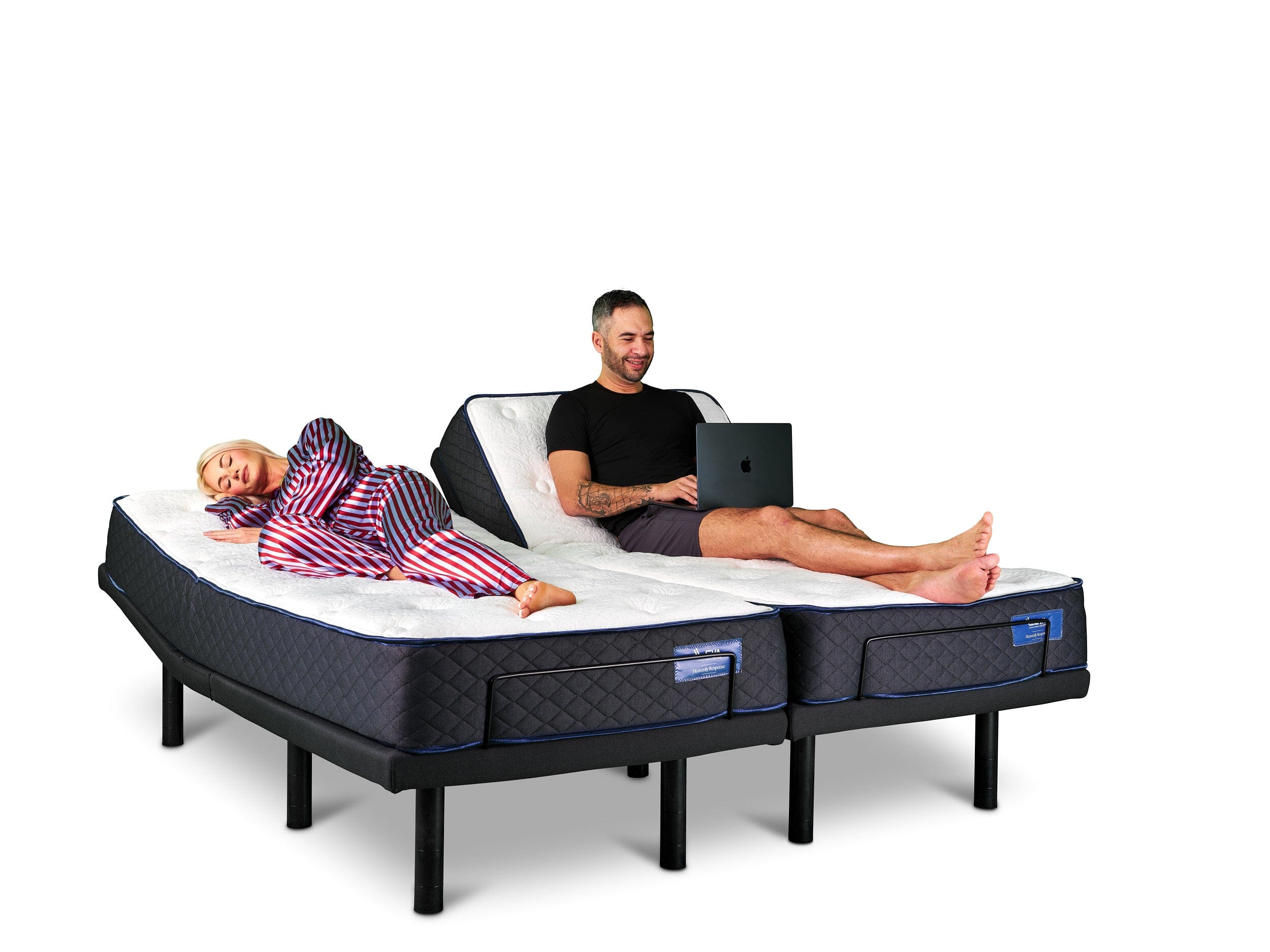
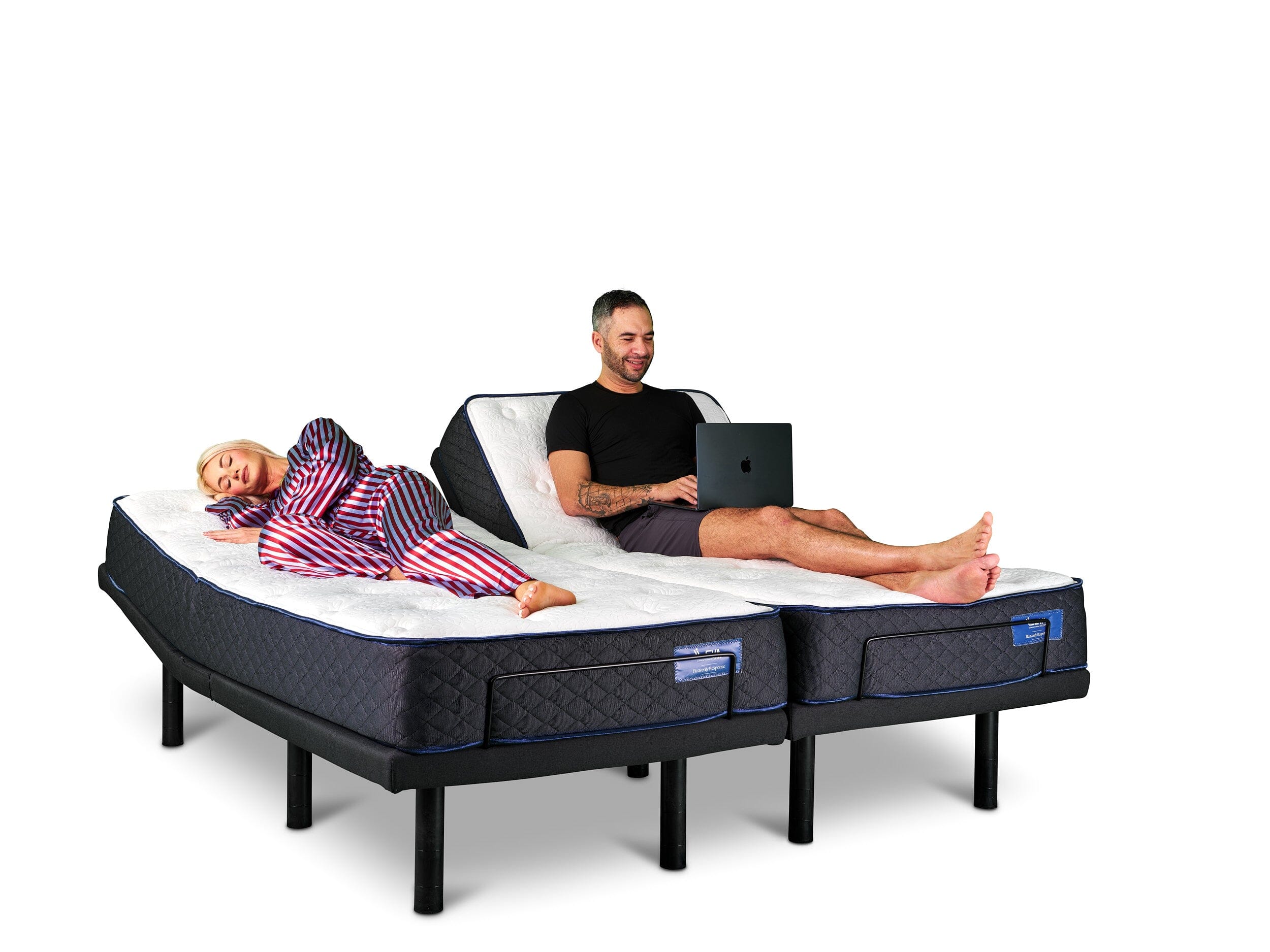
- Integrated split adjustable systems remove the gap entirely by design, so couples avoid after-market fillers and ongoing adjustments.
- Leva Sleep’s purpose-built Split King and Split Queen packages deliver a complete gap-free solution with white-glove service; shop Leva Sleep’s adjustable beds today.
Why Common Gap Fillers Fail on Adjustable Bases
Most gap fillers sold online were designed for stationary beds, not moving bases. Thin foam wedges compress unevenly when a base articulates because softer 25D foam can bulge or sag when the head section raises. This movement leaves a ridge or valley instead of a flat bridge between mattresses.
Elastic strap kits that cinch two mattresses together restrict independent movement and undermine the benefit of a split base. Cheaper elastic-strap designs loosen over time with repeated head and foot movement, so the gap gradually reappears.
DIY fixes such as rolled blankets or pool noodles ignore how adjustable bases move. They cannot span the full length of a split king, commonly 75 to 80 inches. They also shift during the night and provide no mattress-slide control. Many bed bridges are built only for non-adjustable frames, so frame type must be confirmed before purchase to ensure motion compatibility.
Gap Solutions Built for Adjustable Split Bases
Given these limits with traditional approaches, couples need solutions engineered specifically for adjustable bases. Two broad categories exist for split-king setups: after-market gap fillers that retrofit to an existing bed, and purpose-built split systems that remove the gap by design.
After-market fillers range from high-density foam wedges to sheet-bridge hybrids. Each option needs careful review against the criteria below, including foam quality, sizing, and slide control. Purpose-built split systems, such as Leva Sleep’s Split King and Split Queen adjustable packages, integrate the mattress, base, and bedding into one engineered system. This design removes the gap-management problem instead of patching it.
Choosing a Filler That Moves With Your Base
The most important requirement for any gap filler on an independently articulating base is simple. It must handle changing gap shapes without bunching, popping loose, or creating pressure ridges. A gap filler for split-king adjustable bases must be firm enough to resist compression and collapsing, and flexible enough to accommodate the changing gap shape as the adjustable bed moves through different positions.
High-density foam is preferred for gap fillers on adjustable beds because it maintains its shape as the base articulates. This denser foam resists the bulging and sagging described earlier. Wedge-shaped profiles perform better than rectangular blocks on zero-gravity bases because the angle helps grip both mattress edges when the head and foot sections rise.
Install the gap filler with mattresses in the flat position first, then test the adjustable base through its full range of incline positions to catch strap slippage or bunching early. Complete this test before adding sheets so problems remain easy to see and correct.
Stopping Mattress Slide While You Sleep
Gap fillers handle the seam, but mattress slide is a separate mechanical issue. Three features work together to keep mattresses in place and support the filler.
- Non-slip surface fabric: Non-slip fabric on gap fillers helps anchor the wedge in place during bed articulation and restless sleep. This grip reduces side-to-side drift along the seam.
- Deep-pocket fitted sheets: Leva Sleep designs its fitted sheets with extra elastic specifically for adjustable bases. This design keeps the sheet from popping off when head or foot sections elevate and also helps hold the mattresses against the filler.
- Bridging-sheet hybrids: Gap filler kits that include a fitted or flat connecting sheet are better for split-king setups with mismatched mattress thicknesses, as the bridging sheet smooths minor height differences that a foam wedge alone cannot fix. The sheet layer finishes the surface so couples feel one sleep surface instead of two.
Getting Width, Firmness, and Cover Right
Measure the gap between split-king mattresses only when both adjustable base halves are in their flattest, lowest position; common filler widths for split-king setups are 10 or 12 inches. Measure the gap width at the top of the mattress rather than at frame level, because mattress edges often flare slightly outward and change the effective seam width.
Firmness should match the surrounding mattresses so the surface feels continuous. A softer filler will compress into a dip under body weight even if the thickness is correct. This dip becomes noticeable when couples lie close to the centre.
For long-term durability, a removable, machine-washable cover made of breathable fabric such as linen or high-quality polyester is required for hygiene because the filler collects dust, skin cells, and spills while sitting between moving mattress edges. A washable cover also extends the life of the foam core.
Canadian Costs, Shipping, and Service
After-market foam gap fillers typically retail between CAD $9 and $22 per can, with some products shipping from US warehouses and attracting duties and brokerage fees at the border. Delivery timelines to Ontario and Alberta commonly run 3–10 business days for cross-border shipments.
Purpose-built split systems from Canadian retailers avoid cross-border complexity. Leva Sleep delivers to Ontario and Alberta with in-house white-glove service. Trained professionals bring the system to the bedroom, handle assembly, adjust leg heights, provide a product tutorial, and remove the old bed. Leva’s direct-to-consumer model prices its split adjustable packages 30–50% below comparable luxury competitors, so couples can access a complete gap-free system without the premium markup of brands like Tempur-Pedic.
How Different Gap-Filler Types Compare
The table below evaluates five gap-management approaches against criteria that matter most for couples with independently articulating split-king bases. All characteristics come from the sources cited earlier.
| Type | Adjustable-Base Compatible | Mattress-Slide Prevention | Long-Term Durability |
|---|---|---|---|
| T-wedge foam with straps (high-density) | Yes, when foam is high-density and straps are reinforced webbing | Moderate, non-slip fabric helps anchor during articulation | Good if buckles are reinforced, elastic straps loosen over time |
| Wide foam bridge (high-density, full-length) | Yes, the high-density foam discussed earlier resists compression through zero-gravity articulation | Good when filler spans the full mattress length and fits snugly | Good, dense foam maintains shape under repeated movement |
| Sheet-bridge hybrid kit | Partial, smooths height differences but does not fill structural gap | Good for mismatched mattress thicknesses, bridging sheet reduces ridge | Moderate, fabric wears with washing and foam insert longevity varies |
| Inflatable insert | Low, cannot tolerate both sides moving at different angles without popping loose | Low, air chambers shift under body weight and articulation | Low, valve and seam wear accelerate with repeated base movement |
| Integrated split adjustable base system | Full, gap removed by design with independent articulation built in | Full, mattresses and base engineered as a single system | Highest, purpose-built components with manufacturer support |
Fixing Common Split King Gap Problems
Couples who install gap fillers on adjustable bases often report three recurring problems. The steps below address each issue directly.
- Mattress drift on incline: Verify that the filler width matches or slightly exceeds the measured gap at the top of the mattress surface, not at frame level. Switch to a high-density wedge-profile filler with non-slip fabric on both contact faces. Confirm that the filler spans the full mattress length mentioned earlier.
- Straps digging into the mattress or slipping: Replace thin elastic straps with reinforced foam wedges that use wider webbing straps and sturdier buckles to address the loosening problem discussed earlier. Re-tension straps with the base in the flat position at the start of each use cycle.
- Pillow-tilt motor conflicts: Pillow-tilt motors create a secondary articulation point near the head of the mattress that standard full-length fillers do not consider. Measure the gap again with the pillow-tilt engaged at its maximum angle. If the filler bunches at the head end, trim or replace it with a two-piece filler, one section for the body zone and a shorter section for the pillow zone, or evaluate whether an integrated split system removes the conflict entirely.
Frequently Asked Questions
How do you keep sheets on a split-king adjustable bed?
Standard fitted sheets are sized for stationary mattresses and lack the elastic depth to stay anchored when a base elevates the head or foot. Deep-pocket fitted sheets with extra elastic around the entire perimeter, not just the corners, form the baseline. Sheet suspenders or cross-strap sheet grippers attached underneath each Twin XL mattress add a secondary anchor point.
Leva Sleep designs its fitted sheets specifically for adjustable bases, with reinforced elastic that handles significant elevation without pulling free. A bridging sheet placed over both mattresses and tucked under each side can also reduce the visible seam and keep both sheets from migrating outward during the night.
Do gap fillers work with pillow-tilt motors?
Most full-length foam gap fillers are designed for two-zone articulation, head and foot, and do not account for the extra flex point that a pillow-tilt motor creates near the top of the mattress. When the pillow-tilt engages, the upper portion of the mattress rises independently of the head section, which can cause a full-length filler to buckle or pop out at the head end.
The most reliable approach is to test the filler through every motor position, including head, foot, and pillow-tilt, before finalizing installation. If bunching occurs at the pillow-tilt zone, a two-piece filler configuration or a purpose-built split system with integrated bedding provides a more stable long-term solution.
What should couples do when one partner needs zero-gravity while the other stays flat?
Zero-gravity position raises both the head and foot sections at the same time, which creates the largest gap change of any standard base position. A gap filler rated for zero-gravity use should use high-density foam in a wedge profile so it can grip both mattress edges as they rise at different angles.
Measure the gap with both bases flat, then test the filler with one base in full zero-gravity and the other flat. This configuration represents the worst case for gap width and angle mismatch. If the filler cannot maintain contact with both mattress edges in that setup, it will not perform reliably over time. Couples who use zero-gravity regularly are strong candidates for an integrated split adjustable system, where each side articulates independently without any gap-management hardware.
Step-by-Step Decision Guide for Canadian Couples
Couples evaluating gap-filler options for a split-king adjustable base should work through five criteria in order of impact. Start with adjustable-base compatibility, because a filler that cannot tolerate independent articulation makes the rest of the checklist irrelevant.
- Adjustable-base compatibility, can the filler tolerate independent articulation on both sides without bunching or popping?
- Foam density, does it meet the high-density standard described earlier so it maintains shape during articulation?
- Precise sizing, is the width measured at the top of the mattress surface with both bases flat, and does the filler span the full length referenced above?
- Mattress-slide prevention, does the filler include non-slip fabric, and are sheets deep-pocket with full-perimeter elastic?
- Canadian availability, does the product ship domestically to Ontario or Alberta without cross-border duties and multi-week delays?
After-market fillers that satisfy all five criteria can meaningfully improve comfort on an existing split-king setup. Couples who want long-term reliability, prefer to remove gap management entirely, or plan to buy a new sleep system may find that a purpose-built split adjustable base with integrated mattresses, bedding, and independent controls offers a more durable and cost-effective path.
Leva Sleep’s Split King and Split Queen packages are designed and assembled for the Canadian market, delivered with white-glove service to Ontario and Alberta, and priced 30–50% below comparable luxury competitors.