
Written by: Matthew Timmins, Founder and Managing Director, Leva Sleep
Key Takeaways
- Most couples focus on the wrong fix. Matching the solution to the specific conflict is what actually improves sleep.
- Split adjustable bases with independent controls handle firmness, elevation, motion, and schedule conflicts while keeping partners in the same bed.
- Separate duvets and dual-zone temperature pads address temperature mismatch. Pocket-coil mattresses reduce motion transfer. Head elevation helps with snoring.
- Shared mattresses and basic adjustable bases rarely work for couples with different needs on each side of the bed.
- Leva Sleep offers split king and split queen adjustable packages with whisper-quiet motors, anti-snore mode, and white-glove delivery. Explore Leva Sleep adjustable bed packages to match your setup to your main sleep conflict.
Match Each Sleep Conflict To A Specific Fix
Most couples experiencing sleep conflict are solving the wrong problem. A partner who snores benefits from head elevation, not a new mattress. A partner who sleeps hot needs temperature control, not a firmer base. Matching the fix to the specific conflict is the approach that works consistently. The five most common sleep conflicts between couples, and their corresponding solutions, are:
- Different temperature needs — one partner sleeps hot, the other cold: The fix is two separate duvets in different weights, paired with breathable bedding. Partners’ temperature preferences differ by roughly 5–7°F on average, so a shared duvet forces both people to compromise. A dual-zone temperature pad adds active surface cooling or warming per side. Pads regulate surface temperature, not room temperature, and results vary by individual metabolism and hormonal factors.
- Different firmness preferences: The fix is a split king or split queen adjustable base, which places two independent mattresses side by side so each partner selects their own firmness. A shared mattress with a single firmness rating leaves one partner on the wrong surface.
- Motion transfer — one partner tosses and turns: The fix is a mattress with individually wrapped pocket coils, which absorb movement at the point of origin rather than transmitting it across the sleep surface. Motion isolation is the property that matters more than bed size. A king-sized continuous-coil mattress still transfers movement across its full width.
- Snoring and sleep apnea: The fix is head elevation, which opens the airway and reduces the vibration that causes snoring. An adjustable base with an anti-snore preset raises the head of the bed to a slight, steady incline. Snoring paired with choking, gasping, or pauses in breathing warrants a medical evaluation for obstructive sleep apnea before any equipment purchase, since approximately 80% of OSA cases are undiagnosed.
- Schedule mismatch — different bedtimes and wake times: The fix is quiet-entry routines and independent controls. A silent wrist-worn vibration alarm removes the alarm problem entirely. The early riser wakes without disturbing the later sleeper. Independent base controls mean one partner can adjust their side without affecting the other.
The extractable decision rule:
- Different temperature needs → two duvets plus breathable bedding
- Different firmness → split king or split queen adjustable base
- Motion transfer → individually wrapped pocket coils
- Snoring → head elevation or anti-snore positioning
- Schedule mismatch → quiet-entry routines and independent controls
See Leva Sleep’s adjustable packages for independent-control setups by conflict type.
Why Traditional Approaches Fall Short
Separate blankets and the Scandinavian sleep method, where couples share the same bed but not the same bedding, genuinely resolve temperature mismatch and duvet-tugging. They do nothing for firmness differences, motion transfer, or snoring. Basic adjustable bases may offer split configurations but often have loud motors or jerky movements that wake the other partner. Separate bedrooms solve the symptom of disrupted sleep while many couples still prefer to share a bed.
No single traditional fix covers more than one conflict, so couples who try one solution at a time often keep cycling through them. The table below shows which conflicts each option actually resolves.
| Solution | Temperature Mismatch | Firmness Mismatch | Motion Transfer | Snoring / Elevation | Schedule Mismatch |
|---|---|---|---|---|---|
| Separate duvets (Scandinavian method) | ✓ | — | — | — | — |
| Dual-zone temperature pad | ✓ | — | — | — | — |
| Split-firmness mattress (no adjustable base) | — | ✓ | — | — | — |
| Split adjustable base with independent controls | — | ✓ | ✓ | ✓ | ✓ |
| Separate bedrooms | ✓ | ✓ | ✓ | ✓ | ✓ |
The Sleep Foundation notes that a key drawback of separate bedrooms is cost, since it requires two available rooms and potentially a second high-quality bed. The American Academy of Sleep Medicine recommends that couples be intentional about spending time together before retiring to separate sleep spaces when separate rooms are chosen. That recommendation highlights why same-bed solutions are worth exploring first.
The Solution Category: Split Adjustable Sleep Systems
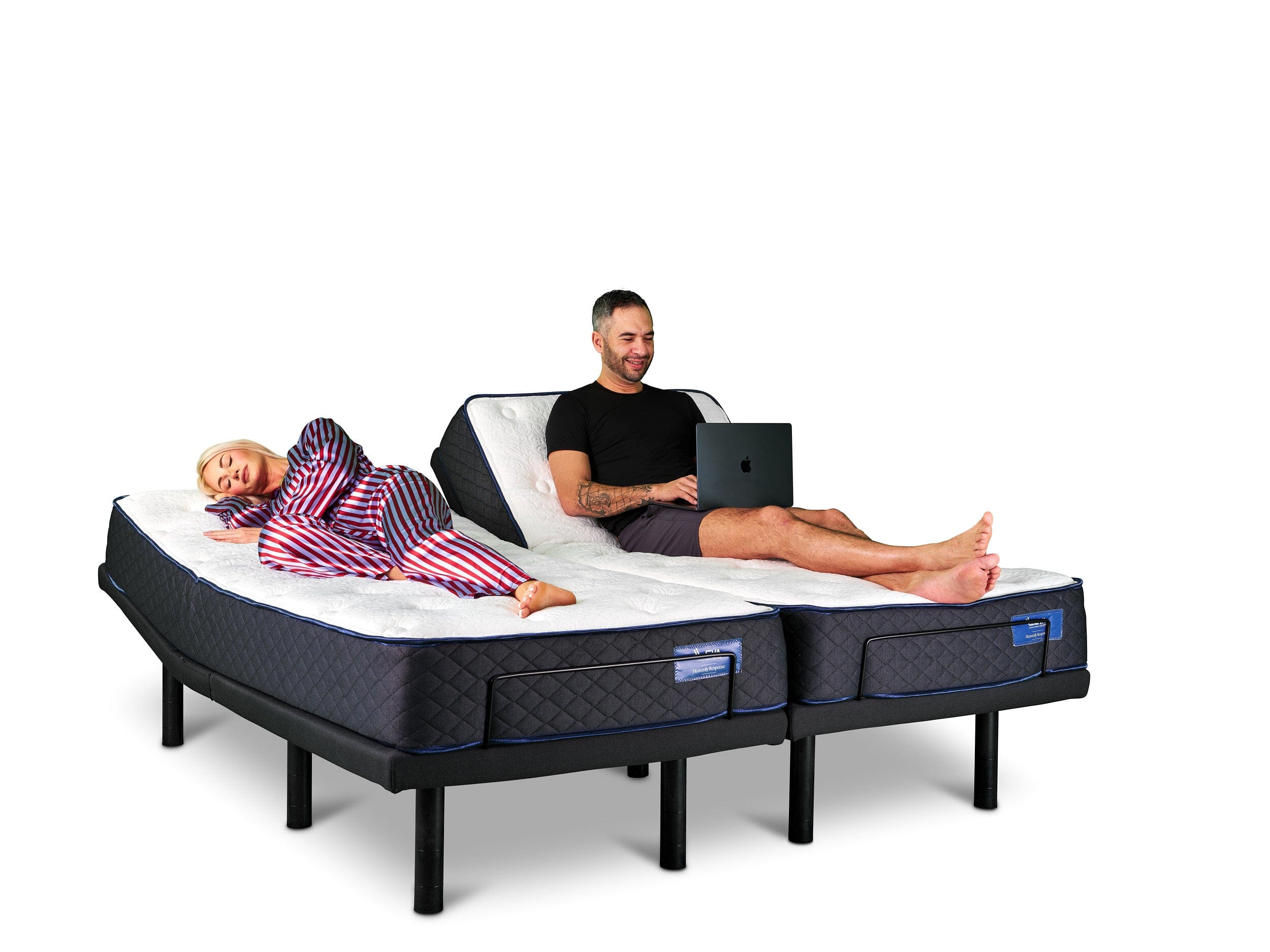
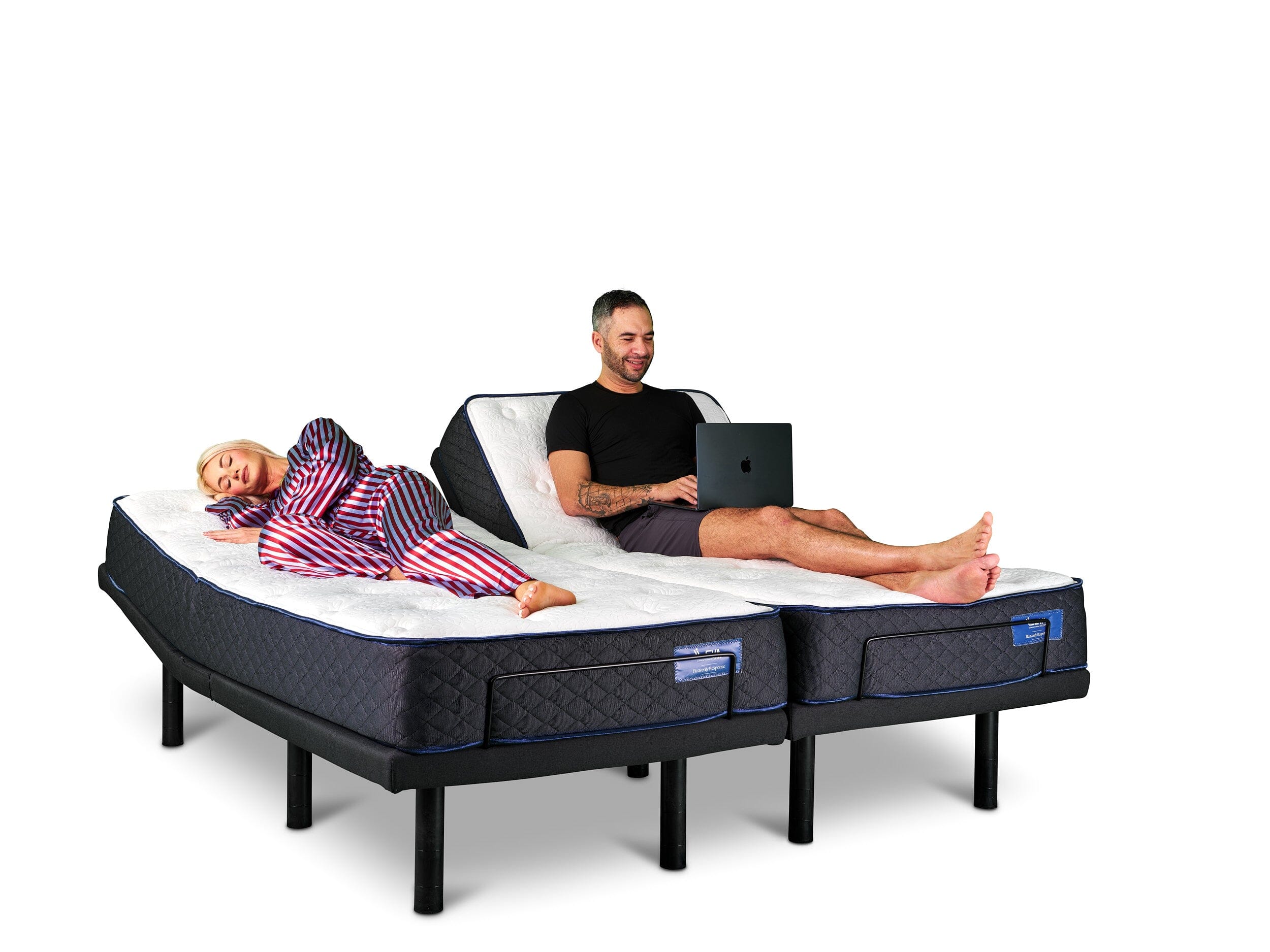
A split adjustable sleep system is the only single-bed configuration that addresses firmness, elevation, motion, and schedule conflicts at the same time. Each side of the bed operates as a fully independent unit. Head and foot articulation, elevation, massage settings, and app control are all controlled separately. Neither partner’s adjustment affects the other side.
Those independent controls come in two footprints. Two Twin XL mattresses placed side by side on two independent bases form a split king, matching the standard king footprint of 76 in × 80 in. A split king consists of two Twin XL mattresses, each measuring 38 in × 80 in, placed side by side. A split queen delivers the same independent adjustability in a more space-conscious configuration suited to smaller Canadian bedrooms. Leva Sleep’s split queen always means two fully independent bases with head and foot articulation on each side.
Leva Sleep offers a broad range of adjustable models compared to the limited selection at a standard retailer and is a unique Canadian provider offering a true Split Queen adjustable bed. Whisper-quiet German motors help ensure that one partner’s adjustments do not wake the other, which separates these systems from basic adjustable bases with loud or jerky motors.
Explore Leva Sleep’s split king and split queen options for Canadian bedrooms.
Split King Vs Split Queen Vs Two Twin XL: Choosing Your Layout
The configuration decision comes down to bedroom size, budget, and bedding logistics.
A split king offers maximum width per partner. Each side is 38 inches wide and suits primary bedrooms of at least 12 ft × 12 ft. Polysleep’s mattress size guide recommends a minimum room size of 12 ft × 12 ft for king and split king configurations. Two Twin XL mattresses on two independent bases create a split king. The terms are interchangeable when both bases are fully independent.
A split queen fits the standard queen footprint of 60 in × 80 in and suits bedrooms of at least 10 ft × 10 ft. That footprint makes it a practical choice for many Canadian homes where primary bedrooms are sized for a queen rather than a king. Each side of Leva Sleep’s split queen is a fully independent base with head and foot articulation.
Before purchasing any split adjustable system, verify the following:
- Motor noise: Ask specifically whether the motors are whisper-quiet. Loud or jerky motors defeat the purpose of independent controls if adjustments wake the other partner.
- Motion isolation: Confirm the mattress uses individually wrapped pocket coils or a high-density foam construction. These absorb movement at the source rather than transmitting it across the surface.
- Bedding compatibility: Fitted sheets must have deep pockets and extra elastic to stay in place when the base is elevated. Split king owners typically use two Twin XL fitted sheets rather than one king fitted sheet. Leva Sleep designs its own bedding, including fitted sheets with extra elastic, duvet clips, and remote pockets, specifically for adjustable bases.
- Delivery and setup: Confirm whether white-glove delivery is available in your province. Leva Sleep offers in-house white-glove delivery and setup for a fee in Ontario and Alberta, including old bed removal and a product tutorial.
- Warranty: Confirm warranty terms for both the base and the mattress before purchasing.
Temperature, Snoring, And Schedule Mismatch: Practical Fixes
Temperature: Without dual-zone temperature control, couples typically settle on a thermostat 4–5°F below the warmer partner’s optimal temperature, which leaves both partners mildly uncomfortable. A dual-zone temperature pad allows each side to be set independently. Pads regulate surface temperature, not room temperature, and results vary by individual metabolism, body composition, and hormonal factors. Breathable bedding and a targeted fan on the warmer partner’s side complement a pad rather than replacing it.
Snoring and sleep apnea: Head elevation opens the airway by shifting soft tissue away from the throat, which reduces the vibration that causes snoring. Leva Sleep’s adjustable bases gently elevate the head to address mild sleep apnea without masks. Leva Sleep’s anti-snore mode, arriving spring 2026, detects snoring and makes micro-adjustments to the head of the bed automatically. As noted earlier, snoring with gasping or pauses in breathing needs a medical evaluation first.
Schedule mismatch: The disruption from mismatched schedules is concentrated at bedtime and wake-up. A silent wrist-worn vibration alarm removes the wake-up problem entirely. Independent base controls on a split adjustable system mean the later sleeper can adjust their side, use massage, or change position without disturbing the partner who is already asleep. Preparing clothes and items outside the bedroom before bed removes another common source of early-morning disruption.
Compare Leva Sleep’s anti-snore and independent-control models for your specific conflict mix.
The Relationship Conversation: Proposing A Split Setup
The guilt around wanting different sleep arrangements is common and well-documented. A 2025 AASM survey found that 31% of U.S. adults had tried sleeping in a separate bed or space to accommodate a partner. That figure shows how widespread the problem is and how common these solutions have become.
Sleeping separately is not necessarily a sign of relationship problems, and some couples find it improves both their sleep and their relationship satisfaction. The same body of evidence shows that poor sleep is linked to couples treating each other with more hostility. Protecting sleep helps protect the relationship.
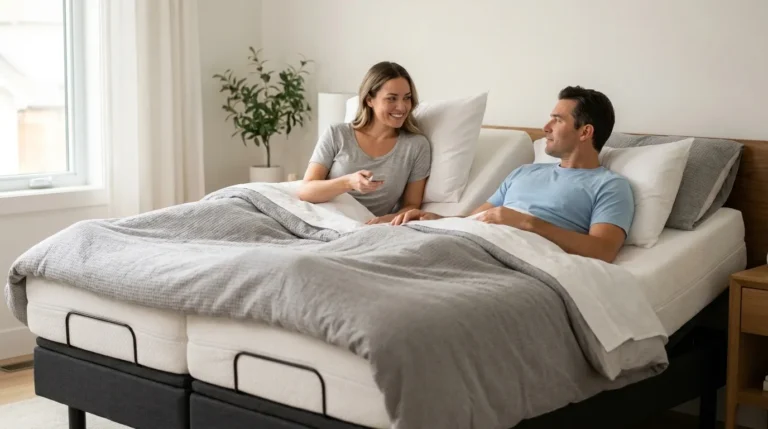
For couples considering a split adjustable base, the framing matters. Leading with the problem rather than the proposal opens a conversation about sleep rather than the relationship. “I’m exhausted and I think the snoring is doing it” starts a different conversation than “I want a separate bed.” A split adjustable base keeps both partners in the same bed while letting each control what affects them.
Practical language for common scenarios:
- Proposing separate duvets: “I read that couples in Scandinavia use two duvets on the same bed, one for each person. It means we both get the weight we want without fighting over covers. Want to try it for a month?”
- Proposing a split adjustable base: “What if we could each adjust our own side of the bed, firmness, elevation, everything, without affecting the other? That’s what a split base does. We’d still be in the same bed.”
- Addressing snoring: “The doctor said head elevation can help. There are bases that do this automatically when they detect snoring. It feels worth exploring before we consider anything more drastic.”
Sleeping separately is not automatically rejection, and sharing a bed is not automatic proof of closeness. If one partner feels abandoned by the proposal, that feeling needs a practical solution with emotional consent as well as a sleep-science explanation.
Why Leva Sleep Fits Couples With Different Sleep Needs
Leva Sleep is a specialist solution for Canadian couples with different sleep needs. Leva Sleep has been in business for over 8 years, with $50M+ in lifetime sales and 25,000+ customers. That track record makes it a specialist in adjustable sleep systems rather than a general furniture retailer.
The core offering for couples is the Split King and Split Queen adjustable base, which gives each side fully independent controls. That includes head and foot articulation, elevation, massage, lumbar control, and pillow tilt, all adjustable through a Bluetooth app with custom sleep positions and vibrating alarms. Whisper-quiet German motors help ensure that one partner’s adjustments do not disturb the other. The anti-snore mode, arriving spring 2026, detects snoring and makes automatic micro-adjustments to the head of the bed.
Leva Sleep’s verticalized, direct-to-consumer model delivers significantly lower prices than many comparable competitors by removing middlemen. The company offers a wide range of adjustable bed models and is one of the only Canadian providers of a true Split Queen with two fully independent bases in a queen footprint.
The full system extends beyond the base. Leva Sleep designs and sells mattresses, both all-foam and hybrid pocket-coil, specifically engineered for adjustable bases. The company also offers a complete bedding suite: fitted sheets with extra elastic and deep pockets, duvet clips, and remote pockets. Leva also pairs its bases with mattresses from Tempur-Pedic, Simmons, Beautyrest, Serta, and Kingsdown for customers who prefer specific brands.
In-house white-glove delivery and setup is available for a fee in Ontario and Alberta. The service includes old bed removal, assembly, leg-height adjustment, and a product tutorial. Local design and assembly in the regions Leva serves supports quality control without adding a large manufacturing markup.
Canadian Buying Checklist For Split Adjustable Systems
Use the following criteria to evaluate any split adjustable system before purchasing:
- Motor noise: Ask the retailer to demonstrate motor operation or read verified customer reviews that mention noise levels. Whisper-quiet motors should appear as a stated specification for the exact model you are considering.
- Bedding compatibility with elevation: Confirm that fitted sheets with deep pockets and extra elastic are available for the configuration you are buying. Standard fitted sheets usually slip off when the base is elevated.
- Delivery and setup in Ontario or Alberta: Confirm whether white-glove delivery is available in your city, what it includes, and whether old bed removal is part of the service.
- Warranty terms: Confirm the warranty period and what it covers for both the base and the mattress. Verify whether the warranty is handled in-house or through a third party.
- Base configuration match: Measure your bedroom before selecting between split king and split queen. A split king works best in rooms around 12 ft × 12 ft, while a queen configuration suits rooms around 10 ft × 10 ft or larger. Confirm that a “split queen” means two fully independent bases with head and foot articulation, not a head-only split on a single mattress.
Frequently Asked Questions
How To Sleep Better Together As A Couple
Start by identifying the specific conflict, such as temperature, firmness, motion, snoring, or schedule, rather than treating sleep disruption as a single problem. Each conflict has a targeted fix. Separate duvets resolve temperature and duvet-tugging. A split adjustable base resolves firmness and elevation differences. A pocket-coil mattress reduces motion transfer. Head elevation addresses snoring. Independent controls and quiet-entry routines address schedule mismatch. Combining the right fixes for your specific conflicts works better than relying on one general solution.
Is It Normal For Couples To Sleep In Different Beds
A 2025 American Academy of Sleep Medicine survey found that 31% of U.S. adults had tried sleeping in a separate bed or space to accommodate a partner. A 2023 AASM survey found that 35% of U.S. couples sleep in separate beds or rooms regularly. Sleeping separately is a common response to specific, identifiable sleep conflicts. Many couples later return to the same bed after addressing the underlying conflict with the right equipment.
How To Share A Bed When One Partner Snores
Head elevation is the primary mechanical fix for snoring. Raising the head of the bed opens the airway by shifting soft tissue away from the throat, which reduces the vibration that causes the sound. An adjustable base with an anti-snore preset or automatic anti-snore mode handles this without requiring the snoring partner to change position manually. If snoring is accompanied by gasping, choking, or pauses in breathing, a medical evaluation for obstructive sleep apnea is the appropriate first step, since the condition is associated with cardiovascular risk and is significantly underdiagnosed. Earplugs and white noise on the non-snoring partner’s side can reduce disruption in the meantime.
What To Do When One Partner Sleeps Hot And The Other Cold
The most effective fixes are two separate duvets in different weights, one light and one heavier, and breathable bedding on the warmer partner’s side. This approach applies the Scandinavian sleep method to temperature mismatch. A dual-zone temperature pad adds active surface heating or cooling per side for couples with a significant temperature gap. Pads regulate surface temperature, not room temperature, and results vary by individual. A cooler room with extra layers on the colder partner’s side generally works better than a warmer room with lighter bedding on the hotter partner’s side, since adding warmth is easier than removing it.
What Is The Scandinavian Sleep Method
The Scandinavian sleep method involves sharing the same bed but using two separate duvets, one per person, rather than one shared duvet. Each partner uses bedding suited to their own temperature preference and can move freely without pulling covers off the other. The method is standard practice in Scandinavia and is increasingly recommended by sleep experts as a practical fix for temperature mismatch and duvet-tugging between bed-sharing couples. It does not address firmness differences, motion transfer, snoring, or schedule mismatch, so it works best as one component of a broader conflict-resolution approach.
Conclusion: Stay Together, Sleep Better
Couples with different sleep needs can sleep together and sleep well. The relationship usually functions; the setup creates the conflict. Temperature mismatch, firmness differences, motion transfer, snoring, and schedule conflicts each have a specific, mechanical fix. Diagnosing the conflict first and matching it to the right solution gives couples a repeatable way to improve sleep.
A split adjustable sleep system is the configuration that addresses the widest range of conflicts at once because each partner controls what affects them without compromising the other. For Canadian couples in Ontario and Alberta, Leva Sleep focuses on this problem with Split King and Split Queen adjustable bases, fully independent controls, whisper-quiet German motors, anti-snore mode, a complete bedding suite designed for adjustable bases, and in-house white-glove delivery and setup.
The right setup exists for every conflict mix. The next step is choosing the configuration that fits your bedroom, budget, and specific sleep needs.
Browse Leva Sleep’s adjustable bed packages to match your setup to your main sleep conflicts.