Written by: Matthew Timmins, Founder and Managing Director, Leva Sleep
Key Takeaways For Couples
- Adjustable mattresses are worth it for couples when at least one partner snores, has acid reflux, back pain, or sleep apnea, or when both partners prefer different firmness or elevation.
- A single-surface adjustable base keeps both partners at the same elevation angle and rarely solves mismatched sleep needs.
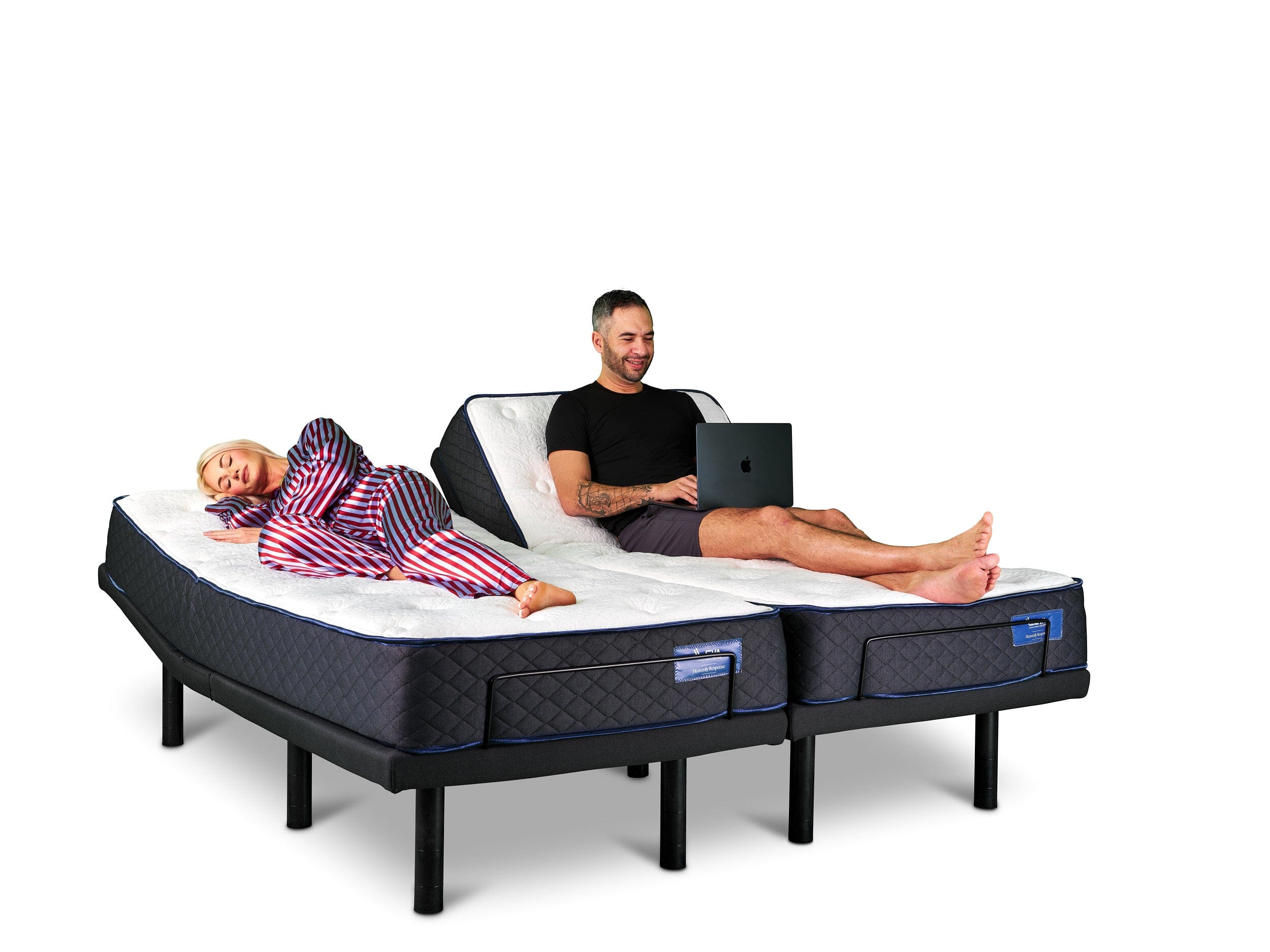
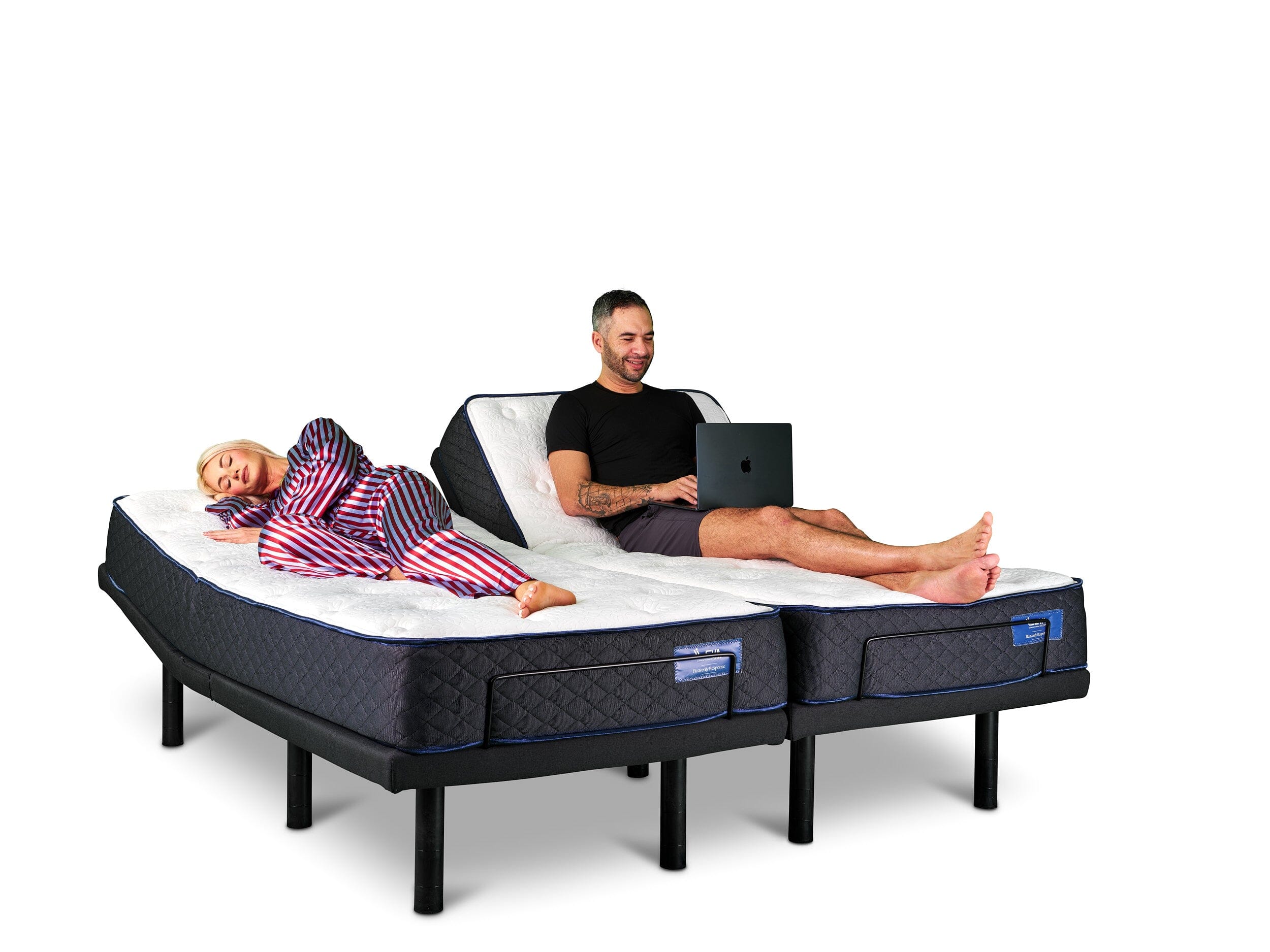
- A split adjustable system gives each partner independent control and directly addresses conflicting sleep positions, health needs, and firmness preferences.
- Split configurations create a center seam that can bother couples who love to cuddle in the middle, although mattress connector straps and pads reduce the impact.
- Leva Sleep specializes in Split King and Split Queen adjustable bases. Each side has independent controls, whisper-quiet German motors, and app-based position management.
Browse Leva Sleep Adjustable Bed Packages
The Three Configurations Compared: Regular Flat Vs Single Adjustable Vs Split Adjustable
The table below compares the three main configurations across elevation control, partner independence, health relief, mattress compatibility, and who each option suits best.
| Feature | Regular Flat Mattress | Single Adjustable Base | Split Adjustable Base |
|---|---|---|---|
| Head and foot elevation | None | Yes, one shared angle for both partners | Yes, independent angle per partner |
| Independent partner control | No | No | Yes, each side operates separately |
| Snoring and reflux relief | None | Only if both partners want the same elevation | Head elevation of 20–30 degrees can reduce snoring even in supine positions |
| Mattress compatibility | Any mattress type | Foam, latex, or pocketed-coil hybrid required | Foam, latex, or pocketed-coil hybrid required per side |
| Choose this if | Both partners sleep flat and share similar firmness preferences | One partner needs elevation and the other is indifferent | Partners have different sleep positions, health needs, or firmness preferences |
The comparison shows that a single-surface adjustable base usually disappoints couples because both partners must accept the same elevation. When one partner wants the head raised for snoring relief and the other prefers to sleep flat, the shared base cannot satisfy both.
Couples with different sleep positions, health needs, or firmness preferences need independent control. A split adjustable system addresses that core problem directly. Leva Sleep focuses on this use case with Split King and Split Queen adjustable bases that give each side its own controls, quiet German motors, and app-based position presets.
Compare Split And Regular Adjustable Bases
Choosing Size: Split King Vs Split Queen Vs Regular King
Once you decide on a split adjustable system, the next choice is size. The decision comes down to bedroom space, layout, and how much surface each partner wants.
A regular king mattress measures 76 inches wide by 80 inches long and is one continuous surface. A split king uses the same 76-by-80-inch footprint but relies on two Twin XL mattresses, each 38 inches wide by 80 inches long, placed side by side on a split king adjustable base. Any room that fits a regular king can also fit a split king.
A standard queen mattress measures 60 inches wide by 80 inches long. A split queen keeps that same 60-by-80-inch footprint while dividing the surface into two independently adjustable halves. This configuration works well in smaller Canadian primary bedrooms where a split king feels too large.
Leva Sleep is a specialist in Split Queen adjustable beds. In Leva Sleep’s lineup, “split queen” always means two fully independent bases with head and foot articulation on each side, so each partner controls their own elevation. This differs from a “split head queen,” which uses one mattress with head-only articulation and does not provide full independence.
Cost increases with complexity. A split king adjustable base requires two motors, one for each side, so it costs more than a single-surface base. Leva Sleep offsets that premium through its direct-to-consumer model and vertical integration, delivering luxury-level split systems at 30–50% less than comparable competitors.
Choose a split king if your bedroom can accommodate a 76-by-80-inch footprint and you want two fully independent Twin XL mattresses. Choose a split queen if you need a smaller footprint but still want independent head and foot articulation for each partner.
Find Your Ideal Split King Or Split Queen
The Honest Downsides Of Split Adjustable Beds For Couples
The main drawback of split adjustable beds for couples is the center seam. Two separate mattresses create a physical division that no accessory removes completely.
For couples who love to cuddle in the center of the bed, the split king’s center seam “can be a significant issue,” and if snuggling in the middle is non-negotiable, a split king may not be the right fit. A mattress connector strap costing $20–40 wraps both Twin XL mattresses together to prevent them from drifting apart during the night, and a split king mattress pad covering both surfaces hides the seam and softens the gap. These accessories reduce the impact but do not remove the division.
Several practical downsides often matter in day-to-day use. Together they shape whether a split system feels convenient or fussy for your household.
- Separate fitted sheets: A split king requires two sets of Twin XL fitted sheets, while a single king-size flat sheet and comforter can still create a unified look.
- Weight and difficulty of moving: Adjustable bases are heavy motorized platforms. Moving or repositioning one usually takes two people and careful planning.
- Unused motors and features: Premium features like massage, sleep tracking, and under-bed lighting are used inconsistently. Some couples rely on them nightly, while others use only basic head and foot elevation. Paying for features you rarely touch can feel wasteful.
- Final sale policies: Most split king adjustable bases are typically final sale with no returns, though some models, such as the Puffy Serenity Adjustable Base, offer a 365-night trial with free returns. The purchase carries real financial weight.
A split adjustable system may not suit you if cuddling in the exact center matters most, you move homes frequently, or your bedroom cannot handle the footprint. Couples whose main challenge is different elevation or health needs usually find these trade-offs manageable.
Review Split Adjustable Pros And Cons
Health And Medical Use Cases For Adjustable Beds
Adjustable beds support specific health-related positions through elevation. They act as comfort and positioning aids rather than medical treatments.
Snoring: Raising the head 10–15 degrees on an adjustable base has stopped snoring for many couples and improved the partner’s sleep quality. Head elevation of 20–30 degrees can further reduce snoring in supine positions. Leva Sleep’s anti-snore mode (coming spring 2026) will detect snoring and make small automatic head adjustments.
Acid reflux (GERD): Head elevation of 15–30 degrees with feet raised 10–15 degrees creates a neutral spinal angle that relieves pressure points and is recommended for snoring and lower-back pain relief. The same range is clinically associated with reducing nighttime GERD symptoms by keeping stomach acid below the oesophagus.
Sleep apnea: Head and foot elevation can help open airways for mild sleep apnea. Superpower’s sleep-divorce guide recommends screening the snoring partner with the STOP-Bang questionnaire before changing any sleeping arrangements. The tool screens snoring, daytime tiredness, observed apneas, blood pressure, BMI, age, neck circumference, and sex, then routes positive screens to a sleep study. Sleep apnea clinics refer patients to Leva Sleep as a comfort aid, but an adjustable bed does not replace clinical diagnosis or CPAP therapy.
Back and hip pain: Orthopedic physical therapist Karena Wu, P.T., D.P.T., recommends a 120-degree angle between the thighs and torso for lower-back pain, known as the zero-gravity position, and notes that a 20-degree knee bend can help knee joint issues. Leva Sleep’s Lumbar Control and Pillow Tilt Motor let you fine-tune lower back support and head position separately from the main elevation.
If snoring, reflux, or back pain drives your decision, screen for sleep apnea first. Then consider whether an adjustable bed’s elevation options match your condition. An adjustable bed supports comfort and positioning but does not replace medical evaluation.
Explore Health-Focused Adjustable Systems
Mattress Compatibility And Durability: What You Need To Know
An adjustable base only works well when the mattress can flex safely. Using an incompatible mattress can damage both the mattress and the base motor.
Memory foam, latex, and most hybrid mattresses with pocketed coils are compatible with adjustable bases. Traditional innerspring mattresses with continuous or Bonnell coils are not recommended, and very firm high-density foam rarely works. Hybrid mattresses with pocketed coils flex well because each coil moves independently, while traditional innersprings with a single continuous wire or heavy-gauge Bonnell coils lack that flexibility.
Adjustable bases may actually extend the usable life of a mattress by reducing wear patterns. This finding counters the common assumption that repeated head and foot elevation always accelerates mattress breakdown. Modern high-quality mattresses are designed with articulation in mind and do not inherently wear out faster on an adjustable base.
Bedding designed for adjustable bases, with extra elastic, deep pockets, and duvet clips, helps keep sheets in place during elevation. Leva Sleep designs its mattresses, both all-foam and hybrid with pocketed coils, and all bedding accessories specifically for adjustable-base use.
Check your mattress warranty for adjustable-base coverage before pairing an existing mattress with a new base. A simple test is to place the mattress on a flat surface and lift the head end about 12 inches. If you hear cracking, feel resistance, or see the top layer separate from the core, avoid using that mattress on an adjustable base.
Check Mattress-Compatible Adjustable Packages
Cost And Value For Canadian Buyers: When The Premium Makes Sense
A split adjustable sleep system costs more than a regular mattress because it includes two motorized bases, independent controls, app integration, and specialized engineering. The value comes from solving problems that a flat mattress cannot address.
Leva Sleep designs, assembles, and delivers its systems in-house. This direct-to-consumer model and vertical integration deliver luxury-level products at 30–50% less than comparable top-tier competitors. The price advantage comes from cutting out middlemen and assembling locally in the regions served, not from short-term discounts.
Leva Sleep offers 15–20 adjustable bed models, compared with the 3–5 typically found at a standard retailer. The company backs that range with 8 years in business, $50M+ in lifetime sales, and 25,000+ customers. In-house white-glove delivery and setup, available for a fee, covers old bed removal, assembly, product tutorials, and real-time height adjustments, which removes the burden of self-assembly that many “bed in a box” brands leave to the customer.
Evaluate the premium by asking whether the adjustable system solves a specific issue such as snoring, reflux, back pain, or divergent sleep preferences. When the answer is yes, the extra cost is usually justified. Couples who both sleep flat and share similar comfort needs often do better with a high-quality regular mattress.
See Pricing On Split Adjustable Systems
Frequently Asked Questions
What Are The Downsides Of Adjustable Beds For Couples?
The main downsides are the center seam on split configurations, separate fitted sheets, mattress drift over time, the weight and difficulty of moving the base, and the risk of paying for premium features that go unused.
As covered in the downsides section, a mattress connector strap and pad can reduce drift and soften the seam, but the center division remains. Adjustable bases are heavy motorized platforms, so relocation takes effort. Couples also vary in how much they use advanced features, and many split king bases follow final sale policies, which makes the decision more consequential.
Do Doctors Recommend Adjustable Beds?
Doctors and physical therapists recommend specific elevation positions for conditions such as GERD, mild sleep apnea, lower back pain, and knee joint issues. Adjustable beds provide a convenient way to hold those positions through the night.
Orthopedic physical therapist Karena Wu, P.T., D.P.T., recommends a 120-degree angle between the thighs and torso for lower-back pain relief, which corresponds to the zero-gravity position, and notes that a 20-degree knee elevation can benefit knee joint issues. Orthopedic spine surgeon Nitin Bhatia, M.D., recommends upper body elevation for GERD and sleep apnea, and leg elevation or zero-gravity positioning for lower back pain. Adjustable beds support these positions as comfort tools. They do not replace medical treatment, and anyone with a diagnosed condition should follow their clinician’s guidance first. Sleep apnea clinics sometimes refer patients to Leva Sleep as a complementary tool alongside clinical care.
Do You Need A Different Mattress For An Adjustable Bed?
You need a mattress that can flex without cracking or separating. That usually means memory foam, latex, or a hybrid with pocketed coils, rather than traditional continuous-coil innerspring designs.
The practical test is simple. Lift the head end of your current mattress about 12 inches off a flat surface. If you hear cracking, feel resistance, or see the top layer separate from the core, the mattress is not suitable for an adjustable base. Check the mattress warranty for adjustable-base coverage as some brands void coverage on non-approved bases. Leva Sleep designs its own mattresses, both all-foam and hybrid with pocketed coils, specifically for use with its adjustable bases.
Do Adjustable Mattresses Wear Out Faster?
A mattress designed for adjustable-base use does not wear out faster. Varying sleep positions can even reduce concentrated wear compared with sleeping flat every night.
Memory foam, latex, and pocketed-coil hybrids are built to flex repeatedly without structural damage. Mattresses not designed for bending, such as traditional continuous-coil innerspring or very firm high-density polyfoam, fail faster on an adjustable base because the materials cannot handle repeated articulation. The key factor is whether the mattress was engineered for adjustable use. Leva Sleep’s mattresses are built with this requirement in mind.
Is An Adjustable Bed Healthy To Sleep On?
An adjustable bed is healthy to sleep on when the mattress is compatible, the elevation positions match the sleeper’s body and conditions, and the base is used as a comfort and positioning tool rather than a substitute for medical care.
Earlier sections outlined clinically supported positions, including modest head elevation for snoring, combined head and foot elevation for a neutral spinal angle, and a 120-degree thigh-to-torso angle for lower back pain relief. Karena Wu, P.T., D.P.T., advises that individuals with spinal fusion and osteoporosis should avoid adjustable beds, as they can worsen or trigger other issues, and anyone with heart or respiratory conditions should seek medical advice before use. For most adults with snoring, reflux, back pain, or differing sleep preferences, a properly configured adjustable bed provides a safe and supportive sleep environment.
Closing Decision Framework: When To Choose Adjustable Vs Regular
Choose a split adjustable bed if:
- You and your partner have different sleep positions, health needs, or firmness preferences.
- One partner snores, has acid reflux, or experiences back or hip pain.
- You want to stay in the same bed and improve sleep for both partners without compromise.
- You have the budget and floor space for a split king (76 × 80 inches) or split queen (60 × 80 inches) configuration.
Choose a regular mattress if:
- Both partners sleep in the same position and share similar firmness preferences.
- You love cuddling in the exact center of the bed and will not accept a center seam.
- You move frequently or have a bedroom too small for an adjustable base footprint.
- You prefer a simpler setup or are not ready to invest in a premium sleep system.
The split configuration is what makes an adjustable system worthwhile for most couples. A single-surface adjustable base rarely addresses conflicting needs. When snoring, reflux, back pain, or divergent preferences drive the decision and you want to keep sharing a bed, a split adjustable system from a specialist like Leva Sleep offers a direct, practical solution for Canadian couples.
Start Building Your Split Adjustable Bed