Written by: Matthew Timmins, Founder and Managing Director, Leva Sleep | Last updated: July 19, 2026
Key Takeaways
- Adjustable base beds let Canadian couples elevate the head and feet independently, which can ease snoring, sleep apnea, and joint pain while still sharing one bed.
- Split Queen and Split King setups give each partner personalized positioning without transferring motion, which reduces the pressure to sleep in separate rooms.
- Only memory foam, hybrid pocket-coil, and select latex mattresses work safely on adjustable bases; traditional innersprings suffer damage from repeated bending.
- Quiet brushless DC motors under 45 dB and purpose-built bedding accessories keep adjustments discreet and prevent sheets from slipping during elevation.
- Leva Sleep offers whisper-quiet German motors, Split Queen options, and white-glove delivery in Ontario and Alberta, so you can explore their adjustable bed packages designed specifically for couples.
Pros and Cons of an Adjustable Base Bed for Couples
- Pro: Independent head and foot elevation lets each partner find a comfortable position without disturbing the other.
- Pro: A zero-gravity preset distributes body weight more evenly, which reduces lumbar pressure and supports circulation.
- Pro: Head elevation can reduce the apnea-hypopnea index in people with positional obstructive sleep apnea.
- Pro: Split Queen and Split King configurations resolve different firmness and elevation preferences within the same bed.
- Pro: Memory foam, latex, and hybrid pocket-coil mattresses can usually flex on an adjustable base without voiding manufacturer warranties.
- Con: Upfront cost is higher than a standard frame, and split configurations roughly double the base cost.
- Con: Budget AC motors can reach 50–60 dB, which can pull a sleeping partner from deep sleep into a lighter stage.
- Con: Traditional innerspring mattresses with interconnected coils are incompatible and will be damaged by repeated flexing.
- Con: Standard fitted sheets and bedding often slip off during elevation unless you use purpose-built accessories.
Is an Adjustable Bed Base Worth It for Your Sleep?
An adjustable base bed delivers the most value when a flat surface is limiting sleep quality. Couples managing snoring, acid reflux, back pain, or post-surgical recovery often see clear benefits from better positioning. Dr. Raj Dasgupta, a quadruple board-certified physician in pulmonary and sleep science, explains that adjustable bases help align the spine, reduce joint pressure, keep airways open by elevating the upper body to reduce snoring, and ease mild sleep apnea symptoms.
Costs vary across Canada. Ontario queen adjustable bases range from $995 to $2,200 in 2026, and most shoppers spend $1,100–$2,200 for a quality model with a wireless remote and basic massage. Split configurations add to the price but deliver independent control that a single-motor queen cannot match. Quality adjustable bases typically last 8–15 years with proper care, so the yearly cost often aligns with replacing a standard frame every decade.
For couples where one partner has a documented medical need such as sleep apnea, GERD, or chronic lower back pain, the positioning capability alone can justify the investment. The Canadian Sleep Society’s 2024 Healthy Sleep Practices guidance supports positional interventions as part of evidence-based sleep improvement, which includes head elevation for specific conditions.
Mattress Compatibility Checklist for Adjustable Bases
Mattress compatibility determines how well an adjustable base performs and how long your mattress lasts.
- All-foam mattresses are the most flexible option and allow users to maximize head and foot elevation in positions such as zero gravity.
- Hybrid pocket-coil mattresses work well when they include at least two inches of foam with individually pocketed coils. Standard Bonnell-coil innersprings are not compatible.
- Latex mattresses are slightly more rigid than foam, and a thinner profile helps them adapt to an adjustable base.
- Thickness: the ideal mattress thickness for an adjustable bed is between 10 and 14 inches, with 10–12 inches most common. Mattresses taller than 14 inches may not bend easily.
- Height-specific models: some mattresses only work in certain heights. For example, the Saatva Classic is compatible in its 11.5-inch version, not the 14.5-inch version.
- Manufacturer confirmation: always confirm the adjustable base manufacturer’s height and compatibility specifications before you buy.
Leva Sleep designs its own all-foam and hybrid pocket-coil mattresses to flex smoothly with its adjustable bases. Its accessory suite, which includes fitted sheets with extra elastic, duvet clips for split configurations, and remote pockets, tackles the common problem of standard bedding slipping during elevation.
Adjustable Base Beds and Sleep Apnea Relief
Head elevation on an adjustable base can support positional therapy for snoring and mild-to-moderate obstructive sleep apnea. Souza et al. tested the effects of 7.5° head-of-bed elevation on obstructive sleep apnea severity. Ravesloot et al. in Sleep and Breathing describe positional therapy via head elevation as an undervalued treatment that consistently reduces snoring intensity and frequency in position-dependent snoring and mild-to-moderate OSA.
The anti-snore preset on many mid-range and premium bases raises the head section by a few degrees to open the upper airway and reduce snoring for positional snorers. In 2026, manual anti-snore presets provide more reliable value than automatic sensor-based systems, which can misfire due to coughing or ambient noise. Mid-range Queen bases with manual presets typically cost $1,000–$1,500 in Canada.
Leva Sleep’s app-controlled anti-snore mode, arriving spring 2026, will make micro-adjustments to the head of the bed when it detects snoring. Dorothy Balicki, Sleep Specialist at Mattress Miracle, cautions that “Snoring can be a sign of obstructive sleep apnea, which has serious cardiovascular implications. An adjustable bed can help with the symptom, but if there is an underlying condition, it needs proper medical attention first.” Positional therapy supports medical care but does not replace a formal sleep study when OSA is suspected.
Split Queen Adjustable Bases and Ending Sleep Divorce
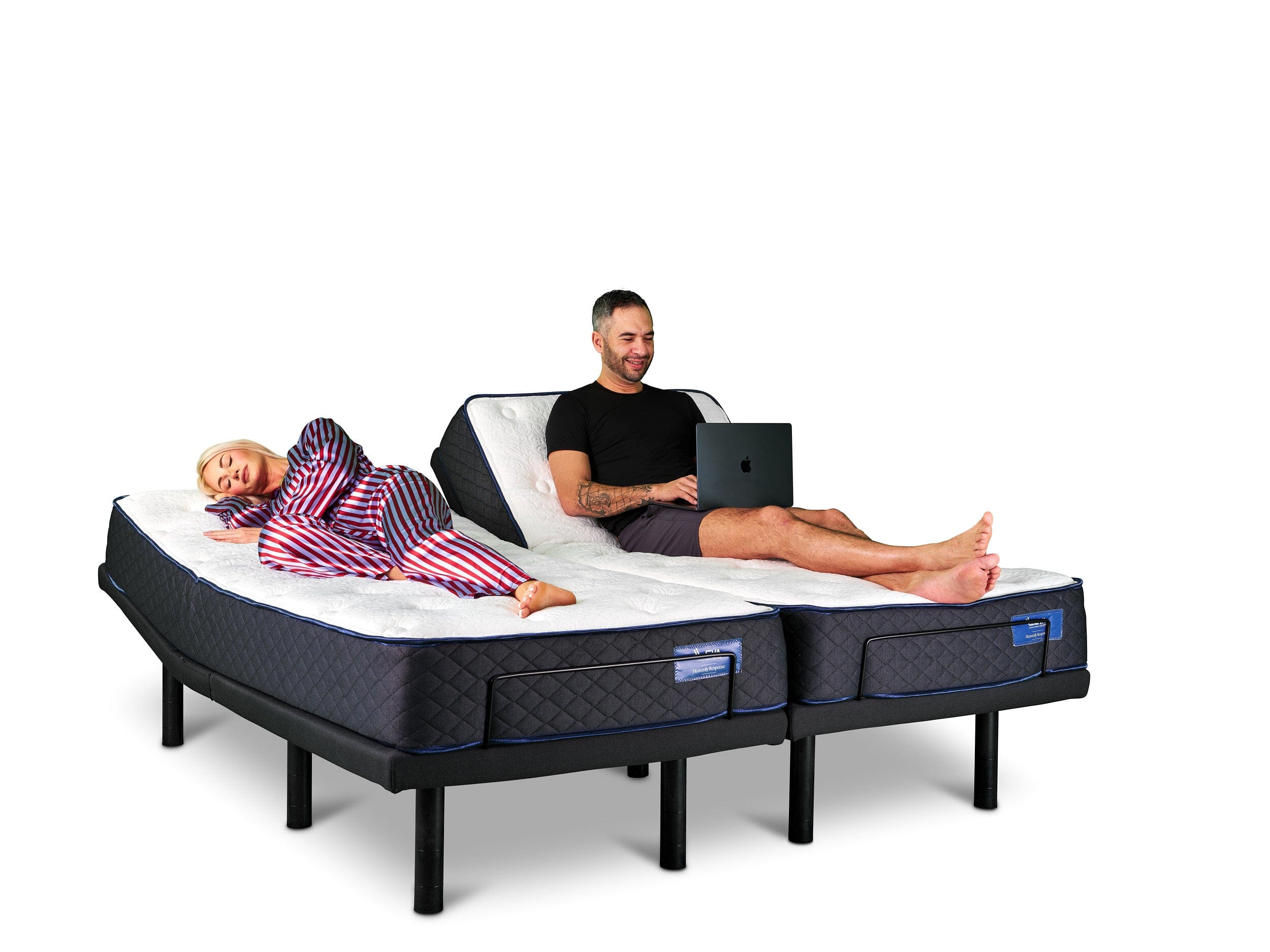
Sleep divorce, where couples sleep in separate rooms due to snoring, movement, or firmness conflicts, is increasingly common among Canadian couples. A split Queen or split King adjustable base addresses this by giving each partner independent control over their side of the bed while staying in the same room.
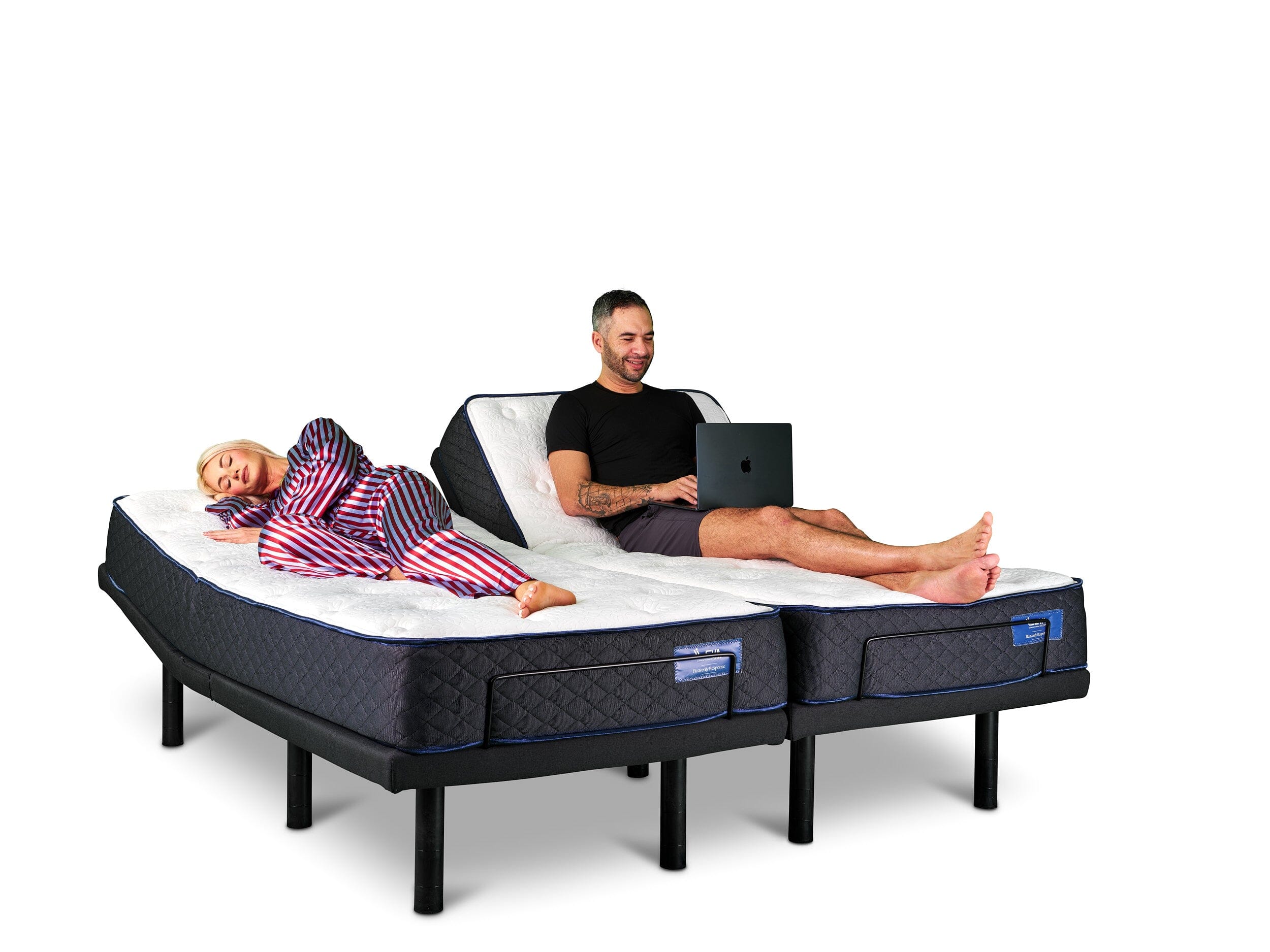
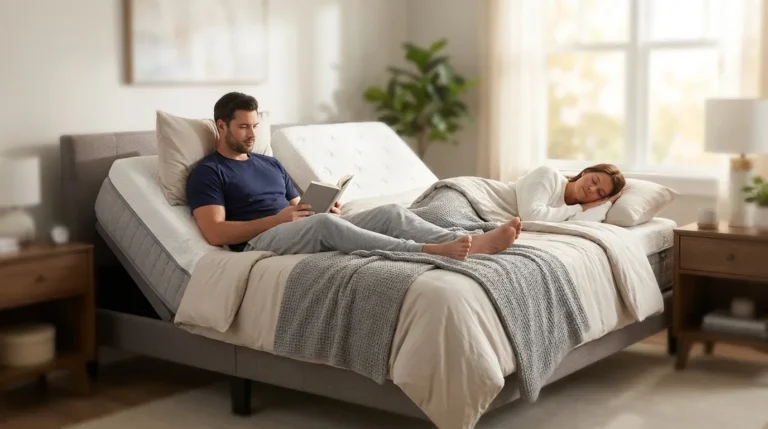
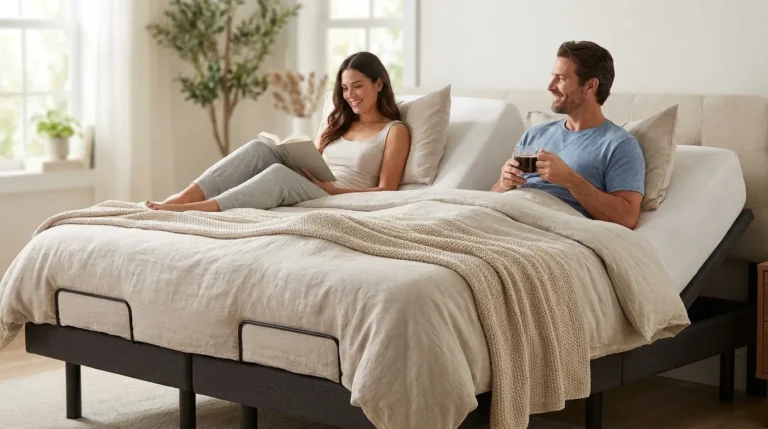
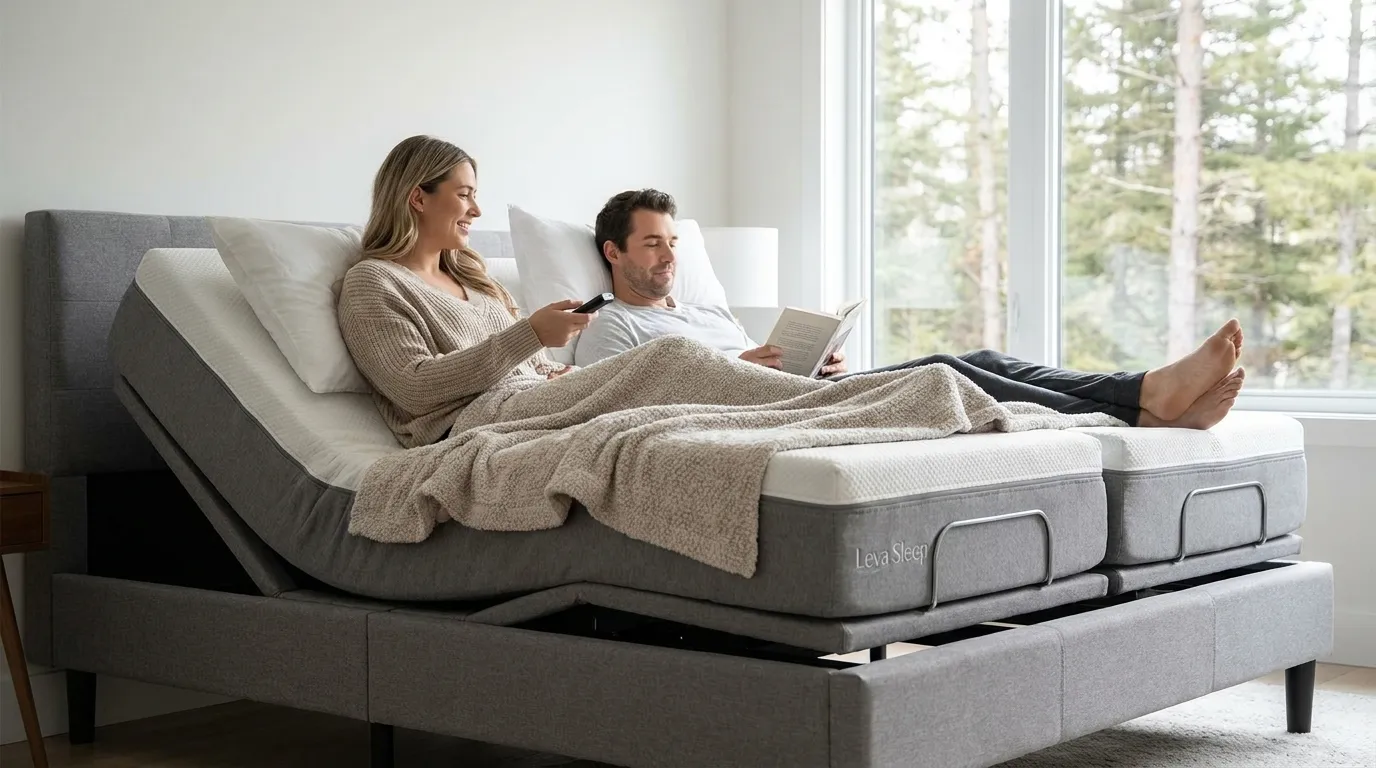
Split-king or split-queen adjustable base configurations allow each partner independent head and foot positioning so one person’s adjustments do not disturb the other during sleep. One partner can use the zero-gravity preset for back pain relief while the other sleeps flat. One side can activate the anti-snore elevation while the other remains at a preferred position.
Leva Sleep is one of the few Canadian specialists offering a Split Queen configuration, which suits couples who want independent adjustability without the larger footprint of a Split King. With 15–20 adjustable models available, Leva offers far more choice than standard retailers, which usually stock 3–5 models. Browse Leva’s split-configuration options to see how independent control can work for your bedroom.
Disadvantages and Tradeoffs of Adjustable Bases
Adjustable bases have clear benefits, but buyers should also understand the tradeoffs.
- Motor noise: Brushless DC motors operate at 30–40 dB, similar to a whisper, while budget AC motors reach 50–60 dB. Motor type largely determines whether nighttime adjustments wake a partner. Leva Sleep uses whisper-quiet German motors rated below the 45 dB threshold recommended for shared bedrooms.
- Cost: Split King or Queen setups with two separate adjustable bases roughly double the cost compared to a single base. Leva’s direct-to-consumer model reduces this impact by delivering 30–50% savings versus comparable premium competitors.
- Durability variance: As noted earlier, durability varies by build quality, and lower-tier models can wear out years before the 8–15 year benchmark. Investing in a quality motor and frame upfront reduces long-term replacement costs.
- Mattress incompatibility: Traditional innerspring mattresses cannot be used, so buyers must verify mattress compatibility before purchasing.
- Bedding fit: Standard fitted sheets often pop off during elevation. Purpose-built sheets with deep pockets and extra elastic, such as those Leva designs for its systems, solve this problem.
- Positioning limits: Excessive head elevation can strain the neck and disrupt breathing. Users should begin with moderate angles and adjust slowly.
Medical Perspectives on Adjustable Beds
Dr. Raj Dasgupta, chief medical advisor at Mattress Clarity, recommends adjustable bases for people with back pain, sleep apnea, or acid reflux because they allow customized positioning for comfort.
Zero-gravity positioning, which typically elevates the feet around 15 degrees and the head 30–45 degrees, is the most widely endorsed preset. The lumbar spine decompresses as body weight spreads across the mattress instead of concentrating at the lower back. Many customers report noticeable reductions in lower back pressure and spinal compression within weeks of regular use.
Not every sleeper benefits equally from an adjustable base. Dr. Joe Tedesco, DPT, explains that strict stomach sleepers generally do not need adjustable bases because elevation can increase spinal extension and cause misalignment. Orthopedic physical therapist Karena Wu advises that people with spinal fusion or osteoporosis should avoid adjustable beds, since improper positioning can worsen these conditions. Anyone with a complex spinal history should consult a physician before purchasing.
Canadian Adjustable Base Pricing and Feature Snapshot (2026)
| Brand / Retailer | Queen Base Price (CAD) | Split King Base Price (CAD) | Key Features |
|---|---|---|---|
| Leva Sleep | Contact for quote | Contact for quote (15–20 models; Split Queen available) | Whisper-quiet German motors, anti-snore mode (spring 2026), lumbar control, pillow tilt, app control, white-glove delivery, local Ontario/Alberta assembly, 30–50% below comparable premium competitors |
| Douglas (online DTC) | $1,399 | $1,898 (bases only) | Massage, USB ports, wireless remote, online purchase, standard delivery |
| Tempur-Pedic Ease 4.0 (via Sleep Country) | Contact for quote | Higher; sold as single-unit king or split king | Brand recognition, no massage at this price point, Ergo Smart 2.0 adds AI snore detection at premium pricing |
| Sleep Country / Chain Retailers (Ontario) | From ~ $1,200 | $4,000+ for premium | In-store testing available, adjustable bases sold as add-ons rather than a specialist focus, 3–5 models typical |
A complete split King setup in Canada, which includes two Twin XL mattresses and two Twin XL bases, ranges from $1,850–$2,780 at the budget tier, $3,080–$4,750 in the mid-range, and $5,150–$9,300+ at the premium tier as of 2026. Leva’s vertical integration, which covers design, assembly, and delivery in-house, positions its packages near the mid-range price point while still offering premium motor quality and specialist expertise.
Compare Leva’s complete packages to see transparent Canadian pricing and split-configuration options that general retailers often do not carry.
Practical Setup and Day-to-Day Ownership
Professional setup makes living with an adjustable base easier from day one. Leva Sleep’s white-glove delivery service, available for a fee in Ontario and Alberta, includes old bed removal for donation or recycling, in-bedroom assembly, leg-height adjustment to your preference, and a full product tutorial. This service removes the burden of self-assembly that many “bed in a box” brands place on buyers.
Simple ongoing maintenance protects the base and keeps it quiet. Tighten all frame bolts every six months to prevent structural creaking as the base flexes. Once a year, apply a silicone-based lubricant to pivot points to maintain smooth, quiet movement. After each sheet change, confirm that the mattress retainer bar is fully engaged so the mattress does not shift during elevation. Keep the area beneath the base clear so the motors can ventilate properly and avoid overheating. Listen for persistent clicking or grinding, since these sounds usually signal a mechanical issue that needs service before it becomes a costly repair.
Noise expectations matter for couples. Whisper-quiet operation usually means below 45 dBA, and many premium bases operate in the 35–40 dBA range during head and foot adjustments. Leva’s German brushless DC motors fall within this range, so nighttime position changes are unlikely to wake a sleeping partner.
Durability benchmarks help set realistic expectations. Quality adjustable bases typically last 8–15 years, and the steel frame often outlives the motors. Warranties on premium brands range from 10 years to lifetime coverage on the frame, so checking warranty terms before purchase is essential.
Frequently Asked Questions
What size adjustable base works best for couples, Split King or Split Queen?
A Split King uses two Twin XL bases, each 38″ × 80″, to create a 76″ × 80″ footprint. This setup gives each partner fully independent head and foot control with no mechanical connection between sides. A Split Queen divides a queen footprint into two independently adjustable halves, which Leva Sleep specializes in and offers as one of the few Canadian brands. Split Queen suits couples with smaller bedrooms or those who prefer sleeping closer together. Both options avoid the compromise of a single-motor queen base, where both partners move together. The right choice depends on room size and how much independent movement each partner wants.
Do adjustable bases work with any mattress?
Adjustable bases do not work with every mattress type. Memory foam and hybrid pocket-coil mattresses are usually the most compatible because they flex without structural damage. Latex mattresses can work but are less pliable, so a thinner profile performs better. Traditional innerspring mattresses with interconnected Bonnell coils are not compatible and will be damaged by repeated flexing. Mattress thickness also matters. A 10–12 inch profile is most common for foam mattresses on adjustable bases, and anything over 14 inches may not bend adequately. Leva Sleep designs its own all-foam and hybrid mattresses to flex with its bases, and its bedding accessories, including extra-elastic fitted sheets and duvet clips, are engineered to stay in place during elevation.
Can an adjustable base really help with snoring and sleep apnea?
Head elevation on an adjustable base can help positional snorers and people with mild-to-moderate obstructive sleep apnea. Souza et al. studied the effects of 7.5° head-of-bed elevation on obstructive sleep apnea severity, and positional therapy via head elevation consistently reduces snoring intensity and frequency in position-dependent snoring and mild-to-moderate OSA. Many adjustable bases include an anti-snore preset that raises the head by a few degrees to open the upper airway. An adjustable base, however, treats the symptom of positional snoring rather than the underlying disorder. Diagnosed sleep apnea still requires a formal sleep study and may need CPAP or other medical treatment. Anyone with suspected OSA should consult a physician before relying solely on positional therapy.
What is zero-gravity positioning and who benefits from it?
Zero-gravity positioning elevates both the head and knees at the same time, typically the head 30–45 degrees and the feet about 15 degrees, to distribute body weight evenly across the mattress surface. This position reduces pressure on the lumbar spine, supports circulation, and can ease acid reflux symptoms by keeping stomach acid below the oesophagus. People with chronic lower back pain, disc herniation, spinal stenosis, or GERD often benefit the most. Stomach sleepers usually do not benefit and may experience increased spinal extension from elevation. Starting at a moderate angle and adjusting gradually helps avoid neck strain from excessive head elevation.
What should I look for in white-glove delivery for an adjustable base in Canada?
True white-glove service for an adjustable base includes delivery to the bedroom, not just curbside. It should also cover full assembly of the base and frame, leg-height adjustment to your specifications, removal and disposal or donation of the old bed, and a hands-on tutorial that walks through remote functions, presets, and app pairing. Leva Sleep provides all of these services in Ontario and Alberta for a fee. When you evaluate any white-glove offer, confirm in writing that assembly is included, that the delivery team is trained on the specific product, and that old-bed removal is part of the service rather than a separate charge. This level of setup is especially valuable for split configurations, which involve two separate bases and require precise alignment.
Conclusion: Bringing Adjustable Comfort to Canadian Couples
An adjustable base bed offers a practical, clinically supported option for Canadian couples dealing with snoring, sleep apnea, back pain, or clashing sleep preferences. The decision process stays simple when you confirm mattress compatibility, prioritize motor quality under 45 dB for shared bedrooms, choose a split configuration if partners have different positioning needs, and verify that white-glove delivery and local service are available in your province.
Leva Sleep’s role as a Canadian adjustable base specialist, with 15–20 models including the rare Split Queen, whisper-quiet German motors, purpose-built mattresses and accessories, and end-to-end white-glove service in Ontario and Alberta, addresses the main barriers that keep couples from upgrading. Its 30–50% price advantage over comparable premium competitors brings a luxury sleep experience within reach for more households.
Find your split configuration and keep you and your partner comfortably sleeping together.