
Written by: Matthew Timmins, Founder and Managing Director, Leva Sleep | Last updated: June 18, 2026
Key Takeaways for Canadian Couples
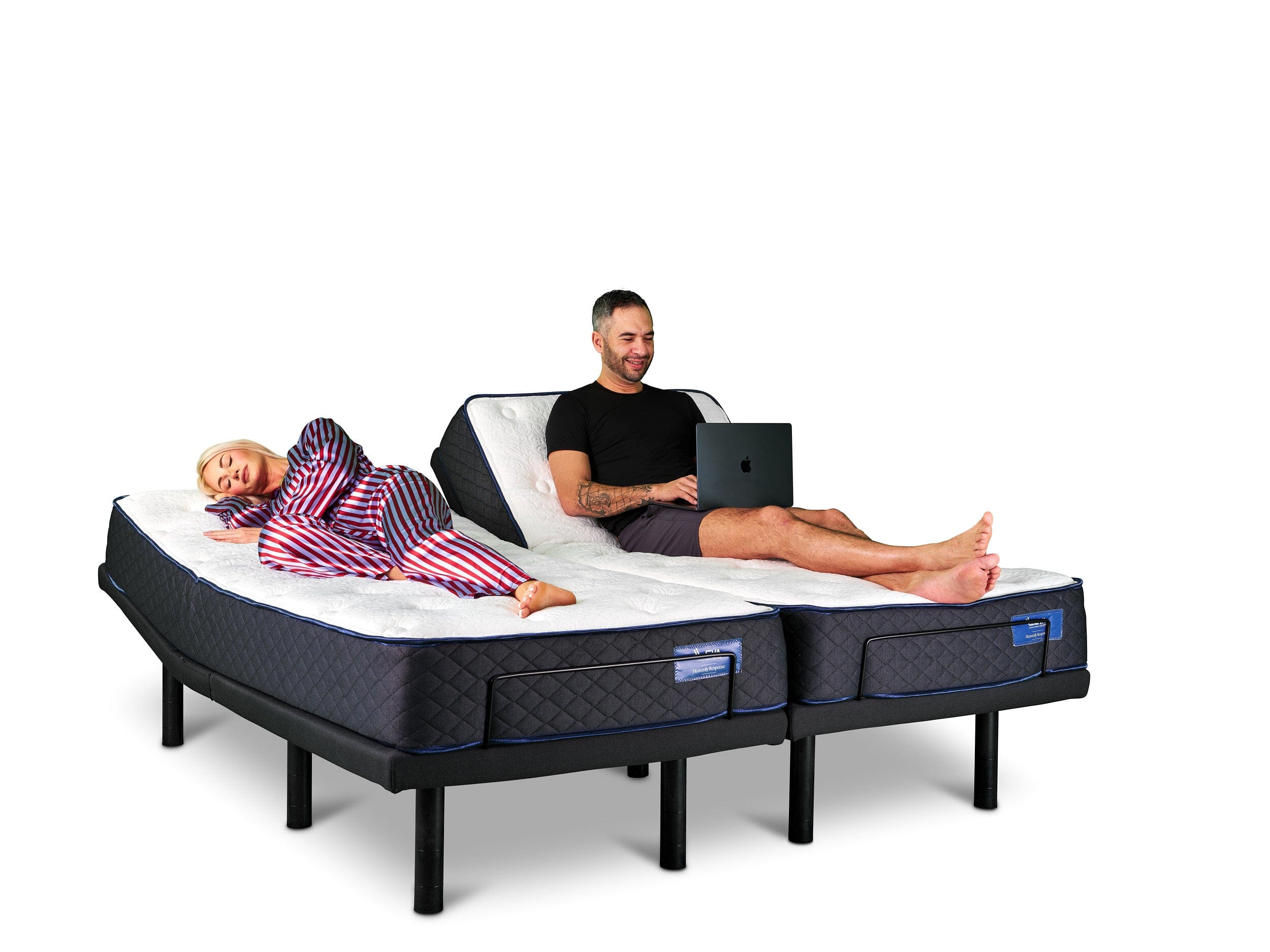
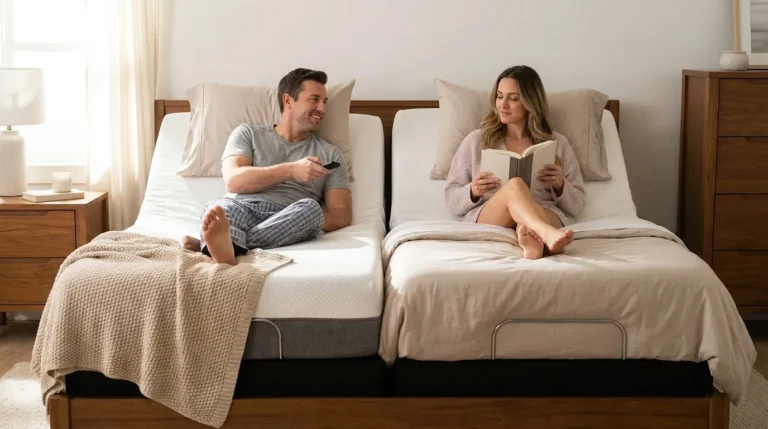
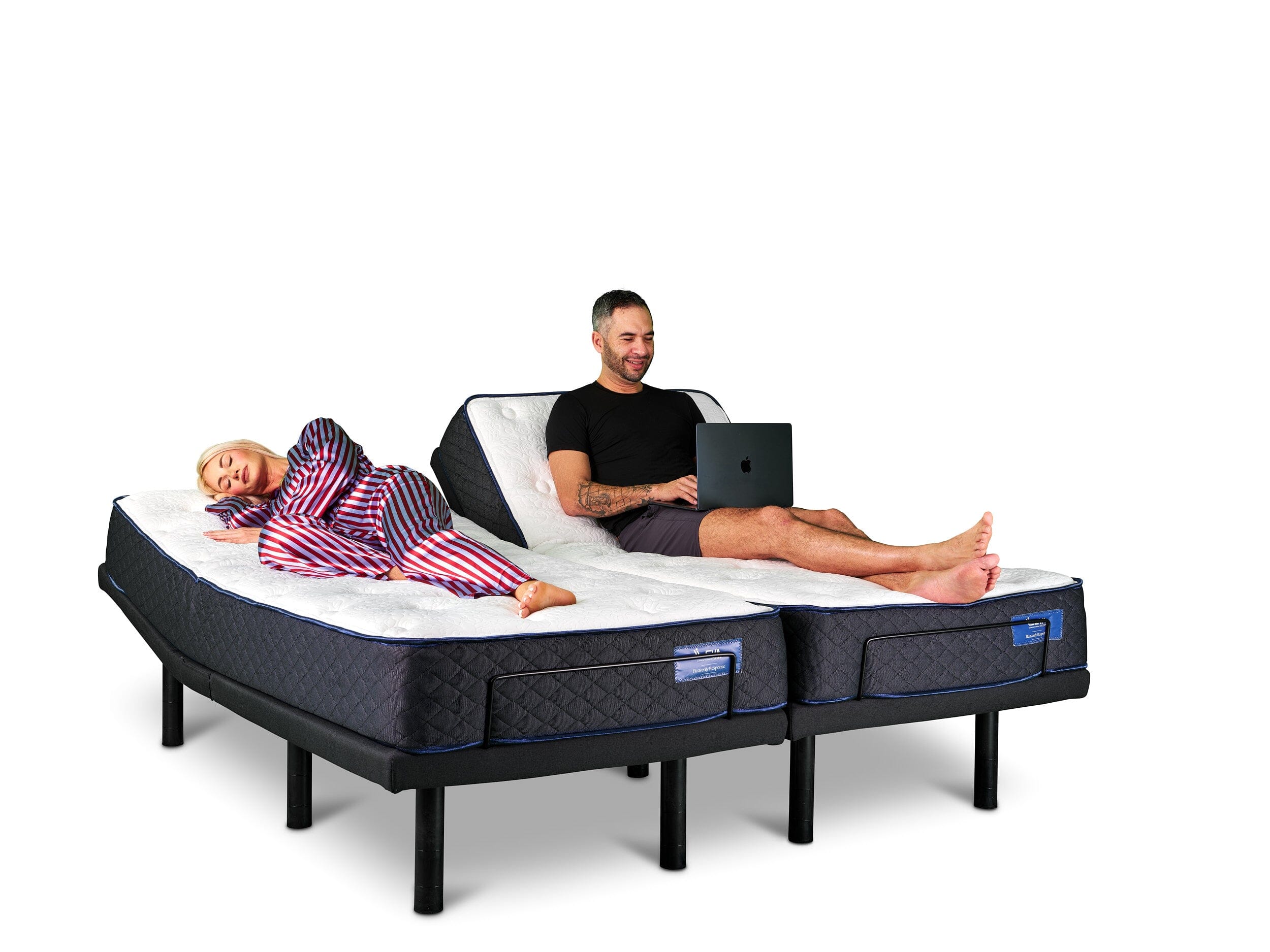
- Split-configuration adjustable beds let each partner raise or lower their own side, so one can ease snoring while the other stays flat.
- Anti-snore presets elevate the head 10–30 degrees, a range shown to reduce snoring and obstructive sleep apnea severity by about 32%.
- All-foam or pocket-coil hybrid mattresses flex safely on adjustable bases, while traditional connected-coil designs can buckle or wear out.
- Quiet German motors, deep-pocket reinforced sheets, and duvet clips help keep sleep peaceful and bedding in place.
- Leva Sleep offers both Split King and the rare Split Queen configurations with white-glove delivery across Ontario and Alberta, so you can explore split configurations for your bedroom without handling setup yourself.
The Problem: Sleep Divorce and Its Hidden Costs
Forty-six percent of adults who maintain separate bedrooms cite a partner’s snoring or other incompatible sleep habits, a pattern often called sleep divorce. Snoring drives much of this split. Estimates of snoring prevalence commonly range from 30–51% of men and 10–40% of women, with habitual snoring often around 40% of men and 24% of women, and up to 70% of snorers have been diagnosed with sleep apnea. In Canada, many adults aged 45 to 85 live with moderate to severe obstructive sleep apnea, yet only 6.4% reported a formal diagnosis in 2016–2017, so most cases remain unaddressed.
Couples also struggle with mismatched firmness preferences, different temperature needs, and medical elevation requirements for issues such as acid reflux, hip or knee pain, and post-surgery recovery. When these problems keep interrupting shared sleep, a full-system change often works better than another pillow, mattress topper, or pair of earplugs.
See how adjustable bases address sleep divorce
Why Traditional Snoring Solutions Fall Short for Couples
Flat beds offer no positional adjustment, so elevating one partner’s head usually means stacking pillows, which bends the neck and disrupts spinal alignment. Basic adjustable bases improve positioning but often use loud motors and jerky movements that wake the non-moving partner. CPAP machines treat sleep apnea clinically but involve masks, hoses, and nightly compliance that many people find difficult to maintain. Sleeping separately removes the disturbance but also removes the emotional and intimacy benefits of sharing a bed.
The table below shows how common approaches handle snoring and partner independence, highlighting why none alone provides a complete solution for couples.
| Solution | Addresses Snoring | Independent Partner Control | Key Limitation |
|---|---|---|---|
| Flat bed | No | No | No positional adjustment possible |
| Basic adjustable base | Partially | Only in split configurations | Noisy motors, limited features |
| CPAP machine | Yes (clinically) | N/A, individual device | Mask discomfort, nightly compliance burden |
| Separate sleeping | Eliminates shared disturbance | N/A | Harms intimacy and relationship harmony |
Compare Leva split systems for your situation
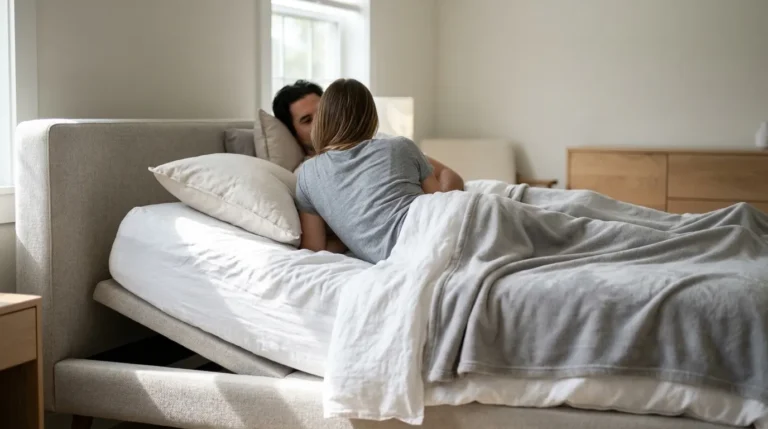
Adjustable Sleep Systems That Keep Couples in the Same Bed
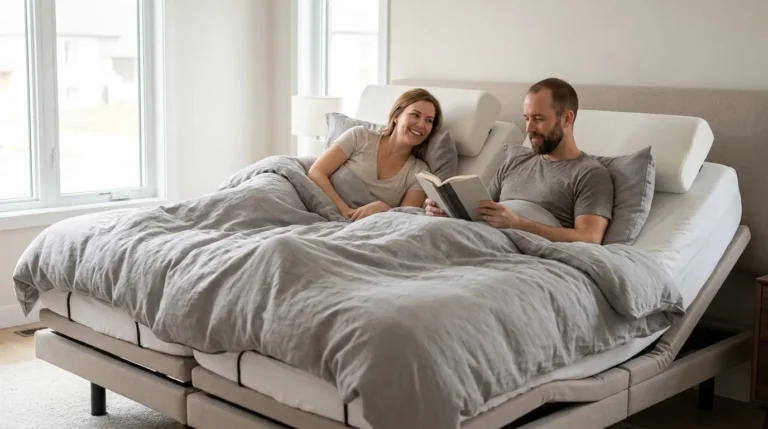
A purpose-built adjustable sleep system for couples combines a split-configuration base, independent controls, a compatible mattress, and bedding designed for movement. Each partner can adjust head elevation, foot elevation, massage intensity, and, on advanced models, temperature and lumbar support without affecting the other side. The anti-snore function raises the head section to between 10 and 30 degrees, the range sleep specialists recommend for snoring relief, and uses gravity to prevent the soft palate and tongue base from collapsing into the airway.
Among Canadian providers, Leva Sleep offers this type of system in two configurations suited to local bedrooms: Split King and Split Queen. The Split King pairs two Twin XL mattresses on dual bases for maximum personal width. The Split Queen, which Leva Sleep specialises in and few Canadian retailers carry, delivers the same independent adjustability in a standard queen footprint, so it fits smaller Ontario master bedrooms and condos.
Find the right anti-snore configuration
How to Evaluate the Best Adjustable Bed for Couples
Independent Adjustability for Each Partner
- Confirm each side has its own motor and controller, not a shared mechanism, because shared motors force both sides to move together.
- After confirming separate motors, verify the app or remote allows saving custom positions per partner, so each person returns to a favourite setup with one tap.
- Finally, check that one side can move without transmitting vibration to the other, since poor isolation can still disturb a sleeping partner.
Anti-Snore Detection and Elevation Mechanics
- Look for a dedicated anti-snore preset that raises the head to at least 10–15 degrees automatically, so you are not guessing at angles in the middle of the night.
- A 4-to-6-inch head raise corresponds to the 10–30 degree incline range, the clinically supported 10–30 degree range noted earlier.
- Advanced systems detect snoring through a microphone or vibration sensor and make small adjustments on their own, which keeps both partners asleep while the base works.
- Head-of-bed elevation reduces obstructive sleep apnea severity by an average of 31.8%, with a 30-degree angle decreasing the apnea-hypopnea index significantly in many patients studied.
Mattress Compatibility with Adjustable Bases
- All-foam mattresses are the most naturally compatible, because foam bends easily, returns to shape, and resists structural fatigue from repeated flexing.
- Hybrid mattresses work when they use individually wrapped pocket coils that move independently; avoid Bonnell or connected-coil systems that can kink on a moving base.
- Confirm mattress thickness is typically between 10 and 14 inches for proper articulation with adjustable beds.
- Verify both the mattress and base warranties explicitly permit adjustable-base use, so coverage stays intact.
Noise and Motor Quality During Adjustments
- Request decibel ratings or ask for a live demonstration before purchasing, because “whisper-quiet” claims can be subjective.
- During the demo, note whether the base uses German-engineered motors or precision-fabricated drive systems, which usually run quieter and smoother than budget actuators.
- Pay attention to whether the motor sound is a brief hum during adjustment or a continuous noise during sleep, since ongoing hums often signal a lower-quality system.
Bedding and Accessories That Stay Put
- Standard fitted sheets often pop off adjustable bases during elevation, so look for deep-pocket sheets with reinforced elastic.
- Duvet clips keep a shared duvet aligned across two independently moving sides.
- Remote pockets and mattress protectors designed for articulating surfaces help keep the system tidy and protected.
Temperature Regulation for Two Sleepers
- Confirm whether heating and cooling sit in the base pad or require a separate topper, since this affects cost and feel.
- Look for independent temperature zones per side if you and your partner run at different temperatures overnight.
Delivery and Setup Across Ontario and Alberta
- White-glove delivery that includes in-bedroom assembly, leg-height adjustment, and a product tutorial removes the setup burden common with bed-in-a-box models.
- Confirm the retailer serves your specific postal code in Ontario or Alberta before you place an order.
Real-World Outcomes for Couples
A couple where one partner snores and the other is a light sleeper can set the snorer’s side to a 20-degree head elevation while the other side remains flat. Both partners share the same bed and still get the positioning they need. A couple with one partner recovering from knee surgery can elevate the foot section on that side for medical positioning while the other side stays neutral. A couple with mismatched firmness preferences can pair a softer all-foam mattress on one side with a firmer pocket-coil hybrid on the other, each resting on the same split base.
These scenarios are not hypothetical; they reflect the real-world use cases Leva Sleep sees across its 25,000+ Canadian customers, including couples referred directly by sleep apnea clinics. Many of these couples had been sleeping in separate rooms for years before switching to a split adjustable system. The consistent result is uninterrupted shared sleep, less morning pain, and a calmer, more connected bedroom.
Split King vs. Split Queen: Configuration Comparison
The choice between Split King and Split Queen usually comes down to room size and how much personal space each partner wants. The table below compares both configurations on dimensions that matter most for Canadian buyers, including footprint, bedding cost, and availability.
| Feature | Split King | Split Queen |
|---|---|---|
| Overall dimensions | 76 in. × 80 in. (193 cm × 203 cm) | 60 in. × 80 in. (152 cm × 203 cm) |
| Width per sleeper | 38 in. | 30 in. |
| Minimum room size (Canada) | 12 ft. × 12 ft., recommended 13 ft. × 13 ft. | Smaller footprint, suits condos and standard Ontario master bedrooms |
| Independent controls | Yes, dual bases | Yes, dual bases |
| Bedding cost | Higher, king-size accessories | Lower, queen-size accessories generally less expensive |
| Canadian availability | Widely available | Specialist offering, Leva Sleep is among very few Canadian providers |
Frequently Asked Questions
Will an adjustable bed actually reduce my partner’s snoring?
Head elevation between 10 and 30 degrees uses gravity to keep the soft palate and tongue base from collapsing into the airway, which is the mechanical cause of most positional snoring. Clinical research supports the 31.8% reduction in apnea severity noted earlier, and a 30-degree angle has been shown to produce measurable improvements in the apnea-hypopnea index. Results vary by individual, and severe sleep apnea still requires assessment by a physician, but positional elevation offers a well-supported, non-invasive first step. Leva Sleep’s anti-snore mode, available on select models, detects snoring and makes automatic micro-adjustments to the head position without waking either partner.
What mattress works best with a Leva Sleep adjustable base?
All-foam mattresses are the most universally compatible because they flex in any direction and return to shape without structural fatigue. Hybrid mattresses with individually wrapped pocket coils also work well, provided the coils move independently rather than being connected by helical wires. Stick to the 10-to-14-inch thickness range mentioned in the evaluation criteria to ensure proper articulation. Leva Sleep designs its own all-foam and pocket-coil hybrid mattresses specifically for use with its adjustable bases and also carries compatible models from Tempur-Pedic, Simmons, Beautyrest, Serta, and Kingsdown. Always confirm that both the mattress and base warranties explicitly permit adjustable-base use before purchasing.
How noisy are adjustable bed motors during operation?
Motor noise varies significantly by build quality. Budget bases often use louder, less precise actuators that produce a grinding or whirring sound audible across the room. Higher-quality systems use precision-engineered motors, and Leva Sleep uses whisper-quiet German motors, which produce only a brief, low hum during position changes and remain silent during sleep. When evaluating any base, ask for a live demonstration at multiple elevation speeds and listen for grinding, clicking, or sustained noise after the motor stops. A motor that continues to hum after reaching the target position usually indicates a lower-quality drive system.
Is a Split Queen adjustable bed available in Canada, and how does setup work?
Split Queen adjustable beds remain rare in Canada, since most retailers stock only Split King configurations. Leva Sleep is one of the few Canadian providers building Split Queen systems to customer specifications, which makes them practical for couples in smaller bedrooms or condos where a king footprint will not fit. Setup runs through Leva Sleep’s white-glove delivery service, which includes in-bedroom assembly, leg-height adjustment, a full product tutorial, and removal of the old bed. This service removes the assembly burden typical of bed-in-a-box purchases and helps ensure the system is configured correctly from the first night.
Is an adjustable bed medically appropriate for sleep apnea?
Head elevation is a recognised form of positional therapy for mild to moderate obstructive sleep apnea and has clinical support. Sleep apnea clinics in Canada refer patients to adjustable bed specialists, including Leva Sleep, as a complementary or alternative approach for people who struggle with CPAP compliance. Adjustable bases do not replace a physician’s diagnosis or treatment plan for severe sleep apnea. For the many Canadians with undiagnosed or mild cases, nightly head elevation can still meaningfully reduce apnea events and snoring without a mask or hose. Always consult a sleep physician before changing or stopping any prescribed therapy.
Conclusion: Choosing the Right System for Shared Sleep
Sleep divorce caused by snoring and mismatched comfort preferences can be solved with the right setup. The key criteria include independent per-side controls, a clinically supported anti-snore elevation range, a compatible all-foam or pocket-coil hybrid mattress, quiet motors, and bedding designed for movement. Configuration choice usually depends on bedroom size, with Split King suiting larger rooms and Split Queen fitting standard or smaller spaces.
Leva Sleep brings over eight years of Canadian adjustable bed specialisation, $50M in lifetime sales, and more than 25,000 customers to this category. Its vertical integration, from in-house design and local assembly to white-glove delivery in Ontario and Alberta, closes gaps that general mattress retailers and bed-in-a-box brands often leave open. Couples receive a luxury-grade sleep system priced 30–50% below comparable luxury competitors, along with specialist guidance to match the right configuration to their specific needs.