Written by: Matthew Timmins, Founder and Managing Director, Leva Sleep | Last updated: July 2, 2026
Key Takeaways
- Independent head and foot articulation lets each partner adjust elevation without disturbing the other, which matters for couples with different sleep needs.
- Quiet, heavy-duty motors with strong duty-cycle ratings support smooth, near-silent movement and reliable performance during nightly adjustments.
- Lumbar and pillow-tilt zones, zero-gravity presets, and wall-hugger mechanics work together to support your back and neck while keeping nightstand items within reach.
- Split configurations, app-based anti-snore technology, and adequate weight capacity help Canadian couples manage snoring, personal sleep preferences, and safety.
- Leva Sleep offers premium adjustable bed packages with all ten must-have features, so you can explore Leva Sleep’s adjustable bed packages and compare configurations for your household.
Independent Head and Foot Articulation
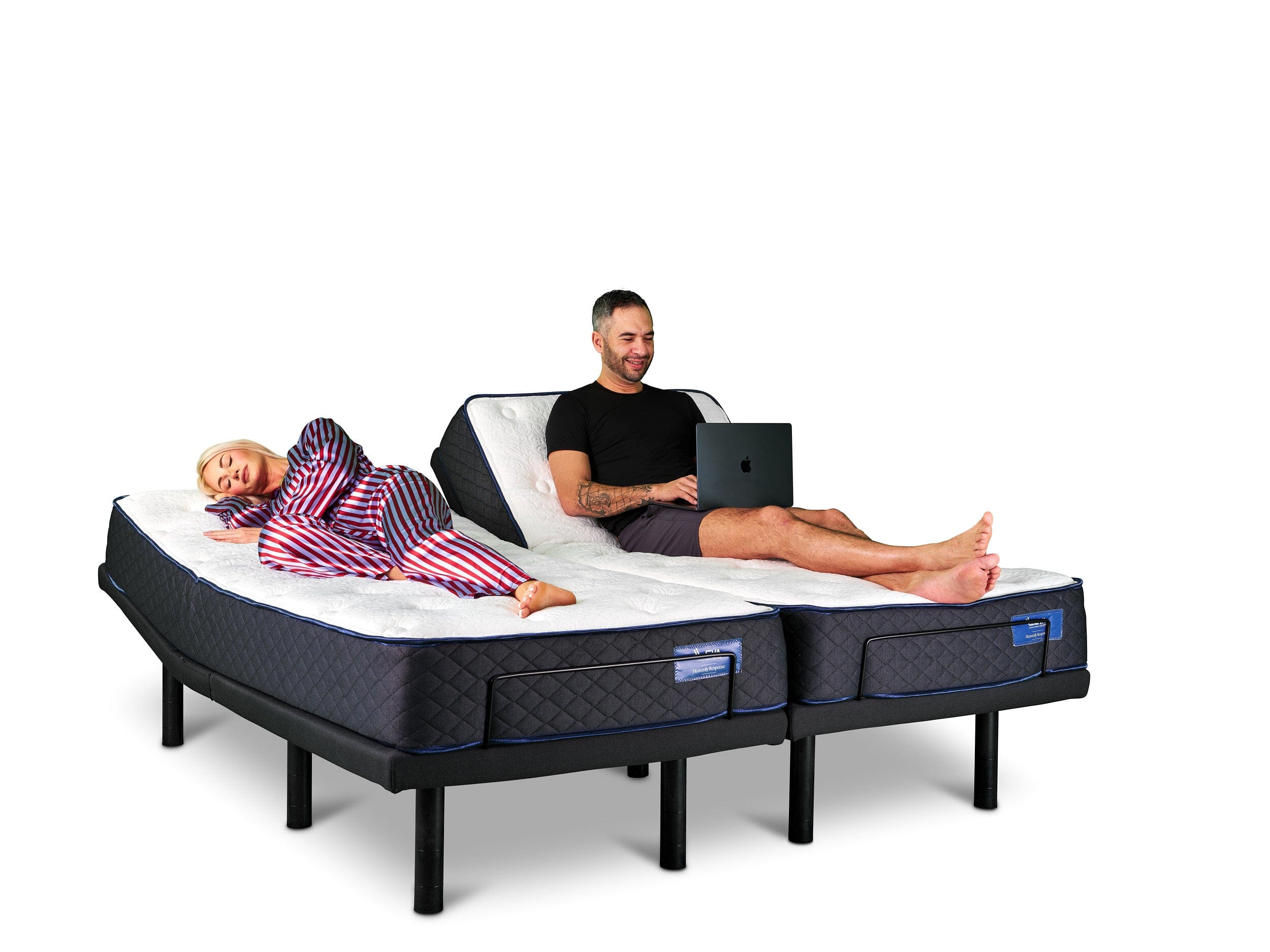
Independent head and foot movement defines a quality adjustable base. A base that only tilts as a single unit offers limited therapeutic value. Look for a head elevation range from flat to at least 60 degrees, and a foot elevation range from flat to about 45 degrees.
For couples, independent articulation lets one partner elevate the head to reduce snoring while the other lies flat. Check whether the motor controls allow small, precise adjustments or only jump between preset stops. Finer control gives more flexibility for medical positioning and comfort.
Scenario — snoring partner: A partner whose snoring wakes the other can raise the head section by 15 to 20 degrees to open the airway. With independent articulation on a split base, this adjustment affects only one side of the bed.
Quiet, Heavy-Duty Motors
Motor quality determines how comfortable those adjustments feel at night. Motor noise is one of the most common complaints about entry-level adjustable bases. A base that grinds or whirs during a 2 a.m. position change undermines the benefit of the adjustment. When you evaluate a base, ask the retailer for a live demonstration at low speed, since that is the speed most people use during the night.
Heavy-duty motors also influence how long the base lasts. Check the duty cycle rating, which states how many full articulation cycles the motor can perform before it needs service. A base used nightly by two people who adjust positions several times will accumulate cycles quickly, so a higher duty cycle rating usually means fewer service calls over the life of the base.
When you compare motors across brands, focus on three points. Start with the duty cycle rating, because it shows how many adjustments the motor can handle. Then look at the motor brand origin, since established manufacturers tend to publish clear data and handle warranty claims more reliably than generic suppliers. Finally, confirm that the motor warranty is separate from the frame warranty, because motors fail more often than frames and need their own coverage.
Lumbar and Pillow-Tilt Support Zones
Targeted support zones add comfort for people with back or neck issues. Standard adjustable bases move only at the head and foot. A higher-quality base adds a third zone, a lumbar lift that raises the lower-back region independently. This feature helps sleepers with chronic lower-back pain or those recovering from spinal procedures.
Pillow tilt uses a small secondary motor that angles only the top portion of the head section. This motion lets the neck flex slightly forward without raising the entire upper body. Pillow tilt works well for reading, watching television, or supporting the neck for sleepers who do not want full head elevation.
Scenario — post-surgery recovery: A person recovering from hip or knee replacement surgery may need the foot section elevated to reduce swelling while the lumbar zone supports the lower back. A base with only head and foot articulation cannot match this combination of support.
Zero-Gravity Presets and Saved Positions
Zero-gravity positioning places the body so the knees sit slightly above the heart and the head rests in a gentle incline. Engineers originally developed this position for astronaut re-entry comfort. It spreads body weight more evenly across the mattress surface and reduces pressure on the lumbar spine.
Finding your personal zero-gravity angle usually takes some trial and error. Memory presets become valuable once you dial in that position. They let you save a preferred angle and return to it with a single button press or app tap. Check how many presets a base stores per side, whether the app saves presets per user profile, and whether the base can return to flat automatically at a set time.
When you compare bases, confirm that the zero-gravity preset can be reprogrammed. Ideal angles vary by height, weight, and body proportions, so a fixed factory setting may not feel right for every sleeper.
Wall-Hugger Design for Small Canadian Bedrooms
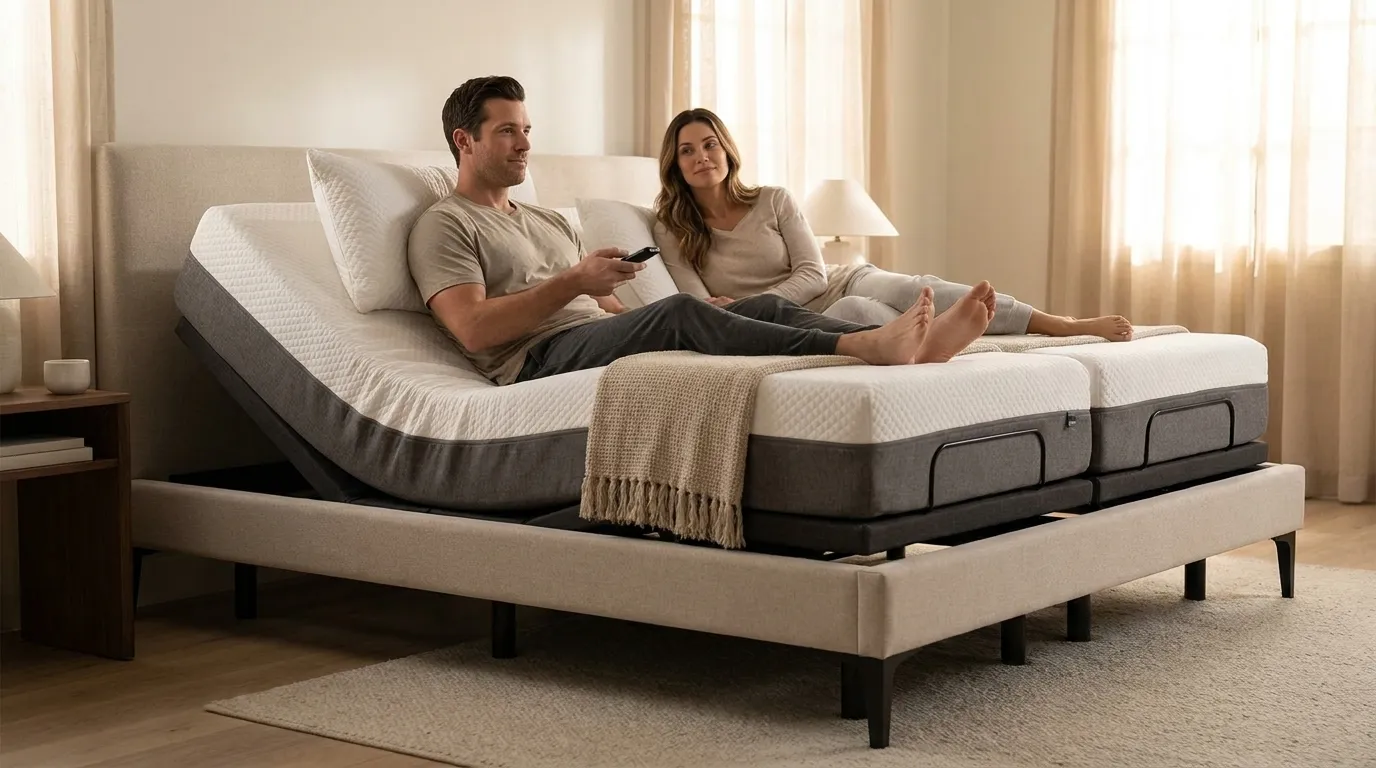
Wall-hugger mechanics keep you close to your nightstand as you sit up. A standard adjustable base slides the mattress backward as the head rises, which pushes you away from your lamp, phone, or glass of water. A wall-hugger mechanism moves the mattress forward as the head elevates, so you stay within easy reach of bedside items.
Space is often tight in Canadian condominiums and older homes. In these rooms, wall-hugger design also lets you position the base closer to the wall without the head section colliding with it during elevation. Before you buy, confirm the required clearance distance from the wall and make sure it fits your room layout.
Platform compatibility matters as well. Many Canadian platform beds and storage bases have no box-spring gap, so the adjustable base must sit flush on the platform. Verify that the base supports zero-clearance platforms. If it does not, you may need a separate foundation or a different bed frame.
Weight Capacity and Frame Strength Benchmarks
Weight capacity affects safety and long-term durability. Ratings on adjustable bases refer to the combined load of sleepers and mattress. A queen-size mattress alone can weigh between 45 and 70 kilograms, depending on construction. Two adult sleepers add significant extra load. For split configurations, always check the rated capacity per side, not just the total frame rating.
To see whether a base matches your household needs, compare its specifications to common market tiers. If a retailer labels a base as premium but its weight capacity or warranty looks closer to mid-range, treat that as a signal to ask more questions or consider other options. The table below outlines evaluation criteria across three tiers. Brand figures vary, so use these ranges as a benchmark when you request specification sheets.
| Specification | Entry-Level | Mid-Range | Premium |
|---|---|---|---|
| Weight capacity (per side, split) | 180–225 kg | 225–295 kg | 295–360 kg |
| Frame warranty | 1–3 years | 5–10 years | 10–20 years |
| Motor warranty | 1–2 years | 3–5 years | 5–10 years |
Steel gauge and weld quality drive long-term frame integrity. Ask whether the frame is welded or bolted at key stress points. Also confirm whether replacement parts are stocked locally in Canada, since local parts shorten repair times.
Split Configurations for Couples Who Sleep Differently
Split configurations give each partner full control over their side of the bed. A split configuration divides the base into two independent halves that share a bed frame but operate separately. Split King is the most common format. Split Queen uses two narrow twin XL equivalent halves within a queen footprint, which suits Canadian bedrooms where a king-size bed feels too large.
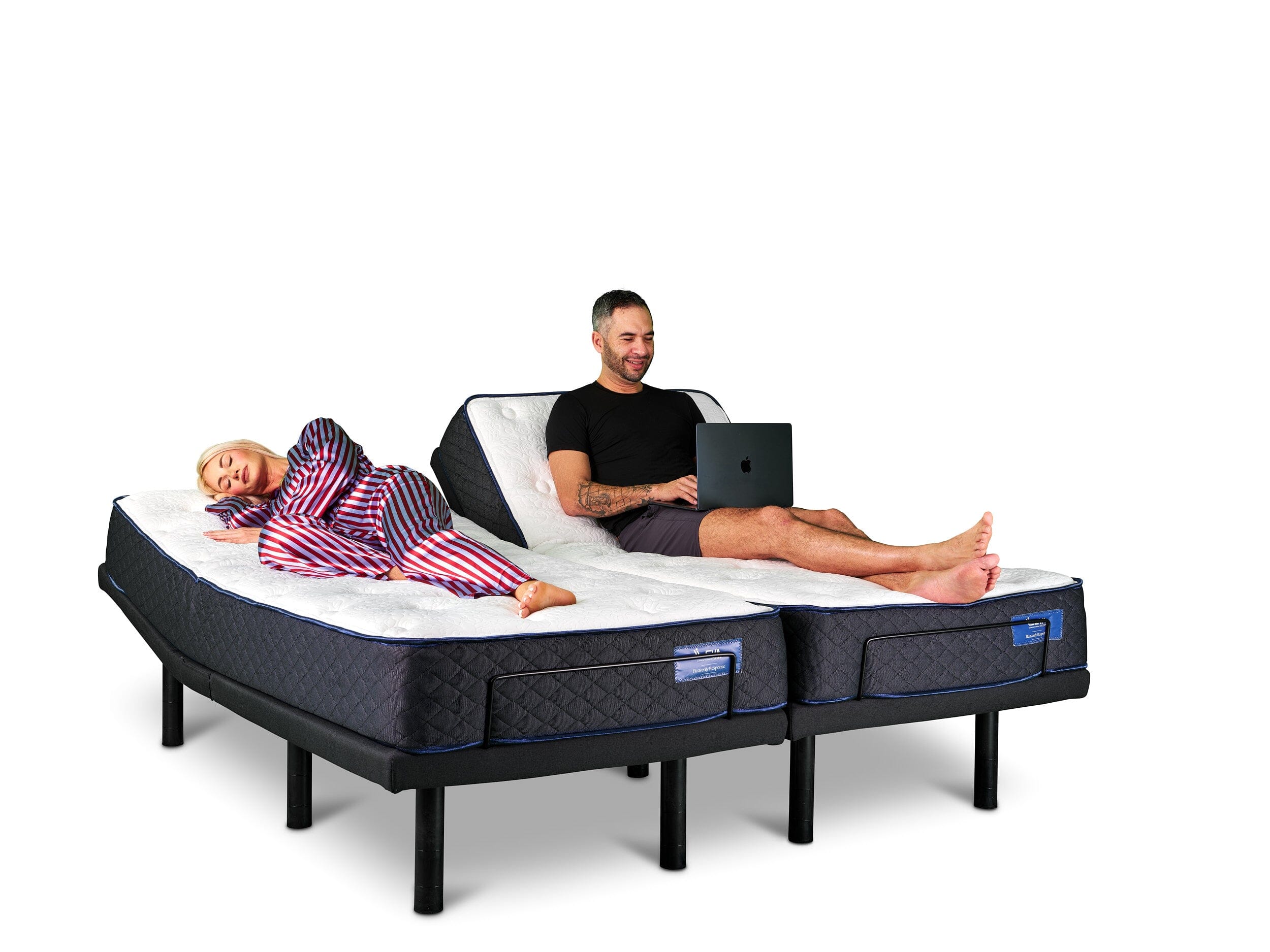
Comfort at the centre of the bed matters. Check whether a connector strap or fill cushion bridges the split gap, since a visible gap can bother a sleeper who moves toward the middle. Also confirm that the app or remote controls each side independently and that massage zones, if included, operate per side.
Split configurations often prevent sleep divorce, where partners move to separate rooms because their sleep needs conflict. Independent elevation, firmness, and temperature settings on each side reduce the need for compromise and help both partners stay in the same bed.
App Control and Anti-Snore Technology
Smart controls make nightly adjustments easier. Bluetooth or Wi-Fi app control lets a sleeper adjust position, activate presets, set a vibrating alarm, and on advanced models, monitor sleep data without reaching for a physical remote. Check whether the app works locally over Bluetooth or needs a constant internet connection. An app that fails during a late-night outage creates frustration.
Anti-snore technology adds automation for couples dealing with snoring. These systems use a microphone or vibration sensor to detect snoring sounds and then raise the head section by a small increment to shift the airway position. The movement stays subtle enough that it usually does not fully wake the snoring partner. When you compare models, review the sensitivity threshold, the maximum auto-elevation limit, and whether you can toggle the feature independently on each side.
Gentle head elevation can help reduce airway obstruction for some people with mild sleep apnea. This approach does not replace medically prescribed CPAP therapy. Anyone with a diagnosed condition should speak with a sleep physician before relying on positional changes alone.
Warranty Length and Local Service Support
Warranty terms only help when service is easy to access. A 20-year frame warranty from a brand with no Canadian service network often means a slow cross-border claims process. Ask whether the retailer stocks replacement parts in Canada, whether in-home service is available in your province, and how the claims process works from start to finish.
For Ontario and Alberta buyers, white-glove delivery simplifies setup. This service brings the base directly to your bedroom, includes full assembly, and covers leg-height adjustments so the bed matches your preferred height. The team connects and tests all motors, walks you through remote and app operation, and removes the old bed so you do not have to manage disposal.
Ask specifically about the motor warranty duration and whether it has separate coverage from the frame. Motors usually need service sooner than frames, so strong motor coverage protects the component most likely to fail within the first decade.
Specialized Bedding and Accessories for Adjustable Bases
Purpose-built bedding keeps the base comfortable in daily use. Standard fitted sheets are not designed for repeated flexing. As the head and foot sections rise and fall, conventional sheets often pull away from the corners and bunch under the sleeper. Look for sheets with deep pockets and reinforced elastic that are engineered for adjustable bases.
Accessories can turn a base into a complete sleep system. Useful add-ons include split-compatible duvet clips that keep a shared duvet aligned when each side sits at a different elevation, mattress protectors with four-way stretch fabric that move with the base, and remote or phone pockets that attach to the side rail. Together, these details help the entire setup function smoothly instead of feeling like a base paired with mismatched bedding.
Mattress compatibility matters just as much. Not every mattress flexes well with an adjustable base. All-foam and hybrid pocket-coil designs usually work. Traditional innerspring mattresses with interconnected coils do not, since the coil grid resists bending and can suffer damage from repeated articulation. Confirm compatibility and ideal mattress thickness with the retailer before you finalize your order.
Browse complete Leva Sleep systems with adjustable-base-compatible bedding and accessories.
Conclusion
A quality adjustable bed base should deliver independent head and foot articulation, quiet heavy-duty motors, lumbar and pillow-tilt zones, zero-gravity presets, wall-hugger mechanics, adequate weight capacity, split-couple configuration, app-based anti-snore control, a locally serviceable warranty, and compatible specialized bedding. A base that lacks more than one or two of these features usually involves trade-offs that show up within the first year.
Leva Sleep is a Canadian adjustable bed specialist with over eight years of experience, $50M in lifetime sales, and more than 25,000 customers across Ontario and Alberta. Its catalogue includes 15 to 20 adjustable base models, compared with the three to five models often found at general mattress retailers, and features the rare Split Queen configuration built to customer specifications. Direct-to-consumer vertical integration keeps pricing about 30 to 50 percent below comparable luxury competitors. Leva Sleep plans to release upcoming anti-snore AI in spring 2026. Ontario and Alberta customers can also choose white-glove delivery with in-bedroom assembly, leg-height customization, and old-bed removal for a complete, low-effort setup.
Use the ten-feature framework above to evaluate any base you consider. Then compare your shortlist against Leva Sleep’s current lineup to see how each model measures up.
Find your ideal adjustable base in Leva Sleep’s full catalogue.
Frequently Asked Questions
What is the difference between a split queen and a split king adjustable base?
A split king consists of two twin XL mattresses placed side by side on two independent bases within a king-size frame. Each half measures approximately 38 inches wide by 80 inches long. A split queen uses the same independent-base concept but fits within a queen-size footprint, which suits bedrooms where a king-size bed feels too large. Each half of a split queen is narrower than a twin XL. Split queen adjustable bases are rarer than split kings and are offered by select Canadian specialists. Both configurations let each partner control elevation, massage, and other settings independently without affecting the other side.
Can an adjustable bed base help with snoring and mild sleep apnea?
Elevating the head of the bed by 15 to 30 degrees can shift the position of the airway and reduce the soft-tissue collapse that causes snoring and contributes to mild obstructive sleep apnea. This positional change does not replace medically prescribed treatments such as CPAP therapy. Anyone with a diagnosed sleep apnea condition should consult their physician before relying on positional adjustment alone. For couples where one partner snores without a formal sleep apnea diagnosis, head elevation via an adjustable base offers a practical first step. Anti-snore technology on advanced bases automates this adjustment by detecting snoring sounds and raising the head section incrementally without fully waking the sleeper.
What type of mattress is compatible with an adjustable bed base?
All-foam mattresses, including memory foam and latex, and hybrid mattresses with individually wrapped pocket coils are generally compatible with adjustable bases because they flex without damaging internal components. Traditional innerspring mattresses with interconnected Bonnell or offset coils are not compatible, since the coil grid resists bending and can be damaged by repeated articulation. When you purchase an adjustable base, confirm mattress compatibility with the retailer before you finalize the order. Mattress thickness also matters. Very thick mattresses above about 35 centimetres can reduce the effective range of head and foot elevation because the extra material absorbs some of the movement.
What should I look for in white-glove delivery for an adjustable bed base in Canada?
White-glove delivery for an adjustable bed base should include delivery directly to the bedroom rather than curbside drop-off. The team should assemble the base and frame, adjust leg heights to match your preferred bed height, and connect and test all motors and app features. A brief product tutorial should cover remote and app operation so you can use every feature on the first night. The service should also include removal of the old bed. In Ontario and Alberta, confirm that the delivery team is employed or trained by the retailer rather than a generic courier, since adjustable bases require specific setup knowledge. Ask whether old-bed removal includes donation or recycling options and whether the team can reposition the base within the room during setup.
How do I evaluate the warranty on an adjustable bed base?
Evaluate the warranty by separating frame coverage from motor coverage, since these parts have different lifespans and failure patterns. A frame warranty of ten years or more provides a solid benchmark for a premium base. Motor warranties of five years or more show confidence in the drive system. Beyond duration, check whether the warranty is serviced within Canada, whether in-home service is included or you must ship components, and how the claims process works. A long warranty from a retailer without Canadian service infrastructure offers less real protection than a slightly shorter warranty from a local specialist with stocked replacement parts.