
Written by: Matthew Timmins, Founder and Managing Director, Leva Sleep | Last updated: July 9, 2026
Key Takeaways for Canadian Couples
- Sleep divorce is common among Canadian couples when snoring, pain, or differing firmness needs cannot be met by a traditional flat bed.
- Independent split configurations with premium motors allow each partner to adjust elevation without disturbing the other.
- Head-of-bed elevation at 4–6 inches or 10–30 degrees can significantly reduce snoring and obstructive sleep apnea symptoms.
- Zero-gravity and leg-elevation positions relieve back, hip, and knee pain while supporting post-surgical recovery when used correctly.
- Leva Sleep offers whisper-quiet German motors, Split Queen and Split King options, and white-glove delivery across Ontario and Alberta; shop Leva Sleep adjustable bed packages to find the right system for your needs.
Real-World Disadvantages of Adjustable Beds
Adjustable beds come with trade-offs that couples should understand before focusing on the benefits.
Motor noise and movement disruption. Basic adjustable bases use motors with loose tolerances that run audibly and move jerkily. Motor quality is the primary component where price correlates with longevity, and cheap motors run louder, wear faster, and fail sooner, with replacement costs of $300–$600 CAD.
Mattress incompatibility. Traditional innerspring mattresses with interconnected coils and a rigid border wire are too rigid for adjustable bases, will not flex correctly, and can damage the motor over time. Memory foam, latex, and hybrid mattresses using individually wrapped pocket coils are required.
Positioning errors. Occupational therapist Annie Schlecht cautions that “the biggest mistake is overdoing it, too much elevation, especially at the head, can strain the neck and disrupt breathing.” Erin Flynn-Evans, director of the Fatigue Countermeasures Laboratory at NASA Ames Research Center, also notes that forcing the body into a single fixed posture can create new discomfort, since movement during sleep is normal and helps redistribute pressure.
Setup complexity and delivery gaps. Bed-in-a-box delivery leaves assembly to the customer. For a system with independent motors, app connectivity, and height-adjustable legs, this creates a meaningful setup burden.
Given these drawbacks, evaluate any adjustable bed against four checkpoint questions that directly address the most common failure points.
- Does the base use German-engineered or equivalent premium motors with documented noise ratings to avoid motor quality issues?
- Is the mattress sold with the base, or must compatibility be verified separately to prevent mattress and motor damage?
- Does the retailer offer in-home assembly and setup, or curbside drop-off only, which shifts the complexity to you?
- What is the warranty term, and is service handled domestically so repairs are practical over the long term?
How Adjustable Beds Actually Help With Snoring
Head-of-bed elevation reduces snoring by limiting the gravitational collapse of soft tissue in the airway. Raising the head 4 to 6 inches is generally sufficient to reduce snoring volume and frequency almost immediately, and most sleep specialists recommend 10 to 30 degrees of elevation depending on severity.
Clinical evidence supports this mechanism for obstructive sleep apnea. A pilot study found that head-of-bed elevation at 20 degrees stopped snoring more often than at smaller angles, without reducing subjective sleep quality. A separate multicenter observational study found that head-of-bed elevation reduced apnea-hypopnea index events per hour and was described as a low-cost, well-tolerated positional therapy.
These findings apply to individual sleepers, yet couples often face a different challenge. One partner may need elevation for snoring or apnea while the other prefers a flat surface. For couples, the critical feature is independent elevation. A split king configuration allows one partner to use an anti-snore incline while the other sleeps flat, with motion isolation preventing disturbance. Leva Sleep offers an anti-snore mode that detects snoring and makes micro-adjustments to the head of the bed automatically via app control, which addresses the problem without requiring the snoring partner to wake and reposition manually.
One important limitation remains. Head elevation addresses obstructive sleep apnea by reducing gravitational airway collapse but does not resolve central sleep apnea, which stems from brain signaling failure rather than positional obstruction. Couples where one partner has a diagnosed central sleep apnea condition should consult a physician before relying on positional therapy alone.
Adjustable Beds for Hip Surgery Recovery and Joint Pain
Many people with back, hip, or knee pain use adjustable beds to change how their body loads pressure during the night. Orthopedic physical therapist Karena Wu, P.T., D.P.T., recommends that individuals with lower back pain evaluate adjustable beds for leg elevation to relieve pressure on the pelvis, combined with zero-gravity positioning to relieve pressure on the backbone. For those with swelling and leg pain, she advises prioritizing leg elevation to reduce pressure on the pelvis and backbone.
The Zero Gravity position, where the head and legs rise above heart level, provides spinal decompression, reduced muscle tension, and enhanced oxygenation. For specific conditions, adjustable beds are most effective for spinal stenosis via semi-Fowler flexion, sciatica and herniated discs via 15–30 degree knee elevation to relax the hamstrings, and degenerative disc disease or osteoarthritis.
Post-surgical recovery, including hip replacement, often requires sleeping in an elevated position to reduce joint stress and swelling. Karena Wu also notes that individuals with spinal fusion or osteoporosis should avoid adjustable beds, as improper positioning can worsen these conditions. Physician consultation before purchase is essential for post-surgical patients.
Use this quick self-assessment before choosing a base for pain or recovery needs.
- Has a physician or physiotherapist recommended a specific elevation angle or position?
- Does the base offer programmable Zero Gravity and leg-elevation presets?
- Is lumbar support adjustable independently from head and foot elevation?
- Does the base accommodate the mattress thickness required for post-surgical comfort?
Split Adjustable Beds That Keep Both Partners Comfortable
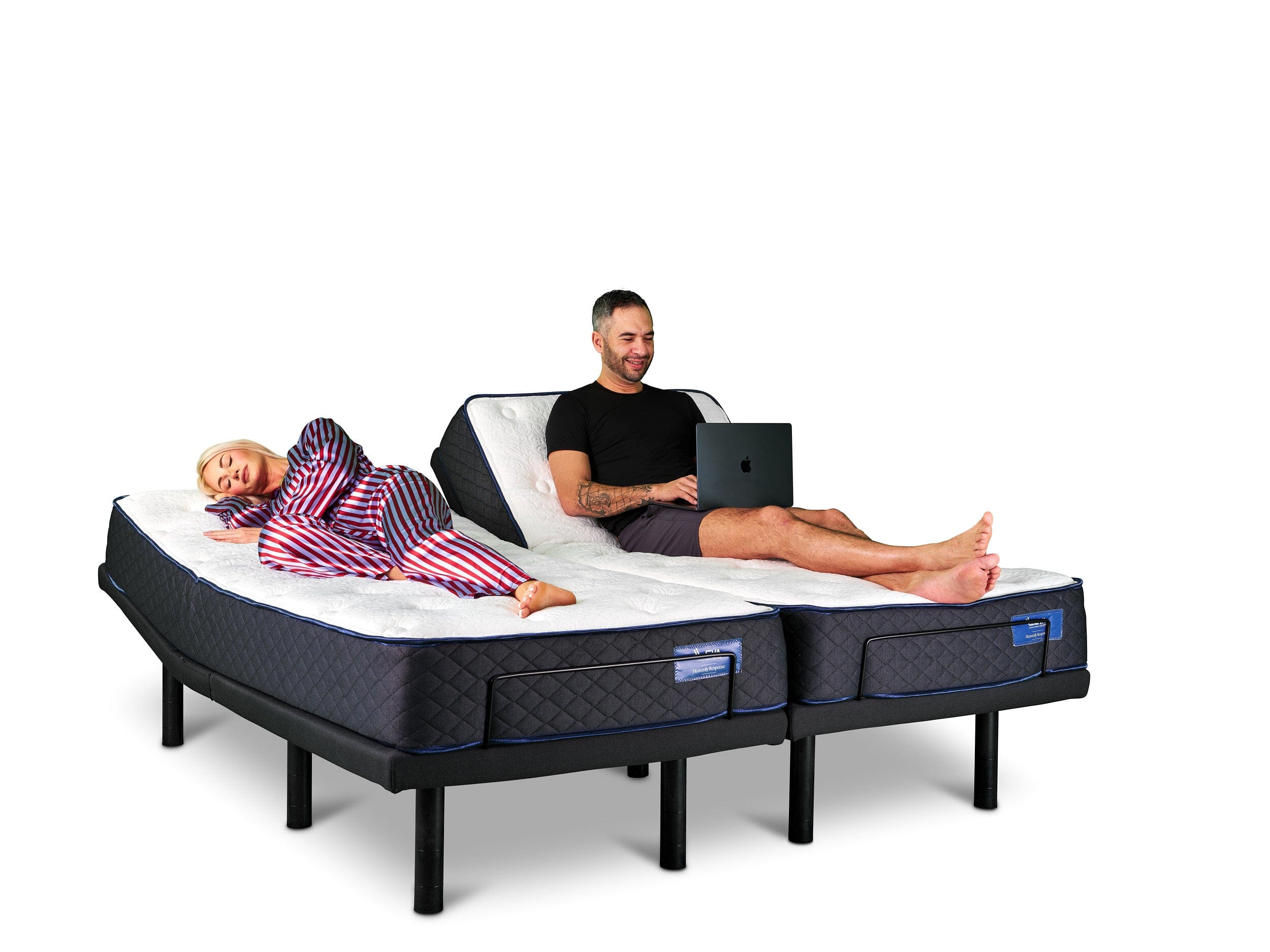
A split adjustable base divides the bed into two independently controlled zones. Each partner sets their own elevation, massage intensity, and, on higher-end models, firmness and temperature without affecting the other side. This configuration is the only one that reliably resolves sleep divorce caused by differing medical or comfort needs.
Split King is the most widely available format and uses two Twin XL mattresses side by side. Leva Sleep also offers Split Queen, a rarer configuration that provides independent adjustability in a smaller footprint and is built to customer specifications. For couples in standard-sized bedrooms where a King is impractical, Split Queen becomes a practical alternative.
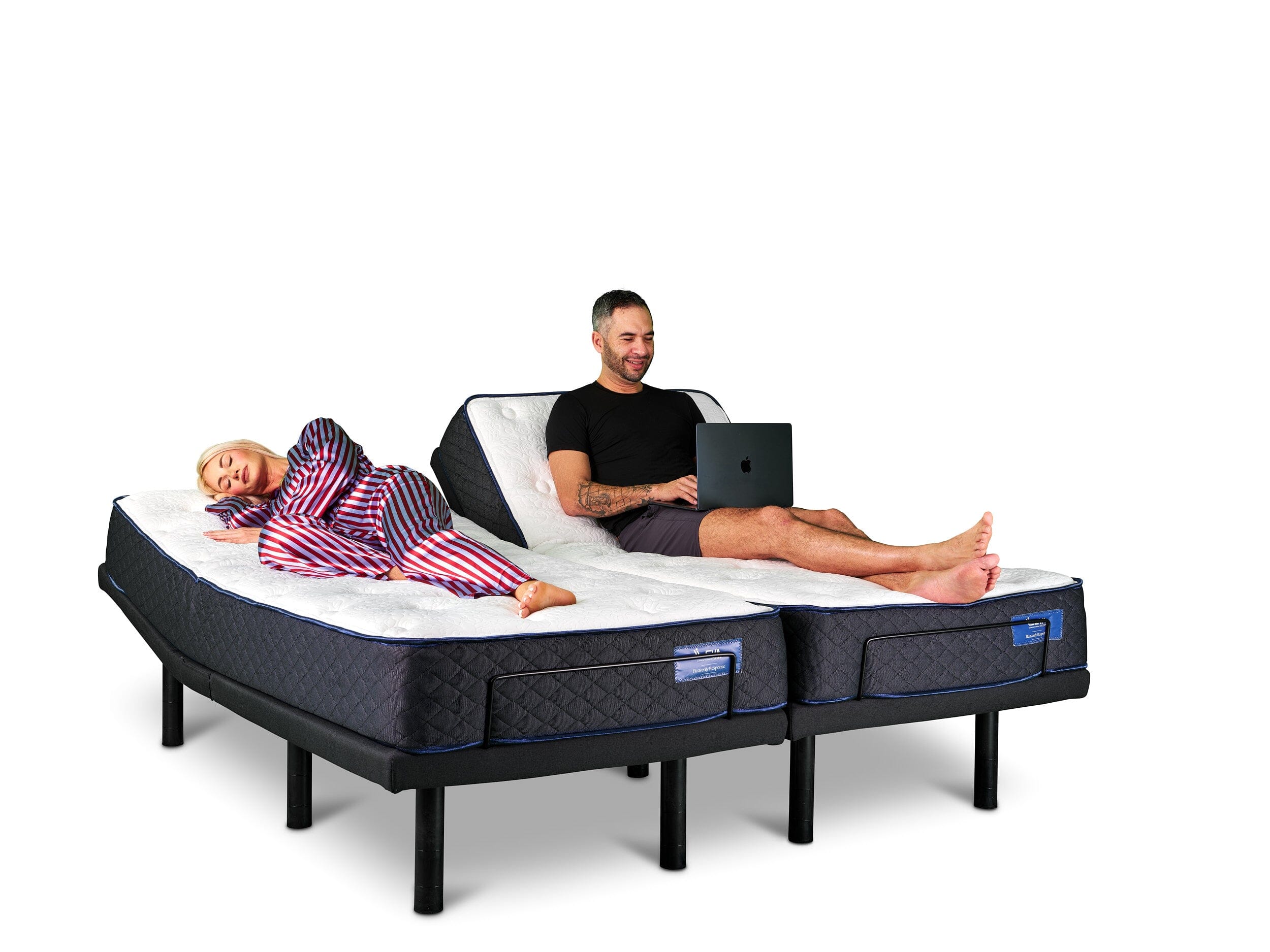
Motor quality determines whether independent adjustment feels truly non-disruptive. Leva Sleep’s whisper-quiet German motors use tighter tolerances and slower operating speeds, the premium engineering characteristics discussed earlier that eliminate the noise and durability issues common in budget bases. Full app control via Bluetooth allows custom sleep position presets, vibrating alarms, and the upcoming anti-snore mode, all operable without disturbing a sleeping partner.
With over 8 years in operation, $50M in lifetime sales, and 25,000+ customers, Leva Sleep’s track record provides the reliability evidence that couples making a long-term investment require. Shop Leva Sleep’s adjustable beds to explore Split Queen and Split King configurations with independent controls.
Mattress and Bedding Choices That Work on Adjustable Bases
Foam, latex, or hybrid mattresses with pocket coils under 14 inches thick are compatible with adjustable bases. As noted in the disadvantages section, only these flexible designs work well, because they avoid the interconnected-coil problem that can strain and damage motors.
Leva Sleep designs its own all-foam and hybrid pocket-coil mattresses specifically for use with its adjustable bases, which removes the compatibility guesswork that arises when purchasing a base and mattress from separate retailers. For couples who prefer established brands, Leva also carries Tempur-Pedic, Simmons, Beautyrest, Serta, and Kingsdown mattresses paired with its bases.
Standard bedding often fails on adjustable bases. Fitted sheets can pop off during elevation cycles, and duvets bunch when partners use different angles. Leva’s bedding accessories, including fitted sheets with deep pockets and extra elastic, duvet clips for split configurations, and mattress protectors, are engineered for this specific use case.
White-glove delivery in Ontario and Alberta includes bedroom delivery, full assembly, leg-height adjustment, product tutorial, and removal of the old bed through donation or recycling. This service removes the setup burden that makes bed-in-a-box purchases frustrating for large, complex systems.
Canadian Cost Breakdown for Adjustable Beds
The table below reflects realistic CAD ranges based on available market data. All figures are estimates, and actual pricing varies by retailer, configuration, and delivery zone.
| Cost Component | Entry-Level Range (CAD) | Mid-Range (CAD) | Premium / Competitor Range (CAD) |
|---|---|---|---|
| Adjustable Base (per side, split) | $895–$1,100 | $1,250–$2,000 | $2,499+ |
| Compatible Mattress (per side) | $600–$900 | $900–$1,800 | $1,800–$4,000+ |
| Specialized Bedding & Accessories | $100–$200 | $200–$400 | $400–$700 |
| White-Glove Delivery & Setup | $0–$300 | $200–$400 | $300–$600 |
| Old Bed Removal | Not typically included | Varies by retailer | Included at Leva Sleep |
A base selling for $600 USD in the US typically costs $850–$1,000 CAD in Canada due to currency exchange, import duties, and retail markup, so US-based price comparisons consistently understate Canadian total cost. Leva Sleep’s direct-to-consumer model, which removes retail middlemen, delivers 30–50% savings versus comparable premium competitors at equivalent feature levels.
Use this decision checkpoint to compare total cost of ownership accurately.
- Are you comparing CAD prices, or converting US figures that exclude duties and markup?
- Is white-glove delivery and old-bed removal included, or priced separately?
- Does the quoted price include a compatible mattress, or only the base?
- What is the warranty term, and is service handled by a Canadian team?
Warranty, Service, and Delivery Across Ontario and Alberta
Warranty coverage only helps when service is accessible where you live. Consumer adjustable beds typically carry manufacturer warranties of 20–25 years on the base, with shorter full-coverage periods for certain parts such as motors. For Canadian buyers, the critical question is not the printed term but who handles service when a motor or remote fails.
Retailers that ship from US warehouses or use third-party logistics often leave Canadian customers without accessible service channels. Leva Sleep handles delivery, assembly, and warranty service in-house across Ontario and Alberta, with trained professionals who perform on-site setup, height adjustment, and product tutorials at delivery. This structure differs from bed-in-a-box brands, where post-purchase support usually stays limited to remote troubleshooting and parts shipping.
For couples making a 7–10 year investment in a split adjustable system, in-house Canadian service functions as a risk-management safeguard rather than a luxury feature.
Frequently Asked Questions
What do studies show about adjustable beds and obstructive sleep apnea?
Clinical evidence consistently shows that head-of-bed elevation reduces the apnea-hypopnea index in patients with obstructive sleep apnea. The pilot and multicenter studies described earlier found that moderate elevation angles reduced events per hour and were well tolerated as positional therapy. Additional research, including a 2017 study of 52 patients, reported that 7.5 degrees of elevation reduced AHI from 15.7 to 10.7 events per hour, a 32% reduction, and improved minimum oxygen saturation from 83.5% to 87%. This mechanism applies specifically to obstructive sleep apnea, where gravitational airway collapse is the primary driver. Central sleep apnea, which originates from brain signaling rather than positional obstruction, is not addressed by elevation. Patients with diagnosed sleep apnea should consult a physician before substituting positional therapy for prescribed treatment.
Can adjustable beds help after hip replacement surgery?
Adjustable beds can support post-hip-surgery recovery by enabling elevation of the legs to reduce joint swelling and pressure, and by allowing the patient to move from lying to seated without twisting the hip joint. Zero Gravity positioning, where the head and legs rise above heart level, distributes body weight more evenly and reduces pressure on the surgical site. However, the appropriate elevation angle and positioning protocol depend on the specific surgical approach and the surgeon’s post-operative instructions. Patients should confirm recommended positioning with their orthopaedic surgeon or physiotherapist before selecting a base. Individuals with spinal fusion or osteoporosis are generally advised to avoid adjustable beds, as improper positioning can worsen these conditions.
Are adjustable beds noisy?
Motor noise varies significantly by price tier and engineering quality. Entry-level and unbranded bases use motors with loose tolerances that operate audibly and can wake a sleeping partner during adjustment. Premium motors, including German-engineered units, use tighter tolerances, slower operating speeds, and higher-quality bearings that produce substantially less noise. For couples using split configurations where one partner adjusts position while the other sleeps, motor noise becomes a practical concern rather than a minor inconvenience. When evaluating a base, ask the retailer for a live demonstration of motor operation at the elevation speeds used for anti-snore and Zero Gravity adjustments, not just at maximum speed.
What mattress types work with adjustable bases?
Compatible mattress types include all-foam (memory foam and polyfoam), latex, and hybrid mattresses using individually wrapped pocket coils. These materials flex with the base through full elevation cycles without losing structural integrity. Traditional innerspring mattresses with interconnected Bonnell coils and a rigid border wire are not compatible, because they resist bending, which strains the motor and can cause premature failure. Mattress thickness also matters. Mattresses over 14 inches thick may limit the effective elevation angle and add resistance to the motor. For split configurations, each side requires its own mattress sized to the split format, such as two Twin XL mattresses for a Split King or custom-sized mattresses for a Split Queen.
Conclusion: Matching an Adjustable Bed to Your Sleep Problems
Canadian couples need evaluation criteria that go beyond generic US-focused feature lists. Independent adjustability in a split configuration forms the foundation for couples with differing medical or comfort needs. Motor quality determines whether that adjustability remains quiet and smooth. Mattress compatibility should be confirmed before purchase, not after delivery. CAD total cost of ownership, including mattress, accessories, delivery, and warranty service, must be calculated in full rather than derived from converted US prices. In-house Canadian service then determines whether the investment holds its value over a 7–10 year ownership cycle.
Leva Sleep’s split adjustable systems address each of these criteria with whisper-quiet German motors, Split Queen and Split King configurations with independent app control, mattresses and bedding designed for adjustable bases, white-glove delivery and old-bed removal across Ontario and Alberta, and pricing 30–50% below comparable premium competitors through direct-to-consumer vertical integration.
Shop Leva Sleep’s adjustable beds to find the split configuration that fits your bedroom size, medical needs, and budget, and start sleeping in the same bed again.