
Written by: Matthew Timmins, Founder and Managing Director, Leva Sleep | Last updated: July 23, 2026
Key Takeaways
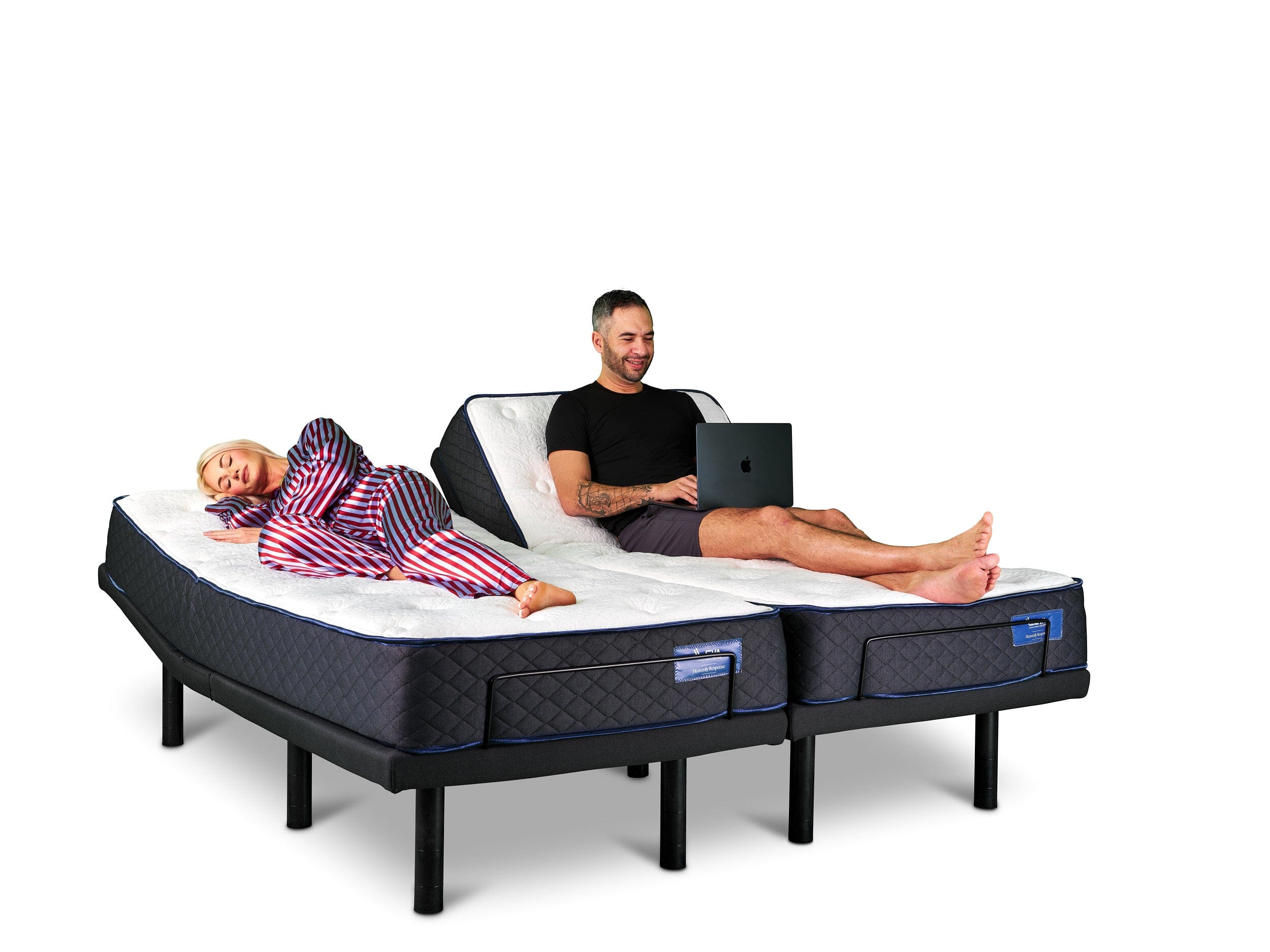
- Split Queen adjustable beds share the standard 152 cm × 203 cm Queen footprint, so they suit most Canadian bedrooms without crowding the space.
- Split King configurations need a larger room, at least 350 cm × 370 cm, and usually cost more because they use Twin XL halves.
- Independent per-side adjustability on Split Queen or Split King bases lets couples manage reflux, snoring, and comfort differences without waking a partner.
- Leva Sleep’s anti-snore mode detects snoring and makes micro-adjustments automatically, and this feature is available on its Split Queen base.
- Shop Leva Sleep’s adjustable bed packages to compare Split Queen and Split King options designed for Canadian couples.
Choosing a bed size for two people
A Queen mattress measuring 152 cm × 203 cm is the most common Canadian bed size, accounting for roughly 40% of all mattress sales in Canada, and it suits most couples and most bedrooms as the space-efficient default choice. It provides each partner with approximately 30 inches (76 cm) of personal width.
A King mattress at 193 cm × 203 cm provides each partner with 38 inches (96.5 cm) of personal width and works well for active sleepers, couples with pets, or rooms at least 366 cm × 366 cm. The Canadian Sleep Society identifies partner motion transfer as one of the most common causes of nighttime wake-ups in couples, and larger or split configurations can reduce that disruption.
Couples with different sleep needs benefit most from a split configuration on either a Queen or King base. Independent adjustment lets each person set their own elevation, firmness, or temperature without compromise. Shop Leva Sleep’s adjustable beds to compare Split Queen and Split King packages side by side.
How bed size affects couples’ sleep
Larger beds reduce motion disruption for couples, providing roughly 34 inches per person in a Queen and 38 inches per person in a King. Bed size alone does not determine sleep quality, though. The Sleep Charity advises that couples select a mattress offering the correct support and comfort for each partner’s individual weight and build. A mattress that is too soft causes slouching, while one that is too firm creates pressure on hips and shoulders.
Independent adjustability, not raw width, usually matters more for couples with medical or comfort differences. A Split Queen base delivers that independence within a standard Queen footprint, so it becomes the practical choice for most Canadian bedrooms.
Split King vs Split Queen in Canada
Independent adjustability now sits at the centre of the decision, so the next step is to compare how Split Queen and Split King configurations differ in size and room fit. The table below uses Canadian measurements, and all dimension data comes from published Canadian mattress standards.
| Factor | Split Queen | Split King | Recommended Room Size |
|---|---|---|---|
| Combined footprint | 152 cm × 203 cm | 193 cm × 203 cm | – |
| Each half | 76 cm × 203 cm | 96.5 cm × 203 cm | – |
| Independent adjustability | Yes, per side | Yes, per side | – |
| Minimum room size | 305 cm × 366 cm | 350 cm × 370 cm | Split Queen fits more Canadian bedrooms |
| Fits standard Queen frame | Yes | No, requires King frame | – |
A Split King adjustable bed needs extra clearance behind the headboard for head elevation, which pushes the total recommended room size to the 350 cm × 370 cm minimum noted in the comparison above. This requirement often surprises buyers.
As Brad Grose, owner of Mattress Miracle with more than 40 years of experience, explains, “The most common mistake we see is people buying a king for a bedroom that’s really a comfortable queen room. They get it home, it fits, technically, but there’s no room to walk around it and the room feels like a mattress storage unit.”
Adjustable bed sizing for reflux and snoring
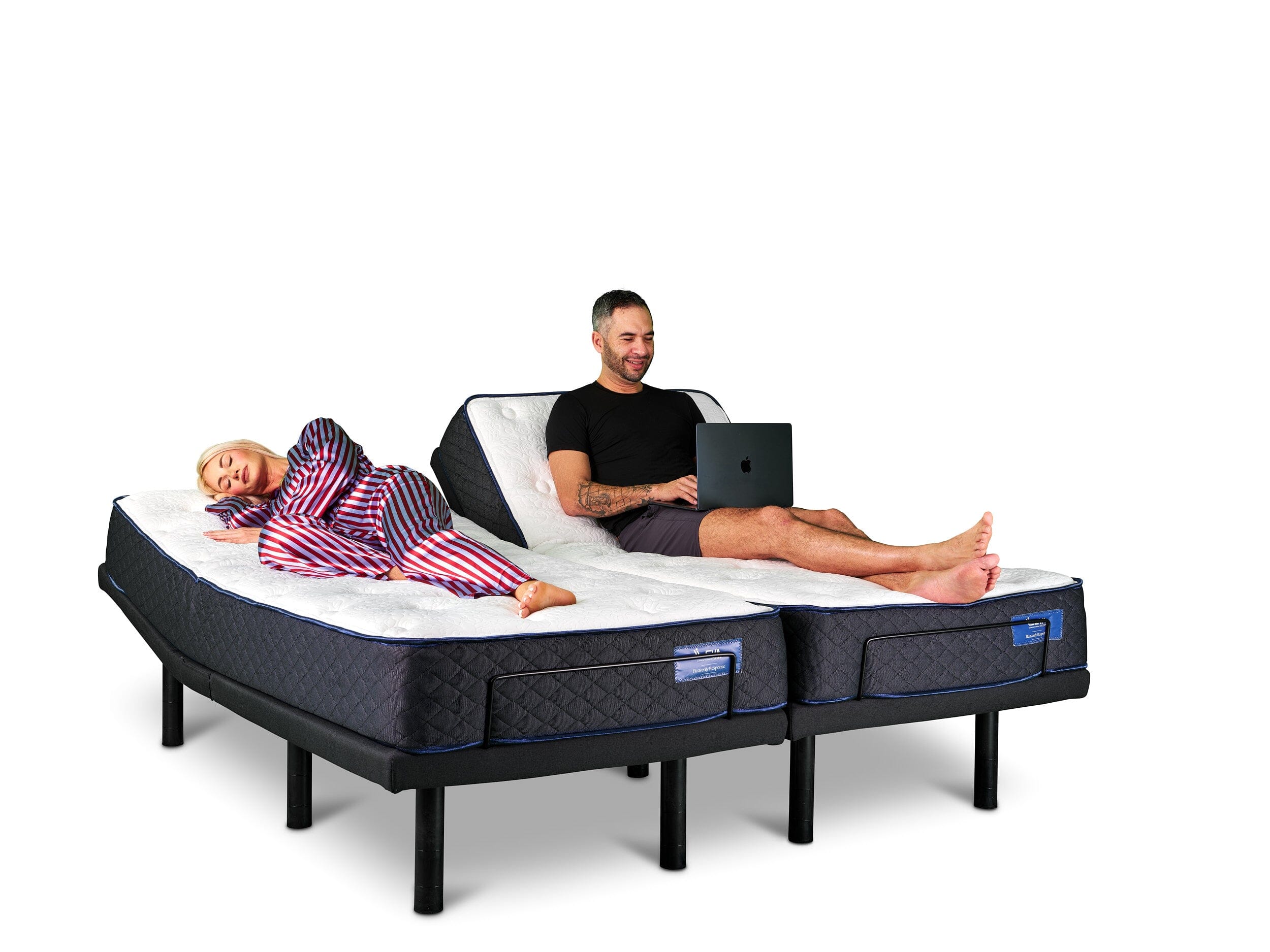
Head elevation is the primary mechanical intervention an adjustable base provides for both acid reflux and snoring. A split adjustable bed configuration lets each side adjust independently, so one partner managing sleep apnea can sleep with head elevation while the other rests flat. Mattress Clarity notes that studies show adjustable beds can improve overall sleep quality and may help relieve pain from certain conditions, with split setups enabling independent head and foot adjustment so one partner can use anti-snore positioning without affecting the other.
Leva Sleep’s anti-snore mode builds on this benefit. The system detects snoring and makes micro-adjustments to the head of the bed automatically, without waking either partner. Whisper-quiet German motors keep those adjustments almost unnoticeable. This feature is available on Leva’s Split Queen base, so couples in standard Queen-sized rooms can access it without upsizing to a King.
When evaluating any adjustable base for reflux or snoring, consider these criteria in order of impact.
- Does each side adjust independently, so the non-snoring partner is undisturbed? Independent adjustment forms the foundation, because any elevation change otherwise affects both sleepers.
- Does the motor operate quietly enough not to cause a secondary disturbance? Even with independent sides, a loud motor can still wake the non-adjusting partner.
- Is head elevation smooth and incremental rather than jerky? Abrupt movements can trigger the same sleep disruption you are trying to prevent.
- Does the base include an anti-snore or auto-adjust mode? Automatic detection removes the need for either partner to wake up and manually adjust the base.
Shop Leva Sleep’s adjustable beds and filter by the anti-snore feature to find the right package for your needs.
Canadian bedroom sizes and bed fit
Condominiums and townhomes in Canada typically feature primary bedrooms at the smaller end of the functional range, from 305 cm × 366 cm to 366 cm × 396 cm. Primary bedrooms in one-bedroom Ontario condos usually fall within 305 cm × 366 cm to 366 cm × 427 cm and comfortably accommodate a Queen mattress, while a King fits only tightly in the largest layouts.
In new Ontario construction, primary bedrooms often measure around 366 cm × 427 cm, which makes a King or Split King viable for many homes. Use the decision flowchart below to match your room size with the right configuration.
Bedroom-size decision flowchart
- Measure your bedroom’s shortest wall. Is it 370 cm or wider?
- No → A Split King will not fit with adequate clearance. Proceed to step 2.
- Yes → Measure the longest wall. Is it 350 cm or longer? If yes, a Split King is viable. If no, proceed to step 2.
- No → A Queen is the maximum practical size. A Split Queen adjustable base fits within the standard Queen footprint.
- Yes → A Split Queen fits comfortably with nightstands and walking clearance on both sides.
- Yes → A split configuration, Split Queen or Split King depending on room size, is the recommended choice.
- No → A standard Queen or King adjustable base may suffice.
The Ontario Building Code (Division B, Part 9) sets a minimum area of 13.5 m² for living areas within dwelling units, though most primary bedrooms substantially exceed this floor. The practical takeaway is that the majority of Canadian condo and entry-level suburban bedrooms function as Queen rooms rather than King rooms.
Reddit pain points: sleep divorce and the centre seam
Two recurring concerns appear in Canadian couples’ discussions about split adjustable beds. The first is the risk of “sleep divorce,” and the second is the physical gap, or seam, between two independent mattress halves.
Sleep divorce describes couples who begin sleeping in separate rooms because of snoring, movement, or incompatible comfort preferences. Leva Sleep’s customer base includes many couples who had reached this point before switching to a split adjustable base. Independent elevation and anti-snore technology address the root causes while allowing both partners to stay in the same room.
The seam in the middle is a legitimate concern with any split configuration. On a Split King, the gap between two Twin XL mattresses, each 96.5 cm wide, feels more pronounced because the halves are wider and the gap falls closer to the centre of the sleeping surface. On a Split Queen, each half is 76 cm wide and the gap sits within a single Queen frame, which helps contain lateral movement. Leva Sleep designs its Split Queen mattresses and fitted sheets, with deep pockets and extra elastic, specifically to minimize gap perception and prevent sheet slippage during elevation.
Leva Sleep’s white-glove delivery service includes a product tutorial and real-time adjustments at setup. Couples can test both sides and fine-tune positions before the delivery team leaves.
Shop Leva Sleep’s adjustable beds and explore Split Queen packages designed specifically for Canadian couples.
Frequently Asked Questions
What is the difference between a Split Queen and a Split King adjustable bed?
A Split Queen consists of two independent bases and mattresses that sit inside a standard Queen frame. A Split King consists of two independent Twin XL bases and mattresses that together form a King footprint. Both configurations allow each partner to adjust head and foot elevation independently. The key difference is footprint, because a Split Queen fits in any room that accommodates a standard Queen, while a Split King requires a room of at least 350 cm × 370 cm with additional clearance behind the headboard for elevation.
Can a Split Queen adjustable bed help with snoring and acid reflux?
Yes. Head elevation is the primary mechanical benefit for both conditions. Elevating the head of the bed opens the airway to reduce snoring and uses gravity to keep stomach acid below the oesophagus for reflux management. Because a Split Queen adjusts each side independently, the partner who needs elevation can raise their head without disturbing the other. Leva Sleep’s 2026 anti-snore mode adds automatic detection and micro-adjustment, so the elevation response happens without either partner needing to wake up and operate the remote.
Is a Split Queen or Split King better for a Canadian condo bedroom?
For most Canadian condo bedrooms, a Split Queen is the better fit. Typical one-bedroom Ontario condo primary bedrooms fall within the ranges described in the Canadian bedroom size guide above, which comfortably support a Queen footprint but leave a Split King tight or impractical. Two-bedroom condo primary bedrooms are slightly larger but still often fall short of the 350 cm × 370 cm minimum recommended for a Split King with adequate walking clearance. Couples in detached homes with primary bedrooms of 366 cm × 427 cm or larger have more flexibility to consider a Split King.
How much does a Split Queen adjustable bed cost compared to a Split King in Canada?
Split King setups generally cost more than Split Queen setups because they require two full Twin XL bases and mattresses rather than two narrower Queen halves. Leva Sleep’s direct-to-consumer model and vertical integration, designing and assembling systems locally without retail middlemen, positions its packages at 30–50% less than comparable luxury competitors. This pricing advantage applies to both Split Queen and Split King configurations. Couples who do not need the additional width of a King can access the same independent adjustability features at a lower total cost by choosing a Split Queen.
What should I look for when evaluating a split adjustable bed for couples?
Start with room dimensions. Measure your bedroom’s shortest wall and confirm it meets the minimum clearance for your target size. Then evaluate these factors.
- Independent per-side adjustment for head and foot elevation
- Motor noise level, because whisper-quiet motors prevent secondary sleep disruption during adjustments
- Anti-snore or auto-adjust capability for hands-free management of snoring
- Mattress compatibility, since the mattress must flex without damage at the head and foot zones
- Bedding design, because fitted sheets and duvets should be engineered for adjustable bases to prevent slippage
- Delivery and setup, as white-glove service ensures correct assembly, leg height adjustment, and a product walkthrough before the team leaves