Written by: Matthew Timmins, Founder and Managing Director, Leva Sleep | Last updated: July 4, 2026
Key Takeaways for Back Support and Couples
- Static medium-firm hybrid mattresses cannot adapt to different firmness needs or sleep positions, so many couples still wake up with back pain and pressure points.
- Adjustable bases with independent per-side controls and dedicated lumbar motors provide spinal support that changes with each sleeper’s position through the night.
- Zero-gravity and semi-Fowler positions on adjustable systems reduce lumbar compression, create space in the spine for spinal stenosis, and ease pressure on arthritic joints more effectively than flat sleeping.
- Split Queen and Split King setups let partners choose different mattress feels, elevation angles, and temperature settings without compromise, which directly addresses the 1-in-3 couples who argue over firmness.
- Explore personalized back support solutions at Leva Sleep and wake up aligned, pain-managed, and more rested.
Why Static Mattresses Often Fail for Long-Term Back Support
Low-back pain is common among older adults and often connects directly to sleep quality. Yet most products sold to this group remain single-firmness hybrid mattresses, which cannot change once they leave the factory.
This limitation is simple. A static mattress applies the same resistance to every body zone, every sleep position, and both partners at once. A randomized controlled trial in The Lancet with 313 people who had chronic lower-back pain found that medium-firm mattresses reduced pain and daytime disability compared with firm mattresses, but all participants still slept flat. Elevation and individualized positioning were not part of that study.
The challenge grows for couples. About 1 in 3 couples have argued about mattress firmness, and a middle-ground compromise on one shared feel usually satisfies neither partner. One partner’s ideal lumbar support can worsen the other partner’s pressure relief. A static surface cannot resolve that conflict and only delivers a weak compromise.
How Sleep Position and Firmness Affect Back Pain Relief
Firmness and support describe different qualities. Firmness refers to the subjective comfort feel of the top layers, while support refers to how well the mattress keeps the spine neutral. A mattress can feel firm yet still fail to support the lumbar region correctly.
Sleep and spine specialists offer position-specific guidance:
- Back sleepers: Medium-firm mattresses rated 5–7 out of 10 are often ideal for back pain because they balance cushioning and support to keep the spine aligned. Mattresses that feel too soft can create a hammock effect, allowing hips to sink and straining the lumbar spine.
- Side sleepers: Soft-to-medium firmness in the 3–6 range lets hips and shoulders sink just enough to keep the spine straight.
- Zoned support: Zoned designs cushion shoulders and hips while reinforcing the lumbar area, and hybrid or memory foam materials contour to body curves to spread weight and reduce pressure points.
Two partners who share a bed and sleep differently, such as a back sleeper needing medium-firm support and a side sleeper needing softer contouring, cannot both get ideal support from a single static surface. This mismatch creates the core case for split adjustable systems.
How Adjustable Bases Create Dynamic Lumbar Support
Adjustable bases replace fixed positions with motorized elevation at the head and foot of the bed. This change directly affects spinal mechanics and pressure distribution.
The Zero Gravity preset raises the head and legs so the spine experiences less compression than it does on a flat mattress. A position that increases the angle between thighs and torso can reduce spinal pressure for many people with lower-back pain.
Spinal stenosis patients often feel relief in a semi-Fowler position on adjustable beds, which creates gentle forward flexion and opens space between vertebrae, unlike flat sleeping, which forces extension and narrows the spinal canal. For osteoarthritis, small overnight movements can help prevent joints from locking, as noted by Dr. Nicholas Callahan.
An adjustable base is one of the most effective sleep tools for herniated discs and can provide more symptom relief than firmness alone by enabling zero-gravity positioning with 120–130 degrees of hip flexion.
Explore Leva Sleep’s range of zero-gravity adjustable systems, with 15 to 20 models available compared with the 3 to 5 at many standard Canadian retailers, and white-glove delivery across Ontario and Alberta.
Key Features to Compare in an Adjustable Sleep System
Comparing adjustable systems by feature helps you match a base to your body, health needs, and bedroom setup.
- Independent side controls: Each partner should adjust head and foot elevation without changing the other side. This design requires separate motors for each platform.
- Lumbar support motor: Beyond basic head and foot movement, a dedicated lumbar motor adds a third adjustment zone for focused lower-back reinforcement. Some bases, such as the Tempur-Pedic Ergo Smart Base, use an adjustable lumbar bar to provide extra lower-back support in zero-gravity mode. Check whether the system you are reviewing offers similar lumbar control.
- Pillow tilt motor: This feature changes the angle of the head section independently from the upper body. It lets you fine-tune neck alignment without raising or lowering the entire head area.
- Motor noise: Quiet motors matter for couples. A partner who adjusts position at 2 a.m. should not wake the other person. Compare stated noise levels and real-world reviews across brands.
- Mattress compatibility: Adjustable bases work best with flexible mattresses, such as all-foam or hybrid pocket coil designs. Innerspring mattresses with rigid border wires usually do not bend safely and can be damaged.
- Temperature regulation: Per-side heating and cooling pads help when one partner sleeps hot and the other sleeps cold. This feature can prevent nightly thermostat battles.
- Specialized bedding: Standard fitted sheets often slip off when the base elevates. Deep-pocket sheets with extra elastic, duvet clips, and remote pockets keep bedding in place and make daily use easier.
Split Adjustable Options for Real Couples’ Needs
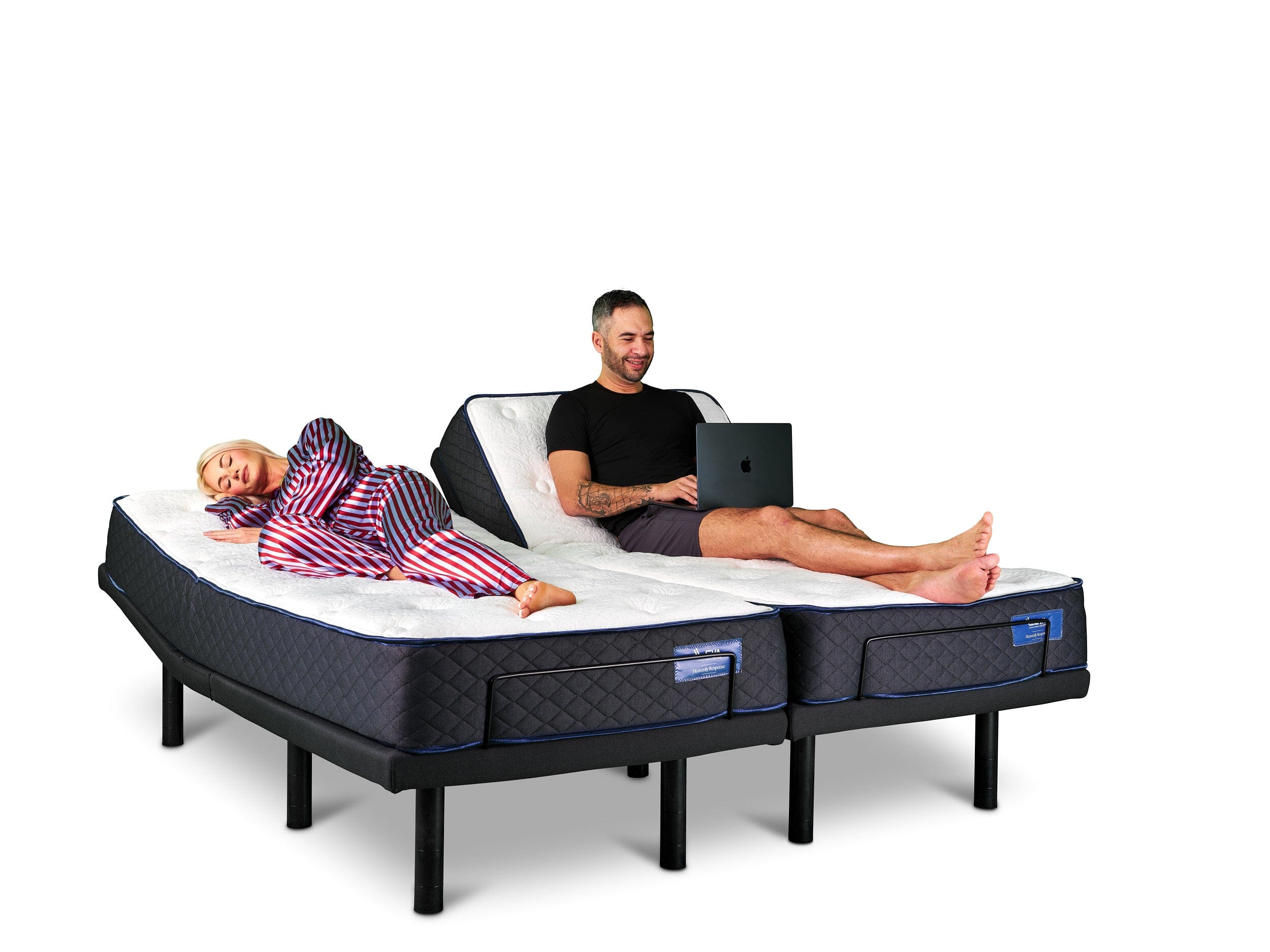
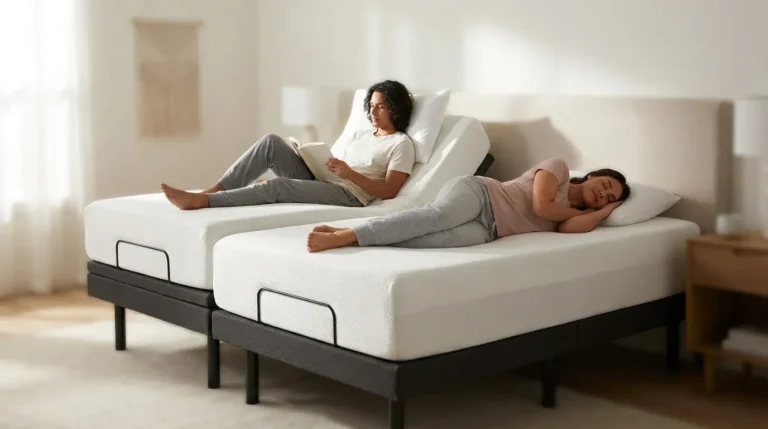
Couples in smaller rooms or those who prefer a smaller footprint can consider Leva Sleep’s Split Queen configuration. This format is uncommon in Canada and offers independent side control in a more compact size. Each side can use different elevation angles, mattress firmness levels, and temperature zones at the same time.
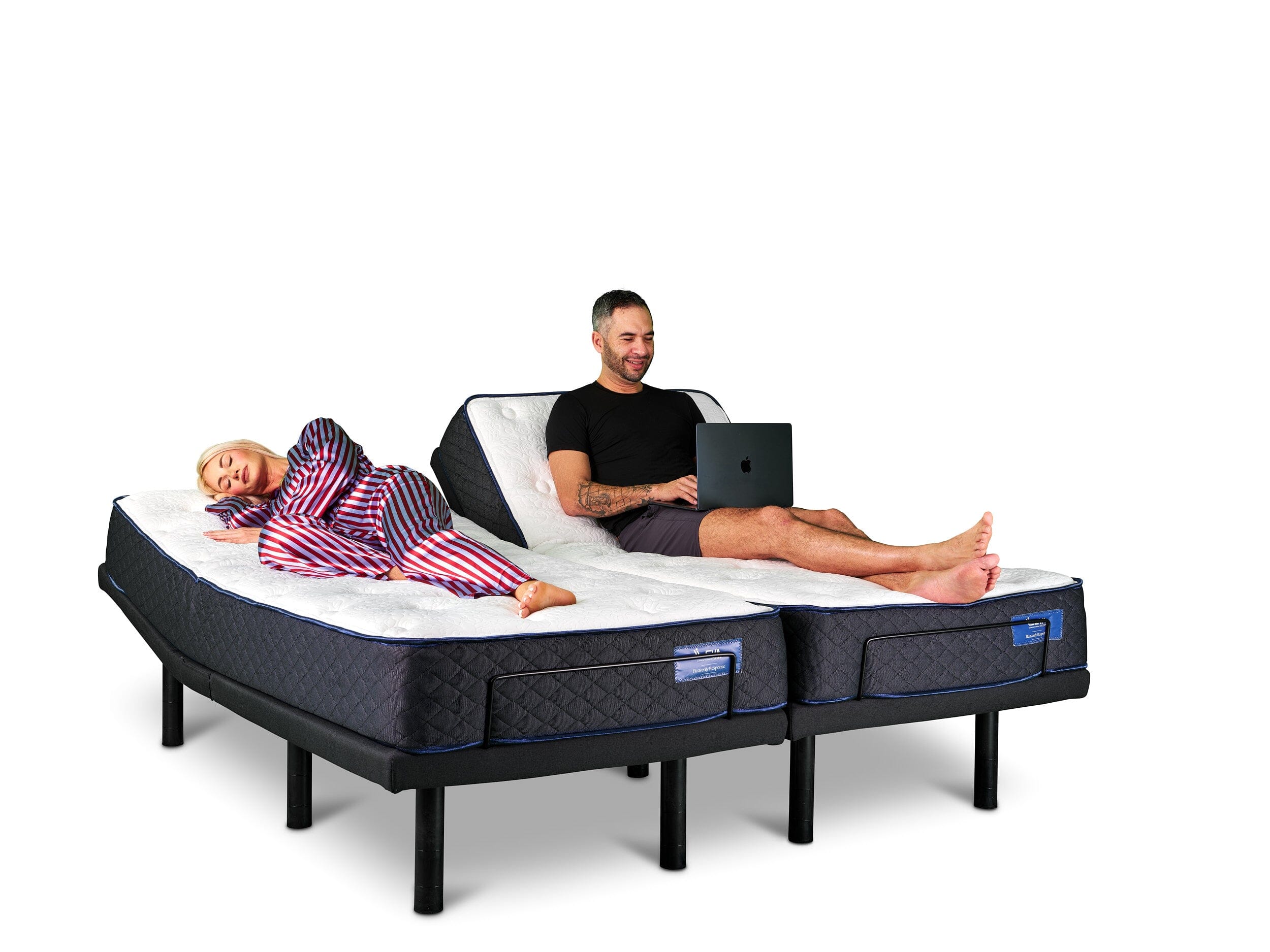
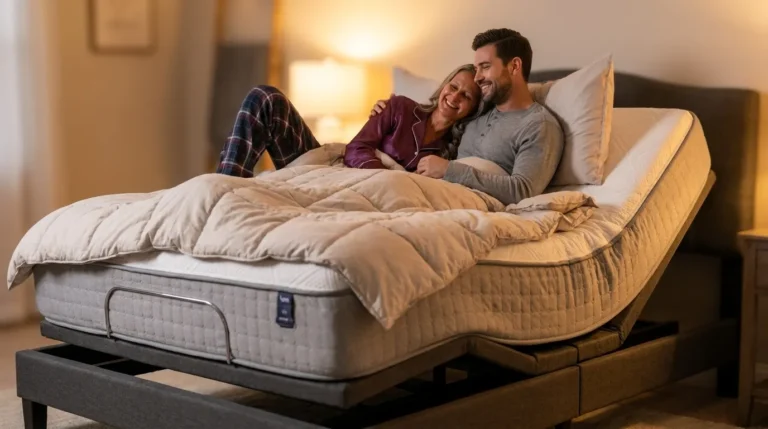
A 2021 study of 1645 older Taiwanese parents found that married parents who slept in separate bedrooms were more likely to feel emotional and social loneliness than couples who shared a bed. Split adjustable systems address many reasons couples move to separate rooms, including firmness disagreements, snoring, temperature differences, and medical positioning needs, while still allowing shared sleep.
Medical and Chiropractic Guidance on Elevated Sleeping
Clinical psychologist and sleep specialist Michael J. Breus, Ph.D., notes that people with conditions such as sleep apnea, GERD, or chronic pain that disrupt sleep can benefit from upgrading to an adjustable bed.
Orthopedic physical therapist Karena Wu, P.T., D.P.T., also reports that adjustable beds help people with chronic back and neck pain, respiratory issues like snoring and obstructive sleep apnea, digestive issues such as acid reflux, and circulation problems.
Clinical sources provide the following condition-specific positioning guidance:
- Lower back pain and sciatica: Raising the knees 15–30 degrees relaxes the hamstrings and reduces pulling on the lower back, which can ease sciatic nerve pain quickly.
- Spinal stenosis: The semi-Fowler position described earlier is the standard clinical recommendation for this condition.
- Arthritis: Elevating the head and foot can reduce pressure on lumbar and hip joints and make getting in and out of bed easier. Many arthritis patients respond well to zero-gravity positioning.
- Sleep apnea: Gentle head elevation opens the airway and can reduce obstruction without a CPAP mask in mild cases. Some adjustable bases include an anti-snore mode that detects snoring and makes small automatic head adjustments.
The Canadian Chiropractic Association recommends lumbar support during sleep, matched to each person’s specific spinal condition. Adjustable bases give you the mechanical tools to apply that guidance every night.
Delivery, Setup, and Long-Term Value for Canadian Buyers
Adjustable systems include heavy bases, split mattresses, and accessories, so professional setup protects both the product and your warranty. White-glove delivery that includes bedroom placement, full assembly, leg height adjustment, old bed removal, and a walkthrough of the controls prevents common setup mistakes.
Pricing also depends on the business model. A direct-to-consumer, vertically integrated approach that covers design, assembly, and delivery without retail middlemen can create a 30–50% price advantage over similar luxury competitors. With 8 years of specialization, $50M in lifetime sales, and more than 25,000 customers, Leva Sleep offers the expanded selection mentioned earlier as a direct result of this model.
Static Medium-Firm Hybrid vs. Adjustable Lumbar System
| Feature | Static Medium-Firm Hybrid | Adjustable Lumbar System (e.g., Leva Sleep) |
|---|---|---|
| Spinal support type | Fixed, with one firmness zone across the full surface | Dynamic, with motorized head, foot, and lumbar zone control |
| Adjustability | No changes possible after purchase | Independent per-side elevation, lumbar, and pillow tilt |
| Motor noise | Not applicable | Whisper-quiet German motors (Leva Sleep), varies by brand |
| Couple compatibility | Single shared firmness that often creates the compromise conflict described earlier | Split Queen and Split King allow fully independent settings for each partner |
Frequently Asked Questions About Leva Sleep Adjustable Beds
How long does Leva Sleep adjustable bed setup take?
With Leva Sleep’s white-glove delivery, a trained team brings the base and mattress to your bedroom, assembles the full system, adjusts leg heights, removes your old bed, and walks you through the remote and app. Most homes are fully set up within a single appointment window, and you do not need to handle any assembly.
Can partners with very different firmness needs share one adjustable bed?
Partners with different needs can share an adjustable system when they choose a Split Queen or Split King configuration. These formats place two independent bases side by side, each with its own motor, controls, and compatible mattress. One partner can choose a softer all-foam mattress while the other selects a firmer hybrid pocket coil. Elevation, lumbar support, massage, and temperature settings remain independent for each side. A standard Queen adjustable base moves as one unit and cannot offer the same flexibility.
Will my current mattress work on an adjustable base?
Compatibility depends on how the mattress is built. All-foam and hybrid pocket coil mattresses flex with the base and usually work well. Traditional innerspring models with rigid border wires or solid cores often do not bend safely and may wear out quickly on an adjustable frame. Leva Sleep designs its own mattresses for use with its bases and also carries compatible options from Tempur-Pedic, Simmons, Beautyrest, Serta, and Kingsdown. If you are unsure about your current mattress, Leva Sleep’s team can review it before you buy.
Do adjustable beds need special maintenance?
Adjustable bases require minimal maintenance. Keep the motor and frame area clear of dust and stored items, and check that the power connection stays secure. Leva Sleep’s whisper-quiet German motors are engineered for long-term use. Bedding made for adjustable bases, with deep-pocket elastic and duvet clips, also reduces wear from sheets pulling during elevation changes.
Are adjustable beds suitable for sleep apnea, arthritis, or herniated discs?
Physicians, chiropractors, and physical therapists commonly recommend adjustable bases for these conditions. Head elevation can open the airway and reduce snoring and mild sleep apnea symptoms. Zero-gravity positioning helps decompress the lumbar spine and ease pressure on arthritic hips and knees. Semi-Fowler positioning supports spinal stenosis by creating forward flexion and more space in the spinal canal. For herniated discs, gradual elevation changes allow symptom-matched positioning that can adjust as recovery progresses. Leva Sleep also receives referrals from sleep apnea clinics. Always speak with your physician or specialist before changing sleep positions for a diagnosed condition.
Conclusion: Choosing a Back-Supportive Sleep System for Two
A back support mattress must do more than feel comfortable for a few minutes in a showroom. It must keep the spine neutral in different positions, serve two partners with different bodies and needs, and adjust as those needs change. A static medium-firm hybrid cannot provide that level of dynamic support, while an adjustable system with split bases, lumbar motors, and quiet operation can.
Use this guide’s checklist when you compare systems: independent per-side control, dedicated lumbar adjustment, motor noise, mattress compatibility, and the quality of delivery and setup. Compare Leva Sleep’s 15 to 20 adjustable models with the smaller selections at general retailers, and include the 30–50% price advantage that comes from a direct-to-consumer Canadian specialist.
Find your split adjustable system at Leva Sleep and let both partners sleep on their own terms in the same bed.