Written by: Matthew Timmins, Founder and Managing Director, Leva Sleep | Last updated: July 20, 2026
Key Takeaways
- Anti-snore adjustable bases raise the head section to open the airway and reduce positional snoring for Canadian sleepers.
- Buyers choose between simple preset elevation and premium automatic sensor-driven systems that detect and respond to snoring in real time.
- Split Queen and Split King configurations give each partner independent head elevation control, which matters for couples with different snoring needs.
- In 2026, preset models in Canada range from $700–$2,200 CAD, while automatic detection systems sit at higher price points with longer warranties.
- Browse Leva Sleep’s Split Queen and Split King adjustable bed packages with white-glove delivery across Ontario and Alberta.
Why Snoring Affects Couples and Why Canadians Want Adjustable Beds
Snoring disrupts more than the snorer. When one partner’s sleep is fragmented night after night, couples face fatigue, tension, and often a full “sleep divorce,” where one person moves to another room to get rest.
For many couples aged 35–70 in Ontario and Alberta, this is a daily reality that a flat mattress cannot solve. The adjustable bed market now responds directly to this problem. Queen-size adjustable bases hold a significant share of the Canadian market, with residential use accounting for most sales.
Global demand for adjustable beds is projected to grow from USD 9.2 billion in 2025 to USD 25.7 billion by 2036 at a CAGR of 9.7%, driven in part by anti-snore and wellness features. In Canada, an aging population increases demand for bases that help with sleep apnea and snoring.
Search intent in this category reflects two clear buyer types. Some want a simple, reliable preset they activate before bed. Others will pay a premium for a base that detects and responds to snoring automatically. This guide covers both paths with 2026 CAD pricing, a smart-versus-preset comparison, Split Queen guidance, and Ontario and Alberta delivery realities. The following overview summarizes the key decision factors before we examine each in detail.
Quick-Read Overview: Key Decision Factors for 2026
Canadian shoppers can focus on a short list of practical factors when comparing anti-snore adjustable bases.
- Detection method: Automatic sensor-based systems and manual preset elevation behave differently for reliability, noise, and cost.
- Split configuration: Split Queen and Split King bases allow independent head elevation per partner, which is essential for couples with differing needs.
- 2026 CAD pricing tiers: Functional anti-snore preset bases typically start at $662–$1,399 CAD, with many entry-level models priced between $700 and $1,200. Automatic detection systems appear at premium price points.
- Motor noise: Mid-range models often produce around 40–50 dB during adjustment, while premium motors usually operate under 45 dB.
- Mattress compatibility: Adjustable bases require flexible foam or pocket-coil mattresses. Standard innerspring mattresses do not bend safely on these frames.
- Delivery and setup: White-glove in-home setup in Ontario and Alberta from specialist retailers removes the assembly burden that online-only brands leave to the buyer.
- Warranty: Budget bases under $800 CAD typically carry 1–3 year warranties, while premium bases extend coverage to 10–25 years.
Smart Automatic Detection vs Preset Elevation in Canada
The Canadian market in 2026 divides anti-snore adjustable bases into two main categories. The table below compares them across the criteria that matter most to couples, using figures from published sources.
| Feature | Preset / Manual Elevation | Automatic Snore Detection | Notes |
|---|---|---|---|
| 2026 CAD price (queen) | $800–$2,200 CAD | Premium pricing from $2,000 CAD | Automatic detection adds a premium over manual models |
| How it activates | Remote button or app before sleep | Accelerometer or microphone detects snoring, then triggers elevation without manual input | TEMPUR-Ergo Smart Base uses a pair of under-mattress sensors to detect snoring vibrations |
| Response reliability | Immediate and consistent, with no false triggers | Can take 3–5 minutes to respond and is prone to false triggers from coughing, traffic noise, or partner movement | Many users disable automatic features due to inconsistent timing and high false-trigger rates |
| Snoring reduction evidence | Head elevation can open the airway and help reduce snoring intensity | Users report that the TEMPUR-Ergo Smart Base can reduce snoring duration | These features are not intended as a treatment for sleep apnea |
Explore Leva Sleep’s automatic anti-snore bases with Split Queen and Split King configurations and independent controls.
How Anti-Snore Elevation Changes Your Airway
A 2022 study published in JMIR Formative Research found that sleeping with the upper body at a 12-degree incline reduces objective snoring duration by 7%. Adjustable bases apply this principle mechanically. An electric motor raises the head section to a set angle, which pulls the tongue and soft palate forward and away from the airway wall.
A standard anti-snore preset uses head elevation with the foot section flat. Automatic systems go further. The TEMPUR-Ergo Smart Base raises the head end of the bed 12 degrees when snoring is detected. This subtle adjustment aims to stop snoring without waking the sleeper.
The Ergomotion SmartSense uses built-in health sensors to monitor snoring patterns in real time. It performs a gradual head elevation so that most sleepers stay asleep during adjustments. Electric motors in adjustable bases complete a full adjustment cycle in seconds when signalled by wireless remote, smartphone app, or voice assistant, with speed varying by model and price point.
Who Benefits Most from Anti-Snore Adjustable Bases
Anti-snore adjustable bases suit a range of sleepers, and the value changes by situation.
- Positional snorers: People whose snoring worsens when lying flat benefit most directly from head elevation, whether through a preset or automatic detection.
- Mild sleep apnea: Elevation can reduce airway obstruction. Adjustable beds can complement sleep apnea management, but they do not replace medical treatment.
- Acid reflux sufferers: Head elevation can reduce nighttime reflux, which makes anti-snore presets useful for both breathing and digestion.
- Post-surgery recovery: Elevated positioning is often medically recommended, and adjustable bases provide precise, repeatable angles.
Split Queen and Split King for Couples
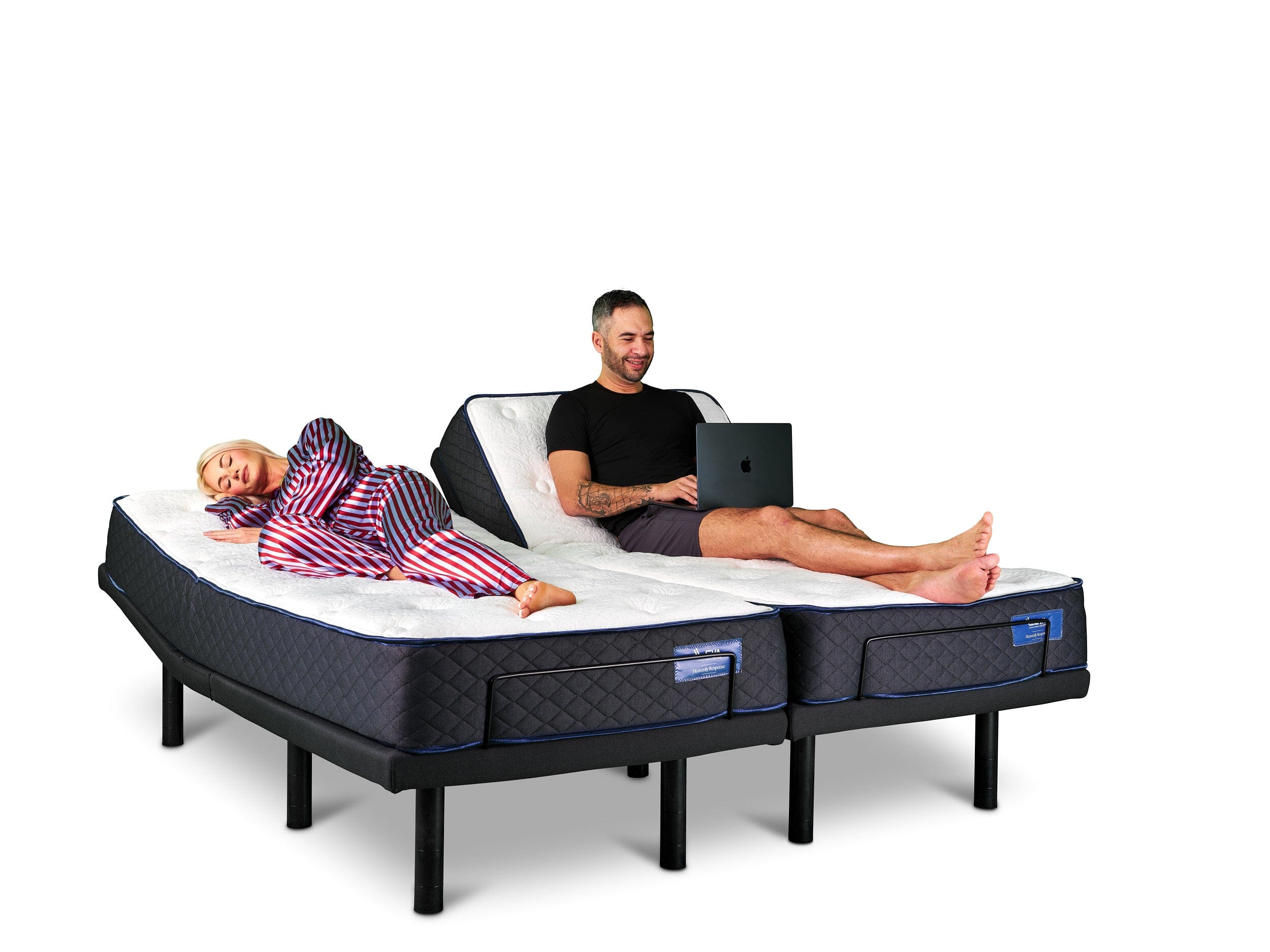
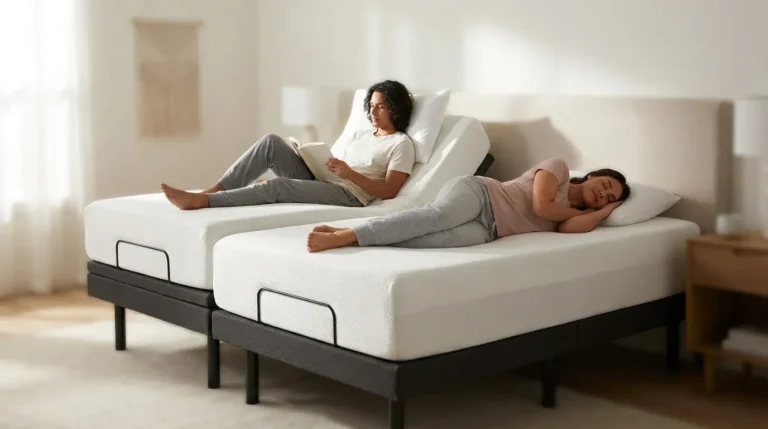
A split king adjustable bed configuration joins two Twin XL bases so each sleeper can independently control head elevation, including anti-snore positioning. This setup suits couples with different snoring-related preferences.
When one partner needs head elevation and the other prefers to sleep flat, a split configuration removes the need for compromise. The availability of Split Queen options in Canada helps couples in smaller rooms, especially in urban Ontario, who cannot fit a king-size frame but still need independent head elevation.
Leva Sleep offers Split Queen configurations built to customer specifications. Leva Sleep’s Split King and Split Queen bases use whisper-quiet German motors and full app control, so each partner can set independent elevation, massage, and temperature preferences.
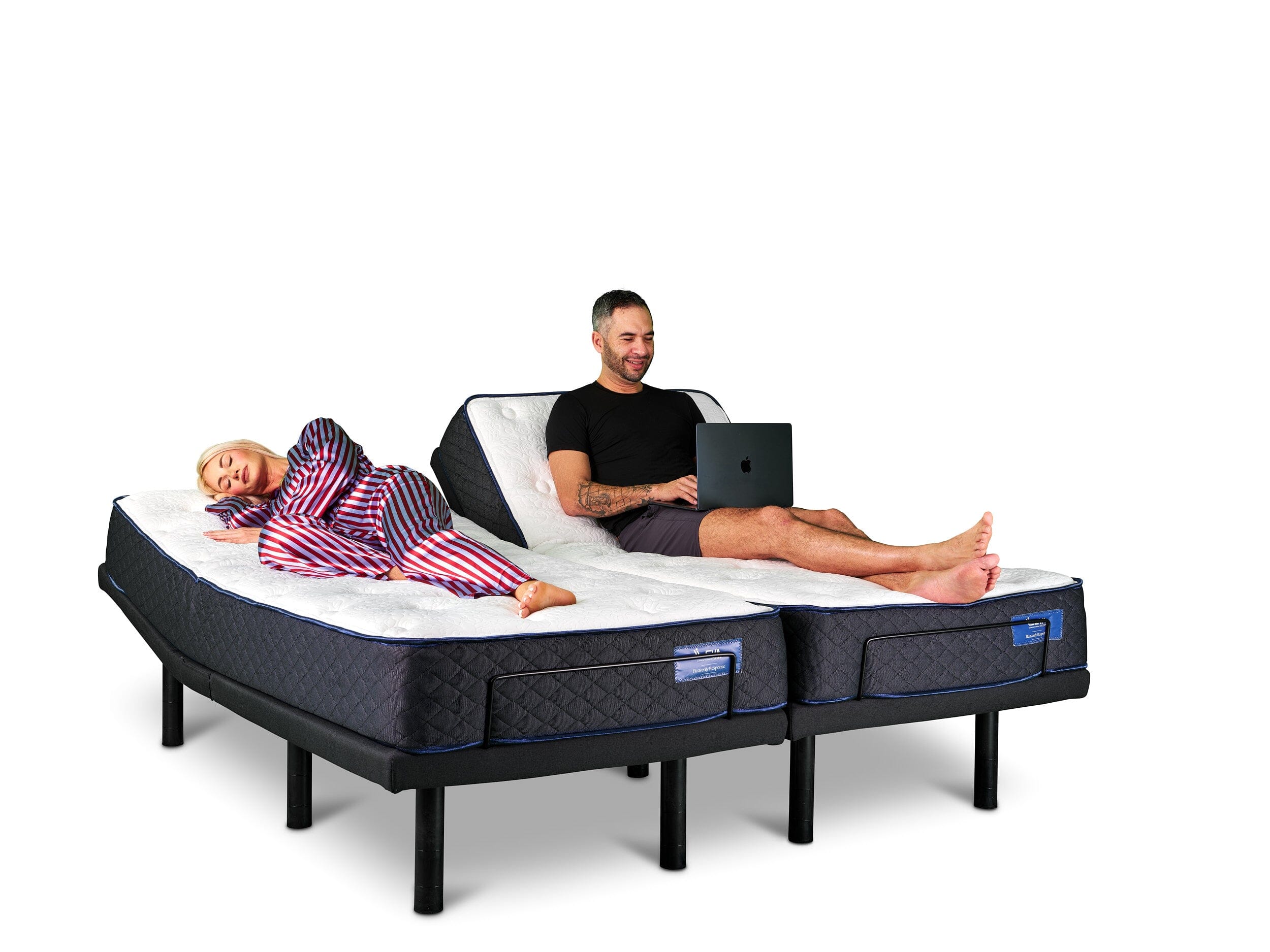
Leva’s spring-2026 lineup introduces automatic snore detection on select split models, automatically detecting snoring patterns and adjusting head elevation in real time, a feature not available from Orthex. With vertical integration and direct-to-consumer pricing, Leva Sleep delivers this capability at 30–50% less than comparable luxury competitors.
Key Considerations Before You Choose a Base
- Motor noise: Adjustable base motors can produce 35–60 dB during adjustment depending on the model. Because automatic systems may activate during the night while you sleep, this noise level matters even more if a light-sleeping partner shares the bed, so review noise specifications carefully.
- Mattress compatibility: Adjustable bases require foam or pocket-coil mattresses that flex without damage. Standard innerspring mattresses will not work safely.
- Warranty length: Budget bases under $800 CAD carry 1–3 year warranties. The TEMPUR-Ergo Smart Base carries a 25-year limited warranty on the base frame. Longer warranties usually signal higher build quality.
- Weight capacity: Confirm that the base supports the combined weight of two sleepers plus the mattress. Many models offer generous capacities suitable for couples.
- App and remote control: Couples benefit from dual remotes or a shared app with per-side profiles. Confirm Bluetooth range and app compatibility with your devices before purchasing.
- Bedding compatibility: Standard fitted sheets often slip off elevated bases. Leva Sleep designs bedding accessories, including deep-pocket sheets with extra elastic and duvet clips, specifically for adjustable bases.
Trade-offs and Limits of Automatic Anti-Snore Modes
Automatic snore detection does not always outperform preset elevation. Automatic systems can take 3–5 minutes to respond or raise the head abruptly to full angle, which can feel disruptive.
The false-trigger problem outlined in the comparison table, including coughing, ambient noise, and partner movement, leads many users to disable automatic features entirely. Automatic adjustments can also produce motor noise of 35–50 dB or cause sudden positional changes that wake the snorer or their partner.
Preset elevation, by contrast, occurs consciously before sleep and removes nighttime motor activation for users who remember to use it. Tempur-Pedic notes that its Sleeptracker-AI Monitor is not a medical device and cannot determine sleep apnea, so buyers with diagnosed sleep apnea should consult a physician before relying on elevation alone.
For most Canadian couples, a high-quality preset base in the $1,000–$2,000 CAD range delivers reliable, repeatable snoring relief without the false-trigger frustration or premium cost of automatic detection. Leva Sleep’s spring-2026 automatic mode uses refined sensor calibration to reduce false triggers, which makes it appealing for buyers who want automation without the trade-offs of first-generation systems.
Setup, Ownership, and Planning in Ontario and Alberta
Adjustable bases are heavy, multi-component systems. A standard queen base weighs 60–100 kg and requires precise assembly to function correctly. “Bed in a box” delivery models leave this entire task with the buyer.
Leva Sleep’s in-house white-glove delivery service in Ontario and Alberta, available for a fee, covers delivery to the bedroom, full assembly, leg-height adjustment, old bed removal for donation or recycling, and a product tutorial. This end-to-end service is especially helpful for Split Queen or Split King purchases, where two independent bases must be aligned, connected, and calibrated together.
The Ontario pricing mentioned earlier ($995–$2,200 CAD for queen bases) reflects the mid-to-premium range most shoppers encounter. Most Ontario buyers spend $1,100–$2,200 CAD on a quality queen base with wireless remote and basic massage. Leva Sleep’s vertical integration, which includes designing, assembling, and delivering locally, removes the retail markup that inflates competitor pricing by 30–50%.
Common Mistakes to Avoid with Anti-Snore Bases
- Buying a base without confirming mattress compatibility. An incompatible mattress can crack or lose its warranty when flexed on an adjustable base.
- Choosing automatic detection without checking false-trigger behaviour. Automatic systems are prone to false triggers from coughing, traffic noise, or partner movement, so confirm the system’s sensitivity settings before purchasing.
- Purchasing a single base for a couple. A single adjustable base raises both sides at once. Couples who want independent control need a split configuration.
- Overlooking the Split Queen option. Many Canadian buyers assume split adjustability requires a king-size frame. Split Queen options address room-size limits for urban buyers who cannot accommodate a king-size frame.
- Ignoring warranty and motor quality at lower price points. As noted in the overview, budget bases under $800 CAD pair their shorter warranties (1–3 years) with louder motors (50–60 dB).
- Accepting “bed in a box” delivery for a complex split system. White-glove setup supports correct assembly, alignment, and calibration, which matters for split configurations with independent motors.
View Leva Sleep’s complete adjustable bed lineup with Split Queen and Split King packages and white-glove delivery across Ontario and Alberta.
FAQ
Do anti-snore adjustable beds actually work?
A 2022 study published in JMIR Formative Research found that sleeping with the upper body at a 12-degree incline reduces objective snoring duration by 7%. Head elevation can therefore reduce positional snoring for many people.
Research supports this approach, and the 7% reduction in snoring duration at 12-degree elevation, noted earlier, shows measurable effectiveness for positional snorers. A standard anti-snore preset raises the head section to an incline, which can help produce meaningful snoring reduction. Automatic detection systems add real-time responsiveness. Results vary by individual, and elevation does not treat diagnosed sleep apnea, so a physician should be consulted for clinical conditions.
What is the difference between automatic snore detection and a preset anti-snore position?
A preset anti-snore position uses a fixed head elevation angle that the user activates manually via remote or app before falling asleep. This approach is immediate, consistent, and produces no nighttime motor noise.
Automatic snore detection uses accelerometers or microphones to identify snoring vibrations and then triggers head elevation without manual input. The trade-off is reliability. Automatic systems can take 3–5 minutes to respond, are prone to false triggers from coughing or ambient noise, and may produce motor noise that wakes the sleeper or their partner.
Many users disable automatic features for these reasons. Leva Sleep’s spring-2026 automatic mode focuses on refined sensor calibration to reduce these limitations.
What is a Split Queen adjustable bed, and is it available in Canada?
A Split Queen adjustable base divides a standard queen-size footprint into two independently controlled halves, each with its own motor, remote, and elevation settings. This layout allows one partner to raise their head for snoring relief while the other sleeps flat, without mechanical linkage between the two sides.
Split Queen is less common than Split King, which uses two Twin XL bases, and suits couples in smaller bedrooms who cannot accommodate a king-size frame. Leva Sleep offers Split Queen bases built to customer specifications, available with white-glove delivery in Ontario and Alberta.
How much does an anti-snore adjustable base cost in Canada in 2026?
Pricing in Canada in 2026 spans a wide range based on features. Functional preset anti-snore bases typically start at $662–$1,399 CAD for a queen size, with many entry-level models priced between $700 and $1,200 CAD.
Mid-range models add features such as massage, app control, and quieter motors. Automatic snore detection systems start at higher price points for premium options like the TEMPUR-Ergo Smart Base. Leva Sleep’s vertical integration and direct-to-consumer model positions its bases at 30–50% below comparable luxury competitors, which makes premium features more accessible.
Is white-glove delivery available for adjustable beds in Ontario and Alberta?
White-glove delivery is available in both provinces. Leva Sleep provides in-house white-glove delivery in Ontario and Alberta for a fee.
The service includes delivery to the bedroom, full assembly, leg-height adjustment to the customer’s preference, a product tutorial, and removal of the old bed for donation or recycling. This service is particularly valuable for Split Queen and Split King configurations, which involve two independent bases that must be correctly aligned and calibrated. Unlike “bed in a box” brands that leave assembly to the buyer, Leva Sleep’s trained delivery professionals handle the entire setup process.
Conclusion: Matching Anti-Snore Features to Your Bedroom
Choosing an adjustable bed with an anti-snore feature in Canada in 2026 comes down to four core decisions. Shoppers weigh preset versus automatic detection, split versus single configuration, price tier, and delivery model.
Preset elevation remains reliable, affordable, and sufficient for most positional snorers. Automatic detection adds responsiveness at a meaningful cost premium, with trade-offs in false-trigger rates that buyers should review carefully. For couples, a Split Queen or Split King configuration enables independent elevation without disturbing a partner.
Leva Sleep addresses all four decisions with a vertically integrated model. The lineup includes Split Queen and Split King bases with whisper-quiet German motors, spring-2026 automatic anti-snore mode on select models, 30–50% lower pricing than comparable luxury competitors, and in-house white-glove delivery across Ontario and Alberta.
With over 8 years in business, $50M in lifetime sales, and 25,000+ customers, Leva Sleep focuses on adjustable sleep systems as a core specialty. Find your ideal anti-snore adjustable base matched to your bedroom size, budget, and sleep needs.