Written by: Matthew Timmins, Founder and Managing Director, Leva Sleep | Last updated: June 29, 2026
Key Takeaways for Snoring Couples
- A split adjustable base with independent head elevation on each side is the most effective setup for couples dealing with snoring.
- Head elevation between 7 and 15 degrees repositions the airway and reduces soft-tissue collapse that causes snoring while keeping the partner undisturbed.
- Quiet German motors and app-based controls allow position changes without waking a sleeping partner.
- Leva Sleep offers Split King and Split Queen options, plus white-glove delivery and setup in Ontario and Alberta.
- Explore Leva Sleep’s adjustable bed packages for Canadian couples at Leva Sleep.
How Adjustable Beds Help Reduce Snoring
Adjustable beds reduce snoring by elevating the head, which opens the upper airway and decreases soft-tissue collapse at the back of the throat. They do not cure obstructive sleep apnea, yet many people with mild to moderate snoring report fewer disturbances and fewer partner wake-ups. For diagnosed sleep apnea, elevation can complement CPAP therapy or serve as a first-line comfort measure before a clinical referral.
Sleeping Well Beside a Snoring Partner
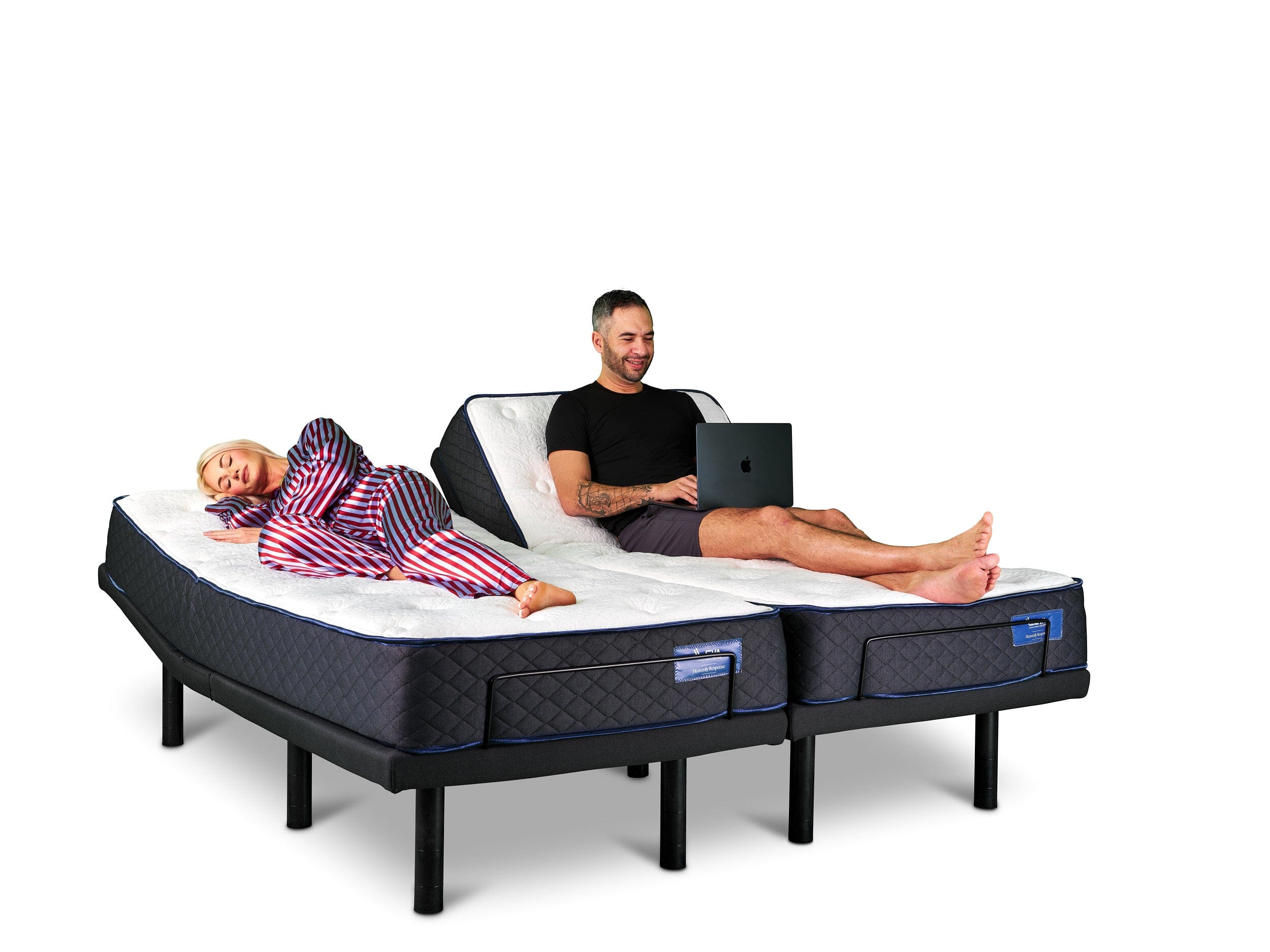
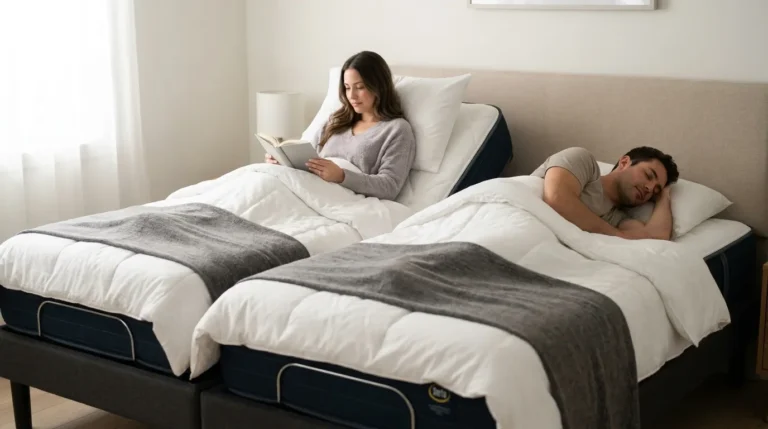
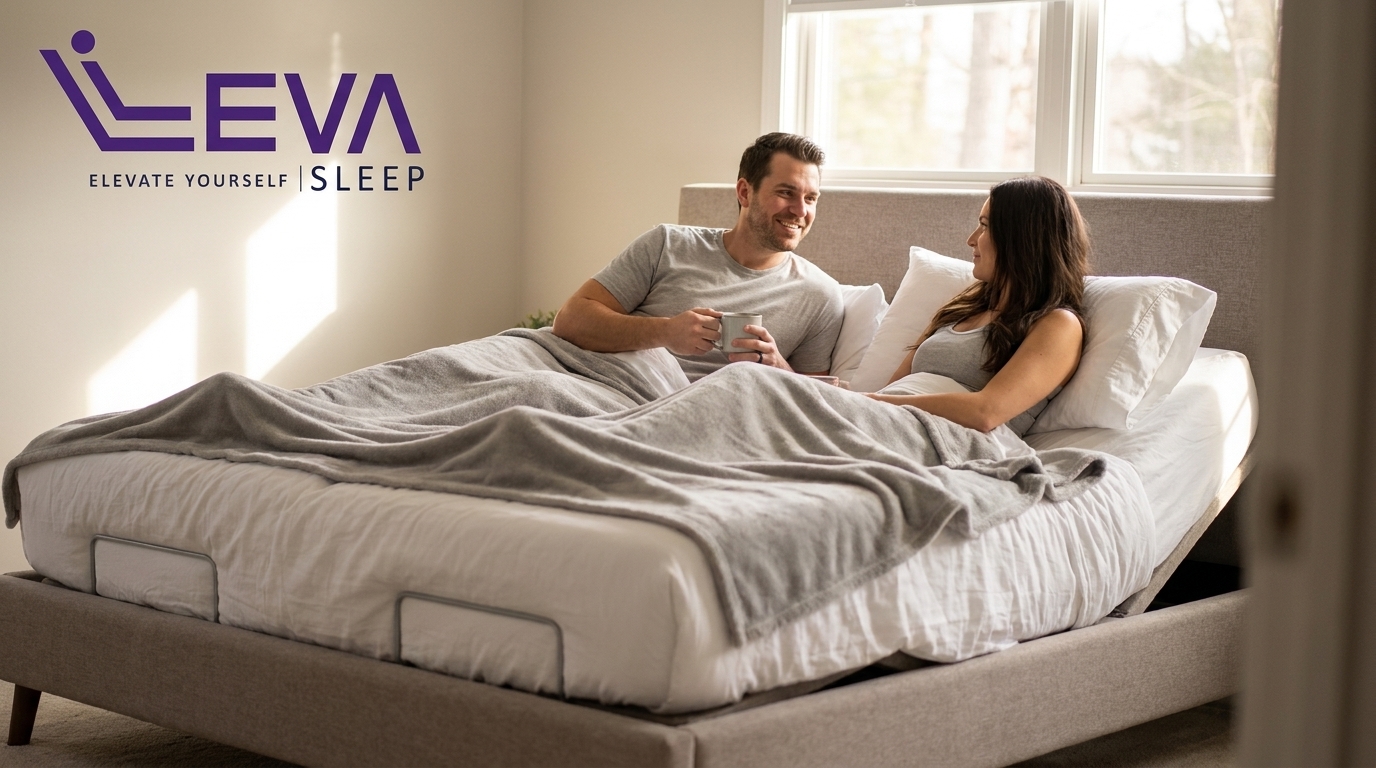
Sleeping well beside a snoring partner requires separating each person’s sleep position without separating the bed. A split adjustable base lets the snoring partner elevate their head independently while the other lies flat or chooses a different angle. With quiet motors, deep-pocket fitted sheets, and individual temperature controls, both partners can stay asleep in the same shared bed.
The Problem: Snoring, Conflicting Needs, and “Sleep Divorce”
Snoring affects a large share of adults and is one of the most common reasons couples start sleeping in separate rooms, often called a “sleep divorce.” Beyond noise, snoring is frequently linked to obstructive sleep apnea, which disrupts breathing cycles and degrades sleep quality for both the snorer and their partner. Sleep apnea clinics across Ontario and Alberta often recommend positional sleep interventions as a first step before or alongside CPAP therapy.
Conflicting comfort needs compound the problem. One partner runs hot, the other cold. One needs a firmer surface for hip or knee pain, the other prefers a softer feel. A flat, static mattress forces one person to compromise every night. Over months and years, that compromise erodes sleep quality, mood, and relationship health. The tipping point usually comes from accumulated exhaustion, not a single bad night.
A new sleep system becomes worth evaluating when snoring or positional needs disrupt sleep more than two or three nights per week, when a physician recommends elevated sleeping, or when one partner has already moved to a spare room. Before looking at adjustable systems, it helps to see why the usual quick fixes rarely solve the problem.
Why Common Snoring Fixes Often Fail
Flat beds offer no positional flexibility. Wedge pillows shift during the night and provide inconsistent elevation. Earplugs reduce noise for one partner while doing nothing for the snorer’s airway. Separate rooms remove the noise but introduce new costs to intimacy and relationship wellbeing.
Basic adjustable bases sold as add-ons at general mattress retailers solve a few issues yet introduce new ones. Many entry-level bases use motors that grind or click loudly, which wakes a light sleeper whenever a position changes. Independent control often covers only a single zone, so both sides of the bed move together. Mattresses sold separately may not flex correctly with the base, creating pressure points at hinge zones. Delivery often arrives as a curbside drop, leaving couples to assemble a heavy, complex system on their own.
These shortcomings feel significant for couples who already invested in a premium mattress and still wake up exhausted. The gap between what a basic adjustable base promises and what it delivers becomes a real source of frustration.
The Split Adjustable System That Keeps Couples Together
A split adjustable sleep system divides the bed into two independently controlled zones. Each partner can raise or lower the head, elevate the foot, engage lumbar support, or use a pillow-tilt motor without affecting the other side. For the snoring partner, head elevation between 7 and 15 degrees repositions the airway and reduces the soft-tissue collapse that generates snoring sounds. For a partner with hip or knee pain, zero-gravity positioning distributes body weight more evenly and reduces pressure on joints.
These adjustments happen quietly so the other person can keep sleeping. Leva Sleep uses German-engineered motors across its lineup that operate at low noise levels, so most partners sleep through a position change. App-based Bluetooth control keeps remotes off the floor and makes adjustments simple in the dark.
For couples managing mild sleep apnea, consistent head elevation can reduce the frequency and severity of apnea events. This support does not replace a physician’s treatment plan, yet it offers a meaningful, non-invasive complement.
Choosing Between Split King and Split Queen
A Split King uses two Twin XL mattresses on two independent bases, creating a combined width of about 76 inches, the same as a standard King. This configuration suits couples who already sleep in a King-sized room and want maximum personal space.
A Split Queen divides a 60-inch Queen footprint into two independently adjustable zones. Leva Sleep is one of the few Canadian providers offering a Split Queen built to customer specifications. This setup works well in older Ontario or Alberta homes where bedrooms do not fit a King, or for couples who prefer a closer sleeping arrangement. The trade-off is a narrower individual surface, which suits partners who sleep close together but still need independent elevation control.
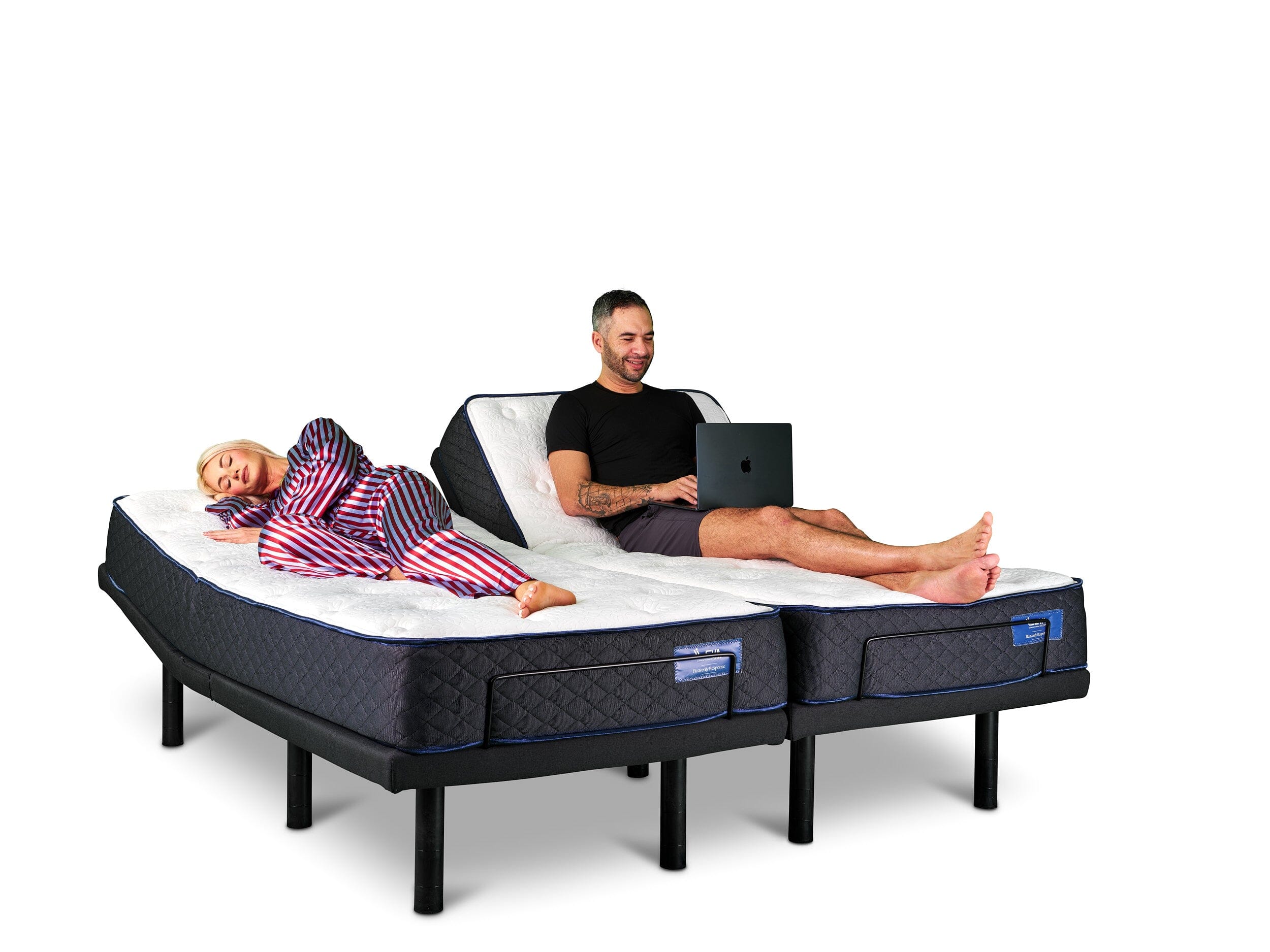
Key considerations include available floor space, whether existing furniture needs rearranging, and each partner’s preferred width. Couples who share a Queen and want to keep that footprint while gaining independent control often choose the Split Queen as the more space-conscious option.
Anti-Snore Presets and Upcoming Auto-Adjust Mode
Current Leva Sleep adjustable bases include a dedicated anti-snore preset that raises the head of the bed to a clinically informed angle with a single button press or app tap. Each side of a split configuration can use this preset independently, so the snoring partner can activate it without disturbing the other.
In spring 2026, Leva Sleep plans to introduce an anti-snore mode that detects snoring and makes small head adjustments automatically. The system responds during sleep instead of relying on the snoring partner to wake up and press a button. This upgrade moves beyond static presets and helps couples whose snoring intensity changes through the night or who sleep too deeply to self-correct.
Quiet German Motors for Real Shared-Sleep Conditions
Motor noise strongly affects adjustable bed satisfaction for couples. A base that hums loudly during adjustment undermines the benefit of independent control. If one partner wakes the other every time they shift position, the core problem remains unsolved.
Leva Sleep’s German-engineered motors are selected for low acoustic output. When evaluating any adjustable base, a practical test is to run a position adjustment while your partner lies still and then check whether the sound is noticeable on their side. Motors that produce a low, smooth hum work better than those with mechanical clicking or variable-speed whine. Leva’s lineup aims for the standard where a sleeping partner usually does not register the movement.
Mattress and Bedding That Work With an Adjustable Base
Not every mattress flexes correctly on an adjustable base. Leva Sleep provides guidance on compatible mattresses for their systems. Mattresses with traditional Bonnell or offset coil systems resist bending and can sustain internal damage when repeatedly elevated.
Bedding also needs to match the system. Standard fitted sheets are not built for the depth changes that occur when a mattress bends at the head or foot. Leva Sleep designs fitted sheets with deep pockets and reinforced elastic so they stay anchored during elevation. Duvet clips keep the shared top layer from bunching when the two sides of a split base sit at different angles. Remote pockets on the side of the base keep controllers accessible and off the floor. These accessories function as core parts of a coordinated system.
Canadian White-Glove Delivery and Setup Support
Adjustable bed bases are heavy, multi-component systems that require careful assembly. A split base arrives as separate units that must be aligned, connected, and calibrated before use. For couples in Ontario and Alberta, Leva Sleep offers in-house white-glove delivery for a fee. This service includes delivery to the bedroom, full assembly, leg-height adjustment, a product tutorial covering app setup and presets, and removal of the old bed, which is donated or recycled where possible.
This service matters because curbside delivery from a general retailer leaves customers lifting heavy components up stairs, assembling the base, and troubleshooting connectivity alone. For a product that depends on precise setup, the delivery and installation experience becomes part of the overall value.
Real Couples’ Stories From Leva Sleep
Leva Sleep customers often describe a return to shared sleep after a period of sleeping separately. Couples who moved to different rooms due to snoring report coming back to the same bed after switching to a split adjustable system. Partners with hip or knee pain describe waking with less stiffness after using a zero-gravity position through the night. Some customers mention that sleep apnea clinics referred them to Leva Sleep as part of a positional therapy plan.
Many couples also comment on the quiet operation of the motors. Customers who previously owned a basic adjustable base from a general retailer frequently highlight the lower noise level as one of the most noticeable upgrades.
Outcomes: Sleep, Comfort, and Long-Term Value
Couples who switch to a split adjustable system usually report three main outcomes. First, they experience fewer nightly disturbances, both from reduced snoring through head elevation and from quieter position changes. Second, they notice less morning pain, especially in the lower back, hips, and knees, which they attribute to zero-gravity and lumbar support positions. Third, they see long-term value in a vertically integrated system purchased directly from the manufacturer at 30 to 50 percent below comparable luxury competitors.
Leva Sleep’s direct-to-consumer model, which covers design, assembly, and delivery, removes the retail markup that inflates prices at general furniture chains and brand-name luxury sleep retailers.
Decision Checklist for Canadian Snoring Couples
When comparing adjustable bed systems for a snoring couple in Canada, start with the feature that matters most: independent control. Confirm that the base offers fully independent head and foot control on each side, not just a single shared motor, so one partner’s adjustment does not move the other.
Once independent zones are confirmed, consider whether using them will wake your partner. Motor noise becomes the next priority. Request a demonstration or read verified customer reviews that mention sound levels during adjustment. After that, review mattress compatibility, because not all mattresses flex properly with an adjustable base.
With the core mechanics covered, check delivery and setup. Confirm that the retailer offers Canadian delivery to your province and clarify whether setup is included or available for a fee. Then look at bedding. Ask whether the bedding sold with the system is designed for adjustable bases or is standard retail bedding repackaged.
Finally, review snoring-specific features and total cost. Ask whether the system includes an anti-snore preset and whether automated snore detection is available or planned. Compare the full system price, including base, mattress, bedding, and delivery, against equivalent configurations from luxury competitors to understand the real cost difference.
Looking Ahead: Spring-2026 Anti-Snore Automation
The spring-2026 release of Leva Sleep’s anti-snore mode that detects snoring and adjusts the head position represents a major feature step for Canadian couples. Current anti-snore presets require manual activation, while the new system responds to detected snoring on its own. For couples where the snoring partner sleeps deeply and cannot reliably activate a preset, this automation closes the gap between a manual system and a responsive one. Couples shopping now should factor this upcoming feature into their timing if automated response ranks high on their list.
Frequently Asked Questions
How long does the white-glove setup process take, and what does it include?
White-glove delivery for a Leva Sleep adjustable bed system typically takes about one to two hours in the home, depending on room layout and access. The team delivers the components to the bedroom, assembles the base and mattress, adjusts leg heights to the customer’s preferred bed height, pairs Bluetooth and sets up the app, and walks through all presets and features. They also remove the old bed for donation or recycling where facilities are available. The service is available in Ontario and Alberta for a fee quoted at purchase.
Is a split adjustable bed suitable for someone with diagnosed sleep apnea?
A split adjustable bed can act as a useful positional aid for people with mild to moderate obstructive sleep apnea because head elevation reduces the degree of airway collapse during sleep. It is not a medical device and does not replace CPAP therapy for moderate to severe cases. Many sleep apnea clinics recommend positional interventions as a complement to or first step before CPAP, and several clinics in Ontario and Alberta refer patients to Leva Sleep for this reason. Anyone with diagnosed sleep apnea should discuss positional therapy with their physician before changing their treatment plan.
What maintenance does an adjustable base require over time?
Adjustable bases require minimal routine maintenance. The main tasks include keeping the motor housing clear of dust and debris, checking that cable connections remain secure, and ensuring the mattress retainer bar at the foot of the base stays properly engaged so the mattress does not slide during elevation. Leva Sleep’s German-engineered motors are designed for long-cycle durability. The Bluetooth module and app connectivity receive standard software updates. If a motor or component needs service, Leva Sleep’s in-house team handles warranty and post-sale support directly instead of routing customers through a third-party network.
Who benefits most from a Split Queen versus a Split King?
A Split Queen works best for couples who currently sleep in a Queen-sized bed and want to keep the same footprint, couples in homes where doorways or stairwells make King-sized delivery difficult, and partners who prefer sleeping closer together. A Split King suits couples who already sleep in a King, want the maximum individual surface per person, or are replacing an existing King mattress and base. Both configurations provide fully independent head and foot control. The choice mainly reflects room size, existing furniture, and preferred sleeping proximity rather than a difference in features or quality.
Can Leva Sleep’s adjustable base be used with a mattress purchased elsewhere?
Leva Sleep’s adjustable bases work with a variety of mattresses. Mattresses with traditional Bonnell or offset interconnected coil systems are not recommended, because repeated articulation can damage the coil structure. Leva Sleep also sells mattresses from partner brands including Tempur-Pedic, Simmons, Beautyrest, Serta, and Kingsdown, all verified as compatible with its bases. Customers bringing an existing mattress should confirm the construction type before purchase. Leva Sleep’s team can advise on compatibility during a pre-purchase consultation.
Conclusion: A Practical Path Back to Shared Sleep
For Canadian couples dealing with snoring, differing sleep positions, or medical elevation needs, a split adjustable sleep system offers a practical and durable path back to shared sleep. It addresses root causes such as airway position and individual comfort instead of masking symptoms with earplugs or wedge pillows. The Split King and Split Queen configurations from Leva Sleep combine independent control, quiet German motors, purpose-built bedding, and white-glove delivery across Ontario and Alberta, at a significant price advantage over luxury retail competitors. With automated anti-snore detection arriving in spring 2026, the category continues to move toward more passive, responsive sleep support. Couples who have been tolerating disrupted sleep or sleeping separately now have a concrete, well-supported alternative.