
Written by: Matthew Timmins, Founder and Managing Director, Leva Sleep | Last updated: June 18, 2026
Key Takeaways
-
Split adjustable beds with independent per-side controls help Canadian couples manage mismatched back pain and sleep preferences without sleep divorce.
-
Zero-gravity positioning and targeted lumbar support reduce spinal pressure and morning stiffness compared with flat beds.
-
Whisper-quiet motors, adjustable-specific bedding, and white-glove delivery reduce mid-night disturbances and setup frustrations.
-
Leva Sleep offers 30–50% savings versus luxury brands, 15–20 models, and features like anti-snore mode launching spring 2026.
-
Explore Leva Sleep’s adjustable beds to find a Split Queen or Split King system that fits your pain profile and bedroom size.
The Problem: How Flat Beds Fail Canadian Couples with Back Pain
Many couples share a similar pattern. One partner wakes at 3 a.m. with lower back stiffness, shifts position, and disturbs the other. The second partner, a light sleeper who runs warm, has already been awake from the first partner’s snoring. By morning, both feel exhausted, and the conversation about a guest-room arrangement starts again.
This pattern has a structural cause. Flat beds lock both partners into a single surface angle with no capacity for individual spinal adjustment. Poor spinal alignment during sleep concentrates mechanical load on the lumbar discs and sacroiliac joints. That concentration contributes to morning stiffness and chronic pain cycles. Partner movement transfers directly through a shared surface, and temperature differences, such as one partner sleeping hot and the other cold, compound the disruption. When these factors accumulate, couples often reach a tipping point and choose sleep divorce, or the decision to sleep in separate rooms. That outcome resolves the disturbance problem but removes the intimacy and shared sleep environment most couples want to preserve.
The Solution Landscape: Four Paths Beyond a Flat Bed
Couples who want to stay in the same room while easing back pain usually compare four broad solution categories. Each option addresses part of the problem and introduces its own trade-offs.
|
Solution Type |
Independent Controls |
Lumbar/Elevation Support |
Key Limitation |
|---|---|---|---|
|
Traditional flat bed |
No |
None |
No positional adjustment possible |
|
Basic adjustable base (single) |
No |
Head/foot only |
One position affects both partners, motors often noisy |
|
Luxury single-brand system (e.g., Tempur-Pedic) |
Split options available |
High retail mark-up, limited model selection at general retailers |
|
|
Specialist split adjustable system |
Yes, per side |
Yes, independent per side |
Requires compatible flexible mattress and adjustable-specific bedding |
Basic adjustable bases address elevation but not independence. When one partner raises the head section, the other side moves identically. Noisy or jerky motors, a common complaint with entry-level units, create their own disturbances. Luxury single-brand options solve many of these problems but arrive at price points that place them out of reach for many Canadian households, particularly when the primary issue is back pain rather than pressure-point relief.
The Better Fit: Zero-Gravity and Lumbar Support for Real Relief
Zero-gravity positioning elevates both the head and legs slightly above heart level. This position distributes body weight across a larger surface area and reduces concentrated pressure on the lower spine and joints. Many people with lumbar disc issues and sciatic nerve compression feel less mechanical load after a night in this posture compared with a flat surface.
Targeted lumbar support adds another layer of control. A reinforcement zone rises specifically beneath the lower back, so users can dial in a neutral-spine position instead of relying only on mattress firmness. Head elevation of 6–8 inches can reduce snoring and acid reflux, feet-up positioning can improve circulation and reduce edema, and slight knee elevation can relieve sciatic nerve pressure. In a split configuration, each of these adjustments can be set independently per side.
Anti-snore mode now appears in more mid-range systems. Technological advancements have made automatic anti-snore adjustments, adjustable firmness, climate control, and personalized positioning more accessible to consumers. Leva Sleep’s anti-snore mode, available in spring 2026, detects snoring and makes micro-adjustments to the head of the bed automatically. The snoring partner does not need to wake or intervene.
How to Evaluate Adjustable Beds for Back-Pain Relief
Independent Adjustability for Each Partner
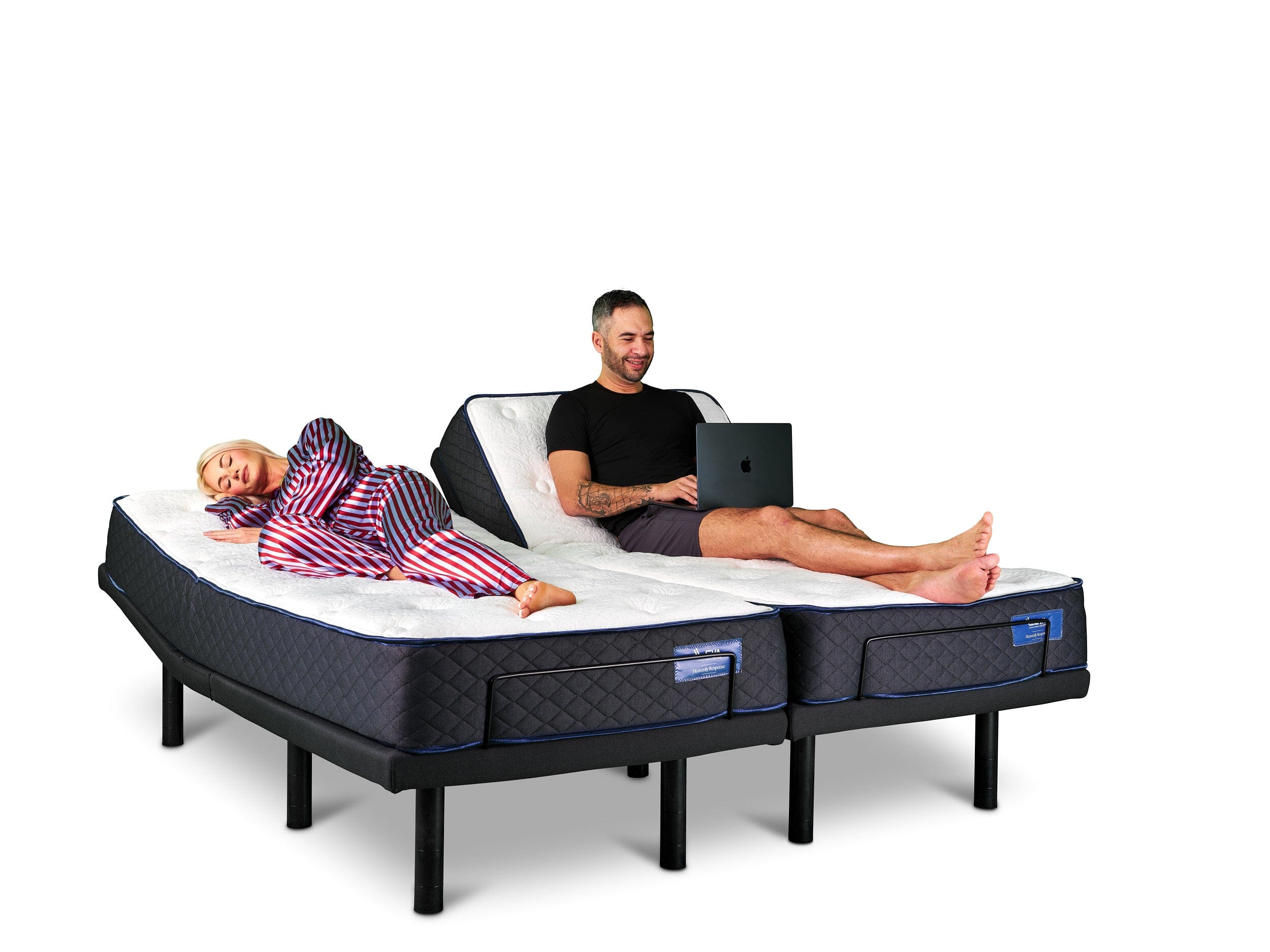
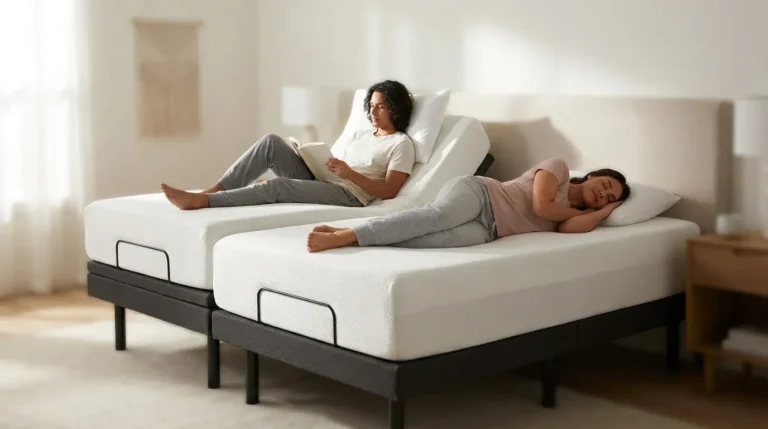
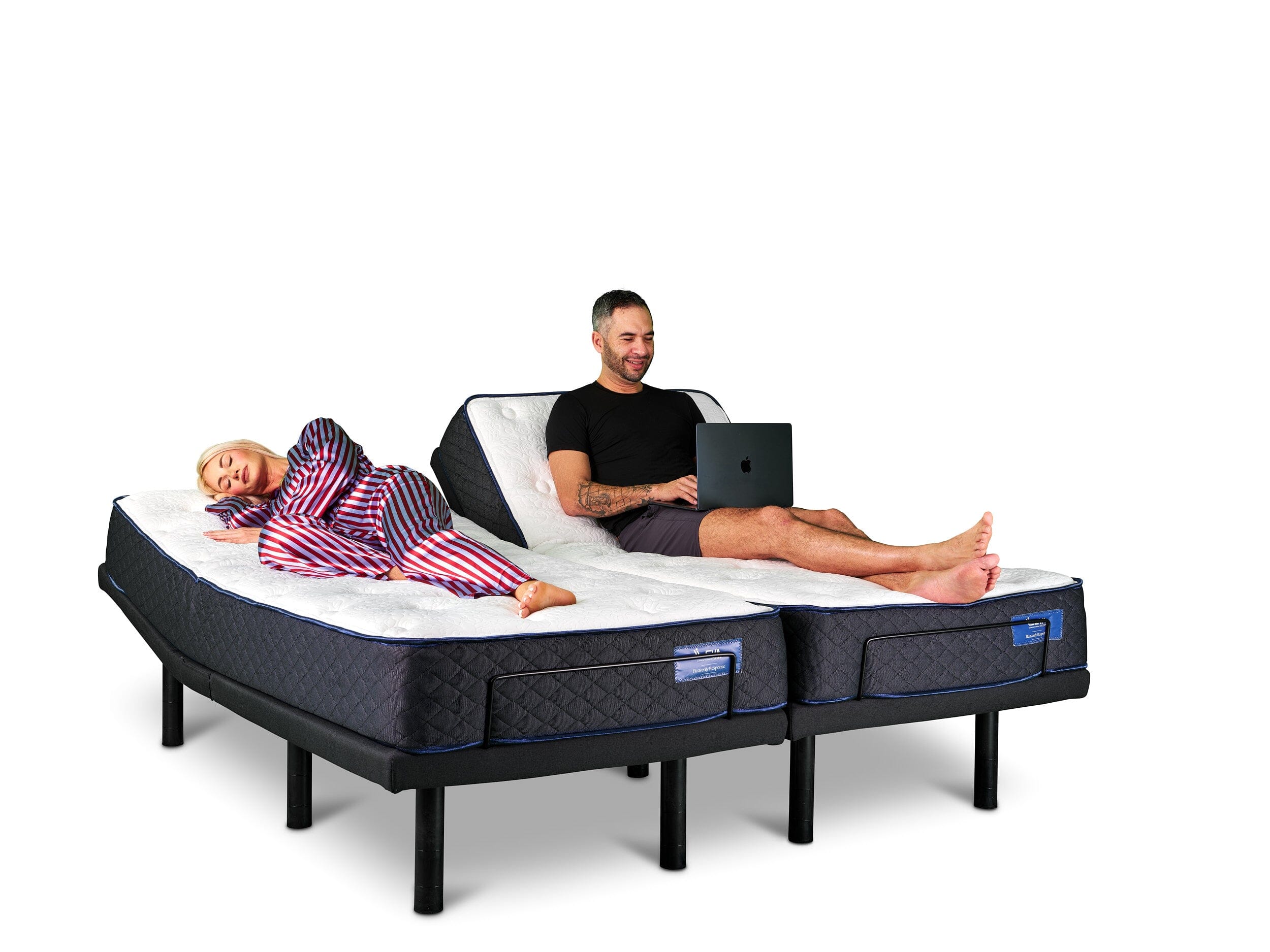
Split King configurations rank as a top adjustable bed option for couples because they allow independent adjustment on each side. A Split Queen offers the same per-side independence in a smaller footprint, a configuration Leva Sleep offers and most general retailers do not stock. Check whether the base provides full independent head, foot, and lumbar control, not just a shared preset.
Lumbar and Pillow-Tilt Support Zones
Dedicated lumbar zones and pillow-tilt motors support more precise positioning. These features allow fine-tuning of the cervical and lumbar spine independently. This precision matters when one partner’s pain sits in the lower back and the other’s pain sits in the neck or shoulders.
Quiet Motors for Mid-Night Adjustments
Motor noise often tops the list of complaints with basic adjustable bases. German-engineered whisper-quiet motors, as used in Leva Sleep’s systems, allow position changes during the night without waking a partner. Review decibel ratings when available, and read verified customer reviews that mention nighttime adjustments.
Mattress Types That Work on Adjustable Bases
Memory foam, latex, and most pocketed-coil hybrid mattresses between 10 and 12 inches thick flex safely on adjustable bases, while traditional innerspring mattresses with interconnected coils risk damage from repeated articulation. Confirm that any mattress you consider is rated for adjustable base use before buying.
Temperature Control for Different Sleep Preferences
Couples with mismatched thermal preferences benefit from per-side heating and cooling pads integrated into the sleep system. This feature has driven significant market adoption, as households seek temperature regulation and home automation integration in their beds.
Bedding Designed for Adjustable Movement
Standard fitted sheets often pull off at elevated angles. Look for sheets with deep pockets and reinforced elastic, duvets with separation clips, and mattress protectors designed for articulating surfaces. Leva Sleep designs its full bedding suite specifically for adjustable bases, which reduces this common frustration.
White-Glove Delivery and Setup in Canada
Adjustable bed systems are heavy, multi-component products that need calibration. White-glove in-home delivery and setup removes the assembly burden from the customer. In Canada, where delivery logistics vary between urban and suburban areas in provinces such as Ontario and Alberta, confirm that the retailer’s white-glove service includes bedroom delivery, old-bed removal, leg-height adjustment, and a product walkthrough, not just curbside drop-off.
Real-World Outcomes for Couples Using Split Adjustable Beds
Couples who adopt split adjustable systems often report several practical outcomes.
-
Reduced morning lumbar stiffness through overnight neutral-spine positioning
-
Fewer nighttime awakenings from partner movement because each side articulates independently
-
Managed mild sleep apnea symptoms through head elevation, which can reduce reliance on CPAP masks for some users (consult a physician for medical guidance)
-
Improved circulation for partners with hip, knee, or edema concerns through feet-up positioning
-
Resolution of sleep divorce, with couples who had moved to separate rooms returning to a shared bed
Sleep apnea clinics in Canada have referred patients to adjustable bed specialists as a complementary positional therapy. Physicians often recommend head elevation between 30 and 45 degrees for acid reflux management, and slight knee flexion for lumbar disc decompression. An adjustable base with programmable presets allows these positions to be saved and recalled without manual adjustment each night.
Decision-Support: Split Queen vs. Split King and Overall Value
|
Configuration |
Dimensions |
Best For |
Value vs. Luxury Competitors |
|---|---|---|---|
|
Split Queen |
Two 30″ × 80″ units |
Couples in smaller bedrooms who want independent control in a space-conscious format |
30–50% savings |
|
Split King |
Couples with very different pain levels or sleep schedules who need maximum surface area |
30–50% savings |
Leva Sleep’s direct-to-consumer model, which keeps design, assembly, and delivery in-house without retail intermediaries, delivers 30–50% savings versus brands sold through general furniture or mattress chains. This price differential applies across both Split Queen and Split King configurations. With 15–20 adjustable models available, compared with the 3–5 typically found at a general retailer, the selection depth also supports closer matching of features to a couple’s specific pain profile and budget.
North America held a 35.2% revenue share in the global smart bed market in 2025, driven by awareness of sleep quality and chronic sleep disorders. Canadian buyers evaluating adjustable beds in 2026 enter a maturing market with more options and stronger reasons to consider specialist retailers over generalists.
Frequently Asked Questions
Do doctors recommend adjustable beds for back pain?
Many physicians and physiotherapists recommend positional sleep therapy for conditions including lumbar disc herniation, sciatica, acid reflux, mild sleep apnea, and post-surgical recovery. Adjustable beds allow patients to maintain prescribed elevation angles consistently throughout the night. Specific medical recommendations vary by condition and individual, so consult a physician or sleep specialist before purchasing for a diagnosed condition.
Are adjustable beds suitable for both partners if only one has back pain?
Yes. Split Queen and Split King configurations allow each partner to set an entirely independent position. The partner without back pain can sleep flat while the other uses zero-gravity or lumbar elevation. Both sides can also sync to a shared position when preferred.
What maintenance does an adjustable bed base require?
Adjustable bases require minimal maintenance. Motors should be kept free of dust, and the base should not be overloaded beyond its rated weight capacity. Connector straps between split units should be checked periodically. Most quality bases include multi-year warranties on motors and frames. Leva Sleep’s white-glove setup includes a product tutorial that covers routine care.
Will standard sheets and bedding work on an adjustable bed?
Standard fitted sheets typically pull free when the head or foot section is elevated. Adjustable-specific bedding with deep pockets, reinforced elastic, and split-compatible duvet clips is strongly recommended. Leva Sleep designs its full bedding line for this purpose, so sheets stay in place at significant elevation angles.
How does anti-snore mode work on a 2026 adjustable base?
Anti-snore mode uses sensors to detect snoring sounds or vibrations and then makes small upward adjustments to the head of the bed automatically. These micro-adjustments shift the airway position to reduce or interrupt the snoring cycle without waking the snoring partner. Leva Sleep’s anti-snore mode, available spring 2026, operates through the Leva Sleep app and can be configured per side independently.
Conclusion: Choosing a System That Supports Pain-Free Sleep Together
The most effective adjustable bed for back pain relief in Canada matches the specific pain profiles of both partners, operates quietly enough for mid-night adjustments, uses a mattress rated for articulation, and arrives with professional setup. For many Canadian couples aged 35–70 in Ontario and Alberta, a Split Queen or Split King system from a specialist retailer, rather than a generalist furniture chain, provides the combination of independent control, feature depth, and value that flat beds and basic bases cannot match.
Evaluate systems against the criteria in this guide: independent per-side adjustability, lumbar and pillow-tilt support, motor noise levels, mattress flexibility ratings, temperature regulation, adjustable-specific bedding, and white-glove delivery. Leva Sleep’s direct-to-consumer model, 8 years of adjustable-bed specialization, and 25,000+ Canadian customers position it as a credible starting point for that evaluation.
Start your evaluation with Leva Sleep’s adjustable bed collection