Written by: Matthew Timmins, Founder and Managing Director, Leva Sleep | Last updated: August 6, 2026
Key Takeaways for Back-Pain-Friendly Adjustable Beds
- Zero-gravity positioning on an adjustable base reduces intradiscal pressure and morning stiffness by elevating the knees and reclining the torso to a low-stress angle.
- Split Queen configurations give couples independent head, foot, and lumbar adjustments within a standard queen footprint, so most bedrooms do not need a size upgrade.
- 2026 CAD pricing for a Leva Sleep Split Queen system ranges from $3,500–$7,000, with independent lumbar control and whisper-quiet German motors priced 30–50% below comparable luxury competitors.
- Only all-foam or hybrid pocket-coil mattresses with the correct flex radius should be paired with an adjustable base, because incompatible innerspring models can void warranties and weaken lumbar support.
- Leva Sleep’s adjustable bed packages combine physician-recommended elevation features with in-house white-glove delivery in Ontario and Alberta, so you can explore models designed for back-pain relief.
How Zero-Gravity Positioning Eases Back Pain
The lumbar spine carries most of the body’s compressive load when you lie flat. In a neutral supine position, intradiscal pressure stays elevated because the psoas muscle, which connects the lumbar vertebrae to the femur, remains partially contracted. Elevating the knees shortens the psoas, reduces its pull on the lumbar curve, and lets the intervertebral discs decompress passively overnight.
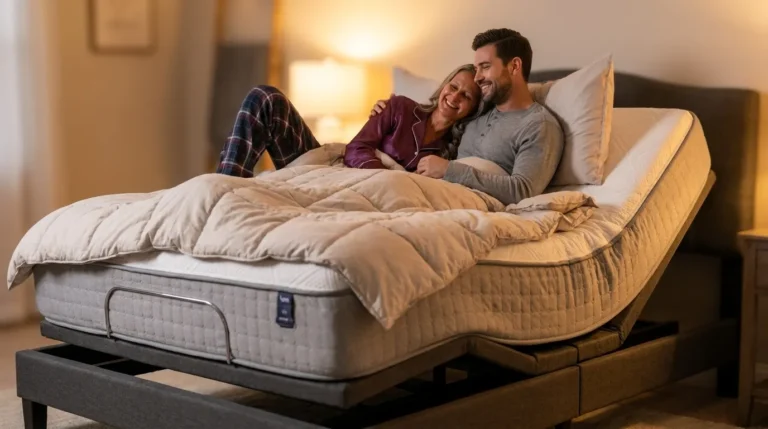
Zero-gravity positioning mirrors the posture NASA engineers identified as the least mechanically stressful for the body during launch. At roughly 120 degrees of hip flexion, gravitational shear forces across the L4–L5 and L5–S1 segments, the two most common sites of disc herniation and degenerative disc disease, drop significantly. Adjustable bases with a dedicated lumbar support pad let users fine-tune pressure directly beneath the lower back, which helps people whose pain concentrates at a specific vertebral level instead of spreading across the entire lumbar region.
Chronic lower-back pain sufferers often notice less morning stiffness when they sleep in this position. The elevated posture also reduces venous pooling in the legs, which can trigger restless leg sensations that fragment sleep and block the deep restorative stages where tissue repair occurs.
Split Queen vs. Single Base for Real-World Couples
A single adjustable base moves both sides of the mattress at once. When one partner needs zero-gravity elevation for lumbar pain and the other prefers a flat position, a single base forces a compromise that satisfies neither. Many couples eventually drift into what sleep researchers and relationship counsellors call “sleep divorce,” where partners move to separate rooms just to get enough rest.
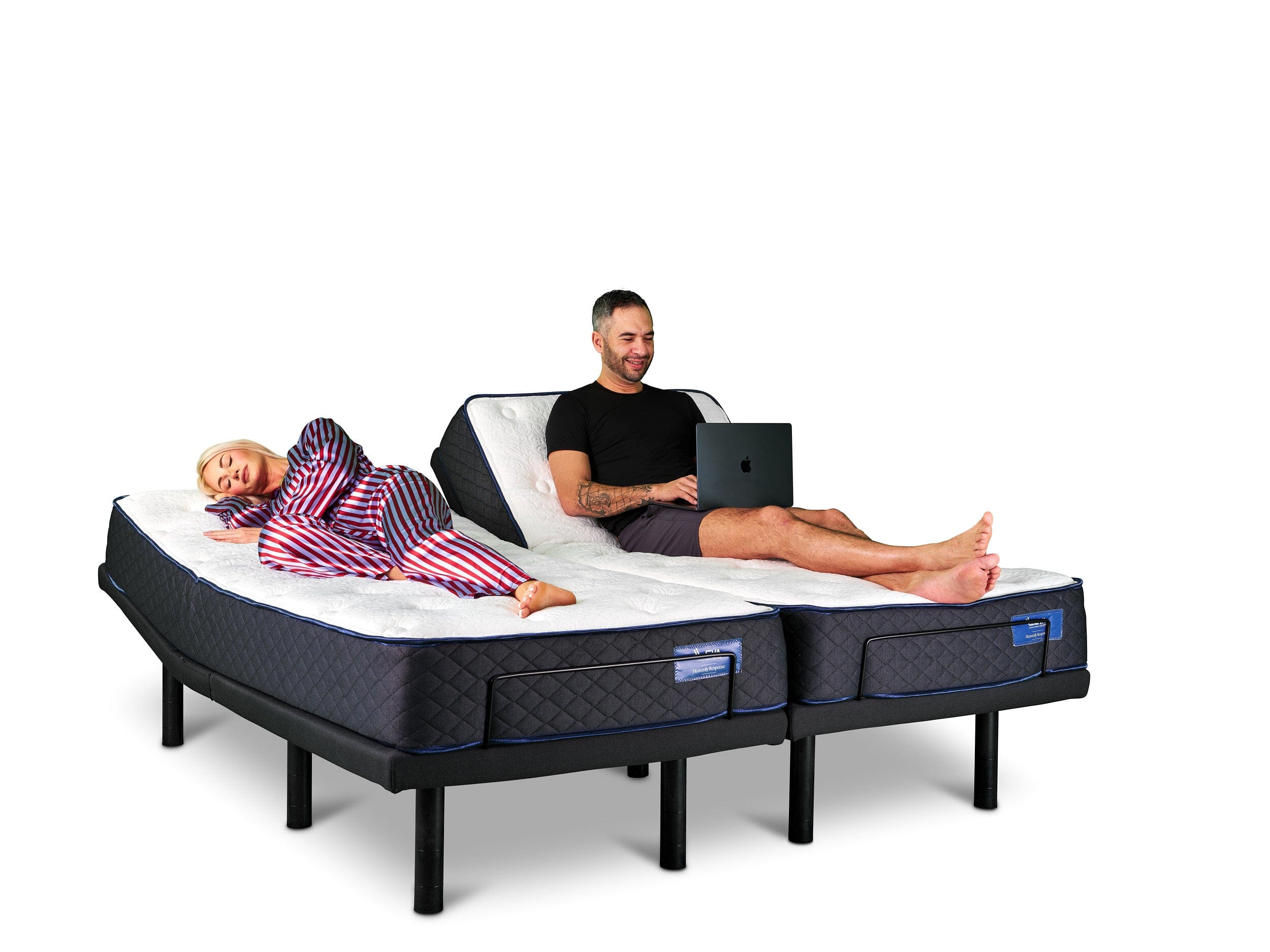
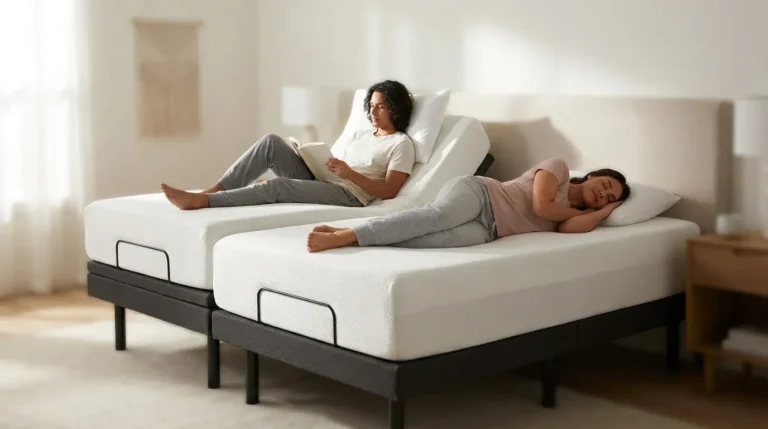
A Split Queen configuration places two independent narrow bases side by side within a standard queen-size footprint. Each side runs on its own motor system, so one partner can hold zero-gravity at 45 degrees of head elevation while the other lies completely flat. Massage intensity, lumbar support height, and anti-snore micro-adjustments stay independent through a shared app or individual remotes.
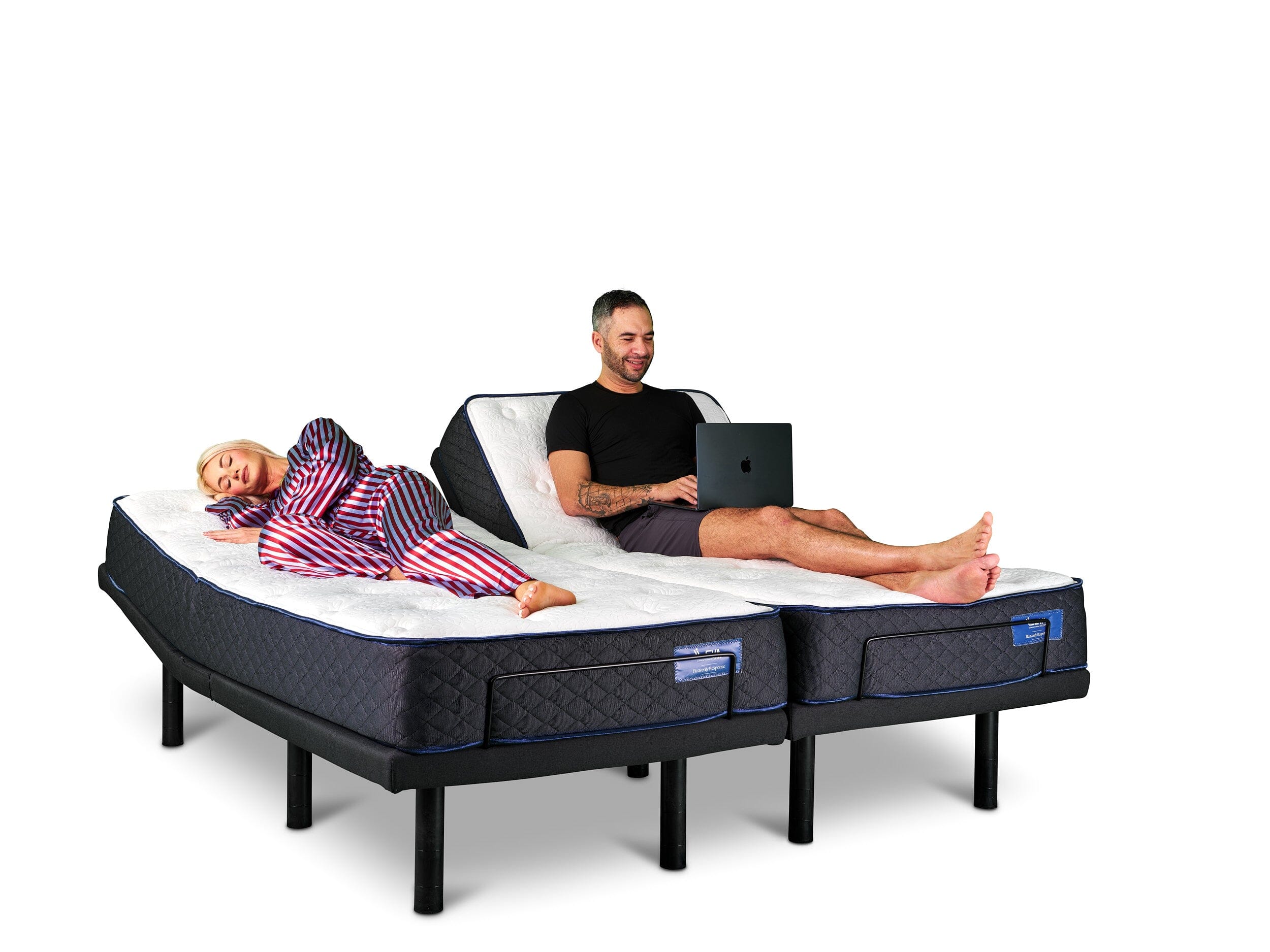
The main trade-off is a small centre gap between the two mattress halves. Manufacturers address this with a centre-fill foam strip or a mattress topper that bridges the seam. Couples who share a queen-size room and cannot fit a Split King, which needs more floor space, often find the Split Queen is the only setup that delivers full independent control without a room change or second bed.
Couples where one partner has a medical elevation requirement for sleep apnea, acid reflux, or post-surgical recovery and the other does not can keep a shared bed. A Split Queen lets the medically advised partner follow elevation instructions without sacrificing shared sleeping space.
2026 CAD Pricing Tiers and Long-Term Costs
Adjustable bed pricing in Canada spans a wide range based on motor quality, feature set, mattress type, and delivery model. The following table outlines general 2026 CAD market tiers for a queen-size adjustable sleep system, including base and mattress, and compares key features. All figures reflect publicly available retail positioning as of July 2026. Contact individual retailers for current promotional pricing.
| Feature | Leva Sleep Split Queen | Tempur-Pedic Ergo (Queen) | Silk & Snow Adjustable (Queen) |
|---|---|---|---|
| Approx. base + mattress (CAD) | $3,500–$7,000 | Premium | $2,500–$4,500 |
| Independent lumbar control | Yes | Yes (Ergo Max tier) | No |
| Whisper-quiet German motors | Yes | Not specified | Not specified |
| Anti-snore mode (spring 2026) | Yes | Yes (SleepTracker tier) | No |
| In-house white-glove delivery (ON & AB) | Yes (fee applies) | Via third-party carriers | Curbside or threshold |
Total cost of ownership includes more than the sticker price. Delivery and setup fees, replacement remote costs, proprietary mattress requirements, and the lack of split configurations that force a king-size room upgrade all add to the lifetime cost of a competing system. Leva Sleep’s vertically integrated model, which covers local design, assembly, and delivery, removes distributor and retailer markups and shapes its pricing position.
Mattress Types That Work for Pain Relief
Only certain mattress types bend safely with an adjustable base. Innerspring mattresses with connected coil systems resist flexion and can crack the coil border wire when repeatedly articulated. Compatible options fall into two main categories.
- All-foam mattresses: These flex freely at any elevation angle, conform closely to the body in elevated positions, and eliminate motion transfer between split sides. Medium-firm density, roughly 4–5 ILD on a 10-point scale, supports the lumbar region without creating pressure points at the hips and shoulders.
- Hybrid pocket-coil mattresses: Individual fabric-encased coils flex independently, so the mattress can articulate while keeping the responsive feel many back-pain sufferers prefer. The coil layer should be tall enough to provide zoned support beneath the lumbar region.
Leva Sleep designs its all-foam and hybrid pocket-coil mattresses specifically for use with its adjustable bases. This approach keeps the flex radius of the mattress aligned with the articulation arc of the motor system. Pairing a third-party mattress with an adjustable base without checking flex compatibility can void the mattress warranty and weaken lumbar support within the first year.
Medical Guidance on Elevation and Back Pain
Orthopaedic surgeons and physiatrists often advise patients with lumbar disc herniation, spinal stenosis, or degenerative disc disease to avoid long periods of flat supine positioning, which raises intradiscal pressure compared with a semi-reclined posture. Elevating the head of the bed to 30–45 degrees approximates the semi-Fowler position used in hospital beds for post-surgical lumbar patients.
Sleep medicine physicians treating obstructive sleep apnea frequently recommend positional therapy, which means elevating the head of the bed by at least 30 degrees, as a first-line adjunct to CPAP therapy or as a standalone approach for mild cases. Adjustable bases with anti-snore detection automate this elevation in response to detected snoring events and remove the need for manual repositioning during the night.
Gastroenterologists managing gastro-oesophageal reflux disease (GERD) have long recommended head-of-bed elevation as a non-drug intervention. An adjustable base delivers this elevation consistently every night without the instability of wedge pillows, which often shift during sleep.
People considering an adjustable base for a specific medical condition should consult a licensed physician or physiotherapist. A clinician can review lumbar imaging and prescribe a target elevation angle that matches the diagnosis.
Noise, Sheets, and Delivery Details That Matter
Most consumer complaints about adjustable beds focus on motor noise during position changes and fitted sheets that pop off the mattress corners when the base moves. The right system and accessories address both issues.
Motor noise mainly depends on motor quality and mounting isolation. Brushed DC motors, common in entry-level bases, generate audible hum and vibration that travel through the bed frame into the floor. Brushless motors with rubber-isolated mounting brackets run at much lower decibel levels. Leva Sleep specifies whisper-quiet German motors across its line, which helps light sleepers who adjust position during the night.
Sheet slippage occurs because standard fitted sheets are built for a flat mattress profile. When the head section rises to 45 degrees, the mattress surface area increases and the sheet corners lose tension. Practical solutions include:
- Deep-pocket fitted sheets with pocket depths of 14–18 inches (35–46 cm), depending on mattress thickness, and reinforced elastic that wraps the full perimeter of the mattress instead of just the corners
- Sheet suspender straps that clip diagonally across the underside of the mattress
- Duvet clips that keep the duvet from sliding toward the foot of the bed when the head section elevates
- Remote pockets sewn into the side of the fitted sheet or base skirt to keep remotes from falling between the mattress and the wall
Leva Sleep designs these accessories in-house for its adjustable bases. In-house white-glove delivery teams demonstrate sheet installation and remote placement during setup, which removes the trial-and-error period that frustrates buyers who assemble beds on their own.
Setup Features and Accessories to Check Before You Buy
Several setup features and accessories determine how comfortable and practical an adjustable sleep system feels over time. Shoppers should review leg height, controls, wall clearance, mattress retention, and warranty coverage before committing.
- Leg height adjustability: The base should offer multiple leg height options, often 15 cm, 20 cm, and 25 cm, so the finished bed height matches the user’s ability to get in and out safely. This detail matters for people with hip and knee pain.
- App and remote redundancy: A Bluetooth app adds convenience, while a physical remote keeps the bed usable during connectivity problems or when a phone is not nearby.
- Wall-clearance mode: Bases that move the mattress forward as the head section rises prevent the headboard from being struck, which helps in smaller Ontario and Alberta bedrooms.
- Mattress retention bar: A horizontal bar at the foot of the base keeps the mattress from sliding downward when the head section elevates.
- Warranty terms: Many systems provide multi-year coverage on motors and extended or lifetime coverage on frames, which affects long-term value.
Frequently Asked Questions
Do adjustable beds really help with back pain?
Adjustable beds can reduce lower-back pain for many users by allowing the spine to rest in a semi-reclined position that lowers intradiscal pressure compared with lying flat. The zero-gravity position reduces the mechanical load on the lumbar discs and lets the psoas muscle relax fully, using the angle described earlier. The degree of benefit depends on the underlying cause of the pain. Disc herniation and spinal stenosis often respond well to elevation, while some types of facet joint pain may need a flatter position. A physiotherapist or orthopaedic specialist can advise on the best elevation angle for a specific diagnosis.
What are the downsides of adjustable beds?
The main downsides involve cost, mattress compatibility, and sheet management. Quality adjustable bases with independent lumbar control and quiet motors cost more upfront than standard flat bases. Many existing mattresses do not work with articulating bases, which can mean buying a new mattress at the same time. Standard fitted sheets often slip off when the base elevates, so most owners switch to deep-pocket sheets. Split configurations introduce a small centre gap between the two mattress halves, which most users barely notice but some find disruptive. Adjustable bases also weigh more than standard frames, so room rearrangement becomes harder.
Is a Split Queen adjustable bed worth it for couples?
For couples with genuinely different sleep needs, such as one partner needing elevation for back pain, snoring, or reflux while the other prefers a flat position, a Split Queen delivers independent control without requiring a room upgrade. It removes the need to expand into a larger space to fit a Split King. The centre seam remains the main trade-off, but a centre-fill foam strip or a mattress topper usually bridges it effectively. Couples who share similar sleep preferences may find a single-base queen sufficient and less expensive.
What should I look for in a doctor-recommended adjustable bed for back pain?
Look for independent lumbar support that adjusts in height and firmness separately from head and foot elevation. A zero-gravity preset helps because it stores the clinically recommended elevation angle as a one-touch setting. Whisper-quiet motors matter if you or your partner change position during the night. Mattress compatibility with medium-firm foam or hybrid pocket-coil construction supports the lumbar region over time. The base should also include a wall-clearance function and a mattress retention bar, since both features affect long-term usability in a standard Canadian bedroom.
How does Leva Sleep compare to Tempur-Pedic for back pain relief in Canada?
Tempur-Pedic’s Ergo line offers strong pressure-relief mattresses and adjustable base integration, but the combined system typically retails at $7,000–$14,000 CAD or more for a queen configuration. Leva Sleep’s Split Queen systems sit in this mid-tier price range with comparable or superior adjustable base features, including independent lumbar control, whisper-quiet German motors, and anti-snore mode, along with in-house white-glove delivery in Ontario and Alberta. Tempur-Pedic’s adjustable bases sell through third-party retailers, which adds a distribution markup and can limit product-specific expertise at the point of sale. Leva Sleep’s specialist focus means its sales and delivery teams train exclusively on adjustable sleep systems instead of a broad furniture catalogue.
Conclusion: Matching an Adjustable System to Your Needs in 2026
The right adjustable sleep system for back pain relief in Canada in 2026 aligns with your lumbar diagnosis, your partner’s sleep preferences, your room size, and your full budget, including delivery and compatible bedding. Zero-gravity positioning with independent lumbar control addresses the mechanical drivers of lower-back pain more directly than a flat mattress or a single-base system that forces compromise. A Split Queen configuration solves the space and independence trade-off for couples in standard queen-size rooms. Whisper-quiet motors, purpose-designed sheets, and in-house white-glove setup remove many of the day-to-day frustrations that often overshadow otherwise capable systems.
For Ontario and Alberta couples comparing options, Leva Sleep offers 15–20 adjustable base models, compared with the 3–5 commonly stocked at general mattress retailers, along with local assembly, in-house white-glove delivery, and pricing positioned significantly below luxury competitors like Tempur-Pedic.