Written by: Matthew Timmins, Founder and Managing Director, Leva Sleep | Last updated: July 21, 2026
Key Takeaways for Canadian Shoppers
- Anti-snore mode elevates the head section 15–30 degrees to reduce airway collapse and snoring on adjustable beds.
- Three main mechanisms exist: automatic sensor detection, preset buttons, and app-controlled micro-adjustments like those on Leva Sleep bases.
- Split configurations, especially Split Queen, let each partner adjust independently, which suits couples with different snoring needs.
- Head elevation works best for positional snorers and does not replace CPAP in moderate to severe sleep apnea.
- Explore Leva Sleep’s adjustable bed packages with anti-snore mode and white-glove delivery in Ontario and Alberta at levasleep.com to find the right setup for your bedroom.
Automatic vs Preset vs Micro-Adjust Anti-Snore: Quick Comparison
The table below compares the three anti-snore mechanism types available on adjustable beds sold in Canada in 2026. All pricing is in CAD and reflects queen-size bases only. When comparing options, consider how the mechanism works, price range, known limitations, and whether split configurations are available.
| Feature | Automatic Detection | Preset Button | Micro-Adjust (e.g., Leva Sleep) |
|---|---|---|---|
| How it works | Built-in sensors detect snoring and raise the head while the sleeper remains asleep | User or partner presses remote to raise head to a stored 20–30° angle | App-controlled incremental adjustments of 2–3° made manually or via snore-detection logic |
| 2026 CAD price range (queen base only) | $2,000+ | $800–$2,000 | Contact Leva Sleep for current pricing |
| Known limitation | False triggers from coughing, traffic noise, or partner movement, plus a 3–5 minute response delay | Requires user or partner to be awake to activate | Requires compatible all-foam or hybrid pocket-coil mattress |
| Couple-friendly split option | Split King only (most brands) | Split King (most brands) | Split Queen and Split King (Leva Sleep) |
Choosing an Adjustable Bed That Actually Reduces Snoring
Research consistently identifies 20–30 degrees of head elevation as the effective range for snoring reduction; below 15 degrees the gravitational effect on the airway is insufficient, while above 35–40 degrees most people find the position uncomfortable for sustained sleep. The best adjustable bed for snoring reliably reaches and holds that range, runs quietly enough not to wake the non-snoring partner, and, for couples, allows each side to move independently.
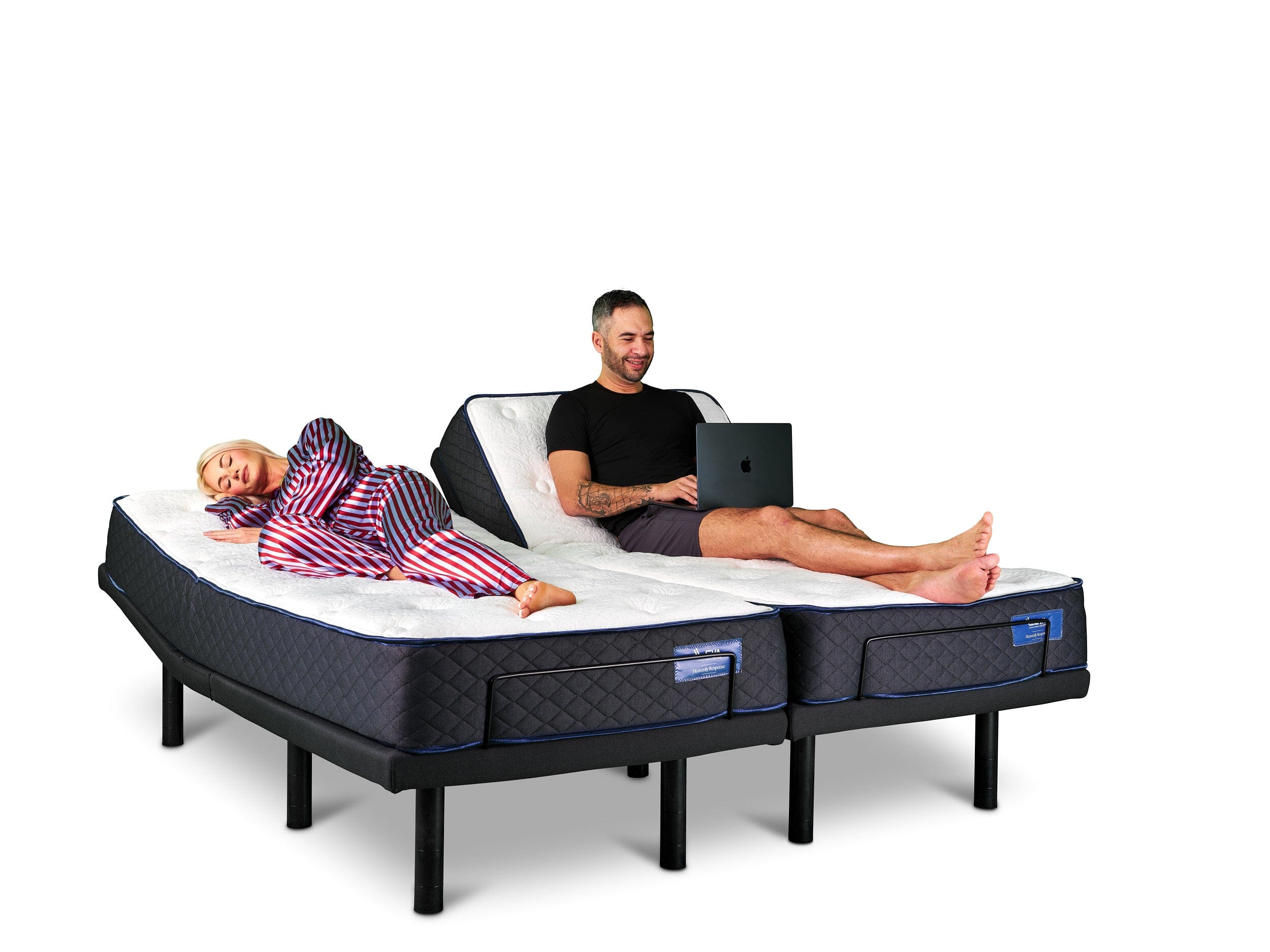
For couples, a split configuration becomes the key feature. In split-king adjustable bed setups, each side operates independently so one partner can program an anti-snore memory preset while the other remains flat, eliminating the need for shared angles. Leva Sleep extends this to a Split Queen format, a configuration not widely available from other Canadian retailers, which makes independent anti-snore positioning possible in smaller rooms.
When you compare bases, look for whisper-quiet motors under 45 dB during movement, a head elevation range of at least 0–45 degrees, programmable memory presets, and a mattress designed to flex with the base. Leva Sleep's spring-2026 anti-snore mode uses app-controlled micro-adjustments and is available on both Split Queen and Split King bases.
Do Anti-Snore Adjustable Beds Work?
Before you invest in an adjustable bed for snoring, it helps to see what clinical research shows about head elevation. A 2017 study of 52 patients with obstructive sleep apnea found that 7.5-degree head-of-bed elevation can reduce the apnea-hypopnea index and improve minimum oxygen saturation. Souza et al. (2017) in Sleep & Breathing tested 7.5° head-of-bed elevation in patients with OSA.
Multiple polysomnography studies find that many habitual snorers snore exclusively or predominantly in the supine position, so head elevation addresses the root positional cause for most snorers. Non-positional snorers, who snore in all positions, receive less benefit because their issue is anatomical rather than positional.
There are clear limitations to keep in mind. Adjustable beds can help mild sleep apnea cases or act as a supplement to CPAP therapy, but they are not a substitute for CPAP in moderate to severe obstructive sleep apnea. Dorothy Balicki, Sleep Specialist at Mattress Miracle, states: “Snoring can be a sign of obstructive sleep apnea, which has serious cardiovascular implications. An adjustable bed can help with the symptom, but if there is an underlying condition, it needs proper medical attention first.” Head-of-bed elevation may also be contraindicated in patients with lower limb edema and venous insufficiency; consulting a doctor before using positional therapy for diagnosed conditions is recommended.
Adjustable Bed Pricing in Canada, Including Delivery
In 2026, lifestyle adjustable beds with anti-snore presets cost approximately $1,000–$2,000 for a queen size in Canada, wellness models with adjustable lumbar support cost $2,000–$3,000, and homecare Hi-Lo models start at $3,000 and up. The table below summarises the four pricing tiers for queen-size bases.
| Tier | 2026 CAD Price Range (Queen Base) | Typical Features | Anti-Snore Type |
|---|---|---|---|
| Entry | $800–$1,200 | Basic head and foot elevation, remote | None or basic preset |
| Mid-range | $1,200–$1,800 | Massage, memory presets, USB ports, app control | Preset at 10–20° head elevation |
| Premium | $1,800–$2,500 | Wall-hugger mechanism, zero-gravity, advanced app, premium motor | Preset or micro-adjust |
| Luxury / Automatic Detection | $2,500–$3,500+ | Split-zone massage, sleep tracking, premium materials | Automatic sensor-based detection |
For context, the Tempur-Pedic TEMPUR-Ergo Extend Smart Base with automatic snore detection is a premium option. Leva Sleep's direct-to-consumer model and local Ontario and Alberta assembly allow it to offer comparable or superior feature sets at 30–50% less than brands at that price point.
Delivery adds a meaningful cost layer. White-glove delivery costs typically range from about $100 on the low end to several hundred dollars on the high end, varying by service level, location, and whether old mattress removal is included. Leva Sleep's in-house white-glove service covers delivery to the bedroom, full assembly, motor testing, leg-height adjustment, a product tutorial, and old-bed removal for customers in Ontario and Alberta.
Best Adjustable Configurations for Couples: Split Queen vs Split King
In Canada, a split king adjustable bed consists of two twin XL adjustable bases placed side by side, creating a 76 by 80 inch footprint identical to a standard king while allowing each side to operate independently. A Split Queen uses two narrower bases to achieve a 60 by 80 inch footprint, the same as a standard queen, which makes it the practical choice for couples in rooms that cannot accommodate a king.
Leva Sleep is one of the few Canadian retailers offering a Split Queen configuration built to customer specifications. This matters because queen remains the most popular adjustable bed size in Canada, but on a standard single-base queen both partners must adjust together, making split configurations preferable for couples with mismatched sleep preferences or anti-snore needs.
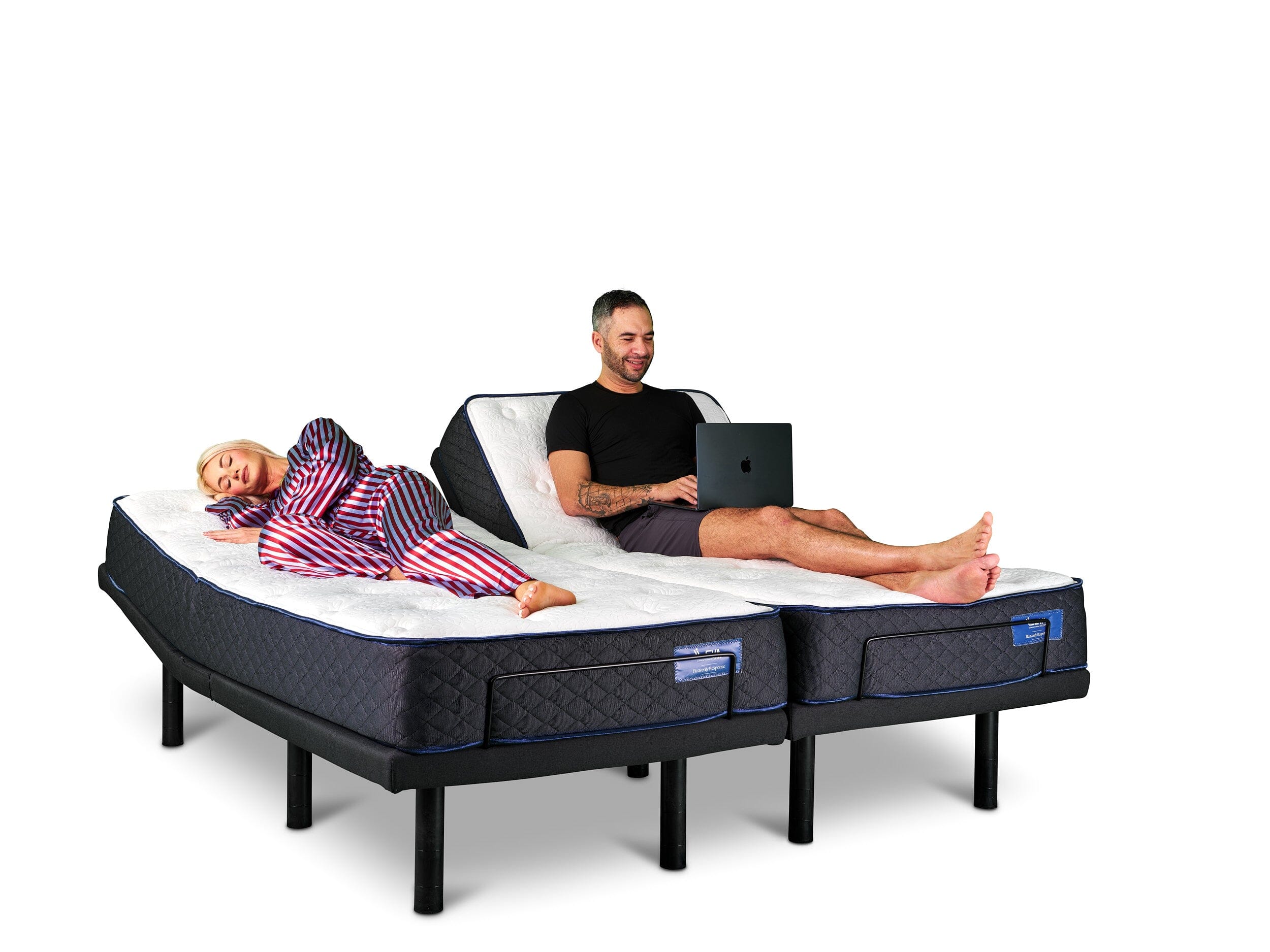
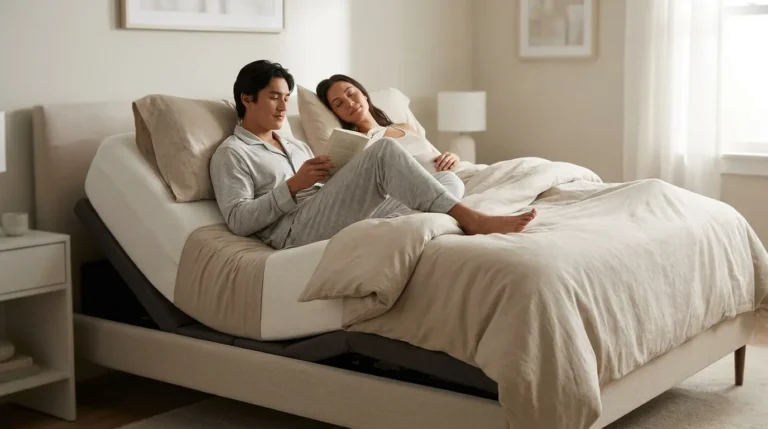
Independent controls mean one partner can activate anti-snore elevation while the other remains flat or uses a zero-gravity preset for back pain without any mechanical compromise to the other side. This setup directly addresses the “sleep divorce” dynamic that pushes many couples into separate rooms.
Key Buying Factors for Anti-Snore Adjustable Beds
Use the following criteria to evaluate any adjustable bed with anti-snore mode before purchasing. Start with the mechanical basics that affect reliability and noise.
- Motor noise: Budget adjustable bases under $800 in Canada often have louder motors (50–60 dB), while mid-range and premium bases use quieter motors that are less likely to wake a sleeping partner during adjustment.
- Motor count: Confirm the base includes both a head motor and a lumbar or pillow-tilt motor if independent lower-back support matters to you.
Next, confirm that your mattress and controls match how you plan to use the base.
- Mattress compatibility: Anti-snore elevation requires a mattress that flexes without damaging internal components. All-foam and hybrid pocket-coil mattresses are compatible, while traditional innerspring mattresses with connected coils are not.
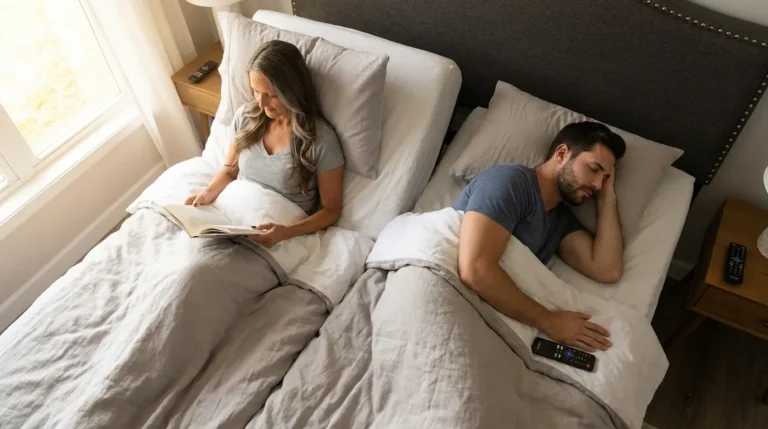
- App and remote control: Bluetooth app control allows quiet, one-tap preset activation without turning on lights. Verify that the app supports independent side control on split bases.
- Automatic detection vs preset: Automatic snore detection systems still produce false triggers from coughing, heavy breathing, traffic noise, or partner movement and may respond too slowly (3–5 minutes) or too aggressively, while a reliable preset at the effective elevation range delivers consistent results at lower cost.
Finally, review long-term support and logistics.
- Warranty: Compare warranty length and coverage tiers, since some warranties shift repair or transport costs to the customer after year one.
- Provincial delivery: Confirm the retailer offers white-glove service to your specific Ontario or Alberta location, not just to the province in general.
Setup, Accessories, and Day-to-Day Ownership
Leva Sleep's white-glove delivery service covers the full setup process for customers in Ontario and Alberta. A trained delivery team handles:
- Transport of the base and mattress directly to the bedroom
- Full assembly and electrical connection of all motors
- Leg-height adjustment to the customer's preferred bed height
- Motor and remote testing before the team leaves
- Product tutorial covering anti-snore mode, memory presets, and app pairing
- Removal and donation or recycling of the old bed
Ongoing ownership works best with a few practical accessories that solve problems unique to adjustable bases. Standard fitted sheets often pop off when the head section elevates, so Leva Sleep designs fitted sheets with deep pockets and extra elastic specifically for adjustable bases. For split configurations, duvet clips maintain separation between two duvets when the sides sit at different angles, which prevents one partner's duvet from sliding onto the other side. Remote pockets attach to the side rail for easy access without searching under pillows, and these accessories are designed as part of the Leva Sleep system rather than aftermarket add-ons.
Common Adjustable-Bed Mistakes to Avoid
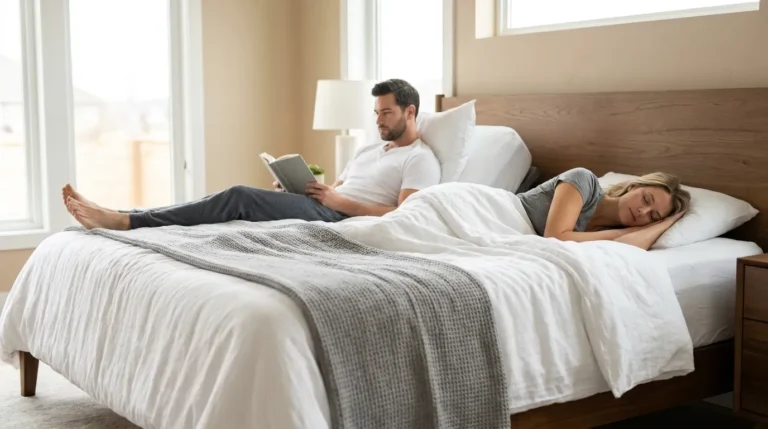
- Buying a single base for a couple: A single queen base moves both sides together, so one partner's anti-snore elevation becomes the other partner's forced incline. A split configuration is the only way to provide independent positioning.
- Ignoring delivery costs in the total price: A base priced $300 less than a competitor may cost more overall if white-glove delivery is not included. As noted earlier, white-glove delivery can add $100 to several hundred dollars to the total cost depending on service level and location. Factor in assembly, old-bed removal, and any applicable taxes before comparing sticker prices.
- Overlooking Split Queen availability: Most Canadian retailers stock Split King only. Couples in standard queen-sized rooms who assume a split option is unavailable may purchase a single-base queen or feel forced to upgrade to a king-sized room setup. Leva Sleep builds Split Queen bases to order.
- Skipping a sleep study for persistent snoring: Many adults in Canada are at risk for obstructive sleep apnea. An adjustable bed addresses positional snoring but does not diagnose or treat underlying OSA. A physician referral for a sleep study remains the appropriate first step when snoring is loud, frequent, or accompanied by pauses in breathing.
Conclusion: Matching Features to Your Snoring and Space
Selecting the best adjustable bed with anti snore mode in Canada in 2026 involves four core decisions: the anti-snore mechanism type, the split configuration, the total cost of ownership including white-glove delivery, and mattress compatibility. Clinical evidence supports head elevation of 15–30 degrees as an effective positional intervention for snoring reduction, with the strongest results in positional snorers. Automatic detection adds cost and introduces false-trigger risk, while a reliable preset or app-controlled micro-adjust system delivers consistent results at a lower price point.
Leva Sleep brings 8 years of adjustable-bed specialization, 25,000+ customers, local Ontario and Alberta assembly, and a direct-to-consumer model that prices comparable systems 30–50% below brands like Tempur-Pedic. The spring-2026 anti-snore mode, Split Queen availability, whisper-quiet motors, and in-house white-glove delivery address every gap identified in this guide.
Frequently Asked Questions
Does anti-snore mode on an adjustable bed work for sleep apnea?
Anti-snore mode on an adjustable bed elevates the head section to reduce the gravitational collapse of soft tissue in the airway, which is the physical mechanism behind positional snoring and a contributing factor in mild obstructive sleep apnea. Clinical studies have documented meaningful reductions in apnea-hypopnea index scores at head elevations between 15 and 30 degrees, with roughly 60% of patients with mild to moderate OSA responding positively to positional therapy. However, an adjustable bed is not a medical device and does not replace CPAP therapy for moderate to severe obstructive sleep apnea. It works best as a non-invasive positional aid that can complement prescribed treatment or address positional snoring in people without a diagnosed condition. Anyone experiencing loud, frequent snoring with pauses in breathing should consult a physician and request a sleep study before relying on an adjustable bed as a primary intervention.
What is the difference between a Split Queen and a Split King adjustable bed?
A Split King uses the two-Twin-XL configuration described earlier in this guide, producing the same 76 by 80 inch footprint as a standard king. Each base operates independently with its own remote and motor, so each partner can set a different head elevation, foot elevation, or anti-snore preset. A Split Queen uses two narrower bases to achieve a 60 by 80 inch footprint, which matches a standard queen mattress and suits couples in rooms that cannot accommodate a king-sized setup. Both configurations provide the independent control that prevents one partner's anti-snore elevation from affecting the other side. Leva Sleep is one of the few Canadian retailers that builds Split Queen bases to order, which matters for couples in standard-sized bedrooms in Ontario and Alberta.
Is white-glove delivery worth the cost for an adjustable bed in Canada?
Adjustable beds are significantly heavier and more mechanically complex than standard flat bases. A queen-size adjustable base typically weighs between 90 and 140 pounds before the mattress is added, and the setup involves connecting multiple motors, programming remotes, pairing Bluetooth apps, and adjusting leg heights. White-glove delivery handles all of this in a single appointment and includes testing every function before the team leaves. For a split configuration, two bases and two mattresses must be assembled and aligned correctly. The cost of white-glove delivery in Canada ranges from roughly $100 to several hundred dollars depending on the retailer and location. Leva Sleep's in-house white-glove service for Ontario and Alberta customers also includes old-bed removal and a product tutorial, which adds practical value beyond basic assembly. For most couples purchasing a split adjustable system, the time, physical effort, and risk of incorrect setup make white-glove delivery a sound part of the total investment.
How do I know if my mattress is compatible with an anti-snore adjustable base?
An adjustable base requires a mattress that can flex repeatedly through a range of angles without damaging its internal structure. All-foam mattresses and hybrid mattresses with individually wrapped (pocket) coils are compatible because neither construction relies on a rigid interconnected support system. Traditional innerspring mattresses with connected coil units are not compatible and will be damaged by repeated articulation. Memory foam, latex foam, and gel foam mattresses all flex appropriately. When you purchase a Leva Sleep adjustable base, the company's mattresses, available in all-foam and hybrid pocket-coil formats, are designed specifically to work with its bases so the flex geometry, edge support, and cover materials all accommodate the full range of anti-snore and zero-gravity positions without slipping or bunching.
Can one partner use anti-snore mode without disturbing the other on a Leva Sleep split base?
Yes. On a split adjustable base, each side has its own motor, remote, and memory presets. One partner can activate anti-snore elevation, raising their head section to 20–30 degrees, while the other side remains completely flat or in any other position. The motors on Leva Sleep bases are engineered for quiet operation, so the adjustment itself is unlikely to wake a sleeping partner. The Leva Sleep app allows preset positions to be saved and activated with a single tap, which means the adjustment can be made in the dark without fumbling with a physical remote. Leva Sleep's spring-2026 anti-snore mode adds app-controlled micro-adjustments that make incremental changes rather than a single large movement, which further reduces the chance of disturbing the non-snoring partner during the adjustment.