Written by: Matthew Timmins, Founder and Managing Director, Leva Sleep | Last updated: July 15, 2026
Key Takeaways
- Split adjustable bases with independent head elevation can reduce snoring at 7–30° inclines so couples keep sharing a bed.
- Split King and Split Queen systems give each partner full positional control, which helps avoid separate rooms due to snoring or firmness conflicts.
- Clinical studies show head-of-bed elevation between 7–30° can reduce AHI by up to 32% and improve deep sleep with a neutral neck position.
- Leva Sleep offers Split Queen configurations, white-glove delivery in Ontario and Alberta, and mattresses designed specifically for adjustable bases.
- Explore Leva Sleep’s adjustable bed packages to choose a Split King or Split Queen setup that supports better sleep together.
How adjustable bases reduce snoring
Souza et al. (2017) found that 7.5° head-of-bed elevation reduced AHI by an average of 31.8% in patients with obstructive sleep apnea. Ravesloot et al. (2017) in Sleep and Breathing described positional therapy as undervalued for snoring and mild-to-moderate OSA. A 2022 PMC study recorded a 7% reduction in objective snoring duration, 4% fewer awakenings, and a 5% increase in deep sleep at a 12° incline. Across studies, clinical data shows snoring reduction at torso elevation angles of 7–15°.
For nightly comfort, many sleep specialists recommend a working range of 20–30°. This range strengthens the gravitational effect on the airway while staying comfortable for sustained sleep. Angles below 7° provide little airway benefit, and angles above 35–40° often feel too steep to maintain through the night. Raising the head with an adjustable base, instead of stacking pillows, keeps the neck neutral and avoids forward flexion that can worsen airway collapse.
Why split bases work better than single adjustable kings for couples
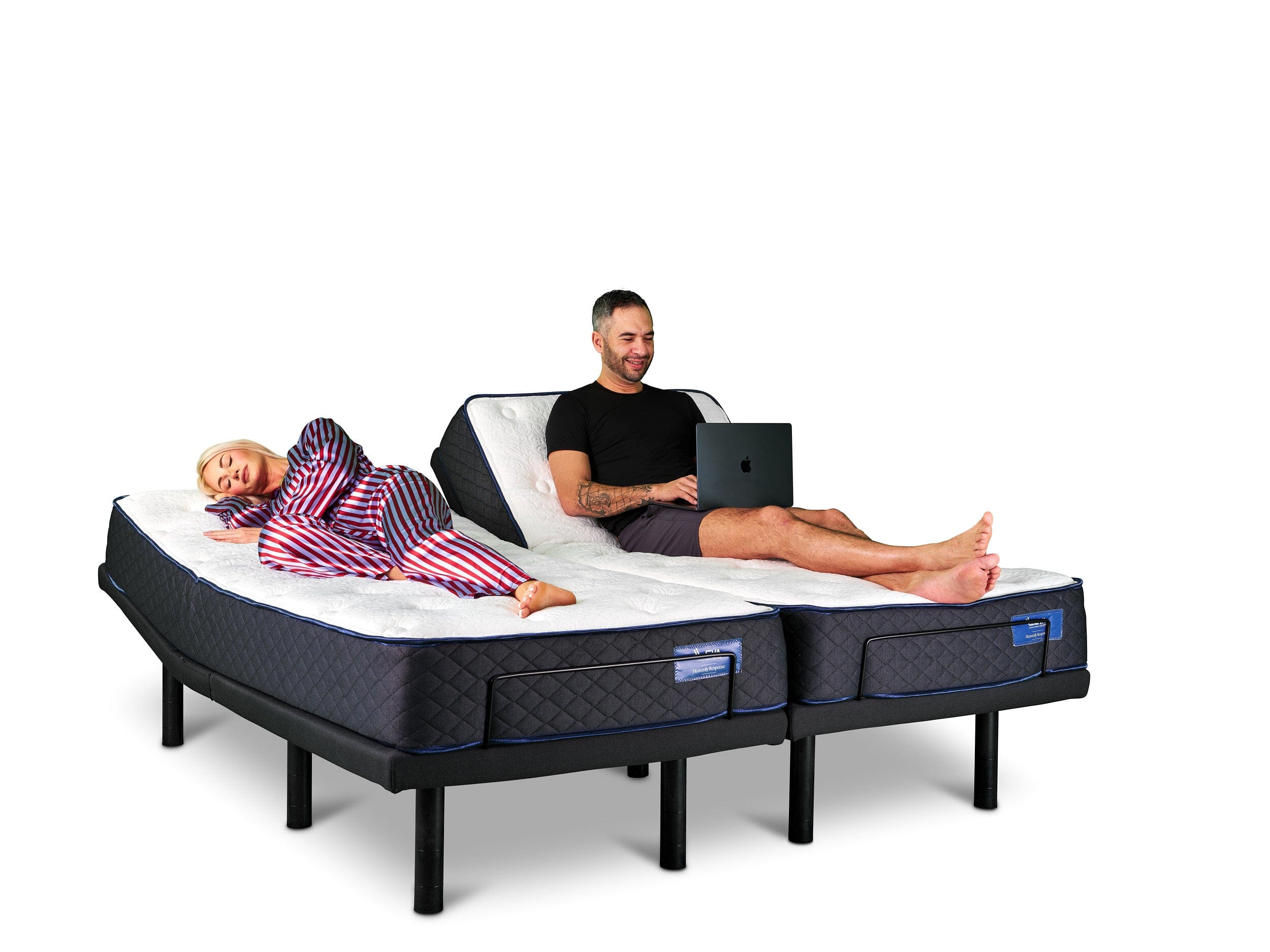
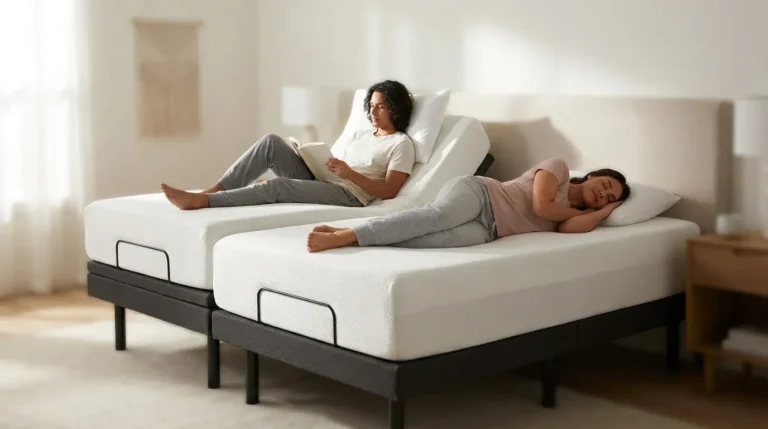
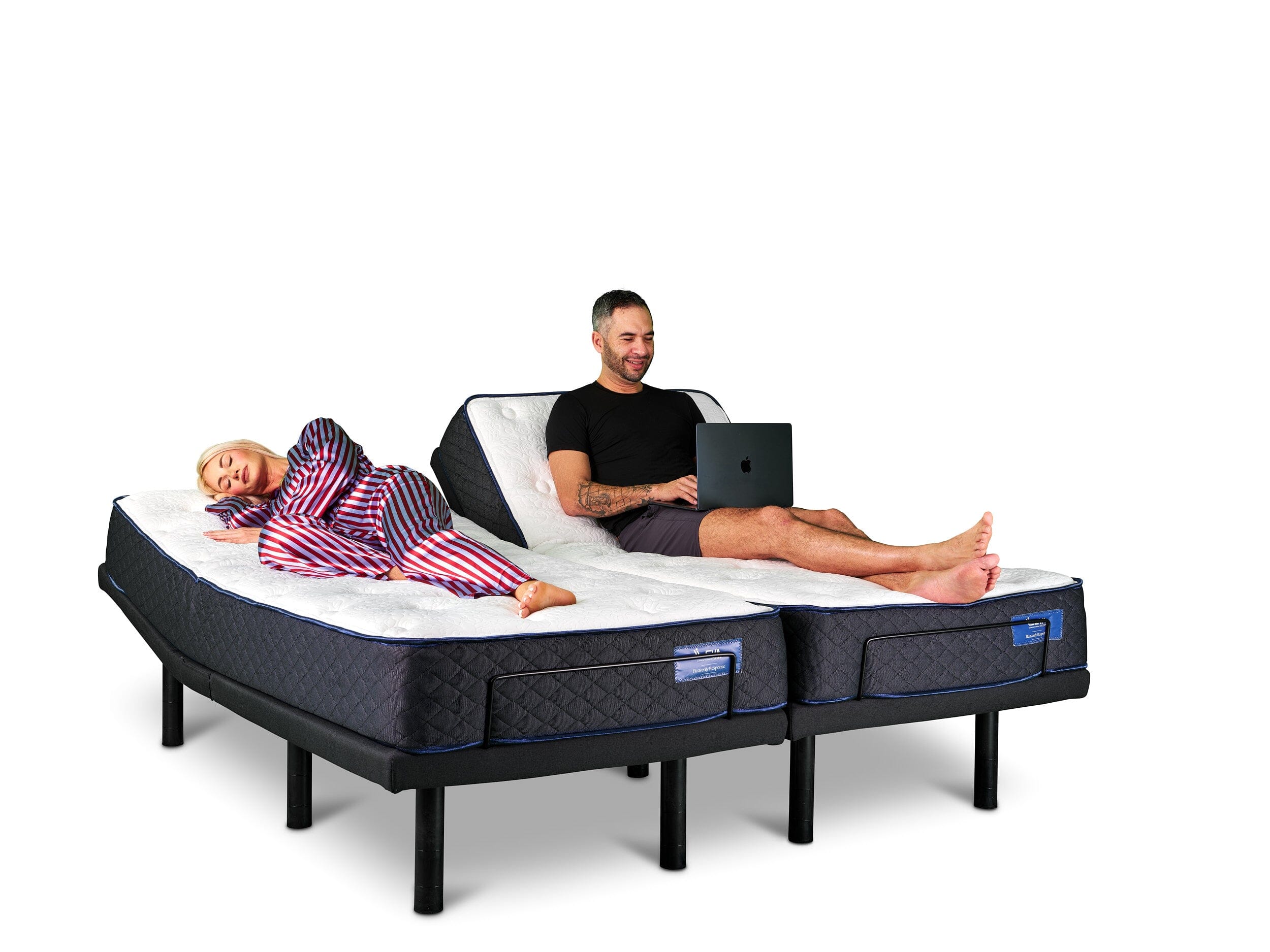
Split bases outperform single adjustable kings because each partner controls head and foot elevation independently. On a single adjustable king, raising one side raises both, so the non-snoring partner must accept an incline they may not need. A split system solves this by allowing the snoring partner to maintain a 20–30° anti-snore incline while the other sleeps flat.
Each side has its own mattress and motor, which prevents motion transfer when one partner changes position. Couples can also choose different mattress firmness levels on each half without affecting the other side. This combination of independent elevation and firmness helps many couples stay in the same room instead of moving to separate beds.
Compare Split King and Split Queen configurations to find the setup that fits your room and sleep preferences.
Split King vs Split Queen: sizes, prices, and room fit
The table below compares five Canadian-market options on size, starting bundle price in CAD, and Split Queen availability. Leva Sleep is listed first. All pricing reflects publicly available 2026 data.
| Brand | Split Configuration | Starting Price (CAD) | Split Queen Available |
|---|---|---|---|
| Leva Sleep | Split Queen & Split King | $3,199 (Split King bundle) | Yes — unique Canadian offering |
| Orthex (Sophia line) | Split King | ~$2,400+ (estimated) | Not confirmed |
| Silk & Snow | Single adjustable base | ~$1,299 (queen base) | No |
| Douglas | Single adjustable base | ~$2,199 (Split King bundle with Douglas Foam) | No |
| Tempur-Pedic (TEMPUR-Ergo Smart 2.0) | Split King | Premium pricing (queen base alone) | No |
A Split King measures 76 × 80 inches, using two Twin XL bases side by side, and matches a standard king footprint. A Split Queen, Leva Sleep’s distinctive offering, fits a standard queen footprint while still delivering independent control per side. This makes a Split Queen a strong option when a king-size frame feels too large for the room.
Mattress pairing rules for motion isolation on split bases
Correct mattress pairing protects warranties and preserves the clinical benefit of head elevation. Dorothy Balicki, Sleep Specialist at Mattress Miracle, notes that the most common mistake is placing an old innerspring mattress on an adjustable base. Within months, the mattress can be damaged and the warranty void.
Compatible mattress types for split adjustable bases:
- All-foam (memory foam or polyfoam): Bends smoothly along the full length, contours to new angles, and contains no rigid internal components.
- Pocket-coil hybrids: Individually wrapped coils flex section by section; avoid any model with border wire or perimeter rods.
- Natural latex: Flexible and durable; split-layer constructions perform better than a single thick latex core.
Mattress types to avoid:
- Continuous-coil or Bonnell innersprings: The interconnected steel grid resists bending and can deform under repeated articulation.
- Mattresses over 14 inches thick: Reduce range of motion and increase bending stress at hinge points.
- Pillow-tops with rigid border rods: These fight the hinge mechanism and can crack over time.
The optimal thickness range is 8–12 inches. Manufacturer certification for adjustable-base compatibility is the most reliable indicator that a mattress has been tested through repeated articulation cycles. Leva Sleep designs its own all-foam and pocket-coil hybrid mattresses for its adjustable bases, which removes compatibility guesswork.
2026 anti-snore detection technology updates
In 2026, buyers choose between manual anti-snore presets and automatic snore-detection systems. The table below compares the main options.
| Feature | Leva Sleep (Spring 2026 Detection Mode) | Tempur-Pedic TEMPUR-Ergo Smart 2.0 | Manual Preset Bases |
|---|---|---|---|
| Detection method | App-integrated snore detection with micro-adjustments | Sleeptracker-AI® Snore Response™ (~12° auto-raise) | User-set preset angle (no sensor) |
| Starting price (CAD) | Lower than Tempur-Pedic equivalent | Premium pricing (queen base) | $900–$1,800 (mid-range queen) |
| Split configuration available | Yes — Split Queen & Split King | Split King only | Varies by brand |
Automatic snore detection typically adds $500–$1,500 CAD to base cost and introduces another potential failure point in the sensors. Many users disable automatic modes after a few months because coughing, traffic noise, or partner movement can trigger unwanted adjustments. Manual presets avoid this issue because the position is set once at sleep onset and does not change in response to sound.
Leva Sleep’s spring-2026 detection mode offers automatic response at a lower price than Tempur-Pedic’s equivalent, while its manual anti-snore preset remains the most dependable choice for nightly use.
White-glove delivery for split systems in Ontario and Alberta
Split adjustable systems involve two bases, two mattresses, connector straps, and app pairing, so setup goes beyond a standard drop-ship delivery. Leva Sleep’s in-house white-glove service, available for a fee in Ontario and Alberta, includes:
- Delivery directly to the bedroom, not just the front door.
- Full assembly of both bases and mattresses with frame alignment verified.
- Leg-height adjustment to match existing bedroom furniture.
- Independent operation testing for each side’s remote and app connection.
- A product tutorial covering anti-snore presets, zero-gravity, and massage settings.
- Removal and donation or recycling of the old bed.
Split king configurations particularly benefit from white-glove delivery because on-site testing of independent operation and frame alignment is especially valuable when two bases must work in concert.
If you live in Ontario or Alberta, add white-glove delivery at checkout so Leva’s team can handle setup and removal for you.
How split adjustable beds help couples avoid sleep divorce
The sleep divorce rate among U.S. adults reached 35% in 2023 and nearly 31% in 2025, with adults aged 35–44 most likely to sleep separately. Leva Sleep customers often report the opposite pattern. Three anonymized Canadian couple stories show how split systems help.
A couple in Mississauga, Ontario, where one partner had mild positional OSA, slept in separate rooms for two years after a doctor recommended head elevation. After installing a Leva Split King, the partner with OSA maintains a 25° incline nightly while the other sleeps flat. Both report uninterrupted sleep, and they have shared a bed consistently for more than a year.
A Calgary couple in their late 50s faced a firmness conflict. One partner preferred a firm surface for lower back support, while the other needed a softer feel after hip surgery. A Leva Split Queen with two different mattress firmness levels on each half resolved the conflict without a room change.
A Toronto couple dealing with loud habitual snoring tried wedge pillows and nasal strips without success. The snoring partner now uses Leva’s anti-snore preset at 20° each night. The non-snoring partner reports sleeping through the night for the first time in years and credits the system with easing resentment that had built up around disrupted sleep.
Drawbacks to consider with adjustable beds
Adjustable bases carry real trade-offs that buyers should weigh before purchasing:
- Cost: Quality queen adjustable bases in Canada range from $900 to $3,500+ CAD, and split configurations require two units.
- Mattress replacement: Existing innerspring mattresses are usually incompatible and must be replaced, which increases upfront cost.
- Bedding adjustments: Split king setups require two Twin XL fitted sheets. Leva Sleep designs bedding accessories that fit these configurations.
- Centre seam: Split configurations have a visible seam and bases can drift apart without a connector strap.
- Warranty complexity: Frame warranties often run 10 to 20 years, while motors and electronics have shorter coverage, so anti-snore and massage features may not be covered as long.
- Motor noise: Basic or older bases can produce disruptive motor sounds. Leva Sleep uses whisper-quiet German motors to reduce this.
Best mattress types for adjustable bases
The most suitable mattress for an adjustable base is explicitly certified as adjustable-base compatible, measures 8–12 inches high, and uses all-foam or pocketed-coil hybrid construction. Good Housekeeping Institute testing of more than 250 mattresses found that foam and hybrid models usually perform best because they flex with the base to maximise elevation.
For split configurations, each half of the base needs its own mattress, such as two Twin XL units for a Split King or two custom-width units for a Split Queen. Pairing the mattress and base from the same manufacturer, as Leva Sleep enables, simplifies compatibility checks and protects both warranties.
How effective head elevation is for snoring
A 2017 study of 52 patients with mild to moderate OSA found that 7.5° head-of-bed elevation decreased AHI from 15.7 to 10.7 events per hour, a 32% reduction, and improved minimum oxygen saturation. A multicenter observational study reported a mean AHI reduction of 31% with head-of-bed elevation.
Most sleep specialists recommend 10–30° of head elevation, with 10–15° for light snoring and 20–30° for moderate to heavy snoring. Elevation works by using gravity to pull the soft palate away from the back of the throat, which reduces tissue collapse and snoring sound. Extra pillows do not match this effect because they flex the neck forward and can worsen airway narrowing for some people.
How to choose the right split adjustable system
Use the following criteria to identify the right split adjustable system:
- Bedroom size: A Split Queen fits a standard queen footprint and suits rooms where a king frame feels crowded. A Split King needs space for a 76 × 80-inch frame.
- Primary sleep issue: Snoring and positional OSA call for a base with a reliable anti-snore preset at 20–30°. Differing firmness needs call for separate mattresses on each half.
- Technology preference: Manual presets provide consistent, predictable anti-snore positioning. Automatic detection adds cost and potential false triggers, so consider whether that trade-off fits your habits.
- Mattress compatibility: Confirm the mattress is certified for adjustable bases, measures 8–12 inches, and uses all-foam or pocket-coil hybrid construction.
- Delivery and setup: Split systems benefit from professional alignment and testing. White-glove delivery in Ontario and Alberta removes this setup work.
- Budget: Leva Sleep Split King bundles start at $3,199 CAD, often 30–50% lower than comparable luxury-brand configurations, with professional installation included.
Leva Sleep has served more than 25,000 Canadian customers over eight years, with $50M in lifetime sales and a catalogue of 15–20 adjustable models. This level of specialisation means recommendations are based on adjustable-base expertise rather than general furniture sales.
Review Leva Sleep’s adjustable bed packages to compare Split Queen and Split King options, confirm mattress pairings, and schedule delivery.
Frequently Asked Questions
What is the difference between a Split Queen and a Split King adjustable bed?
A Split King uses two Twin XL adjustable bases placed side by side, creating a 76-inch width that matches a standard king bed frame. Each Twin XL base operates independently, so each partner controls head elevation, foot elevation, massage, and lumbar settings. A Split Queen follows the same independent-control principle but fits within a standard queen footprint, which suits bedrooms that cannot accommodate a king frame. Leva Sleep is one of the few Canadian retailers offering a Split Queen configuration built to customer specifications, which matters in a market where many homes favour queen-size rooms.
Can a split adjustable base help if only one partner snores?
A split adjustable base fits this situation very well. The snoring partner can set their side to a 20–30° anti-snore incline, the range associated with snoring reduction, while the non-snoring partner sleeps flat. Because the two bases do not share a hinge and each side has its own mattress, movement on one side does not disturb the other. This is the core advantage of a split system over a single adjustable king, where raising one side raises both. Leva Sleep’s anti-snore preset, available through the app, lets the snoring partner activate the correct elevation at bedtime without manual fine-tuning.
Does Leva Sleep offer white-glove delivery for split adjustable bed packages?
Leva Sleep provides in-house white-glove delivery for a fee in Ontario and Alberta. The service covers bedroom delivery, full assembly of both bases and mattresses, leg-height adjustment, independent operation testing for each side’s remote and app connection, a product tutorial, and removal of the old bed through donation or recycling. For split configurations, professional on-site setup is especially valuable because two bases must be aligned, connected, and verified before the system performs as intended. Leva Sleep’s delivery team trains specifically on its own products, which differs from a general third-party logistics crew.
What mattress should I buy for a Leva Sleep split adjustable base?
Leva Sleep designs its own all-foam and pocket-coil hybrid mattresses for use with its adjustable bases, which creates the simplest and most reliable pairing. If you consider a third-party mattress, it should be explicitly certified as adjustable-base compatible, fall within 8–12 inches of total height, and use all-foam or individually pocketed coils. Avoid continuous or Bonnell coil systems, rigid border rods, and stiff pillow-top constructions, which resist bending and can deform under repeated articulation. Leva Sleep also carries mattresses from Tempur-Pedic, Simmons, Beautyrest, Serta, and Kingsdown with confirmed compatibility.
How does Leva Sleep’s pricing compare to Tempur-Pedic for a split adjustable system?
Leva Sleep’s Split King bundles start at approximately $3,199 CAD, including a compatible mattress and professional installation. A comparable Tempur-Pedic setup uses the TEMPUR-Ergo Smart 2.0 base, which sits at a higher price point for a queen size before adding a mattress or split-king upgrade. Leva Sleep’s direct-to-consumer model, local assembly, and vertically integrated supply chain reduce retail markup, which creates an estimated 30–50% price advantage on similar specifications. Tempur-Pedic’s top-tier base includes Sleeptracker-AI automatic snore detection, which carries known false-trigger limitations. Leva Sleep’s spring-2026 detection mode offers comparable automatic response at a lower price, while its manual anti-snore preset remains the most reliable option for nightly use.