
Written by: Matthew Timmins, Founder and Managing Director, Leva Sleep
Key Takeaways
- Traditional flat mattresses cannot support two different sleep needs at once, such as head elevation for snoring and per-side temperature control.
- Split adjustable sleep systems give each partner fully independent controls for head, foot, lumbar, and temperature settings, with no impact on the other sleeper.
- Canadian-made systems provide practical benefits like local assembly, faster warranty response, and true white-glove delivery in provinces such as Ontario and Alberta.
- Smart evaluation focuses on motor noise, mattress durability under flex, medical positioning range for apnea or pain, and compatibility with per-side thermal regulation.
- Leva Sleep offers purpose-built adjustable bed packages designed specifically for couples who want better sleep together.
The Everyday Reality of Sleep Conflict
Sleep conflict between partners usually develops slowly, not as a single crisis. One person nudges the other at 2 a.m., or one side of the bed always feels warmer. Over months, these small disruptions add up. One partner starts going to bed earlier to fall asleep before the snoring begins. The other resents being woken by movement. A guest room eventually becomes the default solution, a pattern sleep clinicians call sleep divorce.
The root causes are physiological and rarely negotiable. Snoring relates to airway structure. Joint pain depends on body position. Each person regulates body temperature during sleep independently. A flat, static mattress cannot adapt to these variables for two people at the same time. Understanding why couples struggle on traditional beds sets up the case for a different kind of system.
Section 1: Why Traditional Beds Fail Couples
Traditional flat mattresses are built around a single, averaged comfort profile. They cannot elevate one side of the bed while keeping the other flat. They cannot manage temperature independently on each side. They offer no positional adjustment for a partner who has been advised by a physician to sleep with the head elevated to help manage obstructive sleep apnea or acid reflux.
The impact shows up in daily life. Couples experience daytime fatigue and increased irritability. In situations involving sleep apnea, cardiovascular risk can rise. Sleep apnea clinics in Canada regularly refer patients toward positional sleep interventions, including elevated head positioning, as a complement or alternative to CPAP therapy for mild-to-moderate cases. A flat mattress removes that option entirely.
Temperature mismatch creates another layer of conflict. Partners who sleep at different thermal comfort levels cannot both stay comfortable on the same static sleep surface. Without independent temperature regulation built into the bed itself, one person ends up too warm while the other feels too cold.
Section 2: Where Mattress-First Brands and Basic Bases Fall Short
Several well-known Canadian mattress brands now offer adjustable base compatibility or bundled bases as an add-on. These options differ significantly from a purpose-built split adjustable system. The table below highlights key differences in features and service levels.
| Feature | Flat Mattress (e.g., Endy, Douglas) | Add-On Adjustable Base (e.g., Logan & Cove, Silk & Snow) | Purpose-Built Split Adjustable System |
|---|---|---|---|
| Independent per-side control | None | Limited or single-zone only | Full independent head, foot, lumbar per side |
| Split Queen availability | No | Not offered | Available as a purpose-built configuration |
| Motor noise | N/A | Varies, basic motors can be audible | Whisper-quiet motors engineered for sleep environments |
| White-glove delivery | Bed-in-a-box, customer assembles | Typically curbside or threshold only | In-home setup, height adjustment, old bed removal |
Mattress-first brands treat the adjustable base as an accessory rather than the core of the system. Their mattresses are not always engineered to flex repeatedly under elevation cycles. Their bases often provide a single motor zone across the full width, so one partner’s adjustment changes the other partner’s position. A Split King uses two Twin-XL bases combined to King width, which creates the correct structure for independent control. Split Queen configurations suit smaller rooms, yet most mattress-first retailers do not offer them.
Section 3: Canadian-Made Split Adjustable Sleep Systems
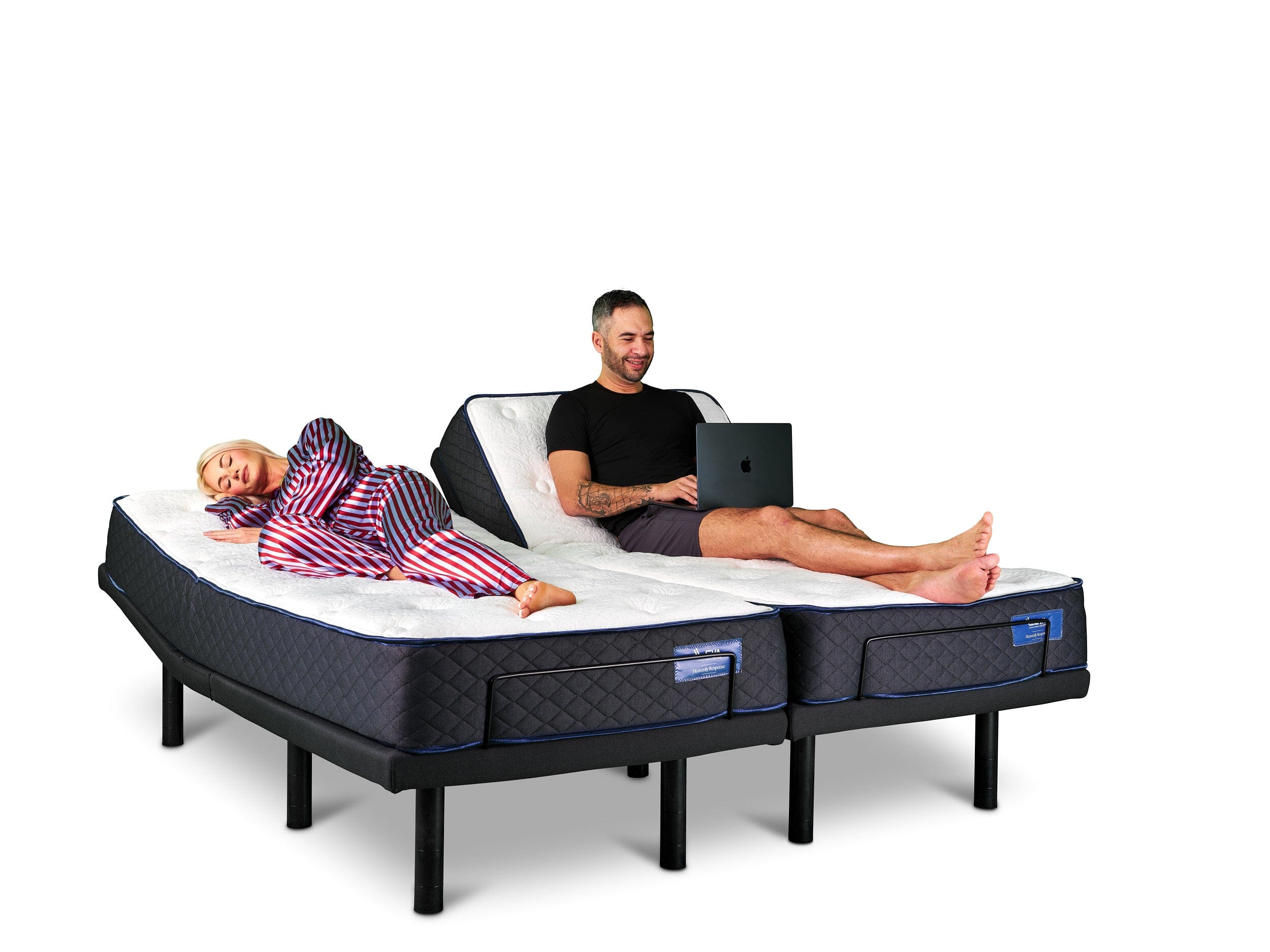
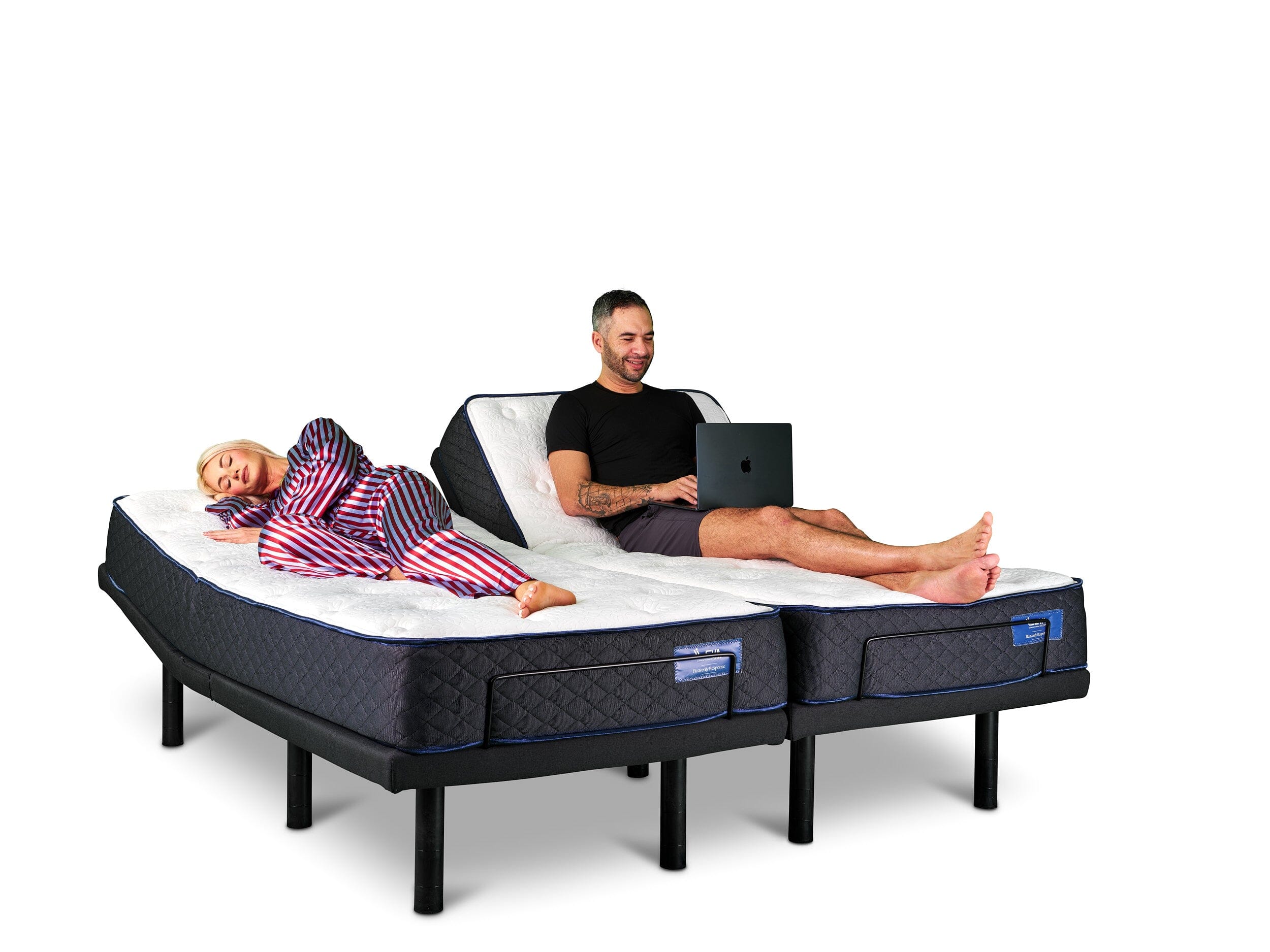
A split adjustable sleep system belongs to a distinct product category, separate from a mattress with an optional base. It uses two independent motorized bases, one for each partner, inside a shared frame. These bases support mattresses that are specifically engineered to flex under repeated articulation without breaking down.
Each side operates on its own controls. Head elevation, foot elevation, lumbar support, and pillow tilt adjust separately through an app or remote. Temperature regulation pads, when included, run per side. Anti-snore modes on advanced 2026 systems detect snoring acoustically and make small head-position changes for the snoring partner without waking them or disturbing the other sleeper.
Canadian-made systems add practical advantages. Local assembly supports tighter quality control. Warranty service can move faster. Delivery infrastructure supports true white-glove setup in regions such as Ontario and Alberta instead of simple curbside drop-off.
Section 4: How to Evaluate a Split Adjustable System
Independent Adjustability for Each Partner
- Confirm each side has its own motor set for head, foot, and lumbar at minimum, since shared motors limit true independence.
- Verify that app or remote controls operate each side separately so one partner’s adjustments do not change the other partner’s position.
- Ask whether custom position presets can be saved per partner, which saves time and avoids nightly readjustment.
Noise and Motor Quality
- Request decibel specifications or ask for a live demonstration before purchasing, because motor noise varies widely by price tier.
- Look for German-engineered motors, which are a recognized benchmark for quiet, smooth articulation in adjustable bases.
- Watch for jerky or stepped movement during the demonstration, since this signals lower-quality actuators that can disturb a sleeping partner.
Mattress and Bedding Compatibility
- Confirm the mattress is rated for repeated flex cycles. All-foam and pocket-coil hybrid designs both perform well when engineered for articulation.
- Verify that fitted sheets, mattress protectors, and duvets are designed for adjustable bases, because standard bedding often pulls free when the bed elevates.
Temperature Regulation Options
- Look for per-side heating and cooling pads that integrate with the system instead of relying on third-party add-ons.
- Confirm the temperature range supports both warmer and cooler preferences at the same time.
Medical Positioning for Apnea and Pain
- Check that head elevation reaches at least 45 degrees, which allows meaningful airway opening for positional therapy.
- Use lumbar support and a zero-gravity preset to help manage hip, knee, and lower back pain.
- Confirm the system can follow physician-recommended positional therapy protocols for your specific condition.
Delivery and Setup Details
- Clarify whether delivery includes in-room setup, leg height adjustment, and a walkthrough of the controls.
- Ask whether old bed removal is included or offered as an add-on service.
- Avoid bed-in-a-box delivery for a multi-component adjustable system, since proper setup requires trained installers.
Long-Term Durability and Support
- Review warranty terms for the base motors and the mattress separately, because coverage often differs by component.
- Ask about the manufacturer’s service infrastructure in your province to understand how support visits are handled.
Section 5: Real Outcomes for Couples
A well-configured split adjustable system directly addresses the situations that push couples toward sleep divorce. A partner with diagnosed obstructive sleep apnea can sleep with the head elevated to open the airway, which reduces snoring and improves oxygen saturation. The other partner can remain flat on a firmer surface, since each side adjusts independently.
Couples dealing with hip or knee pain benefit from the zero-gravity position. Slight head and foot elevation distribute body weight more evenly and reduce pressure on joints. The other partner can keep a different position that suits their own comfort.
Per-side thermal regulation resolves temperature mismatches and removes the blanket-stealing pattern that often wakes light sleepers. Each partner sets a preferred climate and keeps it through the night.
Anti-snore mode in 2026 systems adds another layer of support. The bed detects snoring acoustically and makes subtle micro-adjustments to the snoring partner’s head elevation automatically. These changes occur without manual input and usually without waking either partner.
Section 6: Split King vs. Split Queen Decision Guide
A Split King uses two Twin-XL bases combined to standard King width. This structure makes each mattress panel easier to move than a single-piece King. A Split Queen uses two narrower bases to reach Queen width. Mattress-first retailers rarely offer this configuration, while adjustable bed specialists design it specifically for smaller rooms.
| Consideration | Split King | Split Queen |
|---|---|---|
| Total width | 76 inches (standard King) | 60 inches (standard Queen) |
| Room size suitability | Requires larger bedroom | Fits standard Canadian bedroom dimensions |
| Independent per-side control | Yes, full independent motors per side | Yes, full independent motors per side |
| Availability from specialists | Widely available | Limited, offered mainly by adjustable bed specialists |
Couples in condominiums or homes with standard-sized primary bedrooms often prefer the Split Queen. It preserves floor space while maintaining full independent adjustability. Couples who value maximum sleeping surface and have a larger room usually choose the Split King. Evaluate total system cost as a package, including base, mattress, accessories, and delivery, instead of comparing base prices alone.
Frequently Asked Questions
Are split adjustable beds suitable for sleep apnea?
Split adjustable beds can serve as a positional therapy tool for mild-to-moderate obstructive sleep apnea. Elevating the head of the bed opens the upper airway and can reduce the frequency and severity of apnea events. As noted earlier, head elevation already plays a role in clinical positional therapy. A split configuration lets the affected partner sleep elevated while the other remains in a preferred position. Anyone with a diagnosed sleep apnea condition should discuss positional therapy with a physician before replacing or supplementing CPAP treatment.
How loud are adjustable bed motors during operation?
Motor noise varies significantly by product tier. Basic adjustable bases use lower-cost actuators that create audible humming or grinding during movement. Premium systems use precision-engineered motors, with German-manufactured options recognized as a benchmark, that operate quietly enough to adjust position without waking a sleeping partner. When evaluating a system, request a live demonstration or ask for decibel specifications. Smooth, continuous movement without stepping or jerking indicates a quality motor.
What are the space advantages of a Split Queen over a Split King?
A Split Queen measures 60 inches wide, the same as a standard Queen mattress, compared to 76 inches for a Split King. For couples in condominiums, townhomes, or bedrooms with standard Canadian dimensions, the Split Queen delivers full independent adjustability without requiring a larger room. The trade-off is a narrower sleeping surface per partner. Couples who share a bed closely and prioritize room space often find the Split Queen the more practical configuration. Split Queen adjustable systems are not widely available from general mattress retailers and are primarily offered by adjustable bed specialists.
How do I verify that an adjustable bed system is genuinely Canadian-made?
Ask the retailer exactly where the bases are assembled and where the mattresses are manufactured. Genuine Canadian assembly means the product is built domestically from components, with local quality control and warranty service infrastructure. Confirm that the company has a physical presence in the provinces it serves, such as Ontario and Alberta, and that white-glove delivery comes from in-house staff rather than third-party couriers. A direct-to-consumer model with local assembly removes retail markup and keeps the manufacturer accountable for the product throughout its lifecycle.
What should older couples or those with mobility limitations look for in an adjustable bed?
Couples aged 55 and older, or those managing hip, knee, or lower back conditions, should focus on systems with a zero-gravity preset, lumbar support, and a pillow tilt motor. The zero-gravity position distributes body weight to reduce joint pressure and often helps with post-surgical recovery and chronic pain. Leg height adjustability supports easier entry and exit, since a bed that sits too low makes rising difficult. White-glove delivery and setup matter especially for this group, because self-assembly of a multi-component adjustable system is rarely practical. Confirm that the system includes a simple remote control option as well as app control for partners who prefer not to use a smartphone.
Conclusion: Choosing the Right Canadian Split System
The most effective Canadian made adjustable mattresses for couples are purpose-built split systems, not standard mattresses with a base added as an afterthought. Every component, from the motor set to the bedding, is engineered to work together. A thorough evaluation covers independent per-side control, motor noise, mattress durability under flex, temperature regulation, medical positioning range, delivery quality, and long-term warranty support. Split Queen configurations deliver the same independent adjustability as Split King in a footprint that suits many Canadian bedrooms. Anti-snore technology, app control, and per-side thermal regulation now define the standard for couples-focused sleep systems in 2026.
Couples who have been compromising on sleep quality, managing snoring with separate rooms, or living with joint pain that a flat mattress cannot relieve now have a clear solution category. A Canadian specialist has already served over 25,000 customers at 30–50% below luxury competitor pricing, while providing the local service advantages described earlier.