Written by: Matthew Timmins, Founder and Managing Director, Leva Sleep | Last updated: July 29, 2026
Key Takeaways for Canadian Adjustable Sleep Systems
- A true direct-to-consumer adjustable sleep system bundles an articulating base, compatible mattress, and accessories into one app-controlled package sold factory-direct without retail markup.
- Leva Sleep is currently the only Canadian DTC brand offering a Split Queen configuration, giving couples independent adjustability in a space-saving footprint suited to typical Ontario and Alberta bedrooms.
- Leva Sleep’s spring-2026 anti-snore mode uses onboard sensors to trigger quiet, incremental head adjustments that reopen the airway without waking the snorer, unlike fixed presets from competitors.
- In-house white-glove delivery in Ontario and Alberta ensures motors, wiring, and app programming are installed correctly, which prevents common DIY assembly errors that shorten base lifespan.
- Explore Leva Sleep’s full range of adjustable bed packages and find the split configuration or anti-snore model that fits your household in the adjustable bed collection.
Split Queen Adjustable Bed Options in Canada
Many Canadian couples say their partner’s sleep habits affect their own sleep quality. Snoring, tossing and turning, temperature differences, and mismatched firmness preferences are the main reasons.
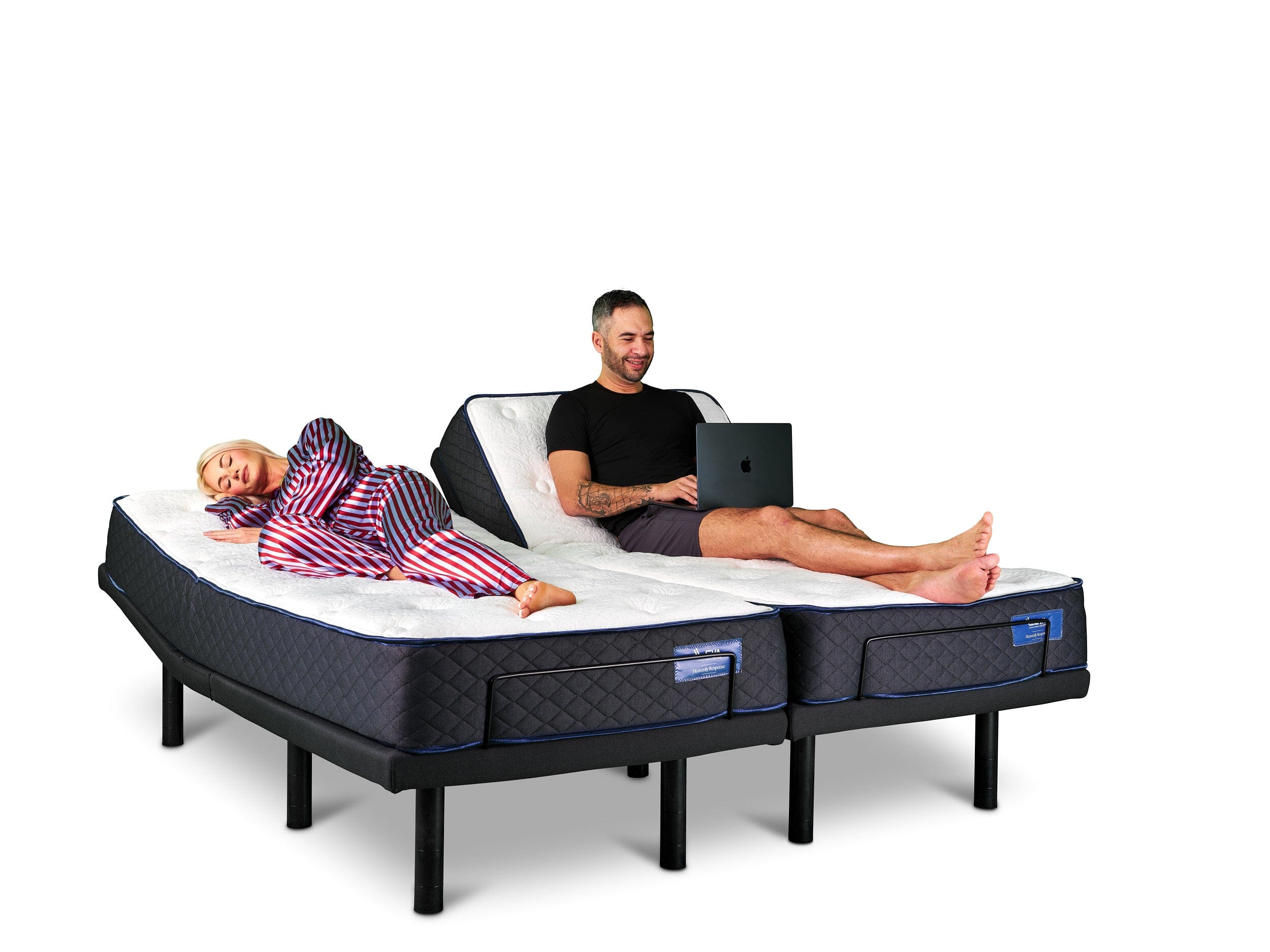
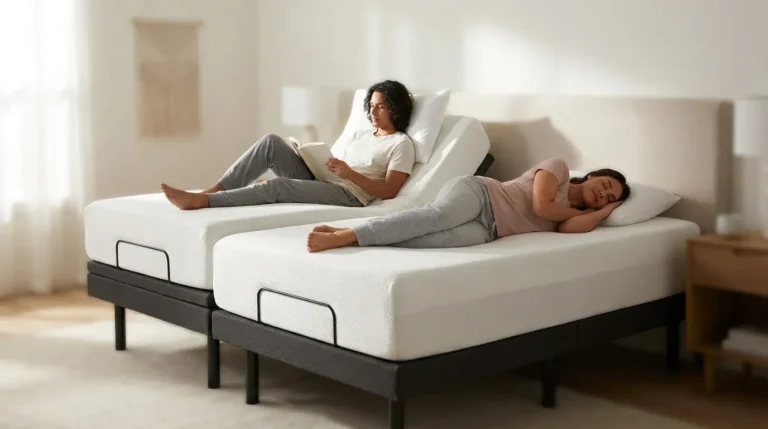
A split king adjustable bed joins two Twin XL bases side by side, so each sleeper can independently control head elevation, leg elevation, massage, and preset positions. Leva Sleep extends this architecture to the Split Queen, a configuration rarely offered by general mattress retailers. This design delivers independent adjustability in a more space-conscious footprint for Ontario and Alberta bedrooms where a full king may not fit.
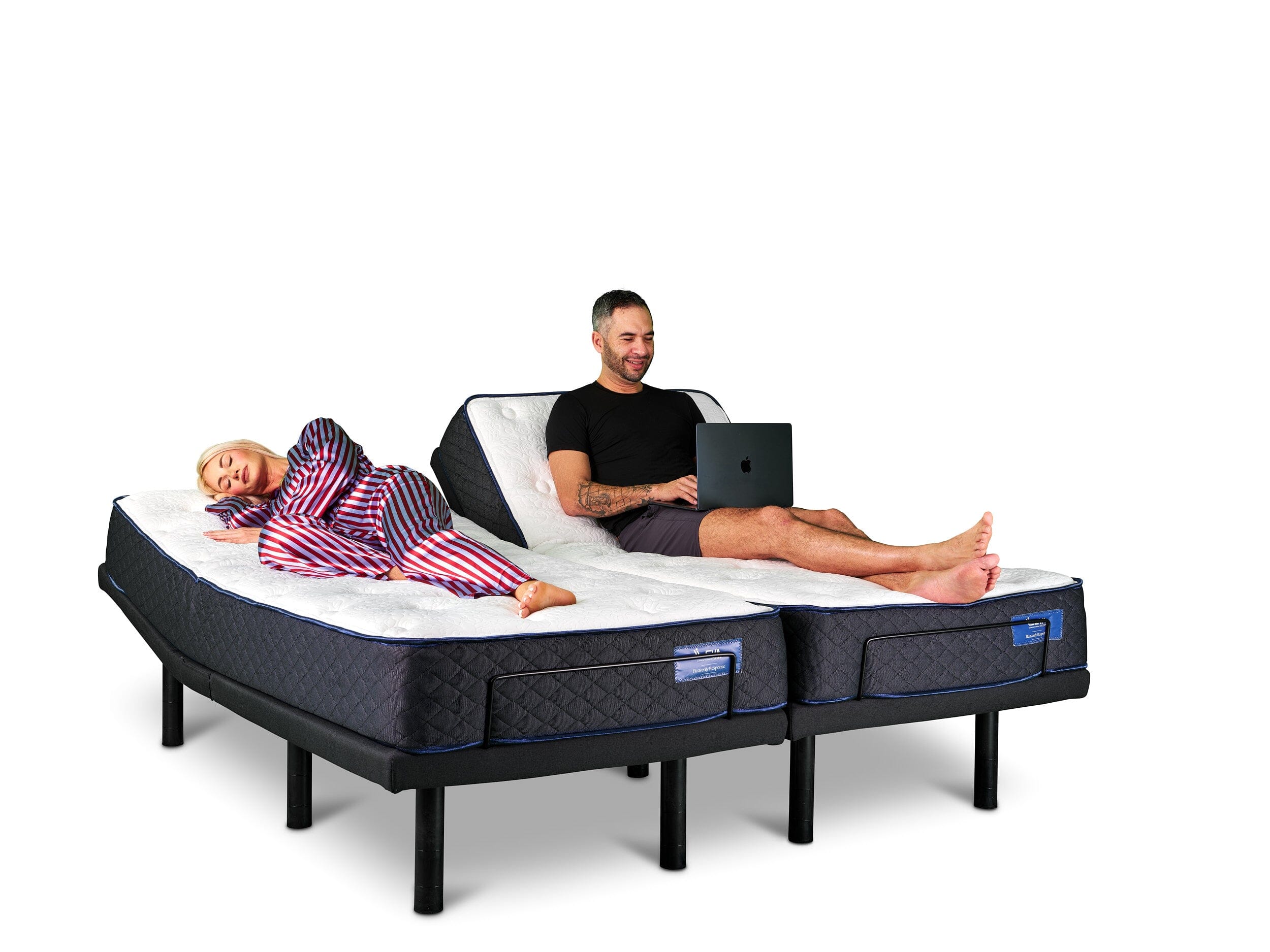
Leva’s Split Queen and Split King bases run on whisper-quiet German motors. Common DIY assembly errors on adjustable beds include reversed motor connections, loose wire harnesses, and legs installed at inconsistent heights, and Leva’s in-house white-glove team prevents these issues at setup. Full control runs through the Leva Sleep app, including custom sleep positions, vibrating alarms, and anti-snore micro-adjustments.
Adjustable Bed with Anti-Snore Mode
Head elevation reduces snoring by shifting the jaw and soft palate forward. This change reduces the airway collapse that produces snoring sound during supine sleep.
The 2019 Sleep and Breathing study examined the effect of torso elevation on minimum effective CPAP pressure for obstructive sleep apnea. The research focused on pressure reduction rather than snoring-frequency changes, but it supports the same airway-opening mechanism that underlies anti-snore positioning.
Most competitor anti-snore implementations rely on fixed presets. Sleep Number’s FlexFit 2 Partner Snore feature lets one partner raise the other’s head section with a single button press, and Tempur-Pedic’s Ergo Smart Base uses AI to detect snoring and adjust position automatically. Leva Sleep’s spring-2026 anti-snore mode takes a continuous-response approach. Onboard sensors detect snoring events and trigger micro-adjustments to the head section, incremental enough not to wake the snorer yet precise enough to reopen the airway.
When you compare anti-snore modes, check whether the system responds dynamically to snoring events or simply holds a fixed elevated angle. Also confirm that adjustments stay quiet enough for the non-snoring partner and that, in a split configuration, the snoring partner’s side can move independently.
Best Adjustable Bed for Sleep Apnea in Canada
Snoring often stands alone as an annoyance, yet it can also signal obstructive sleep apnea, which is a medical condition that needs targeted treatment. Obstructive sleep apnea is common among Canadian adults, with higher rates among men over 50, and many people remain undiagnosed.
Research on head-of-bed elevation for obstructive sleep apnea has focused mainly on positional OSA and airway collapsibility. Available 2022–2023 studies examine experimental head-of-bed elevation effects on these specific mechanisms rather than offering broad systematic reviews of the intervention. Positional therapy functions as a treatment approach for positional sleep apnea.
Leva Sleep’s app-controlled positioning provides precise, repeatable head elevation that you can program as a nightly preset. This setup removes the need to manually adjust the bed before sleep. Sleep apnea clinics in Ontario and Alberta refer patients to Leva Sleep as a non-mask option for mild-to-moderate positional OSA. For moderate-to-severe cases, consult a sleep physician, because an adjustable base complements but does not replace CPAP therapy when a doctor prescribes it.
When you evaluate adjustable beds for sleep apnea, look for app-controlled degree-specific elevation rather than simple “raised” or “lowered” labels. Also check for quiet motors that protect the non-apnea partner’s sleep and a split configuration so the OSA partner’s elevation does not affect the other side.
Browse models with app-controlled elevation suited to sleep apnea management.
White-Glove Adjustable Bed Delivery in Canada
For adjustable beds in Canada, the gap between basic delivery and white-glove setup matters more than for standard mattresses because adjustable bases include motors, wiring, and articulating sections that require precise assembly. A queen adjustable base typically weighs 135 to 140 pounds in the box according to major brands, and a split king configuration also requires synchronizing two independent bases.
Many online-only Canadian brands such as Douglas, Endy, Logan and Cove, and Polysleep offer free or low-cost shipping, but the buyer must handle all assembly and setup. White-glove delivery in Ontario typically costs $100–$250 or is included with purchase. Bed-in-a-box is often marketed as free, yet shipping costs roll into the mattress price and buyers still pay $50–$100 at Ontario waste facilities for old mattress disposal.
Leva Sleep’s in-house white-glove service in Ontario and Alberta includes:
- Delivery directly to the bedroom
- Full frame assembly and motor connection
- Remote and app programming with function testing
- Leg height adjustment for comfortable bed height
- Product tutorial covering all features, including anti-snore mode
- Removal of the old bed, with donation or recycling where possible
Leva’s delivery team works in-house rather than as a contracted crew. The same expertise that built the system also handles installation, which matters for a product with motors, wiring, and articulating sections.
Leva Sleep vs Sleep Number in Canada
Sleep Number is the most recognized adjustable sleep system brand in North America. Its FlexFit 2 Smart Base includes Partner Snore technology and anti-snore presets, and its beds are available in split configurations. The brand’s retail presence in Canada remains limited compared to its US footprint, and its pricing sits firmly in the luxury tier.
Leva Sleep’s competitive position against Sleep Number rests on three structural differences:
- Model depth: Leva offers 15–20 adjustable bed models, while a standard retailer or Sleep Number showroom typically carries 3–5. This range allows more precise matching of features to budget and medical needs.
- Price: Leva’s vertical integration, which covers design, assembly, and delivery in-house, creates a 30–50% cost advantage over comparable luxury competitors without lowering material quality.
- Delivery geography: Leva’s in-house white-glove service operates in Ontario and Alberta, the two provinces where most of its 25,000+ customers live, with no third-party logistics handoff.
Sleep Number’s air-chamber firmness adjustment is a proprietary system that requires Sleep Number-specific mattresses and service. Leva Sleep’s system works with mattresses from Tempur-Pedic, Simmons, Beautyrest, Serta, and Kingsdown, along with Leva’s own all-foam and hybrid pocket coil options, which gives buyers more flexibility at the mattress level.
Adjustable Bed Accessories That Stop Sheet Slippage
Standard bedding often fails on adjustable bases because fitted sheets are sized for flat mattresses. When the head or foot section elevates, the sheet pulls free at the corners, and this frustration grows over months of nightly use.
Leva Sleep designs all bedding accessories specifically for adjustable bases to address the compatibility gaps that standard bedding creates on articulating mattresses:
- Fitted sheets with deep pockets and extra elastic maintain contact across the full range of head and foot elevation without popping at the corners.
- Duvet clips hold the duvet in place when split-configuration partners set different elevation angles, which prevents the duvet from bunching toward the lower side.
- Remote pockets attach to the side of the base and keep wireless remotes accessible instead of letting them fall between the mattress and the wall during articulation.
- Temperature-regulation pads solve the dual-zone temperature problem. Fifty percent of couples prefer different temperatures while sleeping, and individual pads let each partner set a separate thermal environment.
Purchasing accessories from the same brand that built the base removes compatibility guesswork. Elastic depths, clip attachment points, and pad dimensions match Leva’s specific base geometry.
Durability, Warranty Details, and Temperature Pads
The global sleep aid technology market stood at roughly $103.5 billion in 2025 and is projected to reach $136 billion by 2030. Growth comes partly from demand for programmable sleep positions and AI-led adjustments. As the category matures, warranty and lifespan expectations are becoming more consistent.
When you assess any adjustable sleep system’s durability, use these criteria instead of relying only on manufacturer claims:
- Motor origin and rating: German-engineered motors, as used in Leva Sleep bases, carry established industrial quality standards and documented duty-cycle ratings.
- Frame material: Steel frames with welded joints tolerate repeated articulation better than composite or MDF components.
- Warranty scope: Confirm whether the warranty covers motors, electronics, and the frame separately, and whether in-home service is included or requires shipping the base.
- Mattress compatibility over time: Memory foam, latex, and flexible hybrid mattresses work well with adjustable bases because they flex with head and foot movement, while rigid innerspring mattresses adapt poorly. A mattress that resists flexion forces the base motors to work harder and shortens their service life.
Temperature regulation pads integrated into the sleep system add an electronic component with its own lifespan. Check whether the pad can be serviced or replaced independently of the base and whether the brand sells replacement units without requiring a full system repurchase.
Decision Framework and Next Steps
Use the following criteria as a step-by-step framework to identify which adjustable sleep system configuration fits your situation before you contact a brand.
- Snoring severity: Start by deciding whether snoring is mild and positional, which usually responds to head elevation presets, or frequent and loud. More severe snoring often calls for a dynamic anti-snore mode with micro-adjustment capability.
- Sleep apnea diagnosis: If snoring comes with breathing interruptions, confirmed mild-to-moderate positional OSA supports a medical referral to an adjustable base with precise degree-controlled elevation. Severe OSA requires physician guidance on whether positional therapy alone is appropriate.
- Firmness mismatch: Beyond respiratory issues, consider whether partners need different firmness levels. A split configuration with independently adjustable bases and compatible mattresses on each side is the only setup that avoids compromise.
- Delivery zone: After you define the configuration, confirm that the brand offers genuine in-house white-glove service in your province. Ontario and Alberta buyers can access Leva Sleep’s in-house team, while other provinces should verify whether delivery is in-house or contracted.
- Budget: Finally, set a total-system budget that covers base, mattress, accessories, and delivery instead of focusing on the base alone. A lower base price from a vertically integrated DTC brand can fund the full accessory suite at the same total spend as a luxury competitor’s base alone.
Leva Sleep’s eight years of adjustable bed specialization, $50M in lifetime sales, and 25,000+ customers across Ontario and Alberta position it as the most established DTC adjustable sleep system authority in the Canadian market. With 15–20 models, a spring-2026 anti-snore micro-adjustment mode, and in-house white-glove delivery, it is the only Canadian DTC brand that addresses every criterion above within a single integrated system.
Find your ideal sleep system configuration, whether you need split adjustability, anti-snore micro-adjustments, or a complete package tailored to your household.
Frequently Asked Questions
How long does an adjustable bed base typically last, and what affects its lifespan?
A quality adjustable bed base built with steel framing and rated motors typically lasts 10 to 20 years under normal residential use. The main factors that affect lifespan are motor quality, frame construction, and mattress compatibility. Bases running whisper-quiet German motors, as found in Leva Sleep’s lineup, use components engineered to industrial duty-cycle standards, which supports more reliable long-term performance than motors from lower-tier suppliers. A mattress that resists flexion, such as a rigid innerspring, forces the motors to work harder on every adjustment cycle and shortens their service life. All-foam and hybrid pocket coil mattresses flex freely and are the recommended pairing for any adjustable base. Warranty terms vary significantly, so look for coverage that addresses motors, electronics, and the frame separately, and confirm whether in-home service is included instead of requiring you to ship the base back to the manufacturer.
Is a Split Queen adjustable bed available in Canada, and how does it differ from a Split King?
A Split Queen adjustable bed divides a standard queen mattress footprint into two independently adjustable halves, each with its own motor, remote, and app controls. This configuration is significantly rarer than a Split King because most manufacturers do not produce queen-size twin halves at scale. Leva Sleep is one of the few Canadian brands that builds Split Queen bases to customer specifications, which makes it a primary option for couples who want independent adjustability but lack bedroom space for a king-size footprint. A Split King joins two Twin XL bases side by side to reach a standard king width of 76 inches. Both configurations allow one partner to elevate their head for snoring or sleep apnea management while the other remains flat, with no mechanical connection between the two sides. The Split Queen is especially relevant for Ontario and Alberta couples in condominiums or older homes where bedroom dimensions limit the viable bed size.
What is the difference between white-glove adjustable bed delivery and standard bed-in-a-box delivery?
Standard bed-in-a-box delivery ships a compressed mattress to the front door or lobby via courier. The buyer must move the box to the bedroom, unbox it, wait 24 to 72 hours for the mattress to expand, and arrange disposal of the old mattress separately. For a mattress-only purchase, many buyers find this trade-off manageable. For an adjustable base, the situation changes because the base’s weight, noted earlier at 135–140 pounds for a queen, combines with motors, wiring, and articulating sections that require precise assembly. Electrical connections and remote programming also add complexity that most buyers are not prepared to handle correctly. Errors during self-assembly, such as reversed motor connections, loose wire harnesses, and uneven leg heights, are common and can cause ongoing operational problems. White-glove delivery for an adjustable bed means a trained team handles the full installation process described earlier, including assembly, motor connection, programming, positioning, and old-bed removal, instead of leaving the buyer to manage these technical steps alone.
Can an adjustable bed help with sleep apnea, or is a CPAP machine still required?
For mild-to-moderate positional obstructive sleep apnea, head elevation has been shown in clinical research to reduce apnea severity by opening the airway and reducing the soft-tissue collapse that causes breathing interruptions during sleep. Positional therapy functions as an intervention for positional sleep apnea. An adjustable base with precise, app-controlled degree elevation, such as those in Leva Sleep’s lineup, lets you program this position as a nightly preset, which makes adherence easier than manual repositioning with pillows. For moderate-to-severe sleep apnea, or for cases where positional therapy alone does not provide adequate symptom control, a physician-prescribed CPAP machine remains the clinical standard. An adjustable base and CPAP can work together, and many patients use both, with the elevated position improving CPAP mask seal and reducing required pressure. If you have been diagnosed with sleep apnea, consult your sleep physician before replacing prescribed treatment with positional therapy.
Do regular fitted sheets work on an adjustable bed, or do you need special bedding?
Standard fitted sheets are sized and elasticized for flat mattresses. When an adjustable base elevates the head or foot section, the sheet pulls tight and usually pops free at one or more corners, and this problem worsens as the elastic stretches over time. Sheets designed for adjustable bases use deeper pockets and stronger, wider elastic bands that maintain contact across the full range of articulation. Leva Sleep designs its fitted sheets specifically to its own base geometry, so the pocket depth and elastic placement match the actual dimensions and movement range of the mattress during use. For couples using a split configuration where each side sits at a different elevation angle, a standard duvet tends to bunch toward the lower side. Leva’s duvet clips attach the duvet to each side of the base independently, keeping the cover in place regardless of the elevation difference between partners. Purchasing bedding accessories from the same brand that manufactured the base removes the trial-and-error of testing third-party sheets against a specific base’s articulation range.