Written by: Matthew Timmins, Founder and Managing Director, Leva Sleep | Last updated: July 16, 2026
Key Takeaways for Couples Considering Split Adjustable Beds
- Dual-comfort and flippable mattresses lock couples into fixed firmness options that cannot adapt to changing needs or body-weight differences.
- Snoring, temperature sensitivity, and mismatched firmness preferences are leading drivers of sleep divorce among Canadian couples.
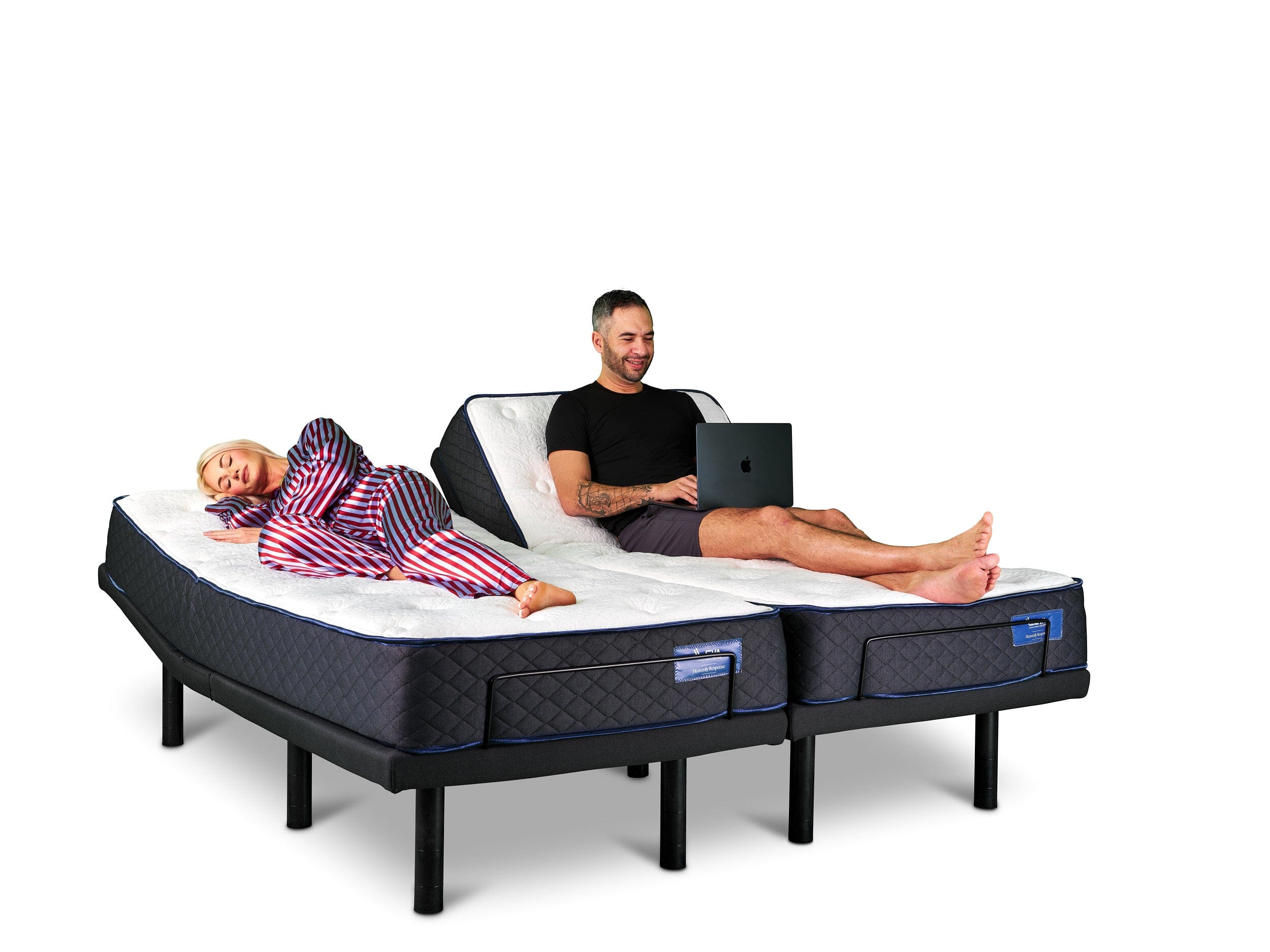
- Adjustable split sleep systems give each partner independent head and foot elevation, firmness control, and app presets without disturbing the other side.
- Leva Sleep offers whisper-quiet motors, Split Queen configurations for smaller Canadian bedrooms, white-glove delivery in Ontario and Alberta, and 30–50% savings versus luxury competitors.
- Discover Leva Sleep’s adjustable bed packages designed to help couples keep sharing a bed here.
Why Many Couples Quietly Drift Into Separate Beds
Picture a familiar scenario: one partner lies awake at 2 a.m., listening to the other snore, weighing whether the guest room is worth the walk. Millions of Canadian couples recognize that moment. A 2023 AASM Sleep Prioritization Survey of 2,005 U.S. adults found that over one-third occasionally or consistently sleep apart from their partner, while the 2024 survey found 29%, and many Canadian couples report that their partner’s sleep habits affect their own sleep quality.
The consequences reach far beyond feeling tired. Research commissioned by healthcare company 32Co found that 85% of couples who had adopted separate sleeping arrangements believed this had directly contributed to their eventual separation. Sleeping apart is not a neutral solution. It slowly erodes shared daily life.
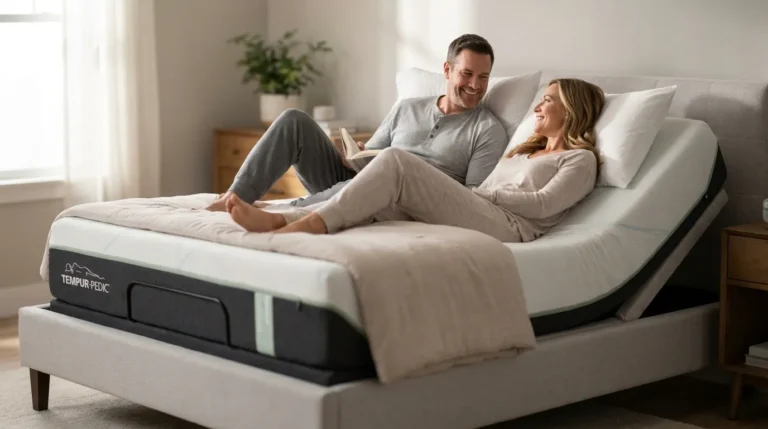
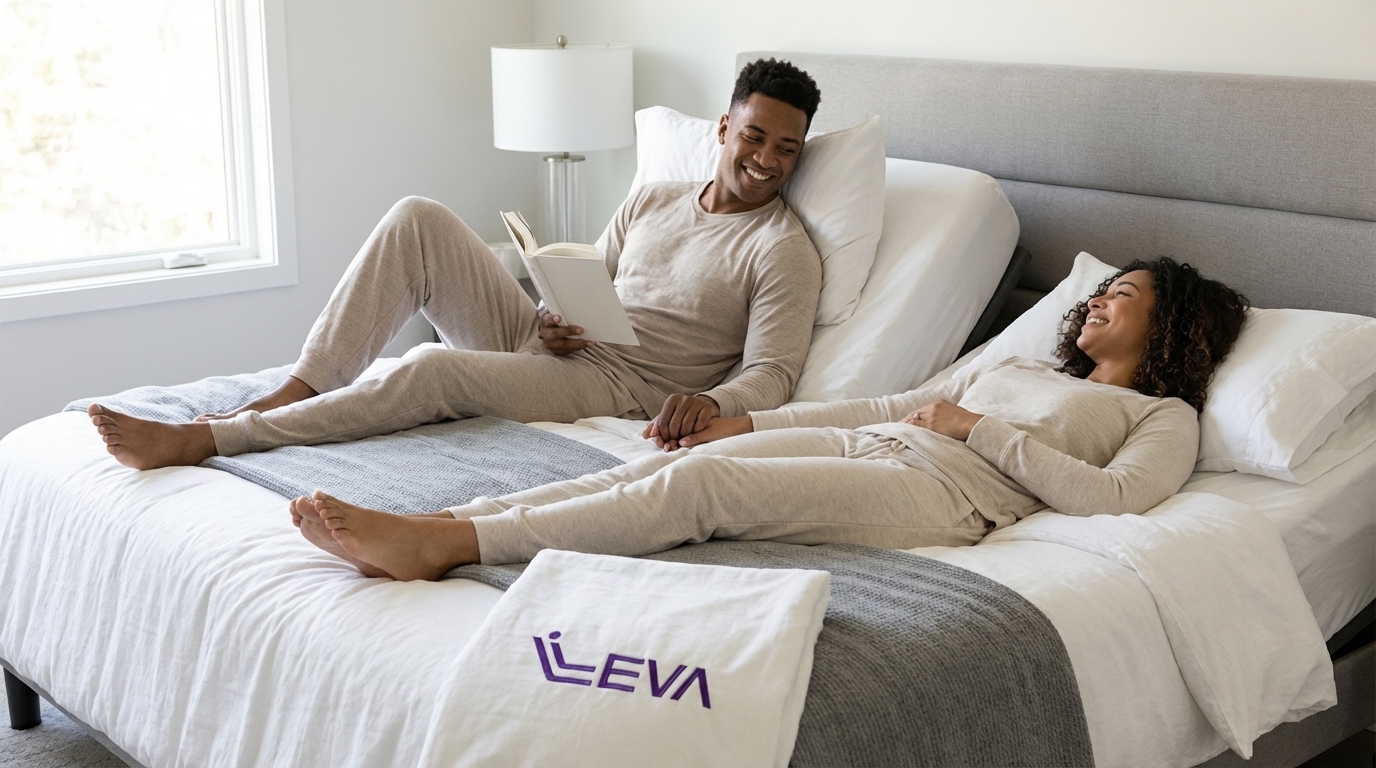
Separation does not have to be the end point. Many couples who had adopted sleep divorce have resumed sleeping together after the snoring partner received treatment. The right sleep system can often replicate that outcome without a clinical intervention and can support both partners as their needs change.
The Core Problem: Conflicting Sleep Needs in One Bed
Sleep incompatibility between partners usually has several causes at once. Common friction points include differing firmness preferences, temperature sensitivity, motion transfer, snoring, and medical conditions such as hip or knee pain and mild obstructive sleep apnea.
Many couples have significantly different mattress firmness preferences based on body weight, sleep position, and medical conditions. When they compromise on a single firmness level, they often report lower sleep quality than couples with individualized support. This firmness mismatch becomes even more problematic when combined with other disruptions. Seventy-five percent of respondents who share a bed with a snorer say the snoring impacts their sleep, which compounds the discomfort from inadequate support.
Snoring amplifies every other issue. Snoring affects 40% of adult men and 24% of adult women, which can cause significant disruption for the non-snoring partner. In couples affected by obstructive sleep apnea, snoring severity correlates directly with the bed partner’s reported marital dissatisfaction, independent of the patient’s apnea-hypopnea index. The louder and more frequent the snoring, the more strain the relationship tends to carry.
Most couples reach a tipping point after months of disrupted nights build into chronic fatigue, irritability, and ongoing tension. At that stage, the focus shifts from whether to act to which solution can actually work over the long term.
Why Dual-Comfort and Flippable Mattresses Rarely Fix the Issue
Static and flippable mattresses are often the first response to mismatched sleep needs. These designs can help for a while, yet their structural limits become more obvious as time passes and bodies change.
Dual-sided flippable mattresses are limited to only two firmness options per mattress, so both partners experience the same firmness across the entire width at any given time and cannot address permanent mismatched needs without compromise. After two to three years of nightly use by couples with a weight differential of 20–30 lbs or more, impressions on each side of a shared static mattress become dramatically different in depth and shape, with no remedy available in one-sided or static dual-comfort designs.
Neither static nor flippable designs address elevation for snoring or pain, and neither offers true independent control. The table below compares these two categories with adjustable split systems across the criteria that matter most to couples.
| Criterion | Static Dual-Comfort Mattress | Flippable Dual-Comfort Mattress | Adjustable Split Sleep System |
|---|---|---|---|
| Independent firmness per partner | No, each half is manufactured with fixed materials and configuration cannot change later without replacing the mattress | No, both partners share the same firmness level at any given time | Yes, each side adjusts independently via app or remote |
| Independent elevation for snoring or pain | None | None | Yes, anti-snore preset raises the head 10–15 degrees to help open the airway |
| Long-term adaptability | Low, impressions form in proportion to weight and no adjustment is possible | Moderate, flipping slows impression formation but does not eliminate it | High, positions, firmness, and features adjust as needs change |
| Partner disturbance from adjustments | N/A, no mechanical adjustment | N/A, no mechanical adjustment | Low, premium models operate below 45 dBA, and split bases isolate movement to one side |
How Adjustable Split Sleep Systems Solve Shared-Bed Conflicts
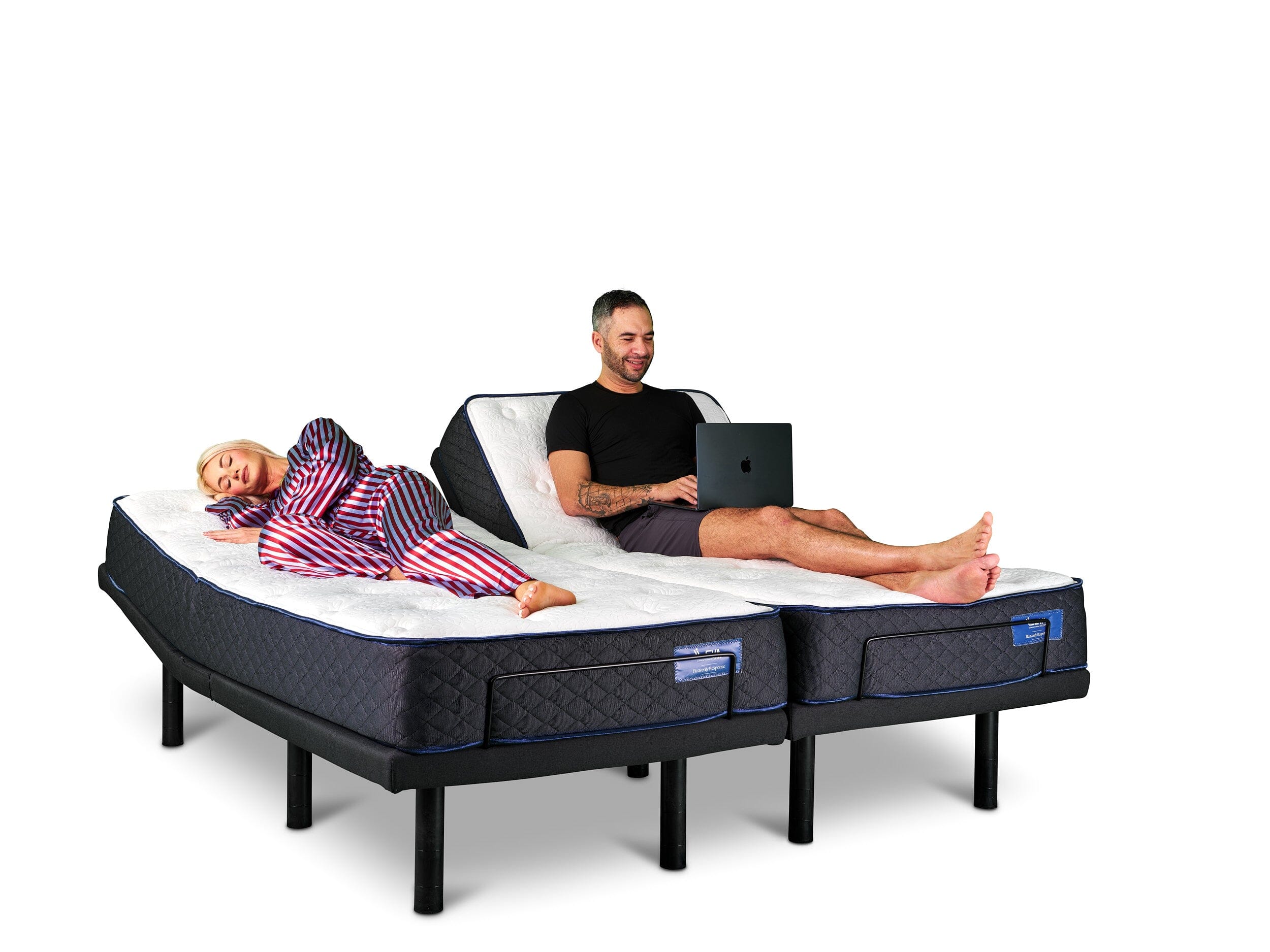
An adjustable split sleep system pairs two independent bases, most commonly in a Split King or Split Queen configuration, with compatible mattresses and app-based controls. Each partner controls their own side’s head elevation, foot elevation, firmness, and extra features without affecting the other side.
Head elevation on an adjustable base can improve airway alignment in patients with positional obstructive sleep apnea. This directly addresses one of the most disruptive causes of sleep divorce and can reduce reliance on a CPAP mask for some users. For pain management, an adjustable base can help align the spine and take pressure off the joints, which matters for couples managing hip, knee, or lower back conditions.
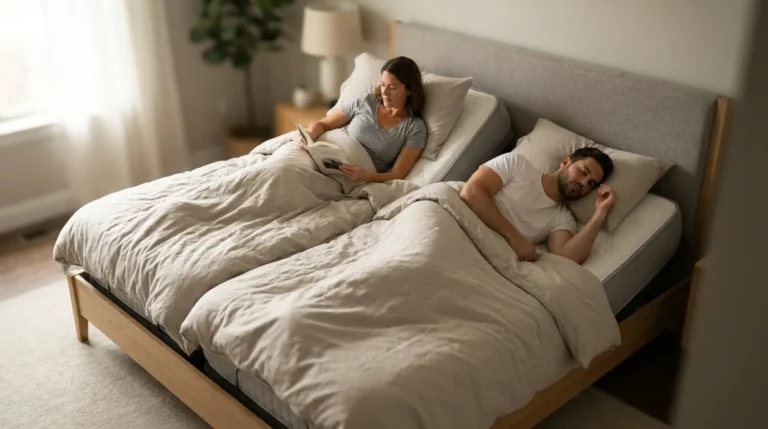
The split configuration allows one partner to activate an anti-snore or zero-gravity preset at midnight without waking the other. The anti-snore elevation is subtle enough that a sleeping partner may not notice the adjustment, which is exactly the point. Each person gets targeted relief while the other side stays undisturbed.
Leva Sleep has built its entire product line around this principle of independent comfort. With over 8 years of expertise, $50M in lifetime sales, and 25,000+ customers, Leva offers 15–20 adjustable models, compared to the 3–5 typically found at general mattress retailers. The lineup includes the uniquely space-conscious Split Queen configuration for Canadian homes where a full Split King footprint is not practical.
What to Look For in a Split Adjustable System
Independent Adjustability Per Side
Effective systems give each partner full control over their side. Confirm that head elevation, foot elevation, and firmness controls operate entirely independently on each side. Split King configurations are the gold standard option for couples with substantially different needs because each partner can select a completely different mattress model, firmness level, and elevation setting. This independence is what turns one shared bed into two personalized sleep environments.
Anti-Snore and Elevation Features
Head elevation of 10–15 degrees on an adjustable base can improve airway alignment and reduce positional snoring for some users. Look for a dedicated anti-snore preset that moves the head to this range with one tap. For more advanced support, consider whether the system offers automatic snoring detection and micro-adjustment capability so the bed can respond during the night.
Whisper-Quiet Motors
Motor noise is a critical factor for couples, because a noisy motor adjusting positions at night can disrupt a partner who goes to bed earlier or later. Premium models offer nearly silent operation, while budget models may produce a noticeable hum. When comparing brands, ask for decibel ratings and real-world feedback. Leva Sleep uses whisper-quiet German motors engineered specifically to avoid partner disturbance during adjustments.
Mattress and Bedding Compatibility
Memory foam and latex mattresses offer excellent flexibility on adjustable bases, hybrids with pocketed coils work well, and traditional innerspring mattresses with interconnected coils are generally incompatible. Leva designs its all-foam and hybrid pocket-coil mattresses specifically for adjustable bases so they articulate smoothly. Its bedding accessories, including fitted sheets with deep pockets and extra elastic and duvets with clips, are engineered to stay in place through elevation changes.
Temperature Regulation
Two bodies generate significantly more heat than one, so breathable materials such as open-cell foam, gel-infused memory foam, and coil-based airflow are recommended for temperature management in shared beds. Leva’s integrated heating and cooling pad allows each partner to set an independent temperature. This feature removes one of the most common non-snoring causes of sleep disruption.
Canadian Delivery and Setup Support
Delivery and setup can make or break the experience. For Ontario and Alberta residents, Leva Sleep offers in-house white-glove delivery. Trained professionals deliver to the bedroom, assemble the system, adjust leg heights, provide a product tutorial, and remove the old bed. This service removes the assembly burden that often comes with bed-in-a-box alternatives.
Long-Term Value and Total Cost
Value depends on both upfront price and how long the system remains comfortable for both partners. Leva’s direct-to-consumer, vertically integrated model, with local design, local assembly, and no retail middlemen, delivers luxury-grade adjustable systems at the pricing advantage mentioned earlier. Over a 10-year ownership horizon, that gap represents a substantial saving compared with replacing static mattresses every few years as wear patterns diverge.
How Split Adjustable Beds Change Nightly Life
Real couples often face overlapping challenges. In one common scenario, one partner has mild positional sleep apnea and the other runs hot at night. A split adjustable system lets the first partner elevate their head independently while the second activates cooling on their side, so both sleep undisturbed. In another scenario, one partner is a light sleeper who goes to bed two hours earlier. Whisper-quiet motors allow the later-arriving partner to adjust their position without triggering an awakening.
Fifty-two point nine percent of those who adopted sleep divorce reported improved sleep quality, and sleep-separated couples slept 37 more minutes per night on average, yet separation carries relationship costs. An adjustable split system captures the sleep quality benefit while keeping couples in the same bed and the same room.
Leva Sleep’s customer base includes couples referred directly by sleep apnea clinics and partners who had been sleeping in separate rooms for years before finding a shared solution. These couples often report that independent adjustability restored both their sleep and their sense of closeness.
Decision Checklist: Static Dual-Comfort vs Adjustable Split Systems
| Decision Factor | Static Dual-Comfort | Flippable Dual-Comfort | Adjustable Split System |
|---|---|---|---|
| Firmness independence | Fixed per side, cannot change without replacing the mattress | Two shared options (see limitations above) | Fully independent per side, adjustable at any time |
| Snoring solution | None | None | Anti-snore preset elevates head 10–15 degrees to open airway |
| Size options for Canadian homes | Standard Queen or King | Standard Queen or King | Split King (two Twin XL) or Split Queen, a unique Leva offering |
| Total cost of ownership | Lower upfront, asymmetric wear can require full replacement every few years under differing body weights | Moderate upfront, lasts 2–3 years longer than one-sided models but still lacks per-partner customization | Higher upfront, significant pricing advantage via Leva’s direct model, long-term adaptability reduces replacement frequency |
Frequently Asked Questions
How difficult is it for couples to set up and use a split adjustable bed system?
Setup complexity varies by retailer. With Leva Sleep’s white-glove delivery service, trained professionals handle delivery to the bedroom, full assembly, leg height adjustment, and a hands-on product tutorial, including app pairing and preset configuration. Each partner receives their own independent remote or app profile. After setup, daily use stays straightforward. Each person adjusts their side independently without affecting the other, and the Leva Sleep app allows saving custom positions, setting vibrating alarms, and activating presets like zero-gravity or anti-snore with a single tap.
Can an adjustable split bed genuinely help with snoring and sleep apnea?
Head elevation on an adjustable base opens the airway by shifting the tongue and soft palate forward, which reduces the vibration that causes snoring. This approach works best for positional snorers, whose snoring worsens when lying flat on their back. For couples where one partner has diagnosed obstructive sleep apnea, an adjustable base can reduce symptom severity, but it does not replace medical evaluation. Leva Sleep’s anti-snore mode, arriving spring 2026, adds automatic detection and micro-adjustment capability. If snoring is severe or accompanied by gasping or witnessed apneas, a sleep study should be completed before relying solely on positional therapy.
Split King vs Split Queen: which is right for a Canadian bedroom?
A Split King consists of two Twin XL bases and two Twin XL mattresses placed side by side, which produces a footprint equivalent to a standard King at approximately 76 × 80 inches. A Split Queen uses two narrower bases to match a standard Queen footprint at approximately 60 × 80 inches. For bedrooms in Ontario and Alberta where space is tight, particularly in older homes or condominiums, the Split Queen delivers full independent adjustability in a more manageable footprint. Leva Sleep is one of the few Canadian providers offering a Split Queen configuration built to customer specifications, which makes it a practical option for couples who want split adjustability without committing to a King-sized room layout.
What maintenance does an adjustable split bed system require?
Adjustable bases require minimal maintenance compared with traditional mattresses. The main tasks involve keeping the base mechanism clear of obstructions beneath the bed, periodically checking that the mattress retainer bar is secure, and ensuring the app firmware updates when prompted. Leva Sleep’s mattresses use compatible materials, with no rigid support boards, so they articulate cleanly without stressing the base mechanism over time. Bedding accessories such as the deep-pocket fitted sheets with extra elastic are machine washable. Motor components in premium bases are sealed units that do not require lubrication or user servicing.
Who benefits most from an adjustable split sleep system?
The strongest candidates are couples where at least one partner snores, has been advised to sleep elevated for a medical condition such as mild sleep apnea, acid reflux, or post-surgical recovery, or experiences hip, knee, or lower back pain that responds to positional changes. Couples with significantly different firmness preferences, particularly where there is a meaningful body weight difference between partners, also benefit substantially, because static mattresses develop asymmetric wear patterns that rotation cannot correct. Couples who have already tried separate sleeping arrangements and found them damaging to their relationship, but have not yet found a shared solution, represent the clearest use case for a split adjustable system.
Conclusion: A Clearer Path to Shared Sleep
Static dual-comfort and flippable mattresses address surface-level preference differences but cannot adapt to changing medical needs, correct asymmetric wear, or ease snoring through elevation. Adjustable split sleep systems solve several problems at once. They provide independent firmness, independent elevation, quiet operation, and app-based control within a single shared bed.
When you evaluate options, the criteria that shape long-term satisfaction include independent per-side adjustability, motor noise level, mattress and bedding compatibility, temperature regulation, and the quality of the delivery and setup experience. For Canadian couples in Ontario and Alberta, Leva Sleep’s direct-to-consumer model, white-glove delivery, Split Queen availability, and significant price advantage over comparable luxury competitors make it a practical starting point for that evaluation.