Written by: Matthew Timmins, Founder and Managing Director, Leva Sleep
Key Takeaways for Canadian Couples
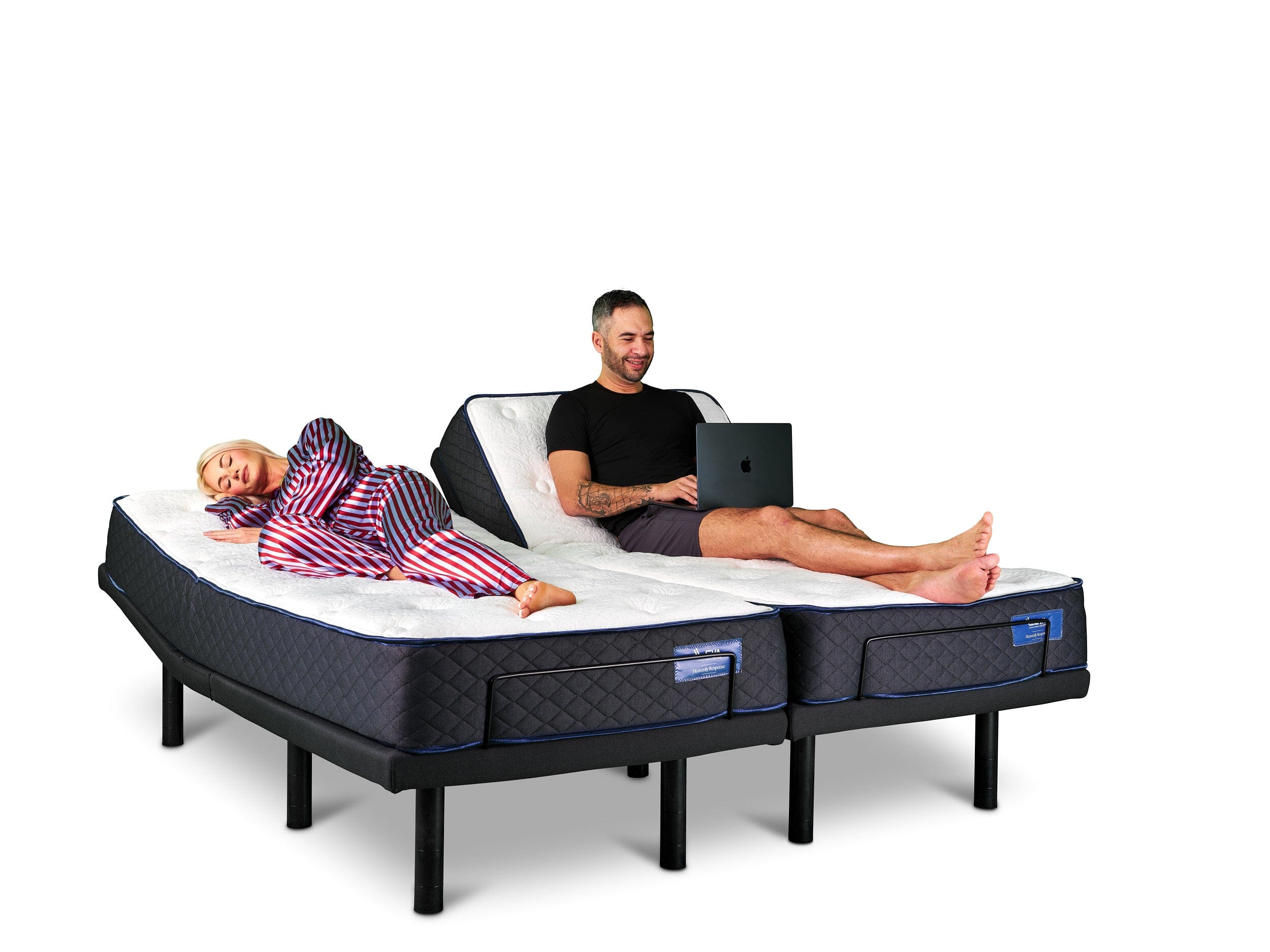
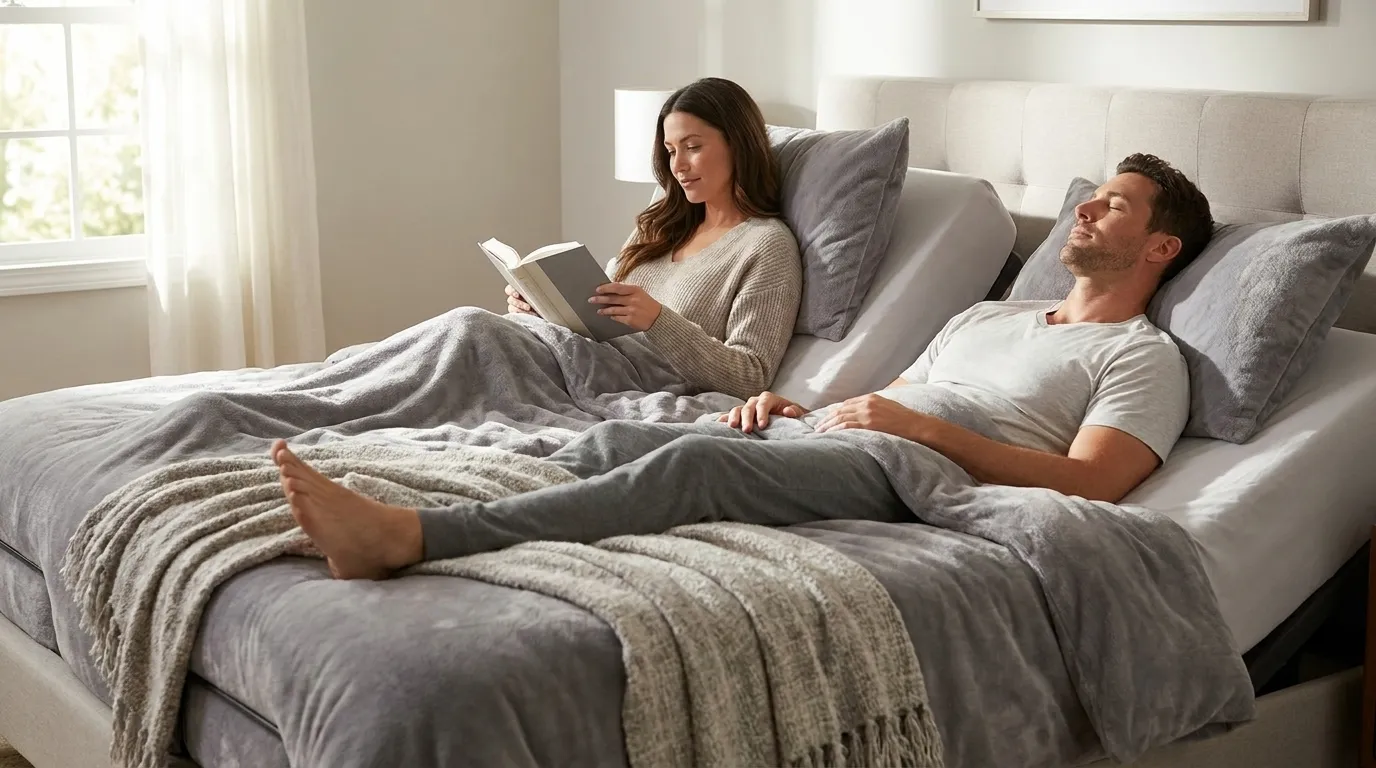
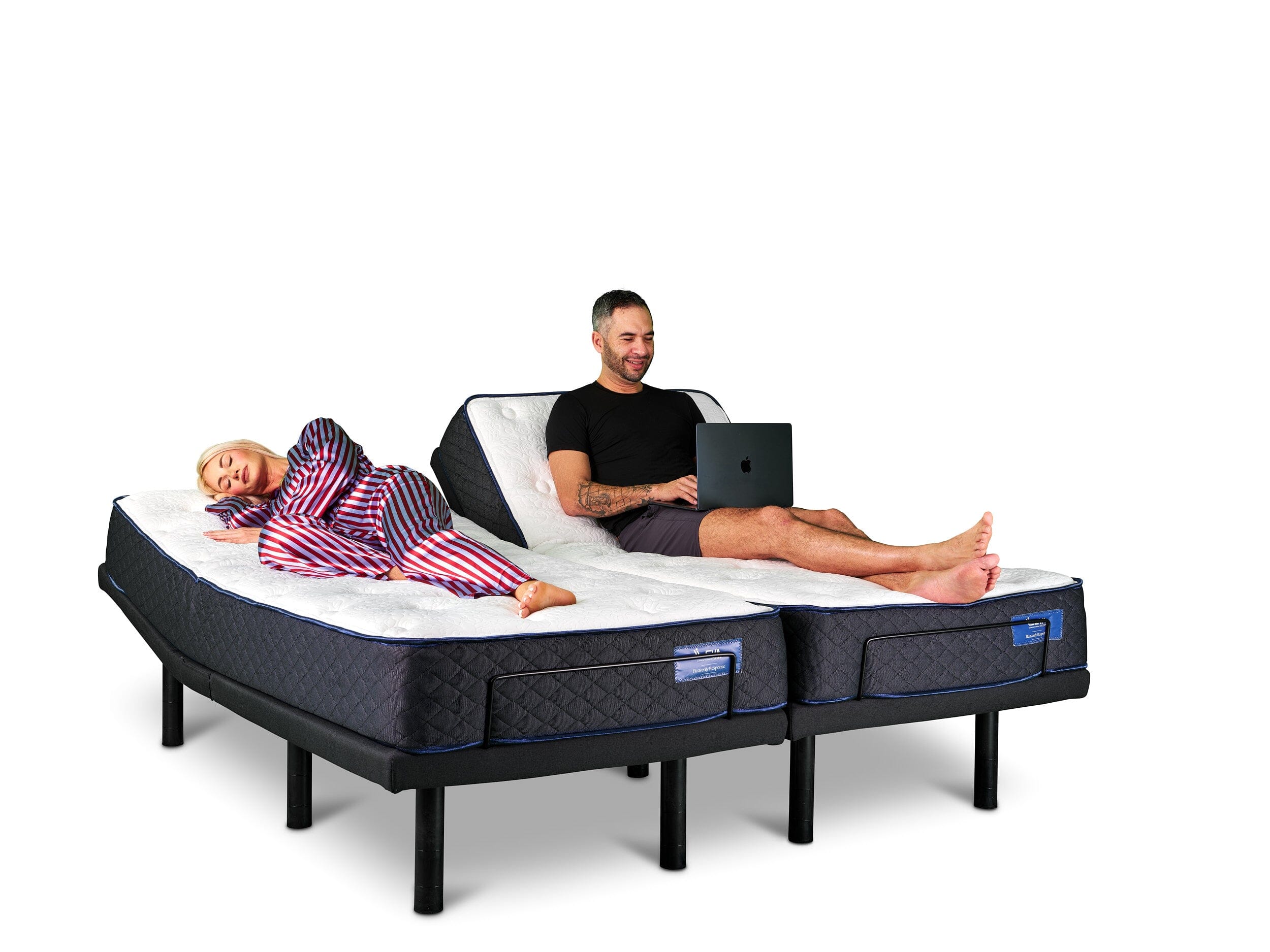
- Split adjustable beds let each partner control head, foot, and lumbar angles independently without disturbing the other side.
- Only all-foam, pocket-coil hybrid, and split-layer latex mattresses flex safely; traditional innersprings with connected coils should be avoided.
- Thickness between 10–12 inches, zoned support, and stretch fabrics protect comfort and motor life through repeated adjustments.
- Split systems suit couples managing snoring, temperature or firmness mismatches, post-surgery recovery, or mild positional sleep apnea.
- Leva Sleep offers certified Split King and Split Queen packages with white-glove delivery in Ontario and Alberta. Explore split configurations with delivery in your province.
Mattress Types That Work on Adjustable Bases
Three mattress categories reliably pair with adjustable bases in 2026.
All-foam (memory foam). Memory foam bends cleanly at the lumbar hinge without bunching or resistance and returns to shape after repeated adjustments. It also delivers strong motion isolation, absorbing movement locally so a partner’s repositioning often goes unnoticed. Foam mattresses held the largest global revenue share at 34.2% in 2025, driven largely by these coupling and comfort advantages.
Pocket-coil hybrids. Hybrid mattresses work with adjustable bases when they use individually wrapped coils rather than connected coil systems. Each coil flexes independently through articulation cycles, which protects both comfort and hardware. Global hybrid mattress market CAGR projections for periods overlapping 2026–2033 range from 8.57% to 12.05% depending on the source and geography, reflecting rising demand for their mix of bounce, support, and contouring comfort.
Latex hybrids. Latex offers strong flexibility for adjustable bases with more bounce than memory foam. A single moulded latex core 12 inches or thicker can create enough resistance at the hinge point to stress the base motor. Split-layer latex constructions bend more easily and handle articulation better.
What to avoid. Traditional innerspring mattresses with Bonnell or continuous coil systems do not pair well with adjustable bases and can be damaged by the movement. Any mattress with rigid internal support boards or stiff perimeter steel rods resists articulation and may void the base warranty.
Key Specs: Thickness, Zoned Support, and Stretch Fabrics
Thickness range. Mattresses between 8 and 14 inches thick generally work well on adjustable bases. Within that range, 10 to 12 inches provides the best balance because thinner mattresses may lack pressure relief while thicker ones create problems. Mattresses exceeding 14 inches increase the risk of straining an adjustable base due to higher weight and a tighter bending radius. Most base manufacturers specify a maximum mattress height of 12–14 inches to maintain full articulation warranty coverage.
Zoned support. A mattress engineered with differentiated firmness zones, softer at the shoulders and firmer at the lumbar, helps maintain spinal alignment across multiple elevation angles. This matters especially in zero-gravity position, where the head rises about 30–45° and the feet lift at the same time to reduce lumbar compression.
Stretch fabrics and edge construction. The cover fabric needs multi-directional stretch so it does not pull or pucker when the base moves. Foam-encased edge support constructions tolerate repeated bending on adjustable bases better than steel-rod edge borders, which can dig into the base mechanism over time.
Manufacturer certification. Manufacturer certification gives the clearest signal of adjustable base compatibility because it confirms the mattress has passed multiple articulation tests. Without explicit certification, compatibility stays unverified. Leva Sleep designs its mattresses specifically for its own bases, which removes guesswork from this step.
Who Benefits Most from Split Adjustable Systems
Split adjustable systems solve several common couple challenges. The use cases below reflect the main reasons Canadian couples choose this category.
Snoring Couples Sharing a Bed
Habitual snoring affects approximately 40% of adult men and 24% of adult women in Canada, with rates rising with age and BMI. ResMed’s Fifth Annual Global Sleep Survey (2025) of 30,026 people across 13 markets found that 18% of couples reported sleeping in separate rooms due to snoring and restlessness.
An adjustable base tackles this mechanically. The anti-snore preset raises the head section 7–12° to open the airway and can help with positional snoring. Leva Sleep’s anti-snore mode, arriving spring 2026, detects snoring automatically and makes small head adjustments without waking the sleeper. The non-snoring partner benefits as well because pocket-coil mattresses and memory foam reduce motion transfer compared to open-coil designs.
Partners with Temperature or Firmness Mismatches
Disagreement about mattress firmness disrupts sleep for many Canadian couples. In a split configuration, each side carries its own mattress, so one partner can choose a plush all-foam surface while the other selects a firmer hybrid. No one needs to compromise on feel. Leva Sleep’s integrated heating and cooling pad adds per-side temperature control on top of independent firmness.
Post-Surgery Recovery and Chronic Pain Relief
Elevated positioning after hip or knee surgery can reduce swelling and keep the joint at a less compressed angle. A head tilt between 30° and 45° combined with slight foot elevation of 15–20° creates the zero-gravity position that unloads the lumbar spine most effectively. This position redistributes body weight more evenly and reduces intradiscal pressure. The recovering partner can hold that position all night while the other side remains flat.
Sleep Apnea Management with Elevation
A gentle head-of-bed incline can reduce breathing events for some sleepers with positional obstructive sleep apnea. Sleep specialists often reference a head elevation of 30–45° for meaningful positional benefit in obstructive sleep apnea. Adjustable beds do not replace CPAP for moderate-to-severe cases, but an adjustable base does not interfere with a CPAP mask or hose and can make elevated positions more comfortable to maintain. Sleep apnea clinics in Canada have referred patients to Leva Sleep for this reason.
If you are managing sleep apnea alongside CPAP therapy, view adjustable bases designed for elevated sleep positioning.
Key Buying Considerations for Split Systems
Use this framework when evaluating any split adjustable system in Canada.
| Specification | Split Queen | Split King |
|---|---|---|
| Footprint | 60 × 80 in. | 76 × 80 in. |
| Minimum room size | Smaller footprint; verify with retailer | 3.5 × 3.7 m plus 30–40 cm headboard clearance |
| Independent controls | Yes, per side | Yes, per side |
| Canadian availability | Limited; Leva Sleep builds to order | Widely available |
| Price Band (CAD, 2026) | Split King, Full Setup | Split Queen, Full Setup |
|---|---|---|
| Entry | ~$2,000 | Varies; verify with retailer |
| Mid-range | $3,080–$4,750 | ~$2,677 avg. (U.S. retail; CAD pricing varies) |
| Premium | $6,000 | Up to $4,561 (U.S. retail) |
Also compare noise rating, warranty length, and whether white-glove delivery comes included or as an extra fee. Leva Sleep’s systems are priced 30–50% below comparable Tempur-Pedic or Ghostbed options, with in-house Canadian assembly and delivery available in Ontario and Alberta.
Trade-offs and Limitations of Split Adjustable Beds
Split adjustable systems cost more upfront than a standard flat bed or a basic adjustable base. A $5,000 Split King setup lasting 10 years works out to $500 per year for two people, or $0.68 per person per night. A $300 topper solution replaced every 2–3 years costs $100–$150 annually and still fails to resolve firmness differences fully.
Beyond cost, two physical trade-offs matter. A small centre gap between the two mattresses comes with the split design. A foam gap filler or mattress connector strap costing $20–$60 usually fixes this, and most couples adapt within the first week. In addition, anti-snore mode addresses positional snoring only. It does not treat moderate-to-severe sleep apnea, where CPAP therapy should continue.
Setup, Ownership, and Room Planning
Delivery logistics for a split adjustable system differ from a standard mattress drop-off. Each base ships as a separate unit. The two units must be aligned precisely, legs set to matching heights, and the app or remote paired before the system works correctly. Handling this without guidance takes time and increases the chance of misalignment.
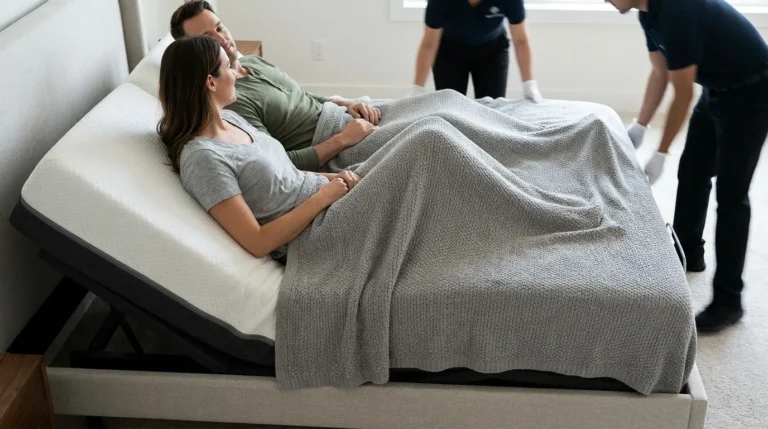
Leva Sleep’s white-glove delivery service, available for a fee in Ontario and Alberta, sends trained professionals to the bedroom. They assemble both bases and mattresses, set leg heights to the customer’s preference, provide a full product tutorial, and remove the old bed, donating or recycling it where possible. This team also designs and assembles the system, so troubleshooting happens on the spot instead of through a third-party call centre.
Plan for a minimum room size of 3.5 × 3.7 metres for a Split King, plus 30–40 cm of clearance behind the headboard so the base can elevate fully without touching the wall.
Schedule white-glove delivery with a Leva Sleep split system for a fully managed setup experience.
Common Mistakes First-Time Buyers Make
Several avoidable errors appear repeatedly among first-time split adjustable bed buyers in Canada.
- Skipping an in-person or virtual test. Elevation angles that look comfortable in a product photo can feel different in practice. Test zero-gravity and anti-snore positions before committing, or ask the retailer for a guided virtual demonstration.
- Using standard fitted sheets. Regular sheets often pop off when the base articulates. Leva Sleep designs fitted sheets with deep pockets and reinforced elastic specifically for adjustable bases. Standard king sheets will not stay in place on a Split King.
- Overlooking anti-snore technology. Given that bed partners can lose up to an hour of sleep nightly to snoring, as noted earlier, choosing a base without an anti-snore preset, or without the automated detection Leva’s 2026 mode provides, leaves the most disruptive issue unaddressed.
- Choosing a mattress without adjustable-base certification. Without explicit certification, compatibility remains unverified, and damage caused by an incompatible mattress may void the base warranty.
Frequently Asked Questions
What are the dimensions of a Split Queen adjustable bed in Canada?
A Split Queen shares the standard queen footprint of 60 × 80 inches but divides that space into two independent bases, each about 30 × 80 inches. This size suits couples who want independent adjustability but do not have room for a Split King’s 76-inch width. Split Queen configurations remain uncommon in Canada because most retailers stock only Split King. Leva Sleep builds Split Queen systems to order, making it one of the few Canadian sources for this size.
Can two partners choose different firmness levels on a split adjustable bed?
Yes. Because each side of a Split King or Split Queen carries its own mattress, partners can select entirely different models, such as one all-foam plush and one pocket-coil firm, without structural compromise. The bases operate independently as well, so elevation, massage intensity, and lumbar support are set per side through separate remotes or app profiles. This flexibility forms the core advantage of a split system over a dual-firmness single mattress.
What mattress thickness works best for adjustable beds?
The practical range for adjustable base compatibility is 10 to 14 inches, with 10 to 12 inches generally offering the best balance of comfort, flexibility, and motor longevity. Mattresses thinner than 10 inches may not provide enough pressure relief at elevation angles, while those exceeding 14 inches add weight and bending resistance that can strain the base motor over time. Back sleepers tend to do well in the 10–12 inch range. Side sleepers who need more shoulder and hip cushioning may prefer 12–14 inches. Always verify that the specific mattress carries the base manufacturer’s compatibility certification.
How does Canadian pricing for split adjustable bed systems compare to the U.S.?
Canadian buyers typically pay more than U.S. buyers for equivalent hardware because of currency exchange, import duties, and retail markup. A $600 USD base often lands at $850–$1,000 CAD after those factors. A complete Split King setup in Canada typically ranges from about $2,000 to $6,000 CAD, with the mid-range sitting between $3,080 and $4,750. Leva Sleep’s direct-to-consumer model and local assembly remove middleman markup, positioning its systems at 30–50% below comparable Tempur-Pedic or Ghostbed equivalents while including Canadian warranty support and white-glove delivery in Ontario and Alberta.
Is an adjustable bed a substitute for CPAP therapy?
No. An adjustable bed can reduce snoring and breathing events for people with positional or mild obstructive sleep apnea by keeping the airway more open at the head incline discussed earlier. It can also make CPAP use more comfortable by providing a stable elevated position that reduces mask leaks. However, it does not address the anatomical causes of moderate-to-severe sleep apnea and should not replace a prescribed CPAP or dental device. Anyone with a diagnosed sleep apnea condition should consult their physician before changing their treatment plan.
Conclusion: Matching a Split System to Your Shared Sleep Needs
The right split adjustable system for a Canadian couple rests on four criteria. You need a compatible mattress type with certification, thickness within the 10–14 inch range, base features that match specific health needs such as anti-snore, zero-gravity, and lumbar control, and a clear view of total cost of ownership over a 10-year horizon. Leva Sleep’s 8-year track record, 25,000+ customers, and vertically integrated model, from mattress design through in-house Canadian assembly and white-glove delivery, makes it a practical starting point for couples in Ontario and Alberta evaluating this category in 2026.