
Written by: Matthew Timmins, Founder and Managing Director, Leva Sleep
Key Takeaways for Couples Sharing a Bed
- Traditional Serta innerspring mattresses transfer motion and lose edge support, so many couples struggle to sleep comfortably together.
- Split-Queen adjustable hybrid systems with pocketed coils give each partner independent firmness, strong motion isolation, and stable edges.
- Adjustable bases with quiet motors and per-side elevation ease snoring, sleep apnea, and comfort differences without forcing sleep divorce.
- Leva Sleep offers 15–20 adjustable base models, white-glove delivery, and 30–50% savings versus luxury competitors for Canadian couples.
- Canadian shoppers can experience luxury-grade split-Queen systems at an accessible price by choosing Leva Sleep’s adjustable bed packages.
The Problem: How Shared Beds Disrupt Canadian Couples’ Sleep
Couples sharing a bed often lose sleep because of one partner’s movement, snoring, or different firmness needs. A survey by the American Academy of Sleep Medicine found that nearly one-third of US adults have opted for a sleep divorce, with the habit more common among adults 35 to 44 (39%) than among people over 65 (18%). Common triggers include snoring or sleep apnea, restless legs, chronic pain, different temperature preferences, and mismatched bedtimes, especially when the mattress cannot support two distinct bodies well.
Traditional Serta innerspring mattresses use Bonnell or continuous-wire coil systems where each coil connects to its neighbours, so motion travels easily across the surface and disturbs a partner. Edge degradation makes this worse. On a standard queen mattress measuring 60 inches wide, weak edge support can cause the sides to sag or feel unstable, shrinking the usable width and forcing couples closer together. Sagging at 1.5 inches or deeper is a common warranty-actionable benchmark used by major manufacturers.
Basic hybrids and bed-in-a-box options solve a few issues but create new ones. Most arrive as a single mattress in one firmness, so couples with different needs, such as one partner needing firm lumbar support and the other a softer shoulder cradle, still lack a workable fix. These formats also do not support medical elevation for sleep apnea or hip and knee pain. For Canadian couples with differing firmness preferences, specialists recommend an adjustable-air system or a split king setup using two different mattresses on independent bases. Sleeping in separate rooms resolves the disturbance but removes the shared sleep experience many couples value. Fortunately, split-adjustable hybrid systems address these issues while keeping couples in the same bed.
The Solution: Split-Adjustable Hybrid Systems for Two-Sided Comfort
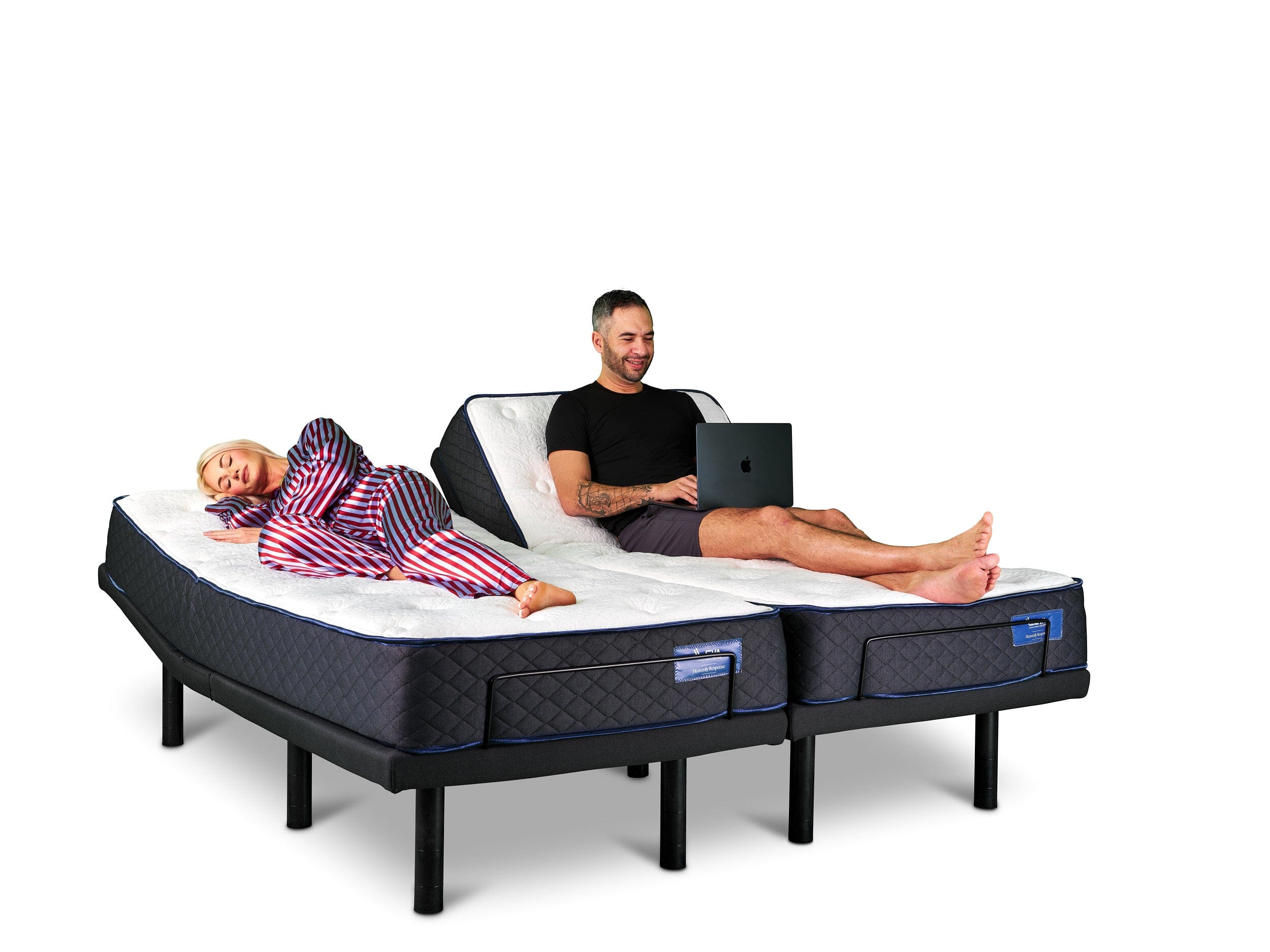
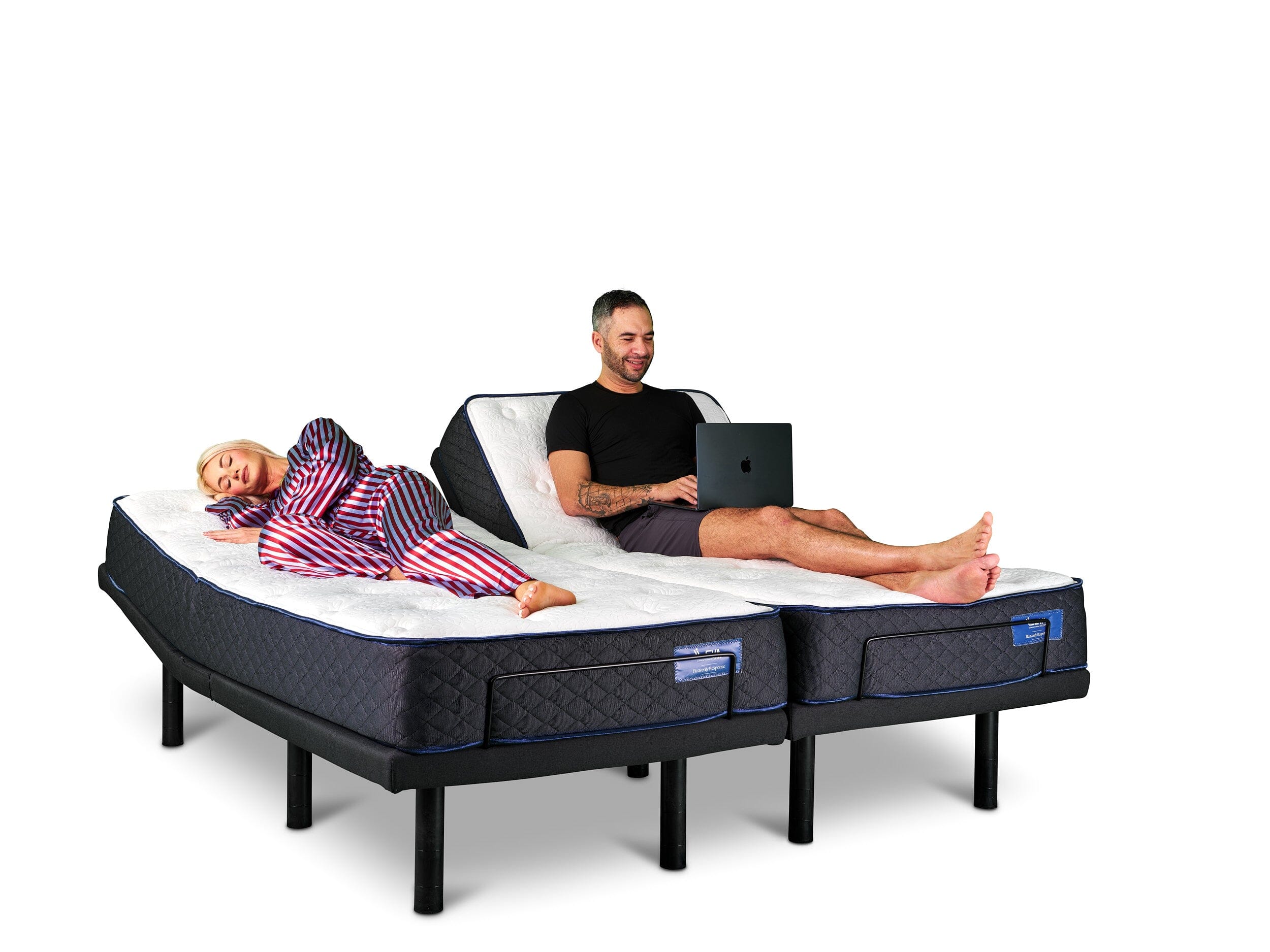
A split-adjustable hybrid system pairs two independently controlled bases with pocketed-coil hybrid mattresses that share a single bed frame. Each partner controls head elevation, foot elevation, and firmness, and advanced models also offer temperature and anti-snore features, all without affecting the other side. Quiet motors matter because older or basic adjustable bases with loud or jerky actuators can wake a partner and defeat the purpose of independent control.
When evaluating split-adjustable hybrid systems, start with motion isolation because that is the main reason couples seek these setups. Look for individually wrapped pocketed coils where each coil moves independently, so pressing one area does not move coils six inches away. Once motion isolation is covered, edge support becomes the next priority because it determines how much of the mattress surface both partners can comfortably use. Lower-gauge reinforced perimeter coils that are thicker and firmer than interior coils resist compression at the edges, which expands the usable sleep surface and makes it easier to get in and out of bed.
After motion and space, focus on temperature control. Pocketed coils create continuous passive airflow channels, so hybrids sleep measurably cooler than comparable all-foam builds in lab testing. Couples with different temperature preferences can add active heating and cooling pads for per-side climate control. Confirm split-firmness options so each side of the split system can be ordered or configured in a different firmness level, not just adjusted later by remote.
Motor noise and setup experience round out the checklist. Request decibel specifications or a demonstration because whisper-quiet German-engineered motors, such as those in Leva Sleep bases, move smoothly without waking a sleeping partner. White-glove in-home delivery that includes assembly, leg-height adjustment, product tutorials, and old-bed removal removes the stress of handling a large item and helps ensure the system works correctly from the first night.
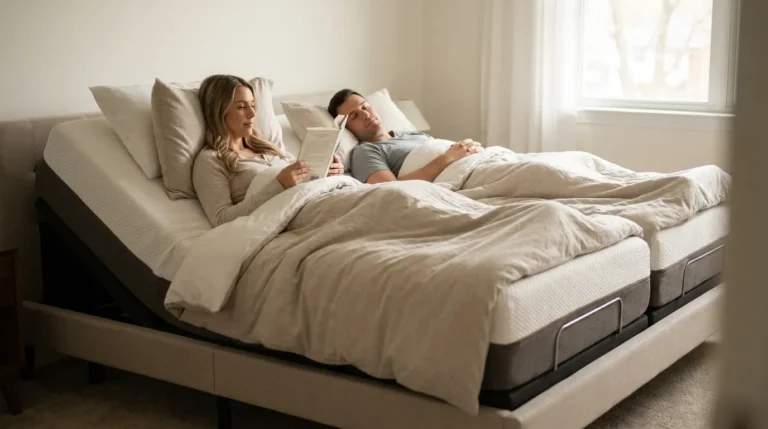
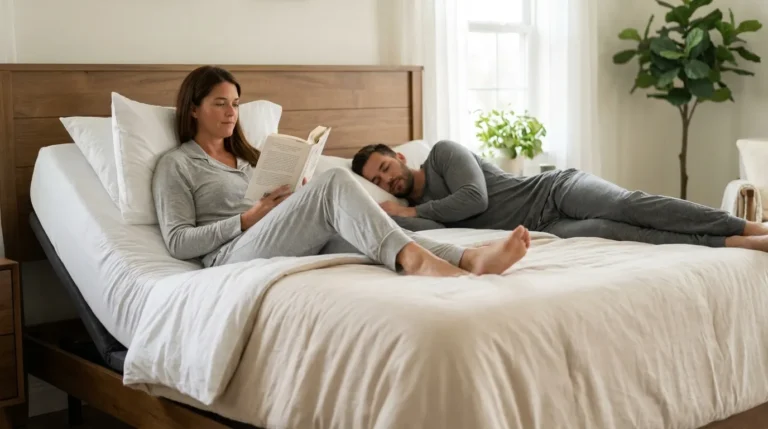
Couples who choose split-adjustable hybrid systems often report uninterrupted sleep for both partners, less morning pain from targeted elevation and zoned coil support, and the ability to keep sharing a bed. One partner can raise the head for mild sleep apnea while the other keeps a flat, firm surface. A partner with hip pain can choose a softer comfort layer while the other keeps a firmer feel. Over half of people who started sleeping separately reported better sleep quality, gaining an average of 37 extra minutes per night, and a split-adjustable system aims to deliver similar gains without separation.
Leva Sleep has served 25,000+ Canadian customers over eight years, generating over $50 million in lifetime sales with a vertically integrated model that designs, assembles, and delivers split-Queen and split-King adjustable systems in Ontario and Alberta. By cutting out retail intermediaries, Leva Sleep delivers the pricing advantage outlined above, with 15–20 adjustable base models compared to the 3–5 typically found at general mattress retailers.
Most Comfortable Mattress Setup for Couples
Comfort for couples depends on motion isolation, edge support, temperature control, and support for two different body types and sleep positions at the same time. Higher-quality hybrid mattresses use individually wrapped pocket coils that provide more targeted support and reduce motion transfer, while latex and higher-density foams in comfort layers maintain their structure longer and resist sagging. A mattress that performs well on all four dimensions and pairs with an adjustable base that allows independent head and foot elevation usually offers the broadest comfort range for couples with different needs.
Mattress Types With Strong Motion Isolation
Pocketed-coil hybrids rank among the strongest options for motion isolation. Pocketed coil mattresses provide superior motion isolation compared to traditional Bonnell or continuous-wire innersprings because each coil is individually wrapped and moves independently. Memory foam comfort layers above the coil core add another layer of dampening. When comparing hybrids for motion isolation, look for at least 800 coils in a queen size, individually wrapped (not continuous) coil construction, and a memory foam or latex comfort layer of at least 2–3 inches.
How Split-Firmness Mattresses Handle Different Preferences
Split-firmness systems directly address the incompatibility that often drives sleep divorce. In a split-Queen or split-King setup, two separate mattresses, each in a chosen firmness, sit side by side on independent adjustable bases within a shared frame. Specialists recommend a split king setup using two different mattresses on independent bases for Canadian couples with differing firmness preferences. One partner can select a plush feel for shoulder and hip pressure relief while the other chooses a firm surface for lumbar support, with no mechanical compromise between the two sides.
Pocketed coils work well with adjustable bases because they flex without damaging the coil structure, whereas traditional coils do not flex and are therefore incompatible with articulating bases.
Neutral Comparison Framework for Common Mattress Types
| Mattress Type | Motion Isolation | Edge Support | Split-Firmness / Adjustable Base Compatible |
|---|---|---|---|
| Traditional Innerspring (Bonnell/Continuous) | Poor, connected coils transfer motion across the surface | Degrades to 1.5-inch+ sagging at perimeter over time | Not compatible with adjustable bases |
| All-Foam / Memory Foam | Excellent motion isolation, suitable for couples | Foam compresses uniformly at perimeter, softer edge support than hybrids | Compatible with adjustable bases, single firmness per mattress |
| Pocketed-Coil Hybrid | Strong isolation from individually wrapped coils plus foam comfort layer | Reinforced perimeter coils expand usable sleep surface | Compatible with adjustable bases, available in split configurations |
| Split-Queen / Split-King Adjustable Hybrid (e.g., Leva Sleep) | Per-side pocketed coil isolation plus independent base reduces cross-partner disturbance | Reinforced perimeter coils on each split mattress, full-width usable surface | Designed for adjustable bases, independent firmness per side, split configurations available |
Frequently Asked Questions
How long does it take to set up a Leva Sleep split-Queen adjustable system?
Leva Sleep’s white-glove delivery team manages the full setup, including delivery to the bedroom, frame and base assembly, mattress placement, leg-height adjustment, and a product tutorial covering app pairing and feature configuration. Most setups finish in a single appointment. The team also removes and donates or recycles the old bed, so the room is ready for the first night’s sleep.
Is a split-adjustable bed suitable for someone with sleep apnea?
Head elevation gently opens the airway and can reduce the frequency and intensity of snoring and mild obstructive sleep apnea episodes without a mask. Leva Sleep’s higher-end bases include an anti-snore mode that detects snoring through vibration sensors and makes subtle micro-adjustments to the head position automatically. For couples where one partner has sleep apnea, the split configuration elevates only that partner’s side and keeps the other side flat and undisturbed. Sleep apnea clinics have referred patients to Leva Sleep as a complementary or alternative approach to positional therapy.
What warranty coverage applies to Leva Sleep adjustable bases and mattresses?
Leva Sleep’s adjustable bases and mattresses carry manufacturer warranties that cover structural defects and sagging beyond the industry-standard threshold mentioned earlier. Specific warranty terms vary by model. Customers should confirm the warranty period and coverage scope for their chosen base and mattress combination at purchase. Because Leva Sleep is vertically integrated, designing, assembling, and delivering its own products, warranty claims are handled directly without third-party retailer intermediaries, which usually speeds resolution.
Does Leva Sleep offer split-Queen sizes, and why does that matter for smaller bedrooms?
Leva Sleep offers split-Queen adjustable beds built to customer specifications for space-conscious homes. A standard Queen measures 60 by 80 inches, the same footprint as a traditional Queen, so it fits bedrooms that cannot accommodate a King at 76 by 80 inches. The split configuration divides the Queen into two 30-by-80-inch independent bases, each with its own motor, remote, and app control, while the mattresses sit side by side in a shared frame. Couples in Ontario or Alberta can access full split-adjustability without upsizing the room or the bed frame.
How does Leva Sleep’s pricing compare to luxury competitors like Tempur-Pedic?
Leva Sleep’s vertically integrated model, which designs systems in-house, assembles locally, and delivers directly to customers, removes the retail markup that luxury brands add through third-party channels. The result is a 30–50% cost reduction compared to top-tier competitors with similar features such as quiet motors, split-firmness hybrid mattresses, anti-snore technology, and temperature regulation. Leva Sleep positions this as a luxury sleep experience at a more accessible Canadian price point, backed by the customer base and sales volume established since 2017.
Decision-Support Takeaway for Canadian Couples
Innerspring mattresses typically last 5–7 years before steel coils lose tension and create dips or uneven support, so many Canadian couples eventually seek motion-isolating alternatives. Evidence points toward pocketed-coil hybrids as the most versatile replacement category because they provide stronger motion isolation, reinforced edge support, passive airflow cooling, and compatibility with adjustable bases. These features address the main weaknesses of traditional innersprings.
Couples with mismatched firmness needs, snoring, or medical elevation requirements gain even more from a split-Queen or split-King adjustable hybrid system that extends those benefits to per-side independence. Leva Sleep’s Canadian-assembled, directly delivered split systems offer this full capability at 30–50% below comparable luxury competitors, with specialist expertise across 15–20 adjustable base models and an end-to-end experience from configuration through white-glove setup. Ontario and Alberta couples evaluating Serta alternatives in 2026 have a vertically integrated, locally supported option that keeps comfort, technology, and pricing in balance.