Written by: Matthew Timmins, Founder and Managing Director, Leva Sleep | Last updated: July 11, 2026
Key Takeaways
- Flat mattresses like Serta hybrids cannot meet the positional needs of sleep apnea, GERD, arthritis, and fibromyalgia.
- Adjustable bases with head and foot elevation improve airway alignment and reduce acid reflux symptoms, based on clinical research.
- Medium-firm hybrid mattresses with pocketed coils work best on adjustable bases, providing pressure relief, airflow, and easier movement than memory foam.
- Split adjustable systems let couples customize elevation and firmness on each side, reducing partner disturbance and helping prevent sleep divorce.
- Leva Sleep offers premium split adjustable bed packages with whisper-quiet motors and white-glove delivery for Canadian couples; explore Leva Sleep adjustable bed packages to find a configuration that matches your medical needs.
The Problem: Flat Mattresses and Medical Sleep Conditions
Sleep apnea, arthritis, gastroesophageal reflux disease (GERD), and chronic hip or knee pain affect many Canadian adults. Insomnia and obstructive sleep apnea are common among rheumatoid arthritis patients. Research indicates that many older adults experience low-back pain, which can lead to sleep problems. Fibromyalgia affects approximately 1.5% of the Canadian population, and many patients report significant sleep disturbances.
A flat mattress addresses surface comfort such as pressure relief, temperature, and motion transfer, but it cannot change the angle of the body. That limitation has clinical consequences. Sleeping flat allows stomach acid to flow back into the esophagus and soft throat tissues to collapse and obstruct the airway. No firmness level corrects either mechanism.
The table below maps common medical sleep conditions to mattress and base configurations that support them, based on current clinical evidence.
| Condition | Medium-Firm Hybrid (flat base) | Latex Hybrid (flat base) | Adjustable Base + Compatible Mattress |
|---|---|---|---|
| Obstructive Sleep Apnea (mild–moderate) | Supports side sleeping; does not address airway collapse from flat position | Responsive surface aids repositioning; does not elevate airway | Head elevation reduces AHI in positional OSA |
| GERD / Acid Reflux | No positional benefit; acid flows freely when supine | No positional benefit | Head-of-bed elevation may improve GERD symptoms |
| Rheumatoid Arthritis / Joint Pain | Medium-firm surface reduces morning pain; no dynamic pressure redistribution | Pressure relief with latex comfort layer; limited repositioning support | Zero-gravity position shifts pressure off spine and sensitive joints; adjustable elevation relieves pressure on sore areas |
| Fibromyalgia | Medium-firm hybrid reduces tender-point activation; no flare-response positioning | Pocketed coils improve airflow and ease repositioning vs. all-foam | Head and knee elevation in zero-gravity redistributes body weight during flares |
Why Memory Foam Often Disappoints for Medical Conditions
Traditional memory foam has slow response time and retains heat, creating two specific problems for people with medical sleep conditions: it resists repositioning during the night and it causes overheating that fragments sleep. Memory foam mattresses relieve pressure for joint pain but make it difficult for people with mobility issues to transition between sleeping positions due to limited responsiveness and bounce. University Hospitals rheumatologist Marie Kuchynski, MD, notes that this construction also retains heat, which may cause discomfort that wakes sleepers. For patients with arthritis, fibromyalgia, or sleep apnea who need to shift positions frequently or maintain a specific elevation angle, a pocketed-coil hybrid paired with an adjustable base now represents the clinical consensus over all-foam construction.
Mattress Firmness Guidance for Rheumatoid Arthritis
University Hospitals rheumatologist Marie Kuchynski, MD, states that medium-firm mattresses tend to work best for back pain, though the ideal firmness depends on anatomy. People with wide hips need a slightly softer surface to keep the spine aligned, and a mattress that is too firm or too soft will not support the spine correctly. Medium-firm mattresses have the strongest evidence base for easing pain and promoting comfort, supported by research cited in the NCOA review (PMC8655046). Orthopedic physical therapist Karena Wu, P.T., D.P.T., recommends a 120-degree torso-thigh angle (zero-gravity position) for lower-back pain and a 20-degree knee resting angle for knee joint issues. These angles are only achievable on an adjustable base, not a flat mattress of any firmness.
Best Mattress Setup for Sleep Apnea in Canada
A medium-firm mattress supports side sleeping without excessive pressure at the shoulders and hips. As noted earlier, medium-firm construction provides the pressure distribution needed for side sleeping, which is why it serves as the recommended starting point for sleep apnea patients. Sleep medicine research indicates that meaningful upper-body elevation outperforms small inclines for reducing obstructive sleep apnea events, with the strongest clinical results at angles between 7.5 and 30 degrees. For Canadians with positional OSA, a medium-firm hybrid mattress combined with an adjustable base that offers head elevation provides an evidence-based configuration.
Split Adjustable Bases for Canadian Couples
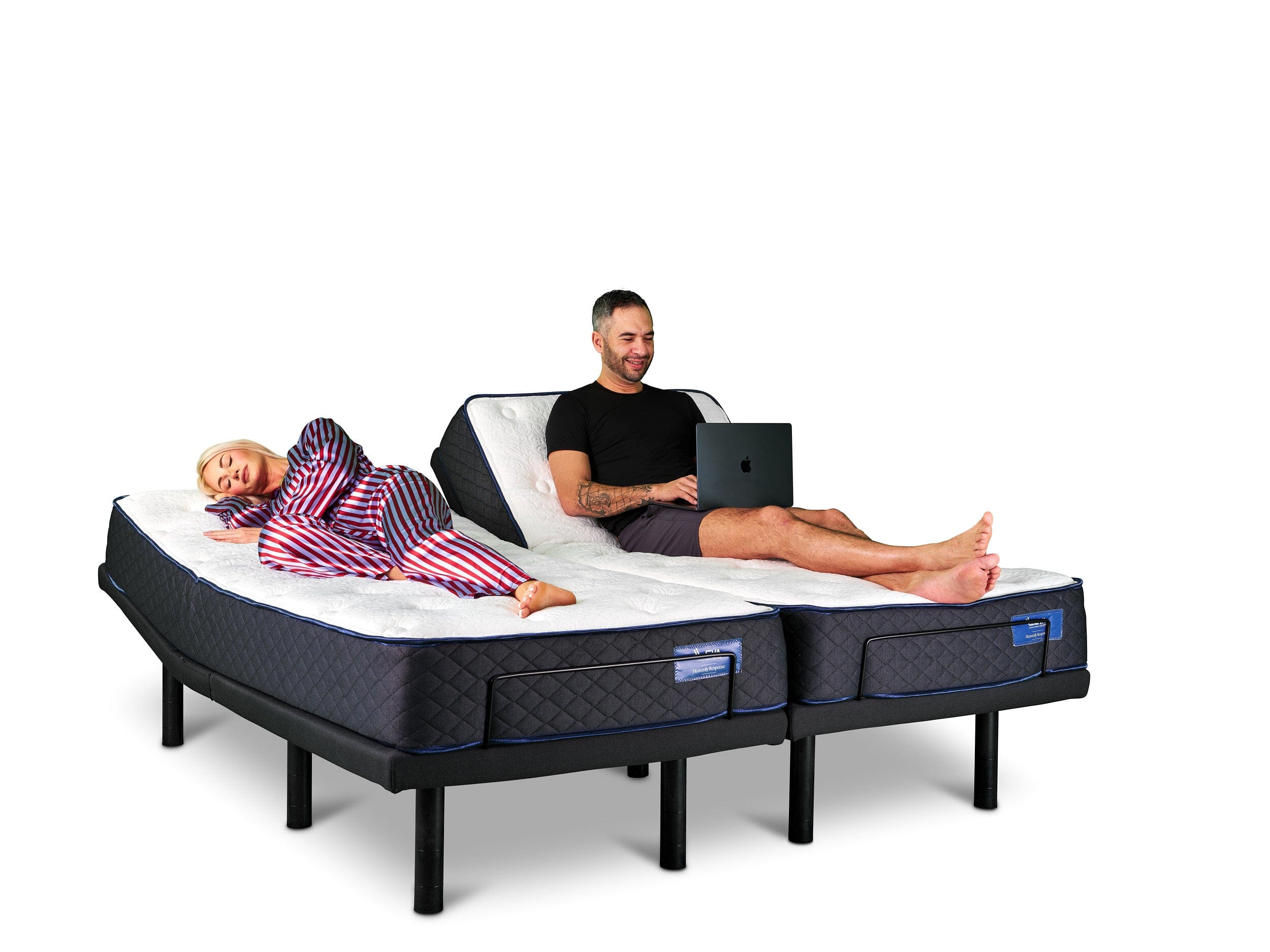
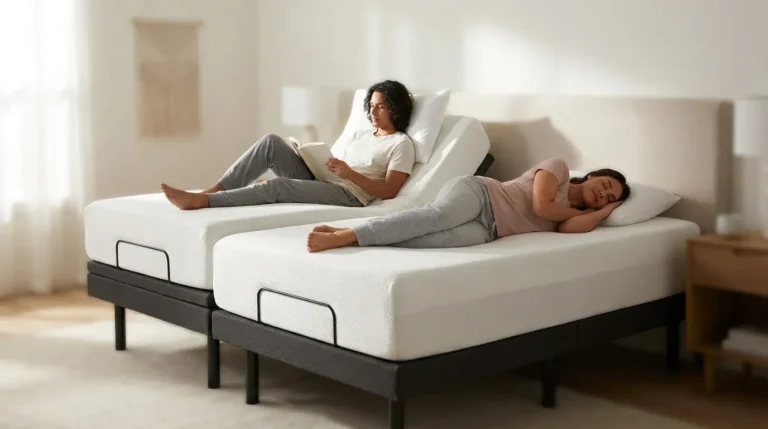
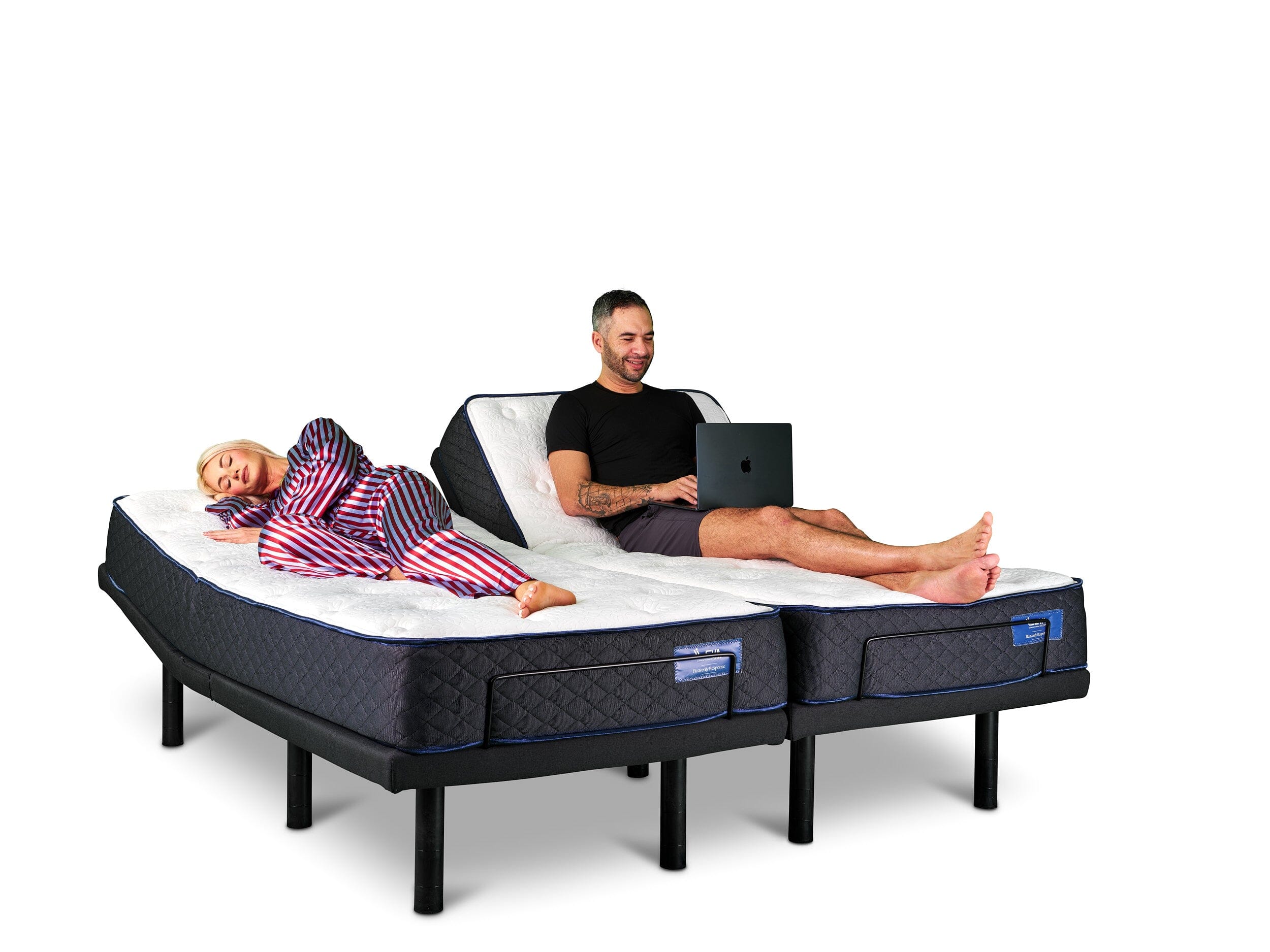
For couples with differing firmness or elevation needs, split adjustable setups enable independent control so one partner can use head elevation while the other sleeps flat, solving two problems at once without sleep divorce. Split king adjustable beds consist of two Twin XL mattresses on independent motorized bases that allow each side to adjust head and foot angles separately while maintaining a standard king sleeping surface. Leva Sleep extends this concept to Split Queen configurations, a rare offering in the Canadian market, for couples who need independent adjustability in a smaller footprint.
Why Traditional Approaches Fall Short
Flat Serta-style mattresses, regardless of construction quality, cannot elevate the upper body or legs, which creates the core limitation for medical conditions. Some couples then try basic adjustable bases sold as add-ons at general furniture retailers, but these typically offer limited elevation range, loud motors, and no independent split control. Others rely on CPAP machines to address moderate-to-severe OSA, yet these introduce noise, mask discomfort, and hose management that disrupt both partners. When these options fail, couples often move to separate rooms, which removes partner disturbance but creates relationship strain and eliminates the practical benefits of shared sleep.
Clinical psychologist and sleep specialist Michael J. Breus, Ph.D., states that anyone with GERD, asthma, low back pain, or sleep apnea can benefit from sleeping on an adjustable bed because elevating the upper body treats many of these conditions. The gap between what a flat mattress can deliver and what these conditions require does not come from brand or price point. It comes from mechanical capability.
Browse Leva Sleep split adjustable systems designed for Canadian couples with differing medical sleep needs.
The Solution: Adjustable Sleep Systems for Medical Conditions
Given the limits of flat mattresses, CPAP alone, and separate bedrooms, adjustable sleep systems provide a more complete approach. An adjustable sleep system combines a motorized base with a compatible mattress, either all-foam or hybrid pocket-coil, to allow independent head and foot elevation, lumbar support, and in advanced models, per-side firmness and temperature control. Adjustable bed bases raise the entire upper body from the waist up, unlike stacking pillows that can kink the neck and increase abdominal pressure, which helps maintain a straighter airway and clearer digestion path.
View Leva Sleep Split Queen and Split King packages with whisper-quiet German motors and full app control.
Independent Adjustability for Couples
Split bases allow each partner to set a different head angle, foot elevation, and massage intensity without affecting the other side. This setup offers a practical mechanical solution to sleep divorce caused by differing medical needs.
Quiet Motor Performance at Night
Motor noise is a documented complaint with basic adjustable bases. Leva Sleep uses whisper-quiet German motors so position changes during the night stay discreet and do not wake the other partner.
Mattress Types That Work Best on Adjustable Bases
A medium to medium-firm hybrid mattress with pocketed coils offers the cradle of foam on top and the airflow and easy movement of coils underneath, which makes it the preferred pairing for adjustable bases used by people with arthritis, fibromyalgia, or sleep apnea. All-foam options remain available for sleepers who prioritize deep pressure relief over ease of repositioning.
Cooling and Temperature Control
Hybrid designs with coils allow air to flow through the mattress for better cooling, which addresses the heat retention problem associated with memory foam. Leva Sleep’s higher-tier systems add a heating and cooling pad for per-side temperature control.
Bedding Designed for Adjustable Bases
Standard fitted sheets often pull off when a base elevates. Leva Sleep designs fitted sheets with deep pockets and extra elastic, duvet clips to maintain separation when positions differ, and remote pockets, all purpose-built for adjustable bases.
White-Glove Delivery and Setup
Leva Sleep offers in-house white-glove delivery in Ontario and Alberta. Trained professionals deliver to the bedroom, assemble the base and mattress, adjust leg heights, provide a product tutorial, and remove the old bed. Customers avoid any assembly burden.
2026 Smart Adjustable Bed Technology
Current Leva Sleep systems include app-controlled positioning via Bluetooth, custom sleep position memory, vibrating alarms, and an anti-snore mode (available spring 2026) that detects snoring and makes micro-adjustments to the head of the bed. Many newer adjustable beds include an automatic anti-snore response that uses sensors to detect snoring and raise the head by approximately 12 degrees to expand the airway. AI-powered sleep tracking enables real-time micro-adjustments throughout the night.
Benefits of Adjustable Sleep Systems for Couples
A 2022 study found that use of an adjustable bed base was associated with 21 additional minutes of time in bed. Specific outcomes by condition include:
- Sleep apnea: A single-center study found mild head-of-bed elevation of 7.5 degrees reduced OSA severity by 31.8% on average.
- GERD: A study (PMID 27629558) shows elevating the head of the bed reduces GERD symptoms such as heartburn when lying down.
- Joint pain and arthritis: Orthopedic physical therapist Karena Wu, P.T., D.P.T., states that adjustable beds can be helpful for those with back and neck pain, chronic pains, respiratory issues, digestive issues, and circulatory issues.
- Partner disturbance: Independent split controls mean one partner’s position change, massage setting, or anti-snore adjustment does not transfer to the other side.
- Sleep divorce prevention: Couples who had been sleeping in separate rooms due to snoring or differing comfort needs report returning to the same bed after switching to Leva Sleep’s split adjustable systems.
When evaluating adjustable sleep systems, use the following feature tiers as a framework:
| Feature | Entry Level | Mid Level | Premium Level |
|---|---|---|---|
| Head/Foot Elevation | Manual preset positions | App-controlled with memory positions | App plus AI micro-adjustment |
| Split Control | Single-zone only | Independent per-side control | Independent per-side and per-zone |
| Anti-Snore | Not included | Manual anti-snore preset | Automatic sensor-triggered adjustment |
| Temperature | Not included | Breathable mattress construction | Active heating and cooling pad per side |
Leva Sleep’s direct-to-consumer model, which includes designing, assembling, and delivering systems in-house, removes distributor and retailer markups. The result is pricing 30–50% below comparable luxury competitors such as Tempur-Pedic or Ghostbed equivalents, with in-house white-glove delivery available across Ontario and Alberta. Leva Sleep offers 15–20 adjustable base models, compared to the 3–5 typically found at general mattress retailers.
Compare Leva Sleep adjustable bed packages across entry, mid, and premium tiers with direct Canadian pricing.
Frequently Asked Questions
How long does white-glove delivery and setup take in Ontario or Alberta?
Leva Sleep’s in-house white-glove delivery team schedules a specific appointment window for each customer. On delivery day, the team brings the base and mattress directly to the bedroom, assembles the full system, adjusts leg heights to the customer’s preference, provides a hands-on product tutorial covering the app and all presets, and removes the old bed for donation or recycling. The full setup process typically takes one to two hours depending on configuration and home layout.
Can an adjustable bed replace a CPAP machine for diagnosed sleep apnea?
No. Adjustable bed elevation is a positional therapy that reduces apnea-hypopnea index events in mild-to-moderate, position-dependent obstructive sleep apnea. It does not replace CPAP therapy in moderate-to-severe cases or central sleep apnea. Customers with a formal OSA diagnosis should consult their sleep medicine specialist before modifying or discontinuing CPAP use. Many sleep apnea clinics refer patients to Leva Sleep as a complementary tool, particularly for those who struggle with CPAP mask compliance or who have positional OSA.
How does a Split Queen adjustable bed differ from a Split King?
Leva Sleep is one of the few Canadian providers offering a Split Queen adjustable bed, built to customer specifications. A Split Queen uses two narrow twin mattresses on independent motorized bases within a queen-sized footprint, giving each partner independent head and foot elevation, massage, and temperature control. A Split King uses two Twin XL mattresses in a king-sized footprint. The Split Queen suits couples who want full independent adjustability but have a smaller bedroom or prefer a queen-sized sleeping surface.
What maintenance does a Leva Sleep adjustable base need?
Leva Sleep adjustable bases use whisper-quiet German motors engineered for long-term reliability. Routine maintenance stays minimal: keep the base clear of obstructions beneath the frame, avoid bending the mattress beyond the base’s designed range, and use the Leva Sleep app to run periodic position checks. Leva Sleep’s direct-to-consumer model means customers work with the manufacturer directly for any service needs, without a third-party retailer.
Who benefits most from a split adjustable sleep system?
Couples where one or both partners have a medical sleep condition such as sleep apnea, GERD, arthritis, fibromyalgia, or chronic hip, knee, or back pain benefit most, especially when each partner has different elevation or firmness needs. Split systems also suit couples experiencing sleep divorce due to snoring or movement disturbance, those recovering from surgery who require elevated positioning, and anyone whose doctor has recommended sleeping at an incline. Individuals with spinal fusion or osteoporosis should consult a physician before using an adjustable base, as certain positions may not be appropriate.
Conclusion: Shared Sleep with Medical Support
Flat mattresses, including quality options from brands like Serta, address surface comfort but cannot resolve the positional requirements of sleep apnea, GERD, arthritis, or fibromyalgia. For Canadian couples aged 35–70 navigating these conditions, evidence points toward split adjustable sleep systems as the category that supports both medical needs and the relationship dynamic of sleeping together. Independent elevation, whisper-quiet motors, compatible hybrid mattresses, per-side temperature control, and automatic anti-snore technology are now available through Leva Sleep’s direct-to-consumer model at the pricing and delivery terms outlined above.
Find your Leva Sleep split adjustable configuration that fits your conditions, your space, and your budget.