
Written by: Matthew Timmins, Founder and Managing Director, Leva Sleep | Last updated: July 1, 2026
Key Takeaways
- Positional therapy and weight loss have the strongest long-term evidence for mild snoring, followed by mandibular advancement devices.
- Adjustable-bed elevation ranks third in evidence and offers unique couple-friendly benefits through independent head adjustments.
- Split adjustable bases let partners manage snoring positionally without masks, wearables, or separate rooms.
- Head-of-bed elevation between 7–15 degrees reduces airway collapse for both mouth and nasal breathers.
- Leva Sleep offers split adjustable bed packages with anti-snore mode and independent controls, helping couples stay together comfortably. Browse Leva Sleep’s split adjustable systems.
What Permanently Stops Snoring?
No single intervention eliminates snoring in every case because snoring has multiple anatomical and lifestyle causes. The most durable outcomes come from interventions that address root causes rather than symptoms alone.
Weight loss reduces fatty tissue around the upper airway, a primary mechanical driver of snoring in adults with a higher body mass index. Positional therapy, which trains the body to avoid supine (back) sleeping, removes gravitational pressure on the soft palate and tongue base. Both approaches require sustained behavioural change to maintain results.
Mandibular advancement devices are the most studied oral appliance category. Custom-fitted MADs prescribed by a dentist outperform over-the-counter versions in both efficacy and comfort. Tongue-retaining devices serve a similar function for patients who cannot tolerate jaw advancement.
Surgical options such as uvulopalatopharyngoplasty and radiofrequency ablation exist for structural causes but carry procedural risk and are not first-line recommendations for simple snoring. Nasal dilators and strips address nasal-passage resistance and work best when nasal obstruction is the primary cause, which affects a narrower subset of snorers.
For couples, most permanent solutions share a practical limitation because they require individual compliance over months or years. An adjustable sleep system addresses the shared-sleep environment directly and can be used alongside any of the above interventions.
What Is Snoring a Red Flag For?
Snoring becomes a red flag for obstructive sleep apnea (OSA) when it appears with witnessed breathing pauses, gasping or choking sounds, excessive daytime sleepiness, morning headaches, or difficulty concentrating. OSA occurs when the upper airway collapses repeatedly during sleep, which reduces blood oxygen levels and fragments sleep architecture.
Partners are often the first to observe these warning signs. If a bed partner reports pauses in breathing, the snorer should consult a physician before relying solely on non-invasive solutions. A home sleep apnea test or in-lab polysomnography can confirm or rule out OSA. Untreated moderate-to-severe OSA is associated with elevated cardiovascular risk, and non-invasive snoring aids do not replace CPAP or other medically indicated OSA treatment.
Snoring without apnea events, sometimes called primary or simple snoring, carries a lower immediate medical risk but still disrupts the bed partner’s sleep, which has its own health consequences. This group benefits most from lifestyle changes, oral appliances, and adjustable-bed elevation as standalone interventions.
Because most snoring happens in shared beds, couples in this primary snoring group often look next at solutions that protect both partners’ sleep without separating them.
Best Anti-Snoring Device for Couples
The most effective anti-snoring device for couples supports the snorer’s airway while preserving the non-snoring partner’s sleep quality. No single over-the-counter device accomplishes both goals at once, so system-level solutions, especially split adjustable bases, have become a leading option for couples who want to remain in the same bed.
Among wearable devices, custom-fitted MADs have the strongest evidence base for reducing snoring frequency and intensity. Combination MAD and tongue-retaining devices may benefit mouth breathers who cannot achieve nasal breathing. Chin straps that encourage mouth closure are low-cost but have limited evidence for sustained efficacy.
For couples, the critical evaluation criterion is whether the device disrupts the non-snoring partner. Wearable devices are worn by the snorer alone and do not directly change the partner’s sleep environment. An adjustable base with independent controls, by contrast, lets both partners fine-tune their own sleep position at the same time. The snorer elevates their head to reduce airway collapse, while the partner adjusts independently for comfort.
Best Anti-Snoring Device for Mouth Breathers
Mouth breathing during sleep bypasses the nasal passages, which normally filter, humidify, and warm air, and places greater vibratory load on the soft palate and uvula. Devices that rely on nasal airflow, such as nasal strips, nasal dilators, or nasal CPAP masks, work less effectively for confirmed mouth breathers.
Tongue-retaining devices hold the tongue forward without requiring nasal breathing and offer a viable option for mouth breathers who cannot tolerate MADs. Full-face CPAP masks that cover both nose and mouth remain the medical standard for mouth-breathing OSA patients. For non-apnoeic mouth breathers, myofunctional therapy, which uses exercises to retrain oral and facial muscles toward nasal breathing, has emerging evidence as a long-term behavioural intervention.
Head-of-bed elevation reduces the gravitational pull on the tongue and soft palate regardless of breathing route. This elevation range, the 7–15 degrees mentioned earlier, works by shifting the tongue and soft palate forward, a mechanical benefit that applies to both mouth and nasal breathers.
The Problem: Snoring as a Couple Issue
Snoring affects an estimated 40–50% of adults, with prevalence increasing with age and body weight. For couples sharing a bed, the impact is bilateral. The snorer experiences fragmented, non-restorative sleep, while the partner loses sleep to noise exposure.
Over time, chronic sleep deprivation in either partner is associated with irritability, reduced cognitive function, and relationship strain. Sleep divorce, the practice of partners sleeping in separate rooms to avoid snoring-related disruption, is increasingly common among Canadian couples. Separate sleeping arrangements can restore individual sleep quality in the short term but remove the physical proximity and intimacy that many couples value.
Most couples want to sleep better together rather than apart. When snoring is accompanied by OSA, the stakes are higher. A bed partner who observes apnea events is in a unique position to prompt earlier medical evaluation, which can reduce cardiovascular and metabolic risk over the long term.
Why Traditional Solutions Fall Short for Couples
Traditional snoring solutions often fail couples because they do not support both partners’ needs at the same time. First, many options lack the mechanical capability to position each sleeper properly. Flat beds provide no positional support for airway management, and basic adjustable bases often use a single-zone motor that moves both sides together, so the snorer cannot elevate without also elevating the partner.
Second, some solutions introduce new disruptions. Noise from older or lower-quality motors can become a sleep disruptor on its own. Bed-in-a-box products are designed for flat sleeping and are not engineered to flex repeatedly with an adjustable base. CPAP therapy is highly effective for OSA but has a documented compliance challenge. Many patients discontinue use within the first year because of mask discomfort, noise, or claustrophobia.
Third, separate rooms resolve noise but eliminate shared sleep entirely. This approach protects sleep quantity but sacrifices intimacy and shared bedtime routines.
| Solution Type | Snoring Effectiveness | Lifestyle Fit for Couples | Canadian Price Range (Approx.) |
|---|---|---|---|
| Nasal strips / dilators | Low–moderate (nasal obstruction only) | High, no partner impact | $10–$40/month |
| OTC mandibular device | Moderate (variable fit) | High, worn by snorer only | $30–$150 one-time |
| Custom MAD (dentist-fitted) | Moderate–high | High, worn by snorer only | $1,500–$3,000 |
| CPAP therapy | High (OSA-indicated) | Low–moderate (mask, noise, compliance) | $800–$3,000 + ongoing supplies |
| Split adjustable base system | Moderate (positional, non-wearable) | Very high, independent controls per partner | $2,500–$7,000+ (system) |
Note: Effectiveness ratings reflect general clinical consensus for primary snoring without confirmed OSA. Individual results vary. Price ranges are approximate Canadian retail estimates as of mid-2026 and are not sourced from a single verified database; consult current retailers for accurate pricing.
How Split Adjustable Sleep Systems Work
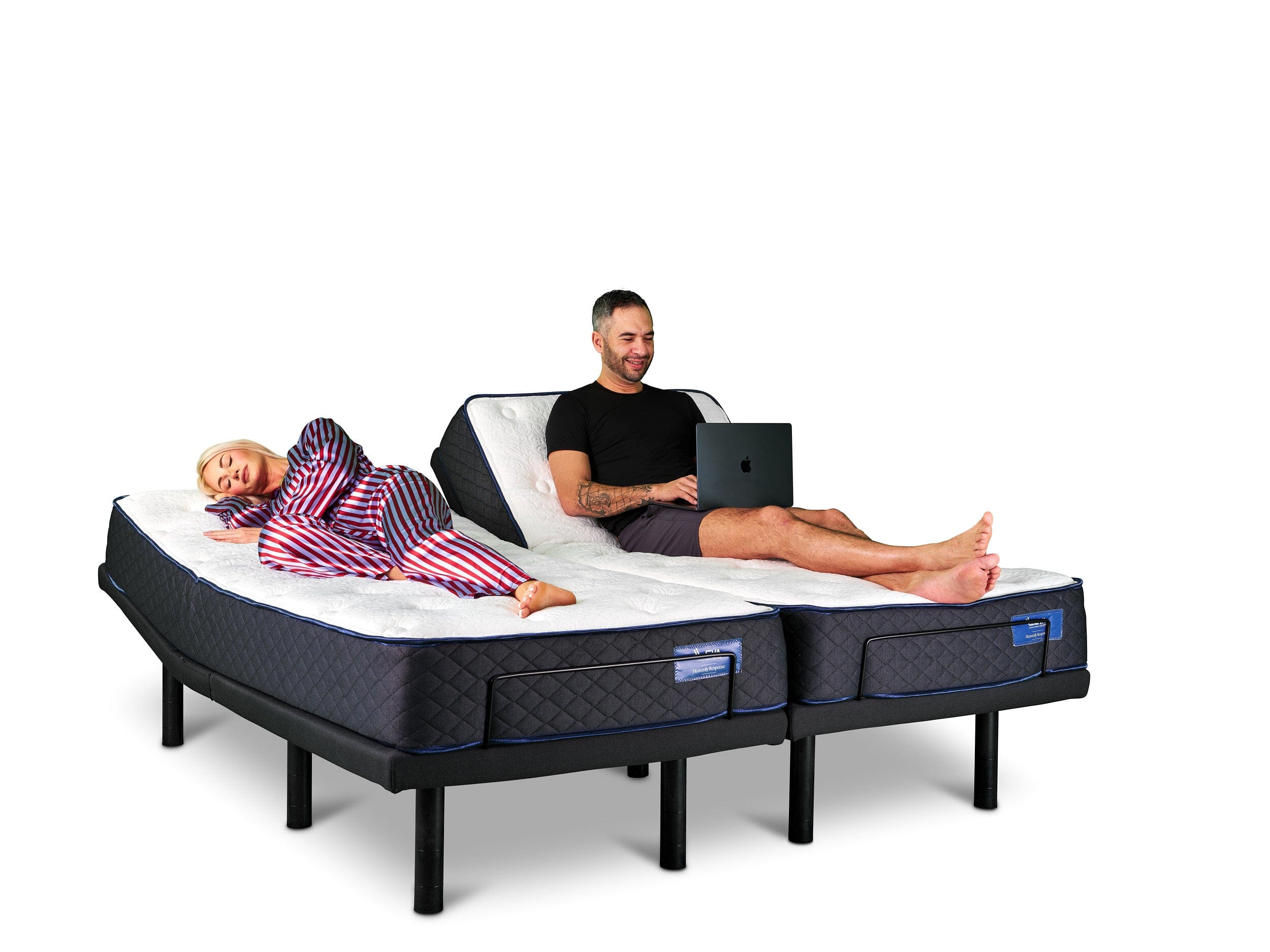
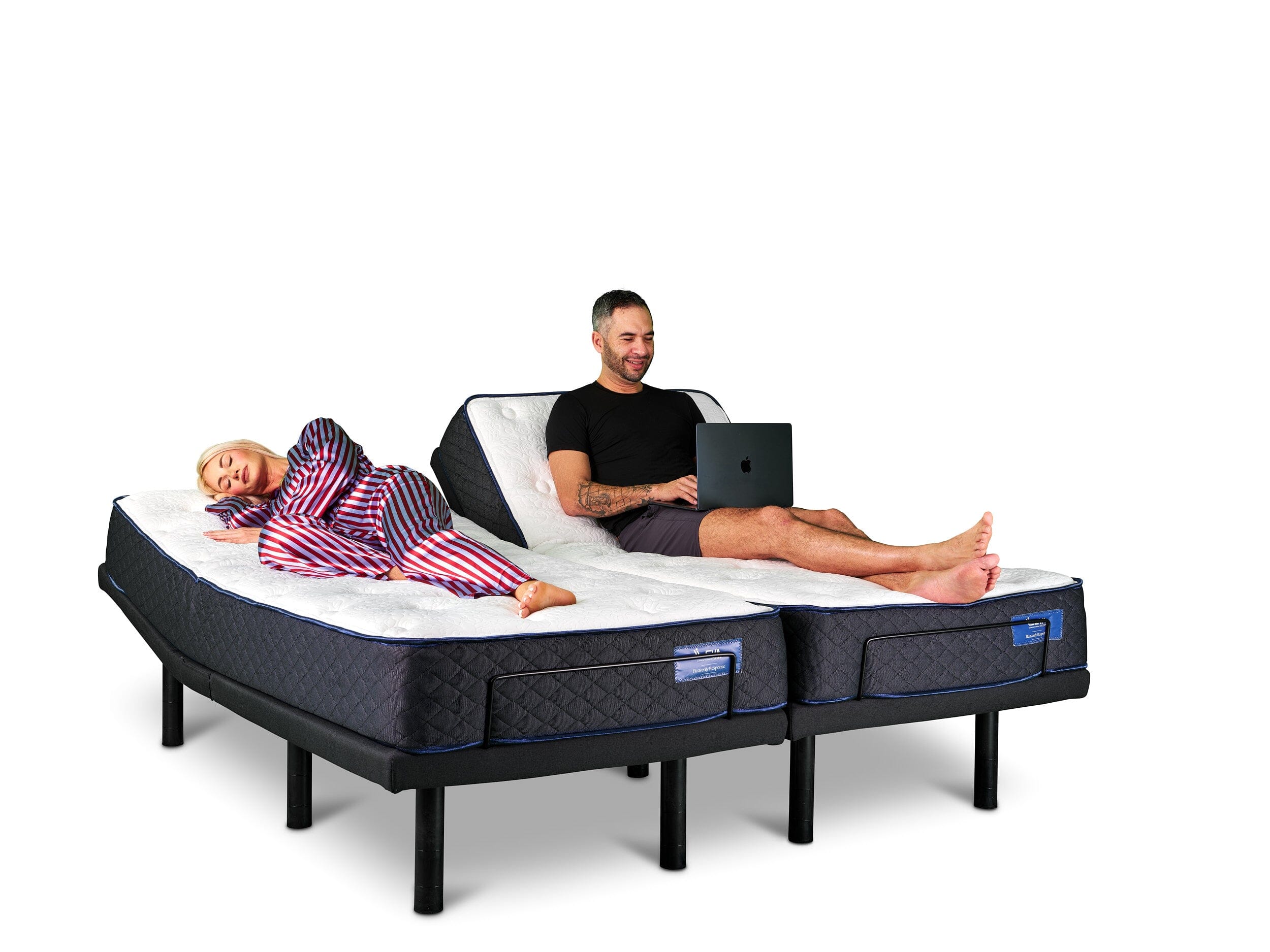
Split adjustable sleep systems form a distinct category separate from both flat beds and basic single-zone adjustable bases. In a split configuration, each side of the bed operates on an independent motor and control system. This design lets partners set different head and foot elevations, massage intensities, and, in advanced models, temperature zones at the same time.
For snoring management, head-of-bed elevation is the key mechanism. Elevating the head within the 7 to 15 degree range shifts the tongue and soft palate forward and lowers the chance of airway collapse during sleep. This positional benefit applies whether the sleeper breathes through the nose or mouth and does not require any wearable device.
Leva Sleep’s adjustable bases use whisper-quiet German motors and include an anti-snore mode that detects snoring and initiates micro-adjustments to the head of the bed automatically. These changes occur without waking the sleeper or the partner. The system is controlled through the Leva Sleep app, which supports custom sleep positions, vibrating alarms, and real-time adjustments. Split Queen and Split King configurations are available, and the Split Queen offers independent adjustability in a more space-conscious footprint that remains uncommon in the Canadian market.
Evaluation Criteria for Couples
Couples can use a clear set of criteria when evaluating a split adjustable base system.
Split configuration availability: Confirm that the base offers true independent control per side, not a shared remote with zone presets. Confirm the retailer stocks your preferred size, especially if you want the Split Queen mentioned earlier.
Motor noise level: Request decibel specifications or ask for a demonstration. Motors that operate above conversational noise levels, roughly 60 dB, can disrupt a light sleeper during position changes.
Mattress compatibility: Adjustable bases require mattresses rated for flex, typically all-foam or hybrid pocket-coil constructions. Innerspring mattresses with interconnected coils are generally not compatible. Verify compatibility before purchasing a mattress separately.
Specialized bedding: Standard fitted sheets often dislodge when a base elevates. Look for sheets with deep pockets and reinforced elastic, and duvets with clip systems that maintain separation when partners use different elevations.
App control and anti-snore mode: Check whether the app supports Bluetooth connectivity, custom position memory, and automated snore-response micro-adjustments. Confirm that the anti-snore mode uses sensors rather than a simple timer.
Delivery and setup: Large adjustable bases work best with professional assembly. White-glove delivery services that include old-bed removal, height adjustment, and a product tutorial reduce setup risk and help ensure the system is calibrated correctly from the first night.
Real-World Outcomes for Couples
Couples who move from a flat bed to a split adjustable system commonly report three main improvements. First, the snoring partner maintains a consistent elevated position throughout the night without relying on pillow stacking, which shifts and loses height. Second, the non-snoring partner can independently adjust their own side for lumbar support, temperature, or foot elevation without disturbing the other side.
Third, couples who had moved to separate rooms to manage snoring often return to shared sleeping and regain the relational and intimacy benefits of co-sleeping. For couples where one partner has been advised by a physician to sleep elevated for mild sleep apnea, acid reflux, or post-surgical recovery, a split base supports the medical recommendation without forcing the other partner to sleep at the same elevation.
Sleep apnea clinics in Canada have referred patients to adjustable-base specialists when CPAP compliance is low and positional therapy is a viable adjunct. Leva Sleep specializes in adjustable bases and offers roughly 15–20 models, a wider selection than the 3–5 options typically found at general mattress retailers, and prices its systems competitively through a direct-to-consumer model.
Decision Checklist: Matching Solution to Snoring Profile
| Tier | Solution | Best For | Evidence Level | Approx. Canadian Cost |
|---|---|---|---|---|
| 1 — Lifestyle | Weight loss, side-sleeping, alcohol reduction | Mild snoring, BMI-related | Strong (long-term) | Low / no direct cost |
| 2 — OTC Device | Nasal strips, chin straps, OTC MAD | Nasal obstruction, mild jaw snoring | Moderate (variable fit) | $10–$150 |
| 3 — Medical Device | Custom MAD, TRD, CPAP | Moderate snoring, confirmed OSA | Strong (custom fit / OSA) | $800–$3,000+ |
| 4 — System Level | Split adjustable base with anti-snore mode | Couples, positional snoring, relationship preservation | Moderate (positional therapy basis) | $2,500–$7,000+ (system) |
Cost ranges are approximate Canadian retail estimates as of mid-2026. Consult current retailers and healthcare providers for accurate pricing and clinical guidance.
Solutions for Couples: Split Configurations and Anti-Snore Mode
For couples specifically, Tier 4 system-level solutions offer advantages that no wearable device can match. Both partners benefit at the same time, neither partner needs to wear or maintain a device, and the system adapts automatically. Leva Sleep’s anti-snore mode automatically adjusts the head of the bed to help reduce snoring, a mechanism that operates passively while both partners remain asleep.
Split Queen and Split King configurations ensure that these adjustments affect only the snoring partner’s side of the bed. Couples with differing firmness preferences can pair the split base with independently selected mattresses on each side, addressing both snoring and comfort differences within a single system.
Frequently Asked Questions
How do you set up and maintain a split adjustable base?
A split adjustable base arrives as two independent units that sit side by side within a shared bed frame or on a platform. Professional white-glove delivery, such as that offered by Leva Sleep, includes in-room assembly, leg-height calibration, app pairing, and a full product tutorial.
Ongoing maintenance stays minimal. Motors are sealed units that do not require lubrication, and the primary user task is keeping the app updated for firmware improvements. Bedding should be checked periodically to ensure fitted sheets remain secure, particularly after frequent elevation changes.
Can a split adjustable base accommodate partners with different firmness preferences?
Yes. In a split configuration, each side of the base is a separate unit, which means each partner can pair their side with a different mattress. One partner might choose an all-foam mattress for pressure relief, while the other selects a hybrid pocket-coil for a firmer feel.
This flexibility is one of the primary advantages of a split system over a single shared base. Leva Sleep designs its mattresses specifically for use with adjustable bases, so both all-foam and hybrid options flex correctly through the full range of elevation positions.
Is a split adjustable base compatible with an existing mattress?
Compatibility depends on the mattress construction. All-foam and hybrid pocket-coil mattresses are generally compatible with adjustable bases because they flex without structural damage. Traditional innerspring mattresses with interconnected Bonnell or offset coils are not compatible and will be damaged by repeated flexing.
Memory foam mattresses vary by density and thickness. Very thick or very dense foam may not flex adequately at higher elevation angles. Before purchasing a base separately from a mattress, confirm compatibility with the base manufacturer. Leva Sleep’s product specialists can advise on compatibility with both Leva-branded mattresses and partner brands including Tempur-Pedic, Simmons, Beautyrest, Serta, and Kingsdown.
When should a person consult a doctor before trying non-invasive snoring solutions?
A physician consultation is recommended before relying solely on non-invasive solutions if any of the following are present. Witnessed breathing pauses during sleep, gasping or choking sounds, excessive daytime sleepiness despite adequate sleep time, morning headaches, or a neck circumference above 40 cm for women or 43 cm for men, which are established OSA risk factors.
A home sleep apnea test or polysomnography can rule out moderate-to-severe OSA, for which CPAP or other medical treatment remains the standard of care. Non-invasive solutions, including adjustable-bed elevation, are appropriate adjuncts for mild OSA or primary snoring but do not replace medically indicated treatment.
Conclusion
Snoring management works best when the solution matches the severity and cause of the snoring. Lifestyle changes and positional therapy carry the strongest long-term evidence for mild snoring and cost the least. Custom mandibular advancement devices offer a step up in efficacy for jaw-related snoring, and CPAP remains the medical standard for confirmed OSA.
For couples who want to remain in the same bed, address positional snoring without wearable devices, and accommodate differing comfort needs at the same time, a split adjustable sleep system offers a comprehensive system-level solution currently available in Canada. Couples evaluating this category should prioritize independent motor control, verified motor noise levels, mattress compatibility, specialized bedding, and professional delivery and setup.
Leva Sleep’s direct-to-consumer model, 15–20 adjustable models, and in-house white-glove delivery make it a specialist option worth comparing with general mattress retailers. This is particularly relevant for couples seeking Split Queen availability or sensor-based anti-snore mode technology at a price point roughly 30–50% below comparable luxury competitors.