
Written by: Matthew Timmins, Founder and Managing Director, Leva Sleep | Last updated: July 23, 2026
Key Takeaways
- Split adjustable beds give each partner independent head and foot elevation, so no one has to compromise on snoring, reflux, or temperature needs.
- Split Queen configurations fit standard queen-sized bedrooms with about 10 feet of width while still delivering the same independent-control benefits as larger Split King setups.
- Leva Sleep’s whisper-quiet German motors, app controls, and upcoming anti-snore mode (spring 2026) help reduce disturbance between partners during nightly adjustments.
- Professional white-glove delivery and mattress-bridge accessories address common concerns such as centre gaps, motor noise, and setup complexity for Canadian couples.
- Find the package that fits your bedroom, budget, and sleep needs by exploring Leva’s Split Queen and Split King configurations.
Split Queen Adjustable Beds: Where They Beat Split King
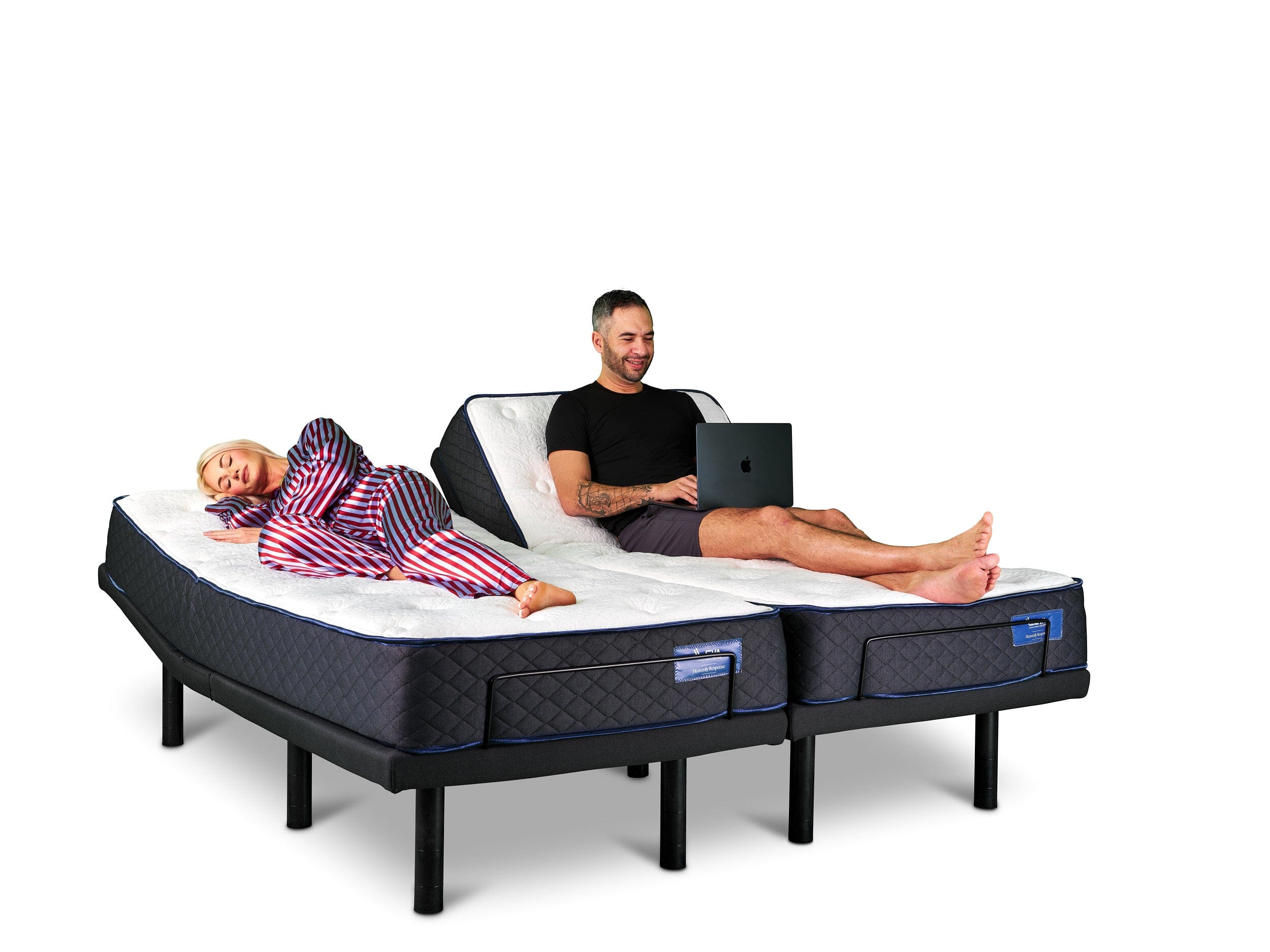
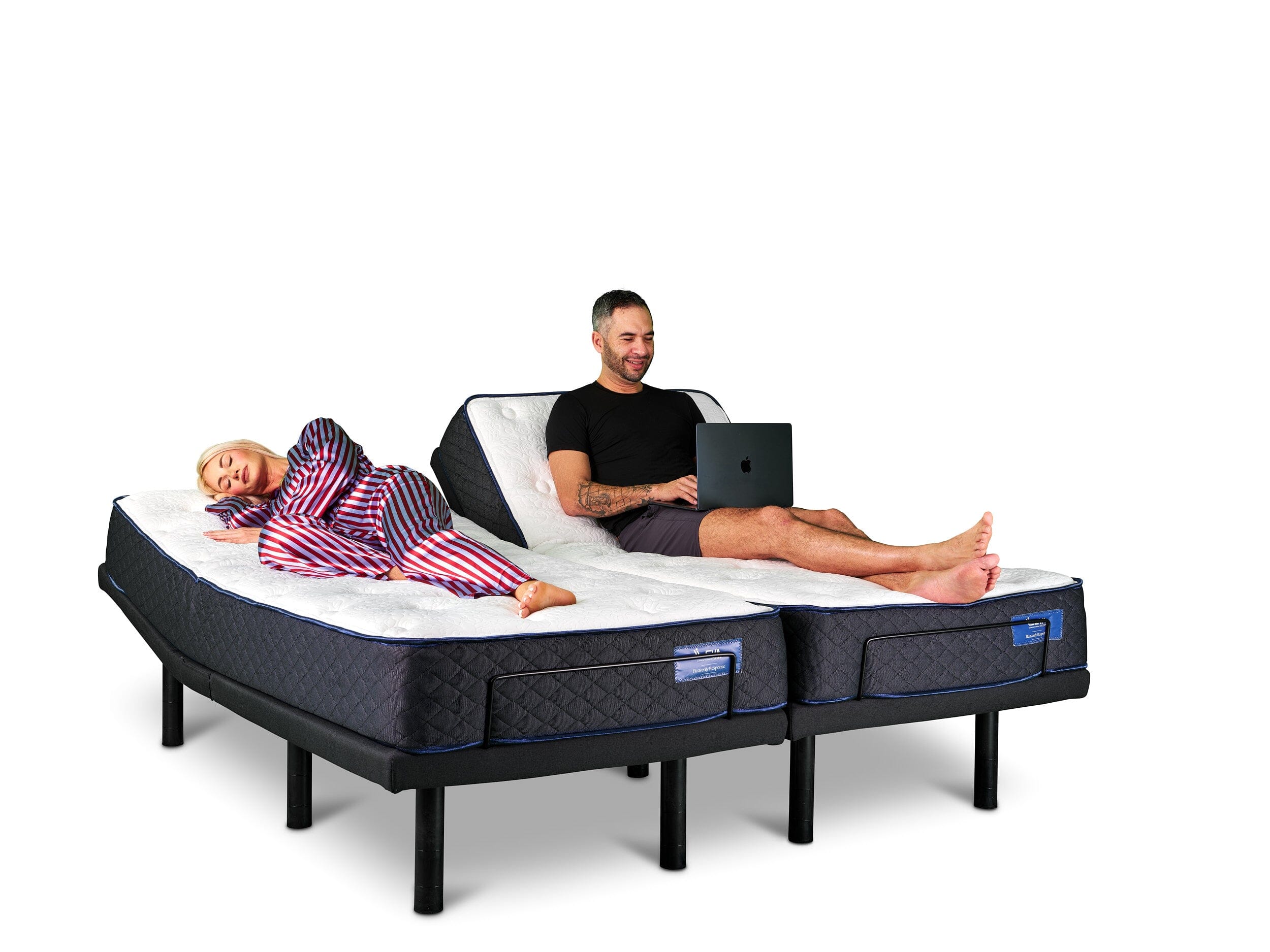
A Split Queen adjustable bed uses two narrow queen-width bases side by side to create a standard queen footprint of 60 × 80 inches, with a separate motor and controls on each side. A Split King uses two Twin XL bases to form a 76 × 80 inch king surface. Both offer independent control, but the Split Queen delivers this benefit in a smaller floor area, which makes it the practical choice for bedrooms that cannot accommodate a king-sized frame.
Leva Sleep is one of the few Canadian providers with a purpose-built Split Queen configuration. Built to customer specifications with whisper-quiet German motors and full app control, Leva’s Split Queen gives couples in tighter spaces personalized elevation, massage, and temperature settings similar to larger split systems. Couples gain these features without needing a bedroom renovation.
Compare Split Queen and Split King packages with independent controls for each partner.
How Split Adjustable Beds Operate Night to Night
Each side of a split adjustable base operates independently, so one partner can raise the head section to 45 degrees for reflux relief while the other remains flat. Foot elevation, lumbar support, and massage zones also run separately on each side. Leva Sleep’s bases use whisper-quiet German motors engineered to minimize vibration transfer between the two sides, which helps prevent one partner’s adjustments from waking the other.
Control options include a physical remote and the Leva Sleep app, which supports custom saved positions, vibrating alarms, and subtle positional micro-adjustments. An anti-snore mode, arriving spring 2026, detects snoring and makes incremental head-of-bed adjustments automatically. Leva offers 15 to 20 adjustable base models, compared with the 3 to 5 typically found at general mattress retailers, so couples can match feature tiers to their specific needs.
Common Split Queen Concerns and How Leva Addresses Them
Split adjustable beds offer strong benefits, and couples considering them should understand four practical concerns that come up consistently during research.
- Centre gap: Two separate bases create a seam at the middle of the mattress. On a Split Queen, the gap is narrower than on a Split King because the individual bases are wider. A connector strap or bridge pad placed between the two mattresses reduces the perceptible gap for most sleepers.
- Motor noise: Basic adjustable bases can produce audible motor sounds during adjustment. The German motors discussed earlier address this concern through their low acoustic output, which matters when one partner adjusts position in the middle of the night.
- Delivery and setup complexity: Split systems involve two bases, two motor connections, wire harness routing, and remote pairing. Common DIY assembly errors include reversed motor connections, loose wire harnesses, and inconsistently installed legs. These mistakes create an uneven sleeping surface, so professional setup removes this risk.
- Mattress compatibility: Standard mattresses are not designed to flex with an adjustable base. Leva Sleep’s all-foam and hybrid pocket-coil mattresses are engineered specifically for articulation, and the accompanying bedding, including fitted sheets with deep pockets and extra elastic plus duvet clips, is designed to stay in place through elevation changes.
Centre Seam Comfort: Split King vs Split Queen
The centre seam on a Split King creates a small gap between the two Twin XL bases. Most couples do not sleep directly on the seam, and a mattress bridge pad or connector strap closes the gap at the surface level. The more noticeable effect is a slight difference in mattress height if the two sides use different firmness levels, which can be felt when moving across the centre.
A Split Queen has the same seam but proportionally less gap relative to the total bed width because each half is wider than a Twin XL. For couples who share the centre of the bed regularly, a Split Queen’s wider individual bases mean the seam is less likely to fall under a sleeping position. Neither configuration removes the seam entirely, yet both can be managed effectively with the right mattress bridge accessory.
Best Split Queen Choice for Smaller Canadian Bedrooms
A standard queen mattress of 60 × 80 inches typically requires a minimum bedroom width of about 10 feet to allow comfortable movement on both sides of the bed. A king mattress of 76 × 80 inches usually needs at least 12 feet of width. Many Ontario and Alberta homes, especially older builds in Toronto, Hamilton, Calgary, and Edmonton, have master bedrooms sized for a queen, not a king.
In those rooms, a Split King is not a realistic option. A Split Queen delivers independent head and foot elevation, separate firmness, and individual temperature control within the same footprint as a standard queen bed. For couples who want split adjustability without reconfiguring their bedroom, the Split Queen often becomes the only configuration that fits.
Split King vs Split Queen: Size, Cost, and Gap Risk
| Configuration | Bedroom Size Needed | 2026 CAD Price Range (Base Only) | Centre Gap Risk |
|---|---|---|---|
| Split Queen | ~10 ft minimum width | Contact Leva Sleep for current pricing | Lower (wider individual bases) |
| Split King | ~12 ft minimum width | Contact Leva Sleep for current pricing | Moderate (narrower Twin XL bases) |
Both configurations provide fully independent head and foot elevation, separate remote or app control, and the option for each partner to choose a different mattress firmness. The main trade-offs involve bedroom footprint and the width of each individual base relative to the centre seam.
Couple Scenarios: Matching Medical Needs to Leva Settings
This section maps common sleep conditions to relevant Leva Sleep features. These are positional comfort adjustments, not medical treatments. Persistent symptoms still require evaluation by a healthcare professional.
| Condition | Relevant Leva Feature | Positional Benefit |
|---|---|---|
| Snoring / mild OSA | Head elevation; anti-snore mode (spring 2026) | A 7.5-degree head elevation reduced apnea-hypopnea index by ~31% in a 2021 randomised controlled trial |
| Acid reflux / GERD | Head elevation; pillow tilt motor | 15–20 degrees of head elevation reduced esophageal acid exposure time by 67% in a randomised controlled trial |
| Hip / knee / back pain | Zero-gravity preset; lumbar control; foot elevation | Slightly elevated knees reduce the lumbar arch, allowing the lower back to settle into a more neutral position |
| Temperature sensitivity | Individual heating and cooling pad per side | Each partner regulates their own sleep surface temperature independently, addressing the most commonly reported couple sleep complaint |
2026 CAD Pricing and Total Ownership Cost
Contact Leva Sleep for current 2026 CAD pricing on Split Queen and Split King configurations. Leva Sleep’s direct-to-consumer model, which designs and assembles systems locally without retail markup, positions its packages at 30 to 50 percent below comparable premium competitors. Over 8 years and $50M in lifetime sales across 25,000+ Canadian customers, Leva has built its pricing model around vertical integration rather than wholesale distribution. For couples comparing Leva to Tempur-Pedic, Douglas, or Orthex, the total ownership cost, including base, mattress, accessories, and delivery, provides the most accurate comparison point.
View current 2026 CAD package pricing for Split Queen and Split King configurations.
White-Glove Delivery vs Bed-in-a-Box Setup
Bed-in-a-box brands ship adjustable bases to the door and leave assembly to the customer. Split king configurations require longer professional setup time than single bases because two separate bases must be assembled and synchronized, and DIY errors such as reversed motor connections, inconsistent leg heights, and improperly positioned retainer bars are common.
Leva Sleep’s in-house white-glove delivery service, available for a fee in Ontario and Alberta, includes:
- Delivery to the bedroom, not just the front door
- Full frame assembly and motor connection
- Wire harness routing and remote pairing
- Function testing of all positions and app setup
- Mattress placement with retainer bars
- Packaging removal
- Old bed removal, donated or recycled where possible
- Product tutorial covering all features and settings
This end-to-end service is handled by Leva’s own trained team, not a third-party courier. The people setting up the bed understand the product’s motors, wiring, and app integration.
Decision Checklist for Choosing Split Queen or Split King
Before purchasing a split adjustable bed, move through the following steps in order.
- Measure the bedroom first. A queen footprint needs about 10 feet of width, and a king needs about 12 feet. Confirm clearance on both sides of the bed, because this measurement determines which configurations are physically possible and narrows your choices before you evaluate features.
- Once you know which sizes fit, identify each partner’s primary sleep issue. Snoring, reflux, back pain, temperature sensitivity, and firmness preference each map to different features. Clear priorities help you select the right feature tier.
- If one partner is a light sleeper, assess noise tolerance next. This step clarifies whether you need premium low-acoustic motors or can work with standard models, which affects both your budget and your shortlist of compatible bases.
- Calculate total ownership cost after that. Add base, mattress, compatible bedding, and delivery. Comparing complete packages, not base prices alone, gives a more realistic view of value.
- Confirm delivery scope before checkout. Ask whether delivery includes in-bedroom setup, motor testing, app pairing, and old-bed removal, or only curbside drop-off. This detail affects both convenience and potential setup risk.
- Check mattress compatibility for your chosen base. Verify that the mattress is designed to articulate with an adjustable base. Standard innerspring mattresses are often not suitable.
- Review warranty terms for each component. Compare coverage on the motor, frame, and remote separately, because warranty tiers often differ by component.
Conclusion: Matching Your Bedroom to the Right Split Configuration
Adults who share a bed often experience more sleep disturbances than solo sleepers, and snoring is common among Canadian adults, so sleep incompatibility has become a widespread and medically relevant issue for Canadian couples. A split adjustable bed addresses this root cause by giving each partner independent control, rather than requiring one person to compromise.
The choice between Split King and Split Queen usually comes down to bedroom dimensions. For rooms that fit a king, a Split King offers the widest individual sleeping surface. For standard queen-sized rooms, which are common across Ontario and Alberta, a Split Queen delivers the same independent-control benefits without needing a larger bedroom. Leva’s purpose-built Split Queen, rare among Canadian providers, is backed by 8 years of adjustable bed specialization, whisper-quiet German motors, in-house white-glove delivery, and pricing 30 to 50 percent below premium competitors.
Find the package that fits your bedroom, budget, and sleep needs by exploring Leva’s Split Queen and Split King configurations.
Frequently Asked Questions
What is the difference between a Split Queen and a Split King adjustable bed?
A Split Queen pairs two narrow bases to form a standard queen footprint of 60 × 80 inches, while a Split King uses two Twin XL bases to create a 76 × 80 inch king surface. Both configurations give each partner independent control over head elevation, foot elevation, massage, and temperature. The key practical difference is bedroom size, since a Split Queen fits in rooms designed for a standard queen bed, while a Split King requires the additional width of a king-sized bedroom. The centre seam is present in both configurations, but the gap is proportionally less noticeable on a Split Queen because each individual base is wider than a Twin XL.
Can a split adjustable bed help with snoring and acid reflux at the same time?
A split adjustable bed allows each partner to set their own head elevation independently, so one person can raise the head section to reduce snoring or reflux symptoms while the other remains flat. Head elevation between 15 and 30 degrees has been studied in the context of both positional obstructive sleep apnea and nocturnal acid reflux, with clinical research showing meaningful reductions in apnea-hypopnea index and esophageal acid exposure time at those angles. Leva Sleep’s bases support head elevation from 0 to 60 degrees, which covers the full range from mild anti-snore angles to a nearly upright position. These are positional comfort adjustments, not medical treatments, so ongoing symptoms should be assessed by a healthcare professional.
Is white-glove delivery worth the extra cost for a split adjustable bed?
Split adjustable beds involve two separate bases, two motor connections, wire harness routing, remote pairing, and function testing, and each step must be completed correctly for the system to operate as intended. Common self-assembly errors include reversed motor connections that cause sections to move in the wrong direction, loose wire harnesses that cause intermittent operation, and legs installed at inconsistent heights that create an uneven sleeping surface. White-glove delivery from Leva Sleep’s in-house team covers all of these steps, plus old-bed removal, app setup, and a product tutorial. For a system with this level of mechanical complexity, professional setup reduces the risk of errors that would require a return visit to correct.
Do split adjustable beds work with any mattress?
Not all mattresses are compatible with adjustable bases. Standard innerspring mattresses with rigid border wires are generally not suitable because they cannot flex through the articulation range without damage. All-foam mattresses and hybrid mattresses with individually wrapped pocket coils are the most compatible options because they bend without structural compromise. Leva Sleep designs its own all-foam and hybrid pocket-coil mattresses specifically to work with its adjustable bases, and its bedding accessories, including fitted sheets with deep pockets and extra elastic plus duvet clips, are engineered to stay in place through elevation changes. When evaluating any split adjustable bed package, confirm that the mattress is explicitly rated for use with an adjustable base before purchasing.
How do I know if a Split Queen or Split King will fit in my bedroom?
Measure the usable width of your bedroom from wall to wall, then subtract the space needed for nightstands and comfortable movement on each side of the bed. As noted earlier, these room-size constraints, approximately 10 feet for a queen and 12 feet for a king, explain why many Ontario and Alberta homes with older master bedrooms can only accommodate a Split Queen configuration. If your bedroom was built for a queen and you want independent adjustability for both partners, a Split Queen usually fits without rearranging the room. If your room accommodates a king, a Split King provides a wider individual sleeping surface on each side. Leva Sleep’s team can help confirm which configuration suits your specific room dimensions during the purchase process.