
Written by: Matthew Timmins, Founder and Managing Director, Leva Sleep | Last updated: July 25, 2026
Key Takeaways for Canadian Split King Shoppers
- Split king adjustable beds give Canadian couples independent control over elevation, firmness, and temperature, which helps with snoring, sleep divorce, and differing preferences.
- Five features separate worthwhile systems from budget options: independent lumbar support, whisper-quiet motors, app-based anti-snore detection, temperature regulation, and white-glove setup.
- Canadian pricing for mid-range split king packages typically falls between $3,000 and $5,500 CAD, with premium configurations reaching about $6,000.
- Leva Sleep stands out with vertical integration, multiple models, in-house white-glove delivery in Ontario and Alberta, and a planned spring 2026 anti-snore mode.
- Ready to upgrade your sleep? Explore Leva’s split king packages and compare configurations that match your needs.
Split King vs. Split Queen: How Each Size Works
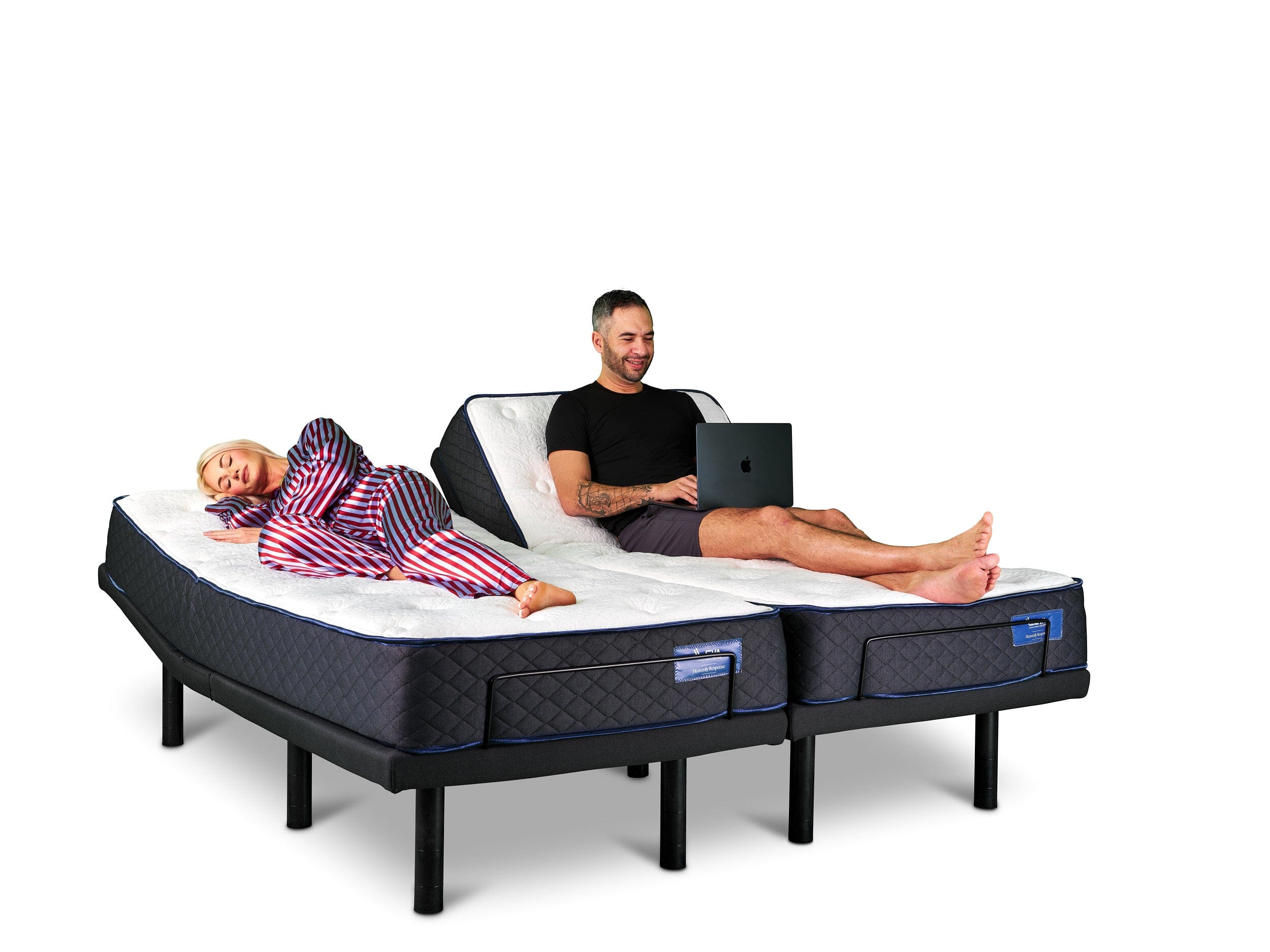
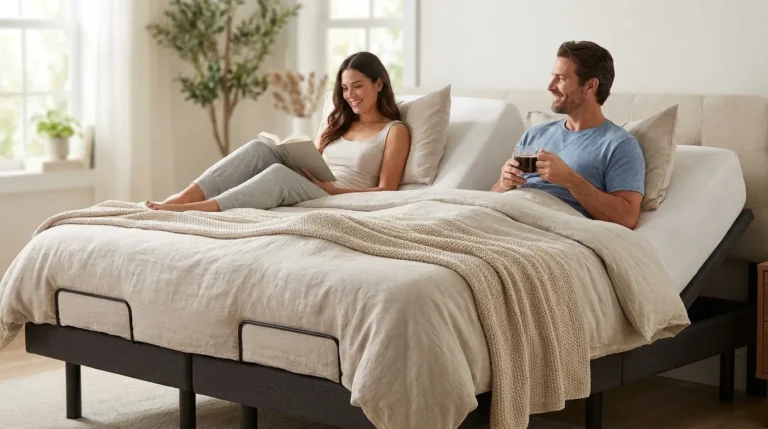
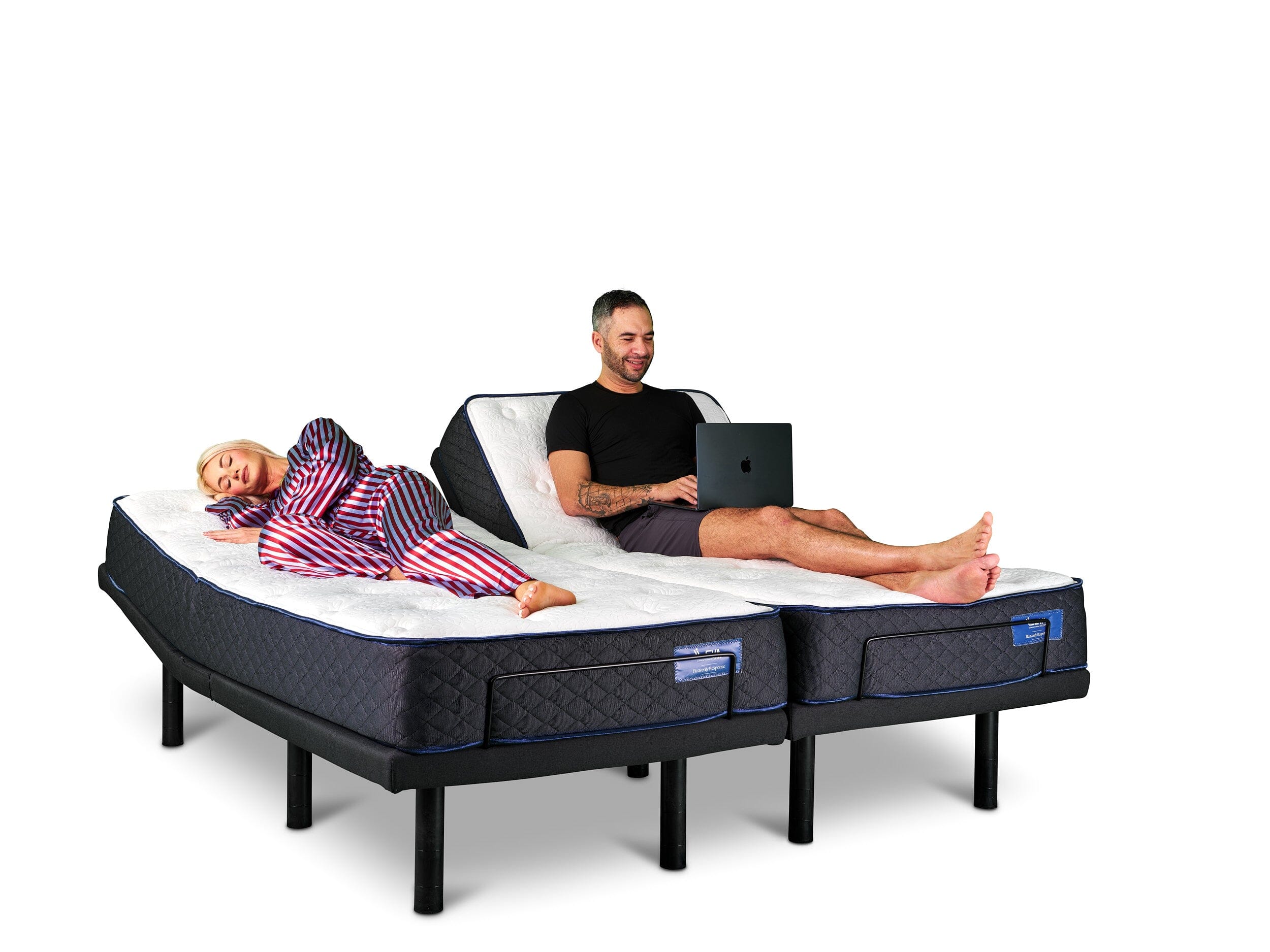
A split king uses two Twin XL mattresses, each approximately 99 cm × 203 cm, on two independent adjustable bases inside a standard king frame. A split queen divides a queen footprint into two narrower halves, each on its own base, which remains far less common among Canadian retailers. Each base operates independently, so one partner can elevate the head while the other lies flat.
Five Split Features That Justify a Higher Price
Not every adjustable base justifies its price tag. Evaluate any split system against these five criteria.
- Independent lumbar support: Modern Canadian adjustable bases incorporate adjustable lumbar support bars for spinal alignment. This matters for couples managing back pain or posture issues on opposite sides of the bed.
- Whisper-quiet motors: Loud or jerky motors undermine the benefit of independent control. German-engineered motors provide a useful benchmark specification to request from any retailer.
- App-based anti-snore detection: Premium adjustable bases priced over $2,000 in 2026 may include accelerometers or microphones that detect snoring and automatically raise the head section. These systems make micro-adjustments of 2–3 degrees at a time to reduce disruption. Note that automatic snore detection adds $500–$1,500 to base cost and is not foolproof, as the disadvantages section explains.
- Temperature regulation: Heating and cooling pads integrated per side address a common couple complaint: one partner sleeps hot while the other sleeps cold.
- White-glove setup: Common DIY assembly errors include reversed motor connections, loose wire harnesses, and improperly positioned retainer bars. Professional white-glove setup of an adjustable bed typically takes 45–90 minutes and removes these risks.
Split King Adjustable Brands in Canada: Side-by-Side Comparison
Pricing reflects publicly listed Canadian website figures. “Split Queen Available” indicates whether the retailer lists a split queen adjustable base configuration as a purchasable product.
| Brand | Split King Price (CAD, approx.) | Split Queen Available | Delivery Type |
|---|---|---|---|
| Tempur-Pedic (Ergo Smart Base + mattresses) | Premium range | No | White-glove (retailer-dependent) |
| GhostBed | Mid-range | No | Threshold/room-of-choice |
| Leva Sleep | Mid-to-premium range (multiple models) | Yes | In-house white-glove (Ontario & Alberta) |
| Logan & Cove | From $1,198 (mattresses only), base pricing separate | No | Curbside/threshold |
| Douglas | $1,198 for 2× Twin XL mattresses, base pricing separate | No | Curbside/threshold |
| GoodMorning.com (bases) | From $1,099 per Twin XL base | No | Threshold |
| Endy | Mattresses + bases; 30-night trial on frames | No | Third-party partner delivery |
| Sleep Country (add-on bases) | Varies; base sold separately from mattress | No | White-glove with old-mattress removal |
Note: Budget split king configurations in Canada start around $2,000 for entry-level mattresses and bases combined. Mid-range split king packages in Canada typically run $3,000–$5,500 CAD, with premium configurations reaching up to around $6,000. Leva Sleep’s pricing sits in the mid-to-premium range while undercutting luxury brands by 30–50%.
Why This Guide Focuses on Leva Sleep
Given Leva Sleep’s competitive positioning in the comparison above, the brand deserves a closer look. Leva Sleep operates a vertically integrated model, designing, assembling, and delivering its systems in-house rather than sourcing finished products from third-party manufacturers and reselling them. That structure removes distributor markups and allows pricing at roughly 30–50% below brands like Tempur-Pedic while keeping direct quality control.
The model range includes several adjustable base configurations, which contrasts with the limited options at many general mattress retailers. Mattresses come in all-foam and hybrid pocket-coil constructions, both engineered to flex with head and foot articulation. Rigid innerspring mattresses adapt poorly to adjustable bases, so this compatibility matters.
Leva Sleep is one of the few Canadian retailers offering a Split Queen configuration, which uses two narrower independent bases within a queen footprint. This option gives couples in smaller bedrooms access to independent control when a king frame will not fit.
Assembly takes place in Ontario and Alberta, and Leva’s own trained team handles white-glove delivery instead of contracted couriers. The service includes bedroom placement, full frame assembly, motor and wire harness connections, remote and app programming, function testing, mattress positioning, packaging removal, and optional old-bed removal. A spring 2026 anti-snore mode, which uses detection technology to make automatic head-elevation adjustments, sits on Leva’s current product roadmap for higher-tier models.
Leva also carries partner-brand mattresses from Tempur-Pedic, Simmons, Beautyrest, Serta, and Kingsdown, pairing them with its own adjustable bases for customers who want a specific mattress brand with specialist base expertise. View Leva’s adjustable base models and partner mattress options.
How Split Systems Address Real Couple Concerns
Many couples disagree on mattress firmness, which often delays replacing an old mattress. When preferences diverge significantly, such as one partner needing soft support for side sleeping and the other needing firm support for stomach sleeping, a split king using two Twin XL mattresses is the only solution that fully satisfies both without compromise.
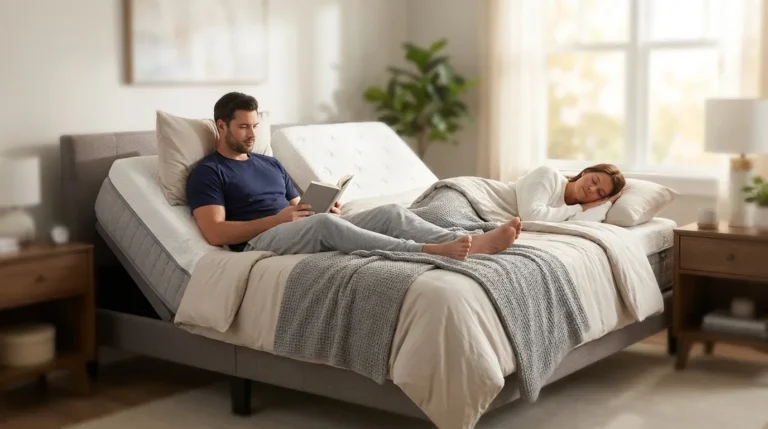
Snoring often compounds these comfort issues. Adjustable bases with dual-zone control allow independent head elevation on each side, so the snoring partner can sleep elevated to open airways while the other maintains a flat position. Tempur-Pedic’s Sleeptracker-AI raises the head approximately 12 degrees automatically upon detecting snoring, and Leva Sleep’s planned spring 2026 anti-snore mode aims to deliver similar benefits at a lower price point.
Sleep divorce, where partners retreat to separate rooms, is the outcome a split system aims to prevent. Independent elevation, independent firmness, and independent temperature control mean neither partner must compromise their sleep quality to share a bed.
Disadvantages of Split King Systems
Split king configurations carry real trade-offs that buyers should evaluate honestly.
- Cost: As noted in the pricing comparison above, buyers typically spend $3,000 or more for a mid-range system, with premium models reaching about $6,000. Two bases, two mattresses, and specialised bedding increase the total investment compared to a standard mattress.
- Room layout requirements: A split king requires a king-size frame and sufficient floor space. Couples in smaller bedrooms may find a split queen more practical.
- Sheet slippage: Standard fitted sheets are not designed for two independently moving bases. Specialised sheets with deep pockets and extra elastic are necessary to prevent the sheet from pulling free during elevation changes.
- Centre gap: Two Twin XL mattresses placed side by side create a seam down the middle of the bed. Mattress connectors and purpose-built toppers can reduce the feel of this seam, but it remains a structural reality.
- Anti-snore false triggers: Automatic snore detection systems can produce false triggers from coughing, heavy breathing, or traffic noise, and may take 3–5 minutes to respond. The feature that justifies the $500–$1,500 premium may not work as seamlessly as marketing suggests.
Delivery, Setup, and Trial Policies in Canada
Canadian adjustable bed retailers distinguish between three delivery tiers: curbside, room-of-choice, and white-glove. Most online-only brands such as Douglas, Endy, and Logan & Cove deliver to the door or entryway and leave assembly to the buyer. Endy offers a 30-night trial on adjustable bed frames, which third-party partners deliver.
Amerisleep Canada treats adjustable beds as final-sale items with no returns accepted, covered only by the manufacturer’s warranty. That policy creates significant risk for a product that usually requires in-person evaluation.
Leva Sleep’s in-house white-glove service in Ontario and Alberta covers bedroom placement, full assembly, motor connections, app setup, function testing, and optional old-bed removal. This service stands out given the complexity and time involved, since the 45–90 minutes mentioned earlier typically include placement, assembly, motor connections, app pairing, full function testing, and cleanup.
Decision Framework: Matching Budget and Features
This framework helps narrow your options by budget tier and feature set.
- Under $2,500 (entry-level): Budget configurations cover basic head and foot elevation with manual remote control. Buyers usually receive curbside delivery and handle self-assembly. This tier suits couples with mild preference differences and no medical requirements.
- $2,500–$5,000 (mid-range): Moving up from entry-level, this tier adds whisper-quiet motors, app control, lumbar support, and massage, which address the noise and control limits of budget bases. White-glove delivery becomes available from specialist retailers. Leva Sleep’s core range sits in this band.
- $5,000+ (premium): At the top tier, buyers gain automatic anti-snore detection, AI sleep tracking, temperature regulation per side, and full white-glove service, which entry and mid-range models lack. Tempur-Pedic occupies this tier, and Leva Sleep’s higher-tier models offer comparable features at lower cost.
Before purchasing, confirm answers to these questions with any retailer.
- Is the adjustable base compatible with the mattress you are selecting, and does the mattress flex adequately for full articulation?
- What is the combined weight limit of the two bases?
- Does white-glove delivery include motor connections, app setup, and function testing, or only room placement?
- What is the return or trial policy specifically for the adjustable base, not just the mattress?
- Is Split Queen available if your bedroom cannot accommodate a king frame?
Once you have identified your budget tier and confirmed these details, compare Leva’s split king and split queen configurations to find your match.
Frequently Asked Questions
What is the difference between a split queen and a split king adjustable bed?
A split king uses two Twin XL mattresses and two independent bases inside a standard king frame, which gives each partner full independent control over elevation, firmness, and features. A split queen divides a queen footprint into two narrower halves on separate bases, creating a smaller overall footprint that suits couples in rooms where a king frame does not fit. Split queen configurations remain significantly rarer among Canadian retailers, and Leva Sleep is one of the few brands that offers this size as a standard purchasable option.
How loud are the motors on split king adjustable bases?
Motor noise varies considerably by brand and price tier. Entry-level bases often use motors that produce audible humming during adjustment, which can disrupt a light sleeper. Mid-range and premium bases, including those using German-engineered motors, operate at whisper-quiet levels that most users describe as barely perceptible. When evaluating a base, ask the retailer for the motor’s decibel rating or request a demonstration. Leva Sleep’s bases use whisper-quiet motors as a standard specification across its model range.
Do split king adjustable beds require special sheets?
Split king setups work best with bedding designed for independent movement. Standard fitted sheets are not designed for two independently moving bases and will pull free when either side elevates. Sheets with deep pockets, extra elastic, and reinforced corners are necessary for a split king configuration. Some retailers, including Leva Sleep, design and sell bedding accessories specifically for adjustable bases, including fitted sheets, duvet clips to maintain separation when positions differ, and mattress protectors. Using a mattress protector from the first night also helps maintain return eligibility under most Canadian trial policies.
What warranty and return policies should I expect for a split king adjustable base in Canada?
Warranty and return terms vary significantly between brands. Some online-only retailers treat adjustable bases as final-sale items with no return option after shipping, offering only a manufacturer’s warranty, typically 10 years on the frame and shorter periods on motors and electronics. Other retailers offer 30- to 120-night trials, although these often apply to mattresses rather than bases. Before purchasing, confirm whether the trial covers the base independently, what condition requirements apply, and whether pickup is included or charged to the buyer. Leva Sleep’s policies are available directly through its sales team and apply to its full system packages.
Is anti-snore mode on an adjustable base a treatment for sleep apnea?
Anti-snore modes on adjustable bases do not treat sleep apnea. Automatic anti-snore features on adjustable bases, including those from Tempur-Pedic and the upcoming mode from Leva Sleep, detect positional snoring and raise the head of the bed to open airways. These features are designed for positional snoring in otherwise healthy individuals and are not intended as a treatment for obstructive sleep apnea or other diagnosed sleep disorders. Individuals with diagnosed sleep apnea should consult a physician before relying on positional adjustment as a substitute for prescribed therapy such as CPAP. Sleeping with the head elevated can complement medical advice and improve comfort for some mild cases, and some sleep apnea clinics do refer patients to adjustable bed specialists.