Written by: Matthew Timmins, Founder and Managing Director, Leva Sleep
Key Takeaways for Split-Queen Adjustable Beds
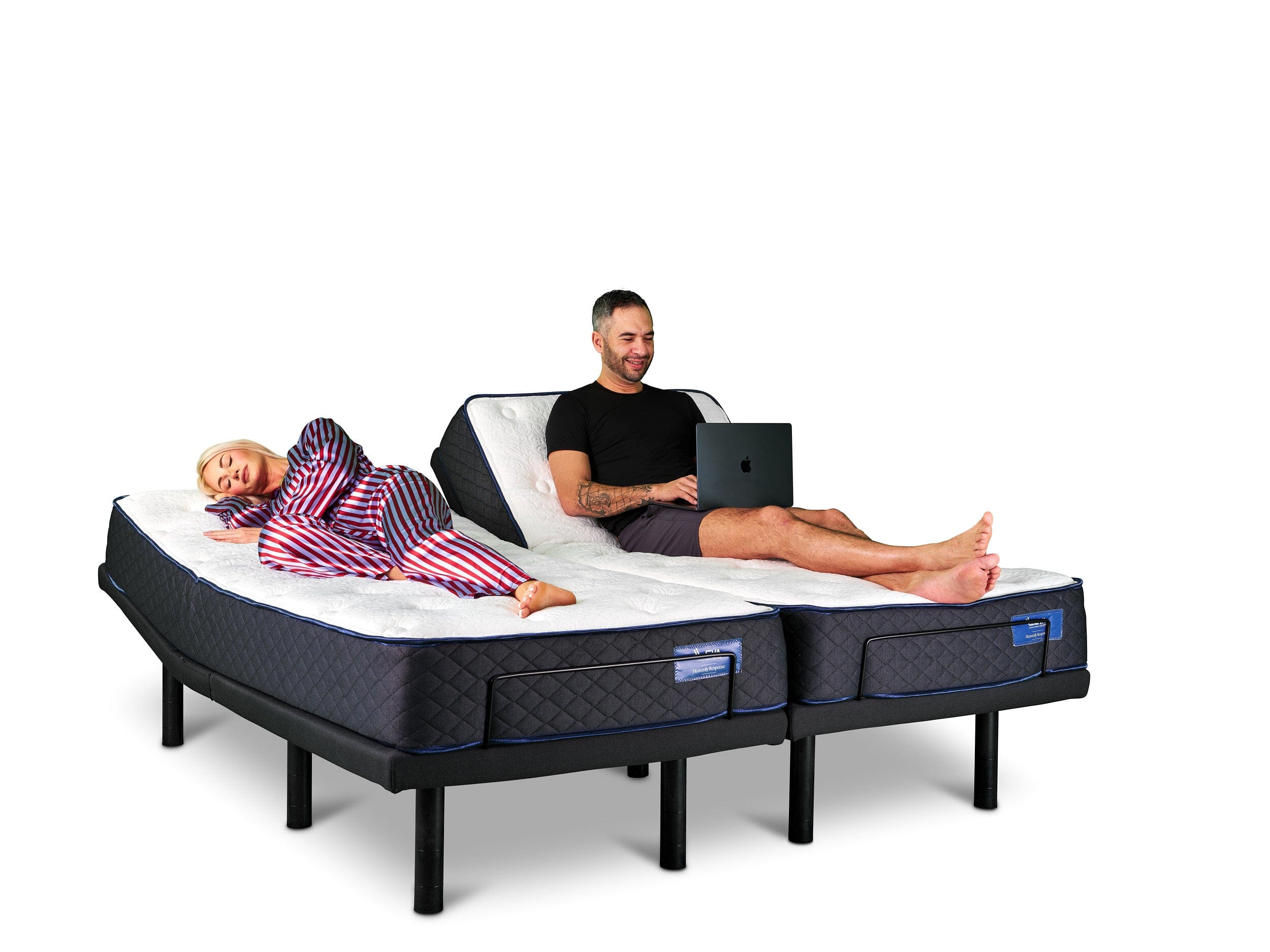
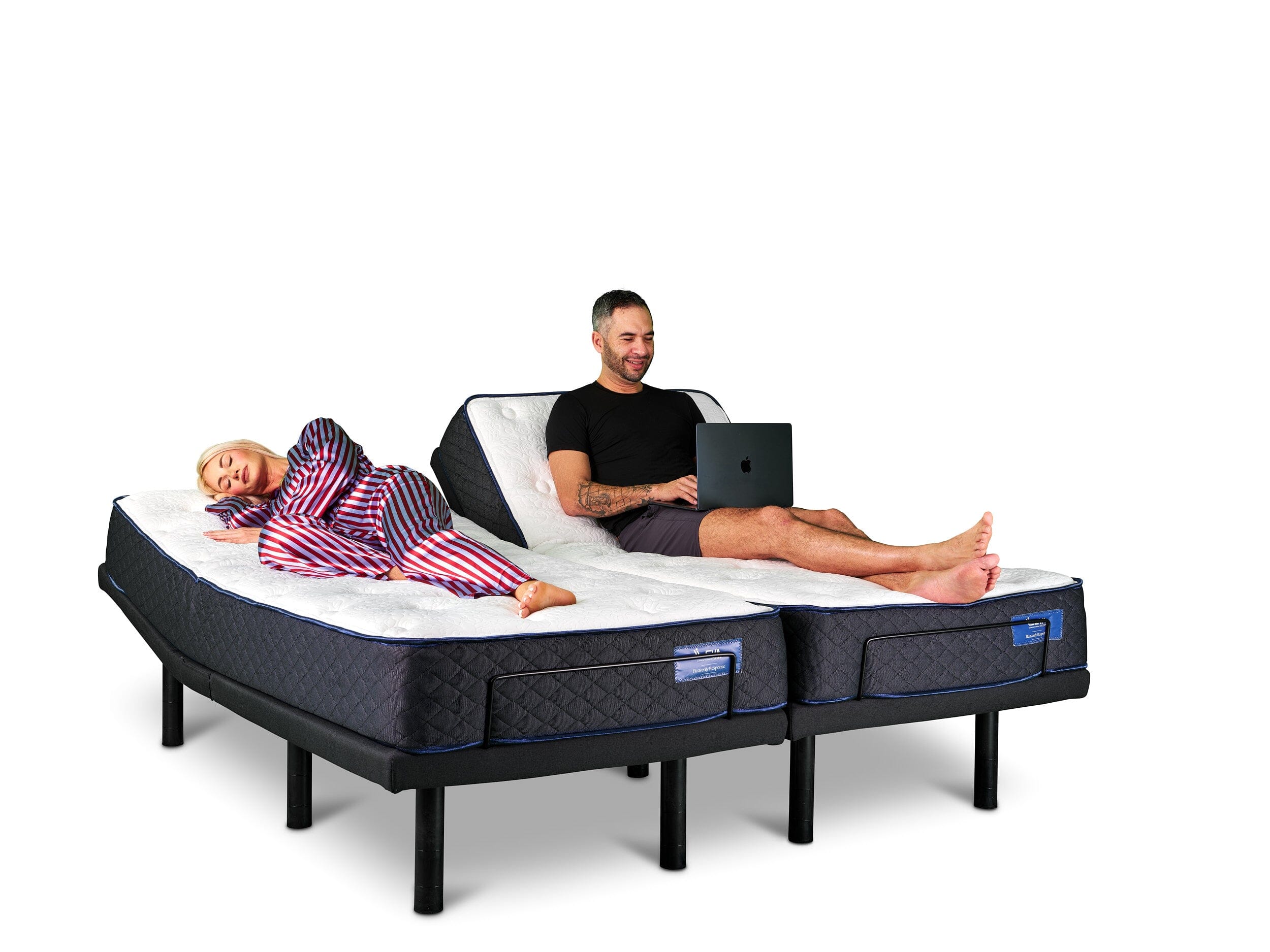
- A true split-queen adjustable bed uses two independent narrow-queen bases so each partner adjusts head and foot positions separately without disturbance.
- Common owner complaints include motor noise, slipping sheets, and shared remotes. Leva Sleep addresses these with quiet motors, deep-pocket bedding, and fully independent wireless remotes.
- Clinical studies show that 7.5–30 degree head elevation can reduce obstructive sleep apnea severity by roughly 30 percent and ease snoring, GERD, and back pain for many users.
- Key remote features to compare include independent per-side controls, anti-snore presets or automatic detection, power-outage memory, and app synchronization for custom positions.
- Leva Sleep offers true split-queen packages with white-glove delivery in Ontario and Alberta. Explore Leva Sleep split-queen packages to find a configuration that fits both partners.
How Split-Queen Adjustable Beds Change the Nightly Routine
The Public Health Agency of Canada estimates that 858,900 Canadian adults have been told by a health professional they have sleep apnea, with the majority undiagnosed. Bed partners of snorers can lose about an hour of sleep per night due to disruptions.
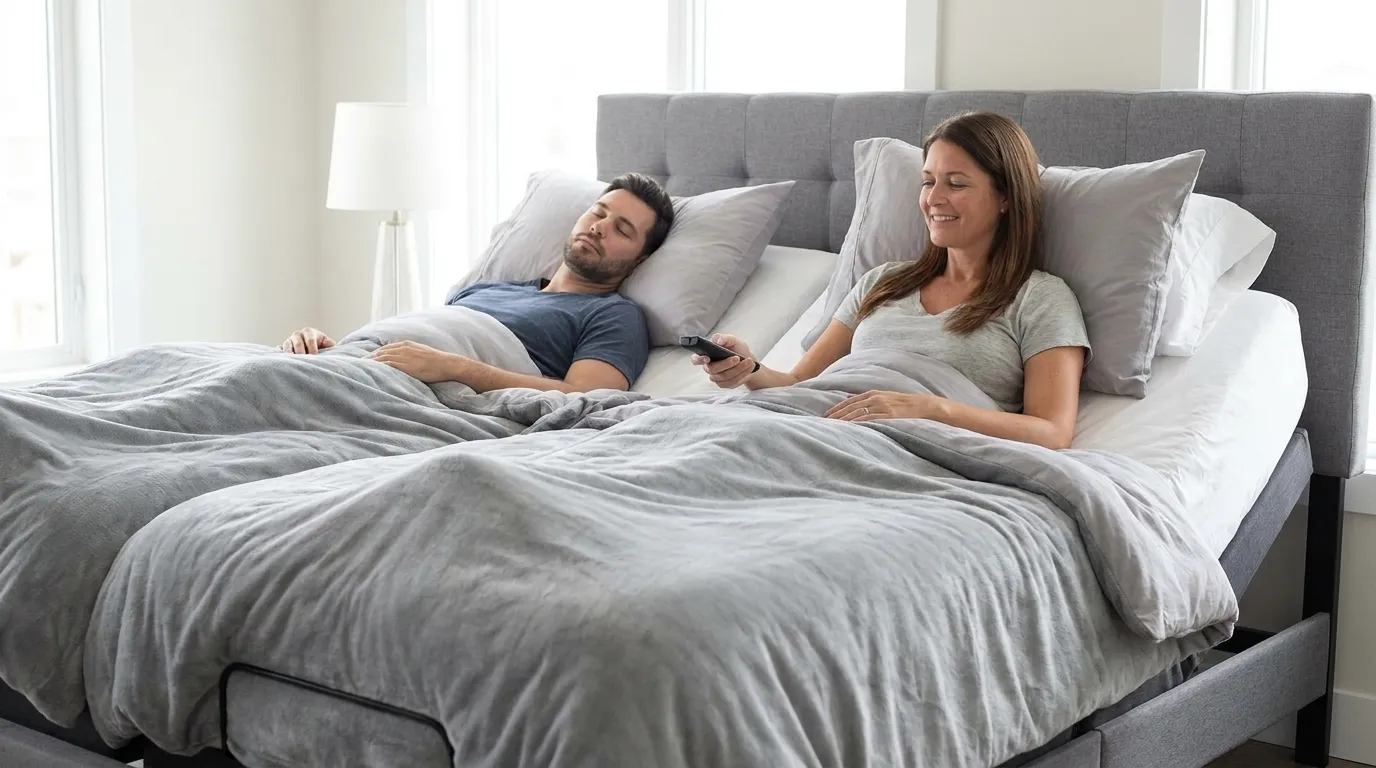
Many Ontario and Alberta couples recognize the pattern. One partner migrates to the couch, and the other feels guilty. A traditional flat bed cannot change this, and a standard adjustable base with shared controls only solves half the problem. A true split-queen with independent wireless remotes lets the snoring partner elevate while the other stays flat, so both stay in the same bed.
Common Problems Reported by Split-Queen Owners
Owners of split-queen bases most frequently report four recurring issues. First, audible motor noise reduces usage and can wake partners, particularly on lower-cost units. Second, standard fitted sheets pop off elevated corners because they lack the depth and elasticity adjustable bases require. Third, limited independent controls, where one remote governs both sides, defeat the purpose of a split configuration. Fourth, motor reliability over time depends heavily on whether the base is paired with a compatible mattress that flexes without straining the lift system.
Leva Sleep addresses each of these directly with quiet German-engineered motors, purpose-built deep-pocket bedding accessories, fully independent wireless remotes per side, and mattresses designed specifically for adjustable bases. Compare Leva Sleep adjustable bed packages built around these standards.
What Doctors Say About Adjustable Beds for Sleep Apnea and Joint Pain
Clinical evidence supports head-of-bed elevation as a meaningful non-invasive intervention. A 2017 study of 52 patients found that 7.5-degree elevation reduced obstructive sleep apnea severity by approximately 32%. A multicenter observational study found head-of-bed elevation reduced AHI from 25.7 to 17.8 events per hour (mean 31% reduction) and described it as a low-cost, well-tolerated positional therapy.
These benefits have limits. Adjustable beds do not replace CPAP for severe apnea, and head elevation does not resolve central sleep apnea, which originates in the brain rather than the airway. Individuals with spinal fusion, osteoporosis, or heart and respiratory conditions should consult a doctor before use.
These findings align with clinical recommendations. Orthopedic physical therapist Karena Wu, P.T., D.P.T., recommends adjustable beds for users with chronic back and neck pain, respiratory issues including snoring, digestive issues like gastric reflux, and circulatory issues. Orthopedic spine surgeon Nitin Bhatia, M.D., recommends upper body elevation for people with GERD or sleep apnea.
Wireless Remote Features That Actually Matter
Remote design determines how easy the bed feels to live with every night. The features worth evaluating include independent head and foot control per side, anti-snore presets that elevate one partner's head without waking the other, power-outage position memory so the bed returns to your saved setting after a power interruption, and app synchronization for custom position saving and vibrating alarms.
Sleep Number's FlexFit 2 Smart Base features Partner Snore technology that lets one partner raise the other's head section via a single button press. The Tempur-Pedic Tempur-Ergo Smart Base uses Sleeptracker-AI to detect snoring and automatically raises the head or vibrates the base to reduce it. Leva Sleep's spring-2026 anti-snore mode detects snoring and makes micro-adjustments to the head of the bed automatically, available on select models via the Leva Sleep app. See which Leva Sleep bases include automatic snore detection.
How to Compare 2026 Split-Queen Models
Use the criteria below when evaluating any split-queen base. Every data point in the table is drawn from publicly available manufacturer specifications and independent reviews, and the comparison applies the remote and motor features discussed above.
| Feature | Leva Sleep Split Queen | Tempur-Ergo Power Base (Split Queen) | Sleep Number FlexFit 2 (Split) |
|---|---|---|---|
| Independent wireless remotes | Yes, one per side | Yes, independent head and foot per side | Yes, Partner Snore button included |
| Motor noise | Quiet German-engineered motors | Known for quiet motors and smooth transitions | Not independently verified in reviewed sources |
| Anti-snore mode | Spring-2026 automatic detection via app | Available on Smart Base upgrade (AI-driven) | Manual Partner Snore button |
| Canadian white-glove delivery | Yes, Ontario and Alberta, includes old-bed removal | Available through retail partners; scope varies | Available through Sleep Number stores; scope varies |
| Price relative to Leva Sleep | Baseline | Higher, premium retail pricing | Higher, subscription model adds ongoing cost |
Leva Sleep's direct-to-consumer model and local assembly remove middleman markups. With 15–20 adjustable models available, versus the 3–5 typically found at general mattress retailers, the selection depth supports more precise matching to individual needs.
Delivery and Setup Realities in Canada
Adjustable bases are heavy, multi-component systems. A simple "bed in a box" drop-off leaves couples to manage assembly, leg-height calibration, and app pairing alone. Leva Sleep's white-glove delivery service, available in Ontario and Alberta, sends trained professionals to the bedroom for full assembly.
The team handles leg height adjustments to the customer's preference, provides a product tutorial, and removes the old bed for donation or recycling. Adjustable bases have specific clearance requirements, and Sleep Number's FlexFit bases, for example, require at least 10.25 inches of clearance from the floor to any internal ledge. Correct measurements at delivery prevent returns and re-installations, and Leva Sleep's in-house team handles these adjustments on-site.
Bedding and Accessories Built for Adjustable Bases
Standard fitted sheets are not designed for the range of motion an adjustable base produces. At a 30-degree head elevation, corners pull free and bunch under the mattress. Leva Sleep designs its fitted sheets with deep pockets and reinforced elastic specifically for this movement range.
Duvet clips maintain separation between the two sides when partners use different elevation angles. Remote pockets attach to the side of each base for easy access without fumbling in the dark. Mattresses on adjustable bases should be rotated 180 degrees every six months to distribute wear evenly and protected with a waterproof cover to prevent damage from spills and perspiration. Leva Sleep offers mattress protectors designed to stay in place through this rotation cycle.
Who Makes the Best Split Queen Adjustable Bed for Canadians?
No single brand works best for every buyer. The right choice depends on motor noise tolerance, required features such as anti-snore automation versus manual presets, mattress compatibility, delivery geography, and budget. Leva Sleep is one of very few Canadian specialists offering a true split-queen configuration, not a split-king adaptation, with independent wireless remotes, quiet German motors, spring-2026 anti-snore mode, and white-glove delivery in Ontario and Alberta at 30–50 percent below comparable luxury competitors. For Canadian couples in those provinces, that combination is difficult to match from a general retailer.
What Are the Common Problems with Split Queen Adjustable Beds?
The problems discussed earlier, including motor noise, sheet slippage, and limited size availability, remain the most common complaints. A gap can form between the two mattress halves, and traditional innerspring mattresses often prove incompatible with frequent bending.
Split queen configurations provide the same independent dual-control functionality as split king setups but in a smaller footprint, though selection is narrower and they are less widely available. Choosing a specialist retailer with purpose-built accessories and compatible mattresses resolves most of these issues before they arise.
What Do Doctors Say About Adjustable Beds?
Medical professionals generally support adjustable beds as a non-invasive positional aid for snoring, mild to moderate obstructive sleep apnea, GERD, lower-back pain, and post-surgical recovery. Raising the head 4 to 6 inches, corresponding to a 10–30 degree incline, is generally sufficient to reduce snoring by preventing the soft palate and tongue from collapsing into the airway.
Doctors do not classify adjustable beds as durable medical equipment for general snoring, so insurance coverage is typically unavailable. Patients with severe sleep apnea are advised to continue CPAP. Many find that using an adjustable bed alongside CPAP improves mask tolerance because the elevated position makes the mask more comfortable.
What Are the Disadvantages of Adjustable Beds for Seniors?
For seniors, the primary concerns are safety, contraindications, and usability. The contraindications mentioned earlier, particularly spinal fusion and osteoporosis, are especially relevant for older adults, who are more likely to have these conditions. Head-of-bed elevation may be contraindicated in patients with lower limb edema and venous insufficiency.
Remote complexity can be a barrier for users unfamiliar with app-based controls, so intuitive wireless remotes with large buttons matter. Weight capacity is also a practical consideration, and buyers should confirm any base they consider is rated for the combined weight of mattress and both sleepers. Seniors with any cardiovascular or respiratory condition should consult their physician before purchasing.
Decision Checklist for Split-Queen Buyers
- Start by confirming the base offers fully independent head and foot controls for each side, since this feature justifies a split configuration.
- Next, verify the motors are rated as quiet and check verified reviews, because motor noise is the most common complaint among owners.
- Then evaluate whether an anti-snore preset or automatic detection mode is included or available as an upgrade, which determines how easily the base can address positional snoring.
- Confirm the mattress is explicitly rated for adjustable base use, such as memory foam, latex, or pocketed-coil hybrid, to avoid straining the lift system.
- Check whether the retailer offers white-glove delivery and setup in your province, since professional installation prevents many early frustrations.
- Look for purpose-built bedding accessories, including deep-pocket sheets and duvet clips, from the same supplier so the system works as a unit.
- Ask a physician to clear adjustable bed use if either partner has osteoporosis, spinal fusion, edema, or cardiovascular conditions.
- Review the total system cost, including delivery, accessories, and warranty coverage, rather than focusing only on the base price.
Conclusion: Choosing a Split-Queen Adjustable Bed with Confidence
For Canadian couples in Ontario and Alberta dealing with snoring, sleep apnea positioning, or differing comfort needs, a true split-queen adjustable bed with independent wireless remotes offers a practical solution without moving to a larger split-king footprint or separate sleeping arrangements. Adults at high risk of sleep apnea face 44 percent higher odds of developing mental health problems over time, so addressing the underlying sleep disruption matters beyond comfort.
Leva Sleep combines quiet German motors, spring-2026 anti-snore mode, purpose-built accessories, and in-house white-glove delivery across Ontario and Alberta at 30–50 percent below comparable luxury competitors. Browse Leva Sleep's full adjustable bed lineup and apply the checklist above to find a configuration that fits both sides of your bed.
Frequently Asked Questions
What is the difference between a split-queen and a split-king adjustable bed?
A split-queen adjustable bed uses two narrow-queen bases, each approximately 30 × 80 inches, placed side by side to fill a standard queen frame. A split-king uses two Twin XL bases, each approximately 38 × 80 inches, to fill a king frame. The split-queen suits couples who want independent adjustability but have a bedroom that cannot accommodate a king-sized footprint.
Both configurations provide fully independent head and foot elevation controls for each partner. The split-queen is significantly less common in the Canadian market, which makes Leva Sleep, one of the few Canadian specialists offering this size, an important option for couples with space constraints.
Can a split-queen adjustable bed actually reduce snoring, or is that just marketing?
The mechanism is well-documented. The elevation range discussed earlier, roughly 7.5–30 degrees, works by using gravity to prevent the soft palate and tongue from collapsing into the airway during sleep, the primary physical cause of positional snoring. Clinical studies have measured meaningful reductions in apnea-hypopnea index scores at these angles.
The effect is most pronounced for positional obstructive sleep apnea, where symptoms worsen when lying flat. It is not a cure for severe sleep apnea and does not address central sleep apnea. For couples where one partner snores habitually, a split-queen base allows that partner to sleep elevated while the other remains flat, without either person compromising. Leva Sleep's spring-2026 anti-snore mode adds automatic detection and micro-adjustment, which removes the need to manually set a position each night.
What bedding works with a split-queen adjustable bed, and why does it matter?
Standard fitted sheets are sized and elasticized for flat mattresses. When a split-queen base elevates one side to 20 or 30 degrees, the sheet corners on that side pull free, bunch under the mattress, and disrupt sleep. Deep-pocket fitted sheets with reinforced elastic around the full perimeter are designed to stay in place through the full range of motion.
For couples using different elevation angles, a shared duvet will slide toward the lower side. Duvet clips that attach to each mattress independently prevent this. Leva Sleep designs all its bedding accessories specifically for adjustable bases, including remote pockets that attach to the side of each base so the wireless remote stays within reach without a bedside table search. Pairing purpose-built bedding with the base from the same supplier eliminates the trial-and-error of sourcing compatible accessories separately.
Is white-glove delivery worth the additional cost for an adjustable bed in Canada?
For a split-queen adjustable base, professional setup provides more than convenience. Each base has independent motors, sync cables, wireless receivers, and app pairing requirements. Leg height must be calibrated to match the existing bed frame or floor clearance.
An incorrect leg height affects both the aesthetics and the mechanical operation of the base over time. Leva Sleep's white-glove delivery team handles all of this in the bedroom, provides a full product tutorial, adjusts settings to the customer's preferences on the day of delivery, and removes the old bed for donation or recycling. For Ontario and Alberta customers, this service removes the most common post-purchase frustrations associated with large adjustable base purchases and ensures the system operates correctly from the first night.
How long does a quality split-queen adjustable base last, and what maintenance does it require?
A well-maintained adjustable base from a reputable manufacturer can last 10 years or more. The motor is the primary mechanical component to evaluate, so buyers should confirm motor failure is covered under warranty and review long-term reliability feedback from verified owners.
Routine maintenance involves checking power cords and sync cables periodically, dusting the motor housing to prevent heat buildup from pet hair and debris, and applying silicone lubricant to pivot points if squeaking develops. The mattress should be rotated 180 degrees every six months, never flipped, and protected with a waterproof cover. Pairing the base with a mattress explicitly rated for adjustable use prevents the resistance that strains motors prematurely. Leva Sleep's 8 years in business, $50M in lifetime sales, and 25,000+ customers provide a track record that supports long-term confidence in motor and build quality.