
Written by: Matthew Timmins, Founder and Managing Director, Leva Sleep | Last updated: July 8, 2026
Key Takeaways
- Sharing a bed often disrupts sleep through snoring, motion, temperature differences, and blanket conflicts, which pushes many couples toward sleep divorce.
- Single-issue fixes like earplugs, separate duvets, or cooling pads handle one problem and leave the rest untouched.
- Split adjustable bases with independent controls address snoring, motion transfer, temperature, and bedding conflicts together in one coordinated system.
- Couples should focus on independent elevation, quiet motors, anti-snore modes, dual-zone temperature options, and bedding designed for adjustable bases.
- Leva Sleep offers split adjustable bed packages tailored for Canadian couples. Explore Leva Sleep’s adjustable bed packages to find a configuration that fits your room and routine.
How Sleep Conflicts Strain Relationships
Sleep conflicts affect many couples. The ResMed 2025 Global Sleep Survey of 30,026 adults across 13 markets found that 18% of couples sleep in separate rooms because of snoring and restlessness. A Mayo Clinic study found that bed partners of people with sleep apnea lose roughly one hour of sleep per night. A 2017 Better Sleep Council survey reported that 40% of respondents saw less tossing and turning from their partner after getting a new mattress, which meant fewer nighttime annoyances.
Temperature differences create another layer of conflict. Core body temperature preferences during sleep vary significantly between individuals, so thermal conflicts reflect real physiological differences. Blanket-hogging and mismatched bedtimes add to the strain and build frustration night after night.
Relationship impacts show up in the data. A 2025 AASM survey of 2,007 U.S. adults found that 31% have tried a sleep divorce, with adults aged 35–44 most likely to sleep apart at 39%. Yet a 2020 polysomnography study in Frontiers in Psychiatry found that couples sharing a bed had 10% more REM sleep, fewer REM disruptions, and longer uninterrupted REM periods than when sleeping apart. Sleeping separately can protect rest but also reduces shared REM benefits.
Why Common Quick Fixes Fall Short
Most off-the-shelf tools solve only one complaint and leave the others in place.
The Scandinavian sleep method, where each partner uses a separate duvet in the same bed, helps with blanket and temperature conflicts. It works best for couples whose main issues involve thermal and duvet disagreements rather than movement, noise, or schedules. It does not address snoring or motion transfer.
White-noise machines mask sound but do not lower snoring volume or treat airway problems. The BedJet 3 Climate Comfort System operates at 43 decibels, which is quieter than many white-noise devices. Even so, dual-zone cooling systems like the Chilipad 2.0 only manage temperature and ignore elevation and motion.
Cooling toppers and dual-zone pads help with temperature mismatches but sit on top of an existing mattress and add extra cost. Couples still need separate solutions for snoring, motion, and bedding conflicts.
Earplugs lower perceived noise for the non-snoring partner but leave the snorer’s airway untreated. They also do not help with motion transfer, temperature, or blanket tug-of-war.
The combined cost of a motion-isolating mattress, a dual-zone cooling pad, a white-noise machine, separate duvets, and anti-snore pillows can easily exceed the price of a single integrated system, while still forcing nightly compromises.
See how Leva Sleep’s integrated systems replace piecemeal gadgets and simplify your setup.
How Split Adjustable Bases Solve Multiple Issues
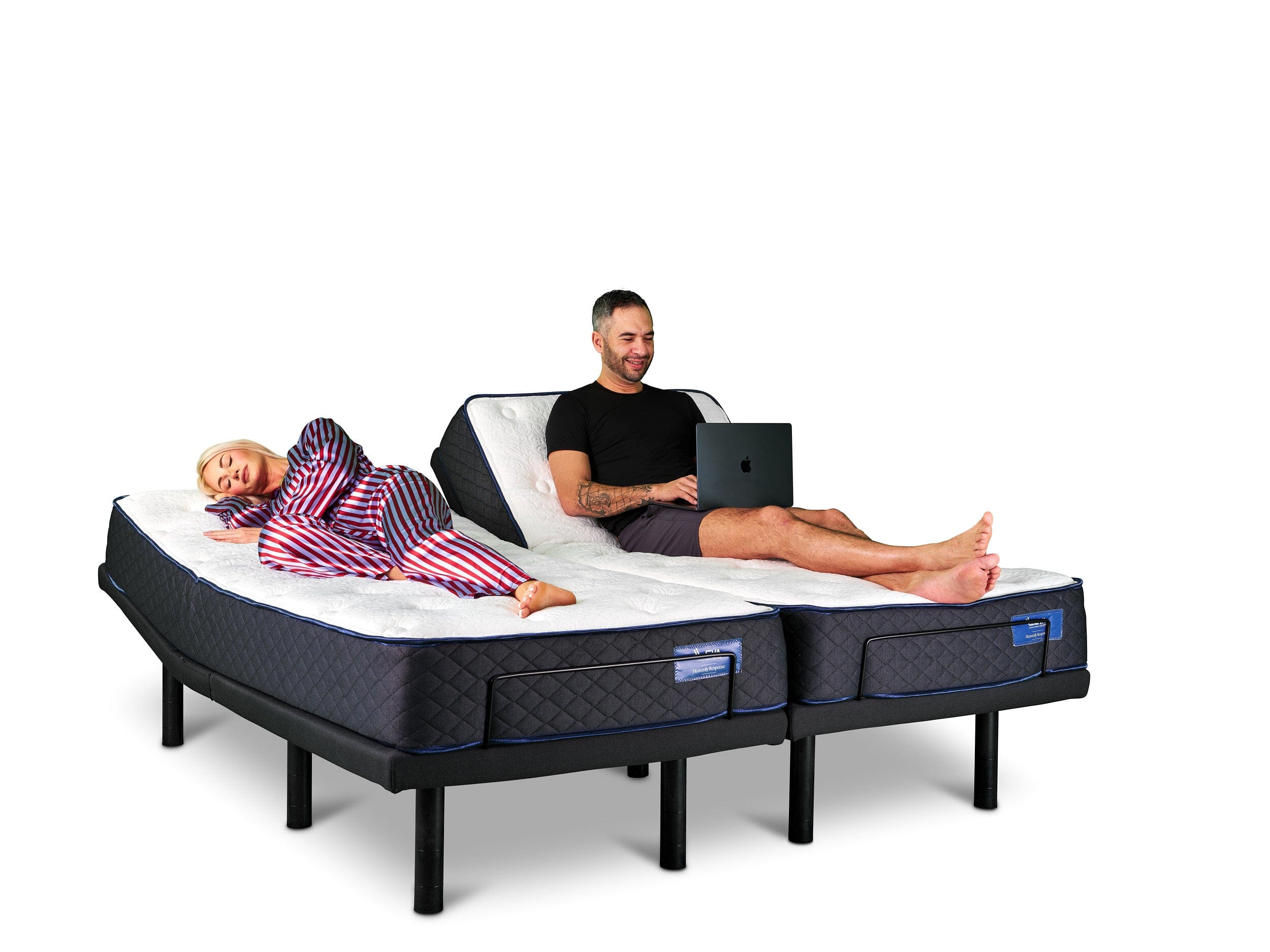
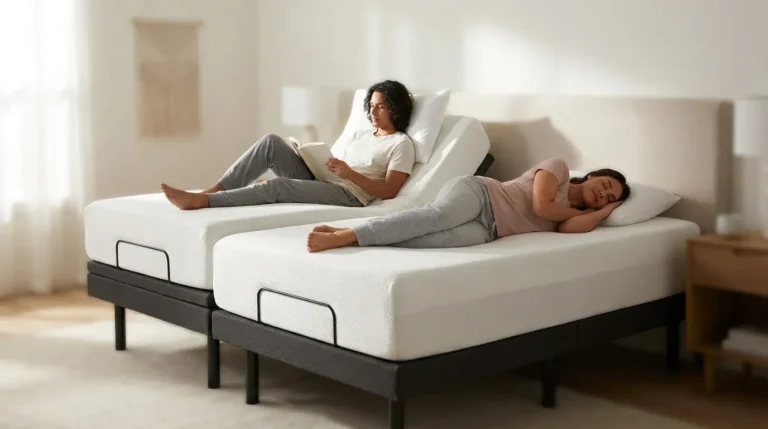
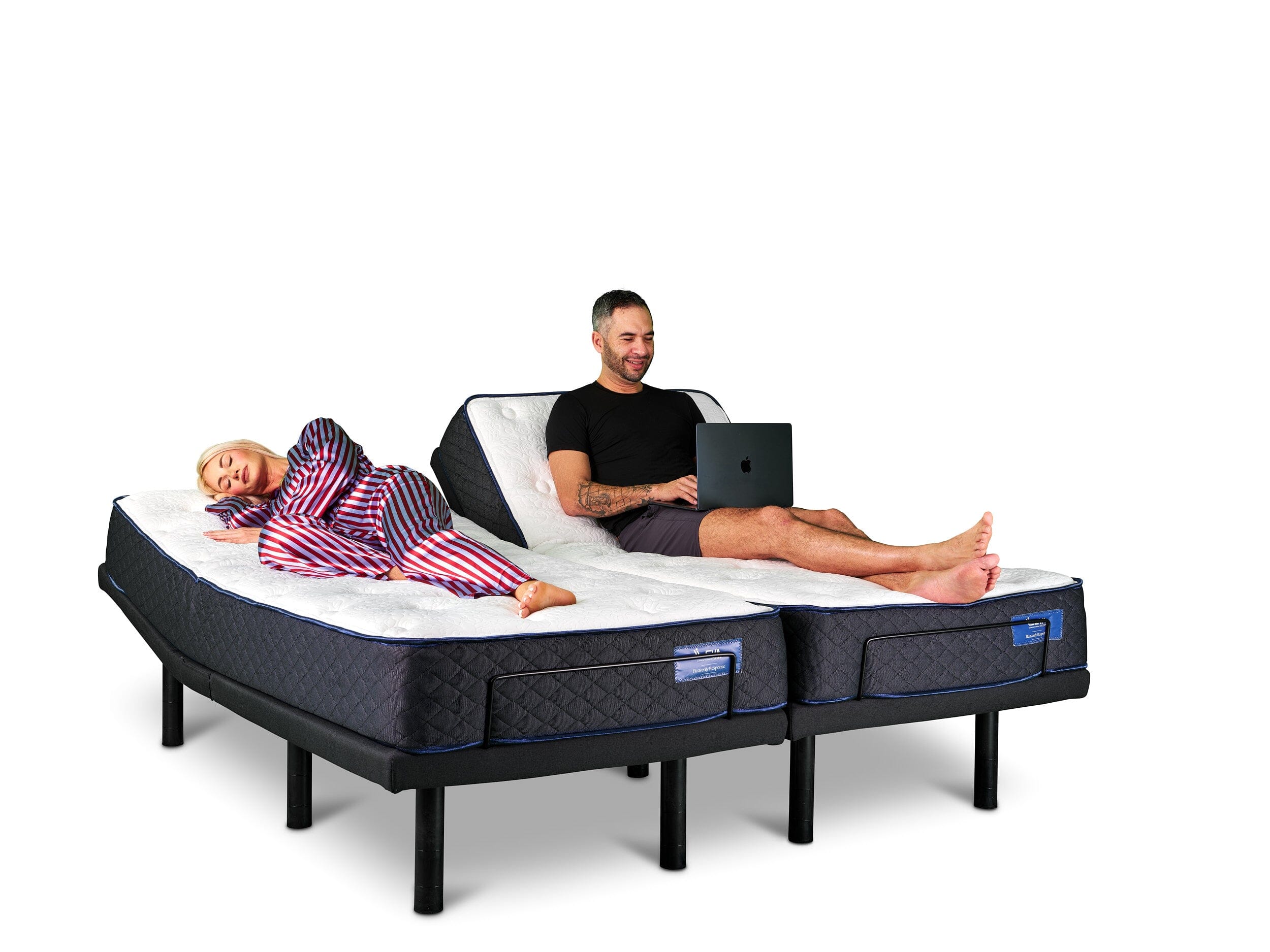
Split adjustable bases with independent controls address snoring, motion transfer, temperature, and blanket conflicts in one coordinated purchase. Each side of the bed moves on its own, so one partner can elevate their head while the other stays flat, without mechanical movement crossing the centre.
Sleep specialists recommend a head elevation of 10–30 degrees for snoring relief, with 10–15 degrees for light snoring and 20–30 degrees for moderate to heavy snoring. This elevation, typically 4–6 inches at the head, uses gravity to keep soft tissues in the throat from collapsing and narrowing the airway.
Bryte reports that split king mattresses deliver 74–82% better motion isolation than single kings, so one partner’s adjustments or repositioning are less likely to wake the other. When couples pair a split base with dual-zone temperature accessories and purpose-built bedding, the result feels like a complete sleep environment rather than another gadget.
Features That Matter Most for Couples
Certain features determine whether a split adjustable base truly resolves all four core conflicts or only some of them.
- Independent head, foot, and lumbar elevation: Each side should adjust without any mechanical linkage to the other side. Lumbar support helps partners with hip, knee, or lower-back pain find a comfortable position.
- Whisper-quiet motors: Premium dual bases use ultra-quiet motors so one partner can adjust at night without waking the other. WHO guidelines recommend less than 40 dB(A) annual average outside bedrooms to prevent adverse health effects from night noise. Leva Sleep uses whisper-quiet German motors across its lineup.
- Anti-snore mode: Leva Sleep’s app-controlled anti-snore mode (arriving spring 2026) will detect snoring and make small head adjustments to open the airway while keeping the sleeper undisturbed.
- Dual-zone temperature integration: Experts recommend confirming dual-sided controls when choosing a bed cooling system for shared beds. Leva Sleep’s Heating and Cooling Pad connects directly to its bases for this purpose.
- Mattress compatibility: All-foam and hybrid pocket-coil mattresses built for adjustable bases flex repeatedly without damaging internal components. Leva Sleep designs its mattresses in-house for this kind of movement.
- Purpose-built bedding: Standard fitted sheets often pop off elevated bases. Leva Sleep’s sheets use deep pockets and extra elastic, and its duvets include clips that keep each side separate when the angles differ.
- Split Queen availability: Many brands sell only Split King models. Leva Sleep is one of the few Canadian providers offering Split Queen adjustable bases for smaller rooms.
- White-glove Canadian delivery: Leva Sleep’s in-house team in Ontario and Alberta handles old bed removal, full assembly, leg-height adjustment, and a product walkthrough, so couples avoid flat-pack assembly.
Browse Leva Sleep’s Split Queen and Split King packages to see which feature set fits your priorities.
Comparing Solutions Without an In-Store Test
Couples can compare adjustable bases remotely by focusing on clear specifications and policies instead of marketing claims. The table below shows how common tools stack up against a split adjustable base across the four core conflicts.
| Tool | Addresses Snoring | Addresses Motion Transfer | Addresses Temperature | Addresses Blanket Conflicts |
|---|---|---|---|---|
| Motion-isolating mattress | No | Partial, with no independent elevation | No | No |
| Separate duvets (Scandinavian method) | No | No | Partial, for thermal and duvet conflicts only | Yes |
| White-noise machine | Masks sound only, does not reduce snoring | No | No | No |
| Dual-zone cooling topper | No | No | Yes, independent temperature per side | No |
| Split adjustable base (independent controls) | Yes, 10–30° elevation reduces airway collapse | Yes, with significantly better motion isolation than traditional kings | Yes, when paired with an integrated dual-zone temperature pad | Yes, when used with purpose-built split bedding |
When requesting details from any brand, ask for motor decibel ratings, return window length, local service coverage, and confirmation that the split configuration operates independently rather than sharing a centre linkage. Compare total cost of ownership across brands by including the base, compatible mattress, bedding, and delivery.
Results Couples Commonly Report
Leva Sleep’s 25,000+ customers include many couples who had already moved to separate rooms before trying a split adjustable base. After installation, a large share report returning to the same bed within the first week. Sleep apnea clinics in Ontario and Alberta refer patients to Leva Sleep when positional therapy, such as head elevation to reduce airway collapse, is part of a treatment plan alongside or instead of CPAP for mild cases.
Customers with hip and knee pain often find that independent lumbar and foot elevation lets each partner decompress comfortably without disturbing the other side. Couples who previously argued over blankets use Leva’s duvet clip system to maintain separate thermal zones while still sharing one bed surface.
Pricing Tiers and Brand Options
Leva Sleep prices its Split Queen and Split King packages 30–50% below comparable offerings from brands such as Tempur-Pedic and Ghostbed. This pricing comes from vertical integration: Leva designs its systems in-house, assembles them locally in the regions it serves, and sells directly to consumers without retail markup. Couples receive a luxury-grade motor, mattress, and bedding system at a price that suits upper-middle-class Canadian households that want performance without paying extra for a logo.
For couples who prefer a specific mattress brand they already trust, Leva also carries Tempur-Pedic, Simmons, Beautyrest, Serta, and Kingsdown mattresses. These options pair with Leva’s adjustable base expertise and give customers access to 15–20 adjustable models, compared with the 3–5 models typically found at a general mattress retailer.
Checklist for Choosing a Couple-Friendly Sleep System
Use this checklist before you commit to any shared sleep setup.
- Does each side adjust independently with no mechanical linkage between them?
- Is the motor rated below the WHO-recommended 40 dB threshold mentioned earlier for nighttime adjustments?
- Does the base include or support an anti-snore elevation preset or detection mode?
- Is dual-zone temperature control available as part of the system?
- Are the mattress and bedding designed specifically for adjustable bases?
- Is a Split Queen configuration available if a Split King is too wide for the room?
- Does the brand offer white-glove delivery and setup in your province?
- What is the return window, and does the brand provide local service support in Canada?
- What is the total cost of ownership when you add the base, mattress, bedding, and delivery?
Compare Leva Sleep’s packages to find a Split Queen or Split King that fits your room and budget.
Frequently Asked Questions
How long does setup take, and do we need to assemble anything ourselves?
Leva Sleep’s white-glove delivery team handles the full setup. A trained crew brings the base and mattress to your bedroom, assembles the system, adjusts leg heights, removes and donates or recycles your old bed, and walks you through the app and remote controls before leaving. No flat-pack assembly is required. Delivery is currently available in Ontario and Alberta.
Is a split adjustable base suitable if one partner has been diagnosed with sleep apnea?
Head elevation is a recognized positional therapy that reduces airway collapse, and sleep apnea clinics refer patients to Leva Sleep when positional support forms part of a treatment plan. For diagnosed obstructive sleep apnea, CPAP therapy remains the primary clinical recommendation. A split adjustable base can complement CPAP use, since the snoring partner can elevate their head while the other side stays flat, or it can serve as a non-invasive option for mild positional snoring. Anyone with suspected sleep apnea should see a physician before relying only on positional therapy.
Will the gap between the two mattresses in a Split King or Split Queen be uncomfortable?
The gap between the two Twin XL (Split King) or two Full (Split Queen) mattresses stays minimal when both sides lie flat. Leva Sleep’s fitted sheets and mattress protectors are designed to bridge and soften this gap. When one or both sides elevate, the gap becomes more noticeable, but most couples consider it a fair trade for independent positioning. A connector strap is available to keep the two bases aligned.
What is the return window, and what happens if one partner loves it and the other does not?
Leva Sleep offers a return window that lets couples test the system at home. Because each partner controls their own side, it is rare for one person to find the base incompatible. Either side can stay completely flat in a traditional position if preferred. Contact Leva Sleep directly for current return policy terms and conditions, which may vary by package.
How do we maintain the base and mattress over time?
Leva Sleep’s adjustable bases use German-engineered motors built for long-term durability with little maintenance. Rotate the mattress periodically if the design allows, and keep the base mechanism clear of dust and debris around the joints. Leva Sleep’s mattress protectors help extend mattress life by limiting moisture and wear. Because Leva assembles its systems locally and runs its own operations, customers in Ontario and Alberta have direct access to Canadian service support instead of an overseas call centre.
Ready to Sleep Better Together?
Snoring, motion transfer, temperature mismatches, and blanket conflicts reflect mechanical problems that respond to mechanical solutions, not personality flaws. Single-issue tools handle one complaint at a time, add up in cost, and still leave couples negotiating every night. A split adjustable base with independent controls, whisper-quiet motors, anti-snore elevation, dual-zone temperature integration, and purpose-built bedding can resolve all four conflicts within one system.
Leva Sleep has spent eight years and reached $50M in sales refining this system for Canadian couples, pricing it 30–50% below comparable luxury brands and backing it with local assembly and white-glove delivery across Ontario and Alberta.
Find the Leva Sleep Split Queen or Split King package that lets you share a bed and still sleep well.