
Written by: Matthew Timmins, Founder and Managing Director, Leva Sleep | Last updated: July 5, 2026
Key Takeaways for Snoring Couples
- Adjustable bases with independent head elevation between 10–30 degrees can reduce snoring by keeping throat tissues from collapsing into the airway.
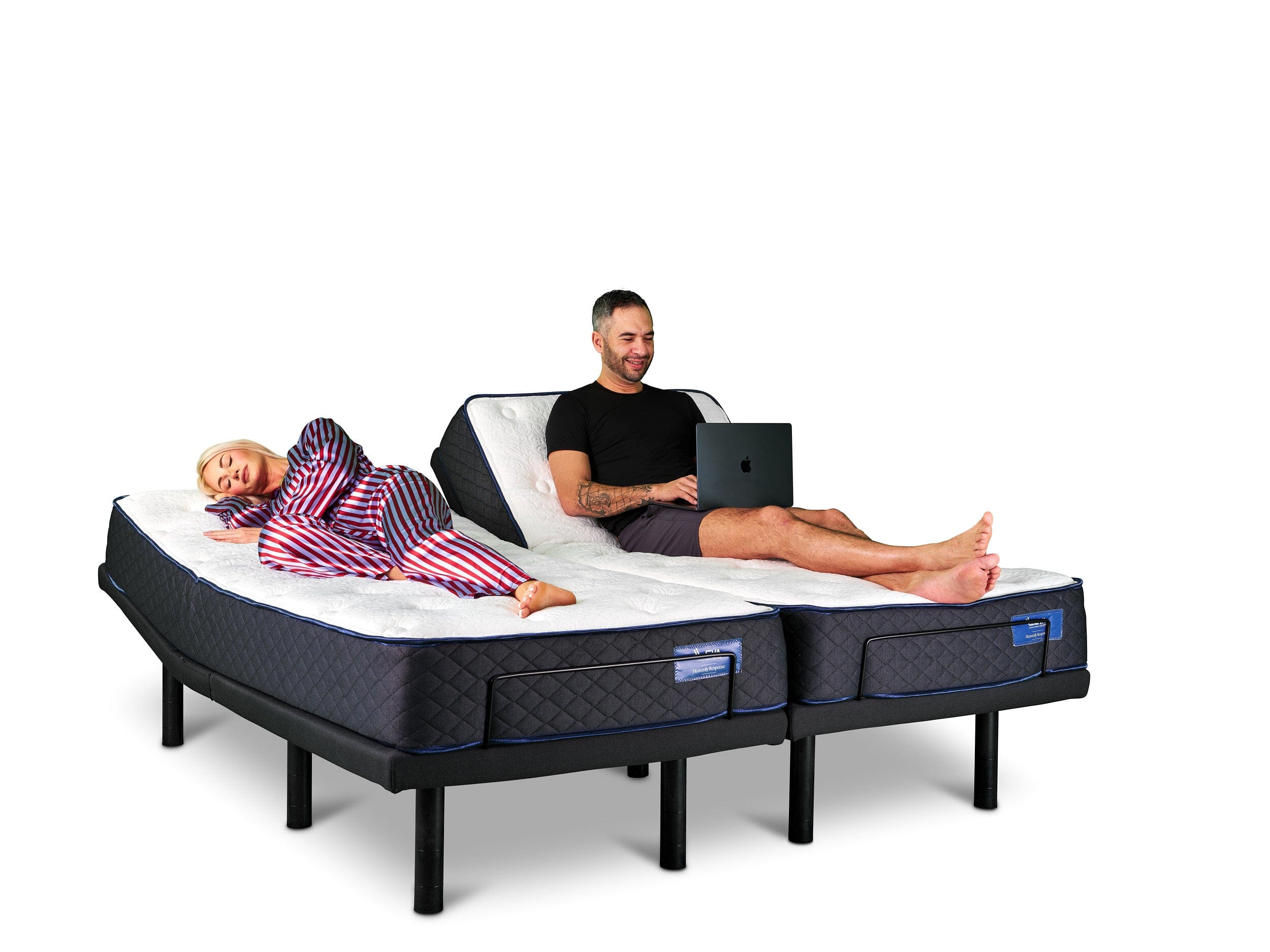
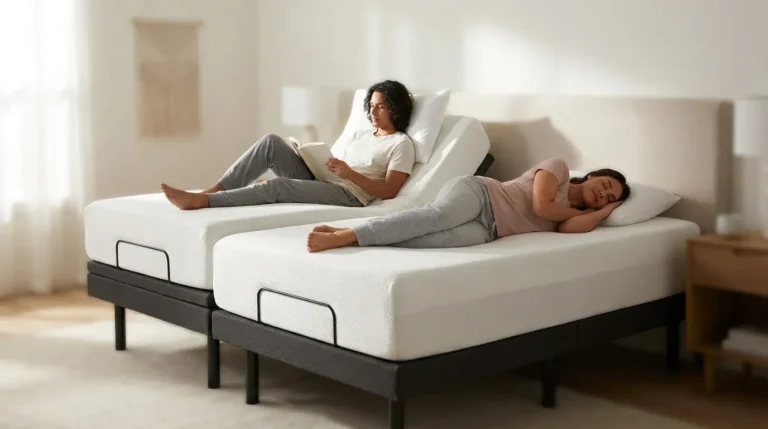
- Split configurations let the snoring partner raise their side while the other stays flat, which helps couples avoid sleep divorce.
- Split Queen bases usually fit standard Canadian bedrooms better than Split King and reduce the gap between mattresses.
- Leva Sleep’s 2026 Anti-Snore Mode uses sensors to detect snoring and automatically adjust elevation without waking either partner.
- Explore Leva Sleep’s adjustable bed packages designed for snoring couples in Ontario and Alberta.
How Adjustable Bases Help Snoring Couples
An adjustable base reduces snoring by elevating the head and torso between 10 and 30 degrees. Gravity then helps keep relaxed throat tissues from collapsing into the airway. Split configurations let the snoring partner elevate independently without disturbing the other side, which makes them a practical option for couples who want to share a bed without sharing the disruption.
A pilot study found snoring stopped in 22% of interventions at 10 degrees of elevation and in 67% of interventions at 20 degrees, with no reduction in subjective sleep quality. Research suggests elevations between 10 and 20 degrees can help reduce snoring. A 2017 study of 52 patients found that 7.5 degrees of head-of-bed elevation reduced OSA severity by 31.8% on average. On a split base, the non-snoring partner remains flat, undisturbed, and in the same bed.
Split King vs. Split Queen in Canadian Bedrooms
Split king mattresses deliver 74–82% better motion isolation than single kings, because each partner sleeps on a physically separate Twin XL mattress that prevents vibration transfer. A traditional single king mattress on one adjustable base does not permit independent positioning, so one partner’s head or leg elevation affects the entire sleeping surface. For snoring relief, independent elevation is the critical feature.
The practical difference between Split King and Split Queen comes down to room size and the gap between mattresses. About 60% of couples find the 2–4 inch gap between the two Twin XL mattresses in a split king setup intolerable for maintaining physical closeness and intimacy. A Split Queen reduces that gap concern by working within a smaller overall footprint. This sizing makes it better suited to many standard Canadian master bedrooms where a Split King may feel oversized.
Leva Sleep is one of the few Canadian retailers offering a Split Queen adjustable base built to specification. Most general mattress retailers do not stock this configuration, so availability can become a deciding factor.
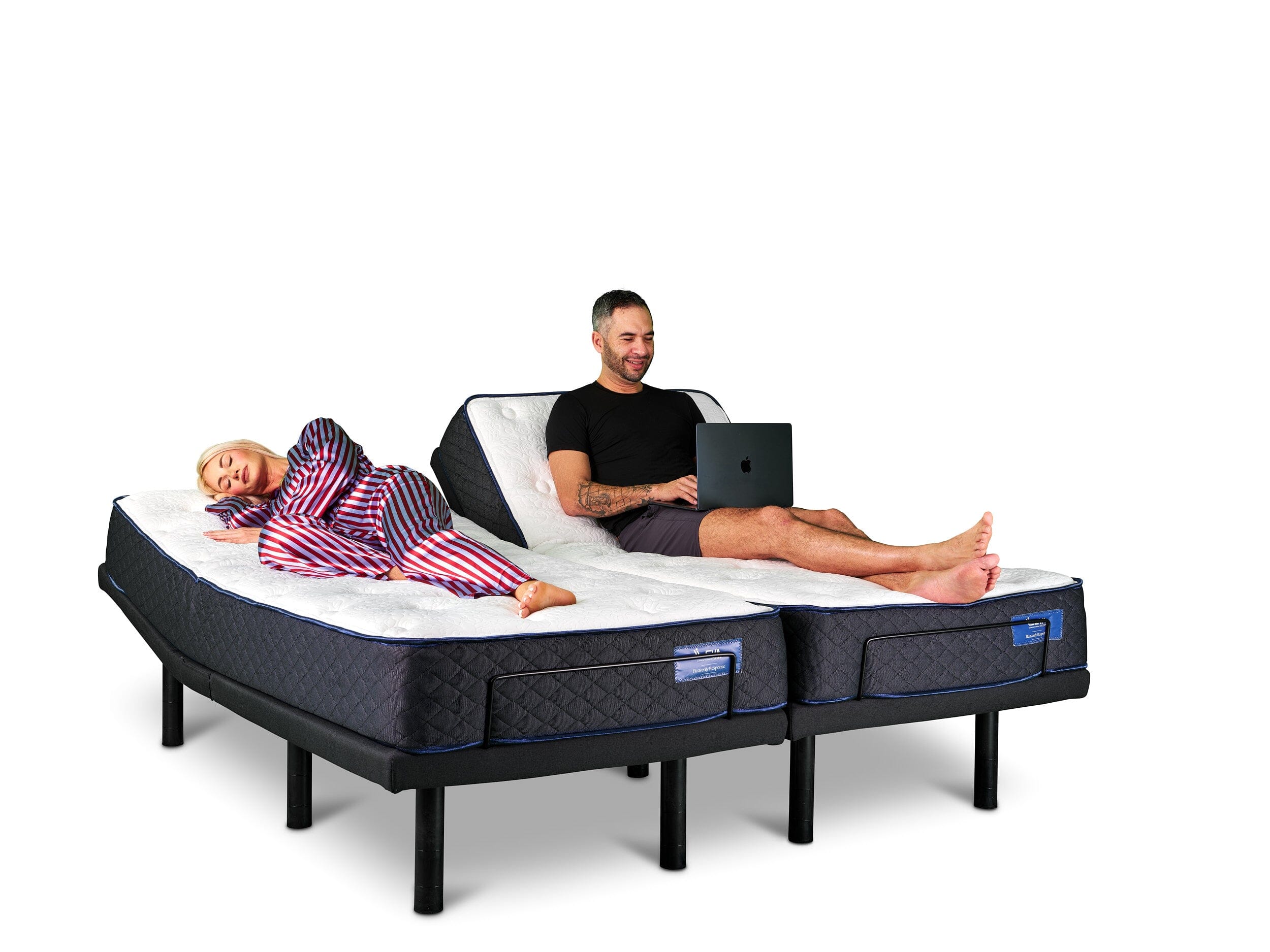
Split king setups commonly cost $2,000–$6,000 CAD when including two mattresses and two adjustable bases. Leva Sleep’s direct-to-consumer model positions its split configurations at 30–50% below comparable offerings from Sleep Country and Tempur-Pedic, while keeping the independent-elevation functionality that makes split bases effective for snoring couples.
Shop Leva Sleep’s adjustable beds to compare Split Queen and Split King packages with current CAD pricing.
The following table compares key features and typical price ranges across split and single configurations. Use it to see which setup delivers the independent elevation and quiet operation couples need.
2026 Adjustable Base Price Comparison in CAD
| Configuration | Independent Elevation | Motor Noise | White-Glove Delivery | Typical CAD Price Range |
|---|---|---|---|---|
| Leva Sleep Split Queen | Yes, each side independent | Brushless DC, 30–40 dB | Available (fee applies), Ontario & Alberta | Varies by configuration |
| Leva Sleep Split King | Yes, each side independent | Brushless DC, 30–40 dB | Available (fee applies), Ontario & Alberta | Varies by configuration |
| Comparable Split King from Other Retailers | Yes, each side independent | Varies by model | Third-party, varies | $2,000–$6,000 |
| Single Adjustable Base (any brand) | No, shared elevation only | Varies by model | Varies | around $800 to $4,500 |
Leva Sleep price ranges reflect base packages. Competitor ranges are drawn from published market data. Confirm current pricing directly with each retailer.
2026 Anti-Snore Technology for Couples
The 2025–2026 product cycle has turned sensor-driven anti-snore features into a clear category rather than a niche extra. Automatic anti-snore response features use built-in sensors to monitor breathing patterns, and when snoring is detected, the head of the bed elevates to expand the airway and reduce snoring. Tempur-Pedic’s AI-powered Tempur-Ergo Smart Base tracks sleep metrics including heart rate and blood oxygen level and automatically detects snoring to adjust the bed as needed. Sleep Number’s FlexFit 2 Smart Base includes anti-snore presets and Partner Snore technology that allows one partner to raise the other partner’s head section via a button press.
Leva Sleep Anti-Snore Mode (Spring 2026): Leva Sleep’s sensor-driven Anti-Snore Mode, introduced in Spring 2026, detects snoring through the base and initiates micro-adjustments to the head elevation of the affected partner’s side. The adjustments are gradual and designed to avoid waking either partner. The feature operates through the Leva Sleep app and can be configured per side on split configurations.
Three anonymized couple experiences from Leva Sleep customers show how this plays out in real bedrooms:
- “We were heading toward sleep divorce after two years of my husband’s snoring. The independent elevation on the Split Queen meant he could elevate his side without me feeling a thing. The anti-snore mode handles the nights he forgets to set it manually.” — Ontario couple, ages 52 and 49.
- “I was skeptical that a bed could do what a CPAP couldn’t. For mild snoring, the elevation alone cut the frequency significantly. The split configuration means my wife’s side stays flat, because she didn’t want any elevation.” — Alberta couple, ages 61 and 58.
- “After six months of sleeping in separate rooms, we needed a solution that didn’t involve a medical device. The Leva Split Queen gave us back the same bed without the compromise.” — Ontario couple, ages 44 and 41.
Quiet Motors and Bedding Fixes for Real Sleep
Brushless DC motors in adjustable bases operate at 30–40 decibels, equivalent to a whisper, which suits couples where one partner adjusts the base while the other sleeps. AC motors in budget adjustable bases reach 50–60 decibels or higher, loud enough to wake a sleeping partner. Research indicates that sounds as low as 40 decibels can cause sleep disturbances in sensitive individuals. Motor type therefore becomes a key specification for couples.
Sheet slippage creates a different but common frustration. Standard fitted sheets are not designed for the range of motion an adjustable base produces, and they pull free at the corners during elevation. Leva Sleep designs its fitted sheets with deep pockets and reinforced elastic specifically for adjustable bases. Its duvets include clips to maintain separation when the two sides of a split base sit at different angles.
Mattress materials that flex during base adjustment, such as those with polyester-wrapped coils or crinkly covers, can produce additional rustling sounds that compound motor noise. This interaction makes mattress and base compatibility a system-level decision rather than two separate purchases.
Shop Leva Sleep’s adjustable beds to explore packages that include base-compatible bedding accessories.
White-Glove Delivery for Heavy Adjustable Bases
White-glove delivery often determines whether an adjustable base feels like an upgrade or a burden. Adjustable bases weigh significantly more than standard bed frames and require precise assembly to function correctly. Leva Sleep’s in-house white-glove delivery service, available in Ontario and Alberta for a fee, covers delivery to the bedroom, full assembly, leg-height adjustment, removal and donation or recycling of the old bed, and a product tutorial covering app setup and position programming.
Delivery is handled by trained Leva Sleep staff rather than third-party couriers. The team setting up the base understands the product’s technical requirements. For couples purchasing a split configuration, the setup process includes calibrating both sides independently and confirming that the anti-snore and elevation features function properly before the team leaves.
When comparing adjustable base retailers, ask whether delivery is in-house or contracted out, whether old-bed removal is included, and whether the delivery team can adjust leg height on-site. These details determine whether the purchase ends with a functioning sleep system or a partially assembled frame in a hallway.
Shop Leva Sleep’s adjustable beds and review white-glove delivery availability for your Ontario or Alberta address.
Doctor Visit vs. Adjustable Base Purchase
Head elevation is a low-cost, well-tolerated positional therapy and a recognized non-CPAP alternative for selected positional OSA phenotypes with mild to moderate apnea. As noted earlier, head elevation can reduce OSA severity by approximately 31% in selected patients, which makes it a viable positional therapy for mild to moderate cases. However, an adjustable bed should not replace proper medical attention when addressing symptoms of obstructive sleep apnea.
Heavy snoring accompanied by gasping, choking, or daytime exhaustion points toward apnea requiring medical evaluation rather than just an adjustable base. Head elevation may also be contraindicated in patients with lower limb edema and venous insufficiency. If a partner’s snoring is mild, positional, and unaccompanied by daytime symptoms, an adjustable base with independent elevation is a reasonable first intervention.
If symptoms suggest moderate to severe apnea, a sleep study and physician consultation should come before any purchase decision. This sequence protects health while still leaving room to add an adjustable base later as a comfort and positional aid.
Decision Checklist for Snoring Relief Bases
- Split configuration: Confirm the base offers fully independent elevation per side. A single base with one motor cannot provide this. Independent elevation allows one partner to raise their head for snoring relief while the other stays flat.
- Motor type: After confirming independent elevation, check the motor type. Brushless DC motors at 30–40 dB are quiet enough for one partner to adjust without waking the other. AC motors at 50–60 dB in budget models often disrupt a sleeping partner every time the base moves.
- Split Queen availability: If room size is tight, verify the retailer can supply a Split Queen. Most cannot, which makes this dimension worth confirming early in your search.
- Anti-snore technology: Decide whether you want sensor-driven automatic adjustment or only manual elevation presets. Couples who do not want to wake up to change positions often prefer automatic modes.
- Mattress compatibility: Confirm the mattress is designed to flex with the base. All-foam and pocket-coil hybrid options behave differently at elevation and affect comfort and noise.
- Bedding system: Plan for fitted sheets with reinforced elastic and duvet clips designed for adjustable bases, or purchase them as part of a package. This prevents nightly sheet slippage.
- Delivery scope: Confirm whether white-glove delivery is in-house, includes old-bed removal, and covers your specific Ontario or Alberta location. These details affect how quickly you can sleep on the new setup.
- Medical threshold: If snoring comes with gasping, choking, or daytime fatigue, consult a physician before purchasing. Medical evaluation should guide next steps in those cases.
Frequently Asked Questions
Does a split adjustable base stop snoring or mainly reduce it?
A split adjustable base addresses the positional cause of most snoring, which is the collapse of relaxed throat tissue into the airway during sleep, by elevating the head and torso. Clinical data shows meaningful reductions in snoring frequency and intensity at elevations between 10 and 30 degrees, with higher angles producing stronger effects. For mild to moderate positional snoring, elevation alone can significantly reduce or eliminate episodes on a given night.
The base does not address snoring caused by nasal obstruction, alcohol consumption, or central sleep apnea, and it does not cure diagnosed obstructive sleep apnea. Sensor-driven anti-snore modes, like the one in Leva Sleep’s Spring 2026 update, add an automated layer by detecting snoring and initiating micro-adjustments without requiring the snoring partner to wake up and manually change position.
How do Split Queen and Split King differ for Canadian master bedrooms?
A Split King uses two Twin XL mattresses side by side on two independent adjustable bases, for a combined width of approximately 76 inches, which matches a standard King. A Split Queen uses two narrower mattresses on two independent bases to match the standard Queen width of 60 inches. Both configurations provide fully independent elevation, so one partner can raise their head for snoring relief while the other remains flat.
The practical difference is footprint and gap. Split Kings suit large master bedrooms but produce a 2–4 inch gap between mattresses that some couples find disruptive to closeness. Split Queens fit many standard Canadian master bedrooms more comfortably and reduce that gap concern. Leva Sleep is one of the few Canadian retailers that builds Split Queen configurations to specification, which makes it a relevant option for couples who want independent elevation without upsizing their room.
How can I tell if my partner’s snoring needs a doctor instead of an adjustable base?
Mild, positional snoring that occurs mainly when the partner sleeps on their back and eases when they shift position is most likely to respond to head elevation. An adjustable base is a reasonable first step in that scenario. Medical evaluation becomes necessary when snoring comes with gasping or choking sounds during sleep, observed pauses in breathing, significant daytime sleepiness despite adequate sleep time, morning headaches, or difficulty concentrating.
These symptoms suggest obstructive sleep apnea at a level that requires a sleep study and physician-directed treatment, which may include CPAP therapy. An adjustable base can complement CPAP by improving mask seal and comfort at elevation, but it does not replace it for moderate to severe cases. When uncertainty remains, a family physician or sleep specialist referral is the safest first step.
Will standard fitted sheets work on a Leva Sleep adjustable base?
Standard fitted sheets rarely stay in place on an adjustable base. At 20–30 degrees of head elevation, the mattress surface geometry changes significantly, and standard sheets tend to pull free at the corners. Leva Sleep designs its fitted sheets with deep pockets and reinforced elastic to remain in place through full elevation cycles.
The company also offers duvet clips that keep the duvet from bunching or sliding when the two sides of a split base sit at different angles. Purchasing base-compatible bedding as part of a package, rather than sourcing it separately, helps the entire sleep system function as intended from the first night.
What does Leva Sleep’s white-glove delivery include in Ontario and Alberta?
Leva Sleep’s white-glove delivery service, available for a fee in Ontario and Alberta, covers delivery directly to the bedroom, full assembly of the adjustable base and mattress, and leg-height adjustment to the customer’s preference. The team also handles removal and responsible disposal or donation of the old bed and provides a hands-on product tutorial that includes app setup, position programming, and anti-snore mode configuration.
Delivery is handled by trained Leva Sleep staff rather than contracted couriers, so the team performing the setup has direct product knowledge. Coverage zones within Ontario and Alberta can be confirmed at the time of purchase. This service is particularly relevant for split configurations, which involve two independent bases that must be calibrated together and tested before the delivery team departs.