Written by: Matthew Timmins, Founder and Managing Director, Leva Sleep | Last updated: July 21, 2026
Key Takeaways for Couples Considering Split Adjustable Beds
- Split adjustable beds give each partner independent elevation, so one can raise the head for snoring relief while the other stays flat.
- Earplugs, wedge pillows, and single-side bases usually solve only one issue and leave snoring or comfort conflicts unresolved.
- Leva Sleep’s anti-snore automation detects snoring vibrations and makes gentle head adjustments without waking the other partner.
- Quiet German motors, app-based controls, temperature options, and purpose-designed bedding support personalized, low-disturbance sleep.
- Leva Sleep offers split adjustable configurations designed for Canadian couples who share a bed but have different sleep needs.
The Problem: Snoring, Sleep Divorce, and Conflicting Comfort Needs
Roughly 40% of adult men and 24% of adult women snore regularly, and the impact goes far beyond noise. Snoring negatively affects the well-being of 77% of people who share a bed with a snoring partner, contributing to daytime sleepiness, anxiety, mood changes, and reduced concentration. Bed partners of snorers lose about one hour of sleep per night, or nearly 15 full days of sleep per year.
Snoring becomes even more disruptive when couples also disagree on firmness, temperature, or elevation. A 2025 American Academy of Sleep Medicine survey reported that 31% of U.S. adults sleep in a different bed or room from their partner. The ResMed 2025 Global Sleep Survey found that 18% of couples sleep in separate rooms because of snoring and restlessness.
Couples usually start considering more comprehensive solutions when earplugs, positional pillows, and separate duvets no longer restore consistent rest for both partners. The need becomes more urgent when one partner is advised to sleep elevated for a medical condition or when sleep disruption starts to fuel recurring relationship conflict. The next section explains why common workarounds rarely solve the full problem.
Why Common Snoring Workarounds Often Disappoint
Most quick fixes address only one part of the problem and leave other issues in place. The table below compares typical solutions against the outcomes couples usually want.
| Solution | Snoring Reduction | Independent Elevation | Motion Isolation |
|---|---|---|---|
| Earplugs | None, only masks noise for partner | No | No |
| Wedge pillow | Partial, elevation below 15° has limited airway effect and can flex the neck forward | One side only, fixed angle | No |
| Flat bed (traditional) | None | No | Varies by mattress type |
| Single-side adjustable base (non-split) | Partial, raises head to open airway but moves both partners together | Both sides move together | Limited |
| Split adjustable base | Meaningful, head-of-bed elevation can reduce apnea events for positional, mild-to-moderate OSA | Fully independent per side | High, split configurations usually reduce motion transfer better than single mattresses |
Separate rooms remove partner disturbance but create emotional and logistical costs. One British survey reported that 47% of recently divorced couples cited snoring as a factor in their relationship breakdown. A split adjustable system targets the mechanical causes of snoring and sleep disruption while allowing couples to keep sharing a bed.
How Split Adjustable Sleep Systems Work for Two Sleepers
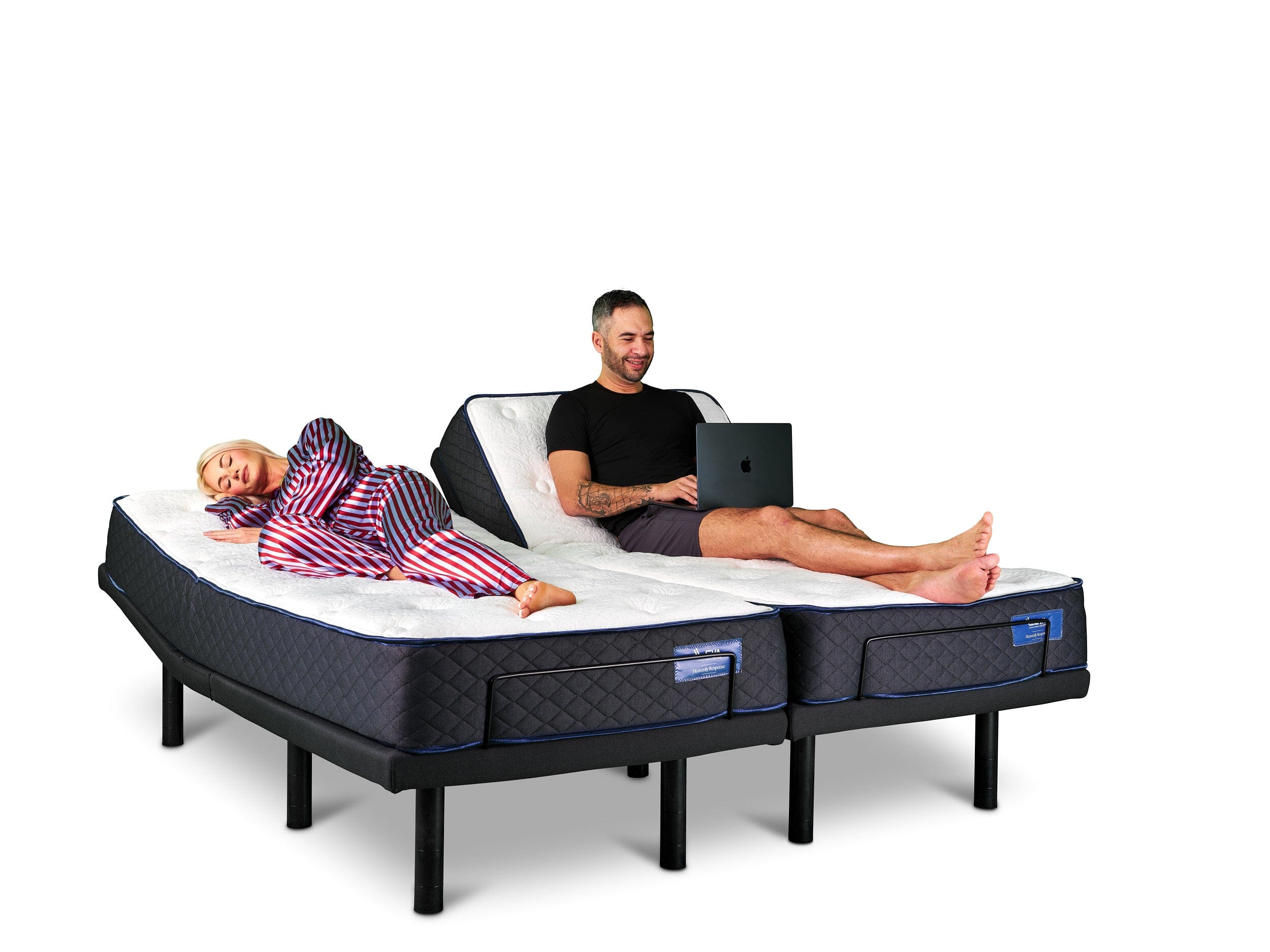
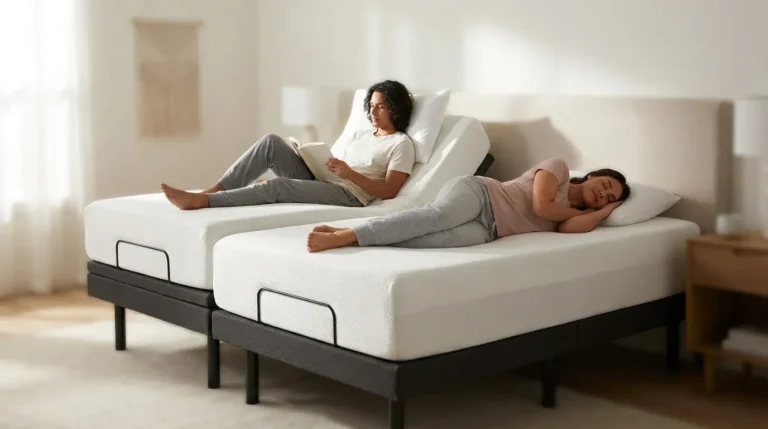
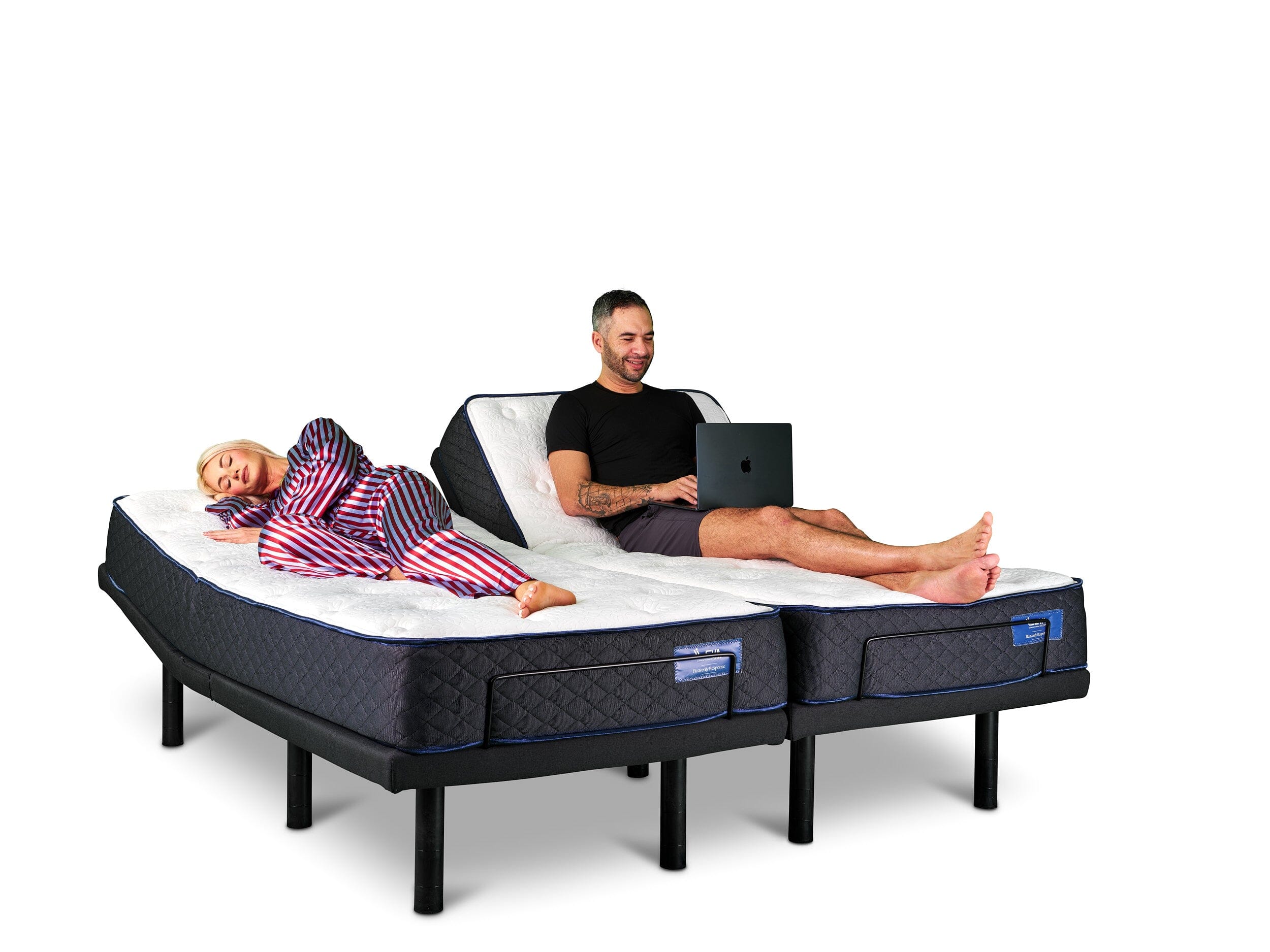
A split adjustable sleep system uses two independently motorized bases placed side by side in one shared frame. Each partner controls their own head and foot elevation, firmness, massage, and, on higher-tier models, temperature through a remote or app. Split queen adjustable bases use two 30″ × 80″ platforms, while split king bases use two Twin XL (38″ × 80″) platforms. Both layouts let one partner elevate for snoring relief while the other stays flat.
Leva Sleep offers a broad range of adjustable bed models, far more than the limited selection at many general mattress retailers. Each model uses quiet German motors and app control, which support features such as anti-snore presets and gentle overnight adjustments. Systems are locally assembled and delivered across Ontario and Alberta, with optional white-glove setup for couples who want professional installation.
Independent Adjustability for Different Medical and Comfort Needs
Split adjustable bases give each partner separate head and foot elevation, which suits couples where one person manages sleep apnea, acid reflux, or back pain while the other prefers a flat position. Each side runs on its own remote or app profile, so a partner who likes a zero-gravity setting for lower back relief does not affect the other side. Leva Sleep’s app can store custom positions, set vibrating alarms, and support subtle overnight changes without waking the other person.
Anti-Snore Automation with Gentle Head Elevation
Head-of-bed elevation can reduce apnea events and snoring for positional, mild-to-moderate OSA, and motorized bases allow more precise angles than fixed wedges. Leva Sleep’s anti-snore mode, available on select models, detects snoring vibrations and raises the head section slightly to help open the airway. Anti-snore automation is designed for positional snorers, while non-positional snoring still requires separate clinical assessment.
Quiet German Motors That Respect Light Sleepers
Motor noise often discourages people from using adjustable beds. Older or basic bases can make sounds that wake the non-adjusting partner and undermine the benefit of independent controls. Leva Sleep uses whisper-quiet German motors that operate at levels that do not disturb sleep for most users. This allows mid-night position changes and automated anti-snore adjustments without noticeable noise.
Mattress and Bedding Built for Adjustable Motion
Mattresses on split adjustable bases need to flex repeatedly without damage, so most rigid innerspring models are not recommended. Leva Sleep designs all-foam and hybrid pocket coil mattresses specifically for adjustable use. Standard bedding can also cause issues, since fitted sheets on split setups often slip into the centre gap.
Leva addresses this with fitted sheets that have deep pockets and extra elastic, duvets with clips that keep each side in place at different angles, and mattress protectors rated for frequent flexing. These details help prevent common frustrations such as sheets popping off in the middle of the night.
Temperature Control Options for Partners Who Run Hot or Cold
Different temperature preferences can disrupt sleep even when snoring is under control. Leva Sleep offers an integrated heating and cooling pad on higher-tier systems, so each partner can set a personal sleep temperature. This reduces the need for separate duvets or fans and works with the app’s AI-powered sleep tracking to make small adjustments during the night.
White-Glove Delivery and Setup in Ontario and Alberta
Leva Sleep’s in-house white-glove delivery service, available for a fee across Ontario and Alberta, handles the heavy lifting and setup. The team delivers the system to the bedroom, assembles the base and mattress, adjusts leg height, walks through the controls, and removes the old bed for donation or recycling when possible. This removes the assembly burden common with bed-in-a-box brands and helps ensure the system works correctly from the first night.
Relationship and Health Benefits of Staying in the Same Bed
A split adjustable system helps couples stay in the same bed while still meeting individual needs. Independent elevation supports positional relief for mild sleep apnea, acid reflux, and joint pain, which tend to become more common between ages 35 and 70. This adaptability can make the bed more useful as health needs change over time.
Long-term usability also matters. Adjustable bases can support post-surgery recovery, evolving back conditions, and pregnancy without requiring a new bed. Leva Sleep’s model range allows couples to choose a configuration that fits their current needs and then upgrade features later if desired.
Split King vs Split Queen: Sizing Choices for Canadian Bedrooms
| Factor | Split Queen | Split King |
|---|---|---|
| Total dimensions | 60″ × 80″, standard queen footprint | 76″ × 80″, standard king footprint |
| Personal width per partner | 30″ per side | 38″ per side, similar to a Twin |
| Minimum room size | 10 × 12 ft fits comfortably | 12 × 12 ft minimum, 13 × 13 ft recommended |
| Independent elevation | Yes, on Leva Sleep’s split queen configuration | Yes, with two Twin XL bases side by side |
| Best suited for | Couples whose room fits a queen but not a king, or who want adjustability in a smaller footprint | Couples with larger bodies, restless sleep, or a strong need for personal space |
Leva Sleep is one of the few Canadian retailers that offers a Split Queen adjustable bed built to customer specifications. This can be a major advantage for couples in pre-1980s Ontario or Alberta homes with smaller primary bedrooms. Both split queen and split king configurations are typically priced 30–50% below comparable Tempur-Pedic or Sleep Number systems, reflecting Leva’s direct-to-consumer, locally assembled model.
When Snoring Requires Medical Evaluation
Professional assessment is recommended when snoring is loud or frequent, disturbs a bed partner, or includes pauses in breathing, gasping, or daytime sleepiness. Watchful waiting is not advised when snoring appears with restlessness, daytime fatigue, or breathing pauses, because these signs may indicate sleep apnea. Head-of-bed elevation with an adjustable base is a recognized positional therapy for mild-to-moderate, position-dependent OSA and is often mentioned by sleep specialists as a supplemental strategy. It does not replace CPAP for moderate-to-severe cases.
Doctors generally view adjustable bed elevation as an adjunct rather than a primary treatment for diagnosed sleep apnea. Couples should seek a sleep study before relying only on positional therapy when red-flag symptoms are present.
Frequently Asked Questions
Can both partners use different settings on the same split adjustable bed?
Yes. Split adjustable bases give each partner a fully independent control system with a separate remote or app profile. Each person can adjust head elevation, foot elevation, massage intensity, and, on higher-tier Leva Sleep models, temperature. One partner can sleep flat while the other uses an anti-snore preset, and changes on one side do not move the other side.
Does a Split Queen save space compared to a Split King?
A Split Queen keeps the standard 60″ × 80″ queen footprint, which usually fits well in a 10 × 12 ft bedroom. A Split King uses a 76″ × 80″ footprint and typically needs at least a 12 × 12 ft room. For couples in older Ontario or Alberta homes with smaller primary bedrooms, the Split Queen often becomes the only way to maintain walkway space while still gaining independent elevation on each side. Leva Sleep builds Split Queen systems to order, which is still uncommon among Canadian retailers.
Are Leva Sleep adjustable bases compatible with CPAP machines?
Adjustable bases and CPAP machines work together rather than competing with each other. Head-of-bed elevation can improve mask comfort and make CPAP use more consistent for positional OSA patients. Leva Sleep’s bases do not interfere with CPAP equipment, and the elevated position can reduce the pressure difference required for some users. Anyone using CPAP for diagnosed sleep apnea should continue that therapy and consult a sleep specialist before changing treatment.
What bedding works with a split adjustable base?
Standard fitted sheets often slip into the centre gap between two independent mattresses. Leva Sleep designs bedding specifically for adjustable bases, including fitted sheets with deep pockets and extra elastic, duvets with clips that keep each side separated at different angles, and mattress protectors built for repeated flexing. Buying the complete Leva Sleep system helps ensure the base, mattress, and bedding work together without sheets popping off overnight.
How long does white-glove delivery and setup take in Ontario and Alberta?
Leva Sleep’s in-house delivery team books a confirmed time window and brings the system directly to the bedroom. The team assembles the base and mattress, adjusts leg height, walks through app setup and preset positions, and removes the old bed. On-site setup usually takes one to two hours, depending on the configuration. Because Leva manages delivery in-house instead of using a third-party carrier, scheduling and any changes are handled directly with the company.
Conclusion: A Practical Path to Better Shared Sleep
Snoring and mismatched sleep preferences are common sources of sleep disruption for Canadian couples, yet they are often manageable with the right setup. Traditional workarounds treat symptoms in isolation: earplugs hide noise without opening the airway, wedge pillows offer fixed and sometimes inadequate elevation, and single-side bases move both partners together. Split adjustable beds with independent elevation and anti-snore features address airway position, motion transfer, firmness differences, and temperature while keeping both partners in the same bed.
Leva Sleep’s Split Queen and Split King systems focus on these challenges with quiet German motors, app-controlled settings, anti-snore automation, purpose-built bedding, and white-glove delivery across Ontario and Alberta. Prices are typically 30–50% lower than comparable luxury competitors because of Leva’s direct-to-consumer, locally assembled model.