Written by: Matthew Timmins, Founder and Managing Director, Leva Sleep | Last updated: July 31, 2026
Key Takeaways for Adjustable-Bed Comforters
- Down-alternative comforters give Canadian couples on split adjustable beds breathable warmth, easy machine washing, and hypoallergenic performance.
- Baffle-box construction, percale or Tencel shells, corner loops, and gel-fibre or Primaloft fills work together to keep comforters stable on articulating bases.
- Match fill weight in GSM to each sleeper: 160–200 GSM for hot sleepers, 300–400 GSM for all-season use, and 500+ GSM for cold sleepers or winter rooms.
- Washing every 2–3 months when using a duvet cover, plus gentle cold cycles and low-heat drying, preserves loft and extends comforter life.
- Leva Sleep’s duvet clips and extra-elastic fitted sheets keep separate comforters anchored during independent elevation, and adjustable bed packages bundle everything into a complete sleep system.
Down vs Down-Alternative Comforters for Split Bases
Natural down delivers exceptional loft and longevity. Real down lasts 10–15 years under nightly use, but it creates two practical problems for Canadian couples. Traditional down contains feather proteins that can trigger IgE-mediated immune responses, while synthetic fills contain no protein-based allergens. Traditional down comforters also tolerate home machine washing only every three to five years when a duvet cover is used.
Down-alternative fills solve both issues. OEKO-TEX Standard 100 certification verifies that fill, shell fabric, and components are free of over 100 harmful substances including formaldehyde, heavy metals, and allergenic dyes, which gives a clear safety benchmark beyond the unregulated “hypoallergenic” label. Most synthetic fills are also machine washable at 60°C, which kills dust mites, so regular home laundering becomes a genuine hygiene advantage.
The trade-off is lifespan. A basic microfibre down-alternative insert maintains good loft for 1–2 years, a siliconised polyester insert lasts 0.5–2 years, and real down lasts 10–15 years with proper care. For couples on split adjustable bases who wash bedding more often because of independent movement and extra heat, the washability advantage of down alternative usually outweighs the shorter replacement cycle. Even the right fill, however, cannot perform well if the comforter slides off during elevation, so construction features become just as important as material choice.
| Attribute | Standard Polyester Cluster | Gel-Fibre / Primaloft | Real Down |
|---|---|---|---|
| Typical Lifespan | 1–2 years | Varies by product | 10–15 years |
| Machine Washability | Yes, gentle cold cycle | Yes, machine washable without flat or lumpy result | Machine washable at home every 1–5 years as needed |
| Loft Retention After 50 Wash Cycles | Decreases with repeated washes | Generally retains loft well | Good recovery with proper care |
| Duvet Clip Compatibility | Compatible when corner loops are present | Compatible when corner loops are present | Compatible when corner loops are present |
| Canadian Queen Pricing (2026 CAD) | Starts at approximately $238 | $130–$285 | Roughly 3× the price of comparable down alternative |
Why Comforters Slide on Adjustable Beds
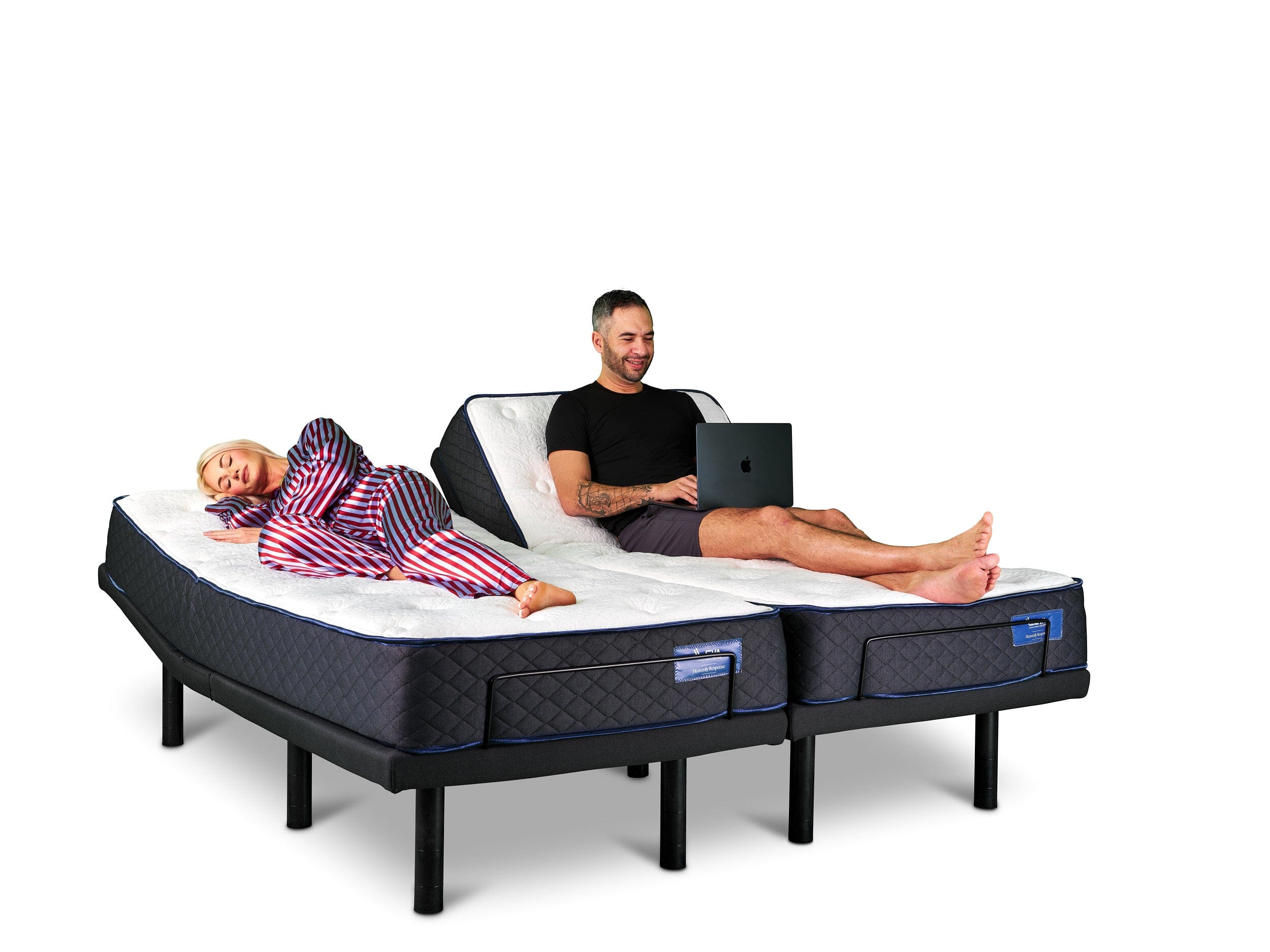
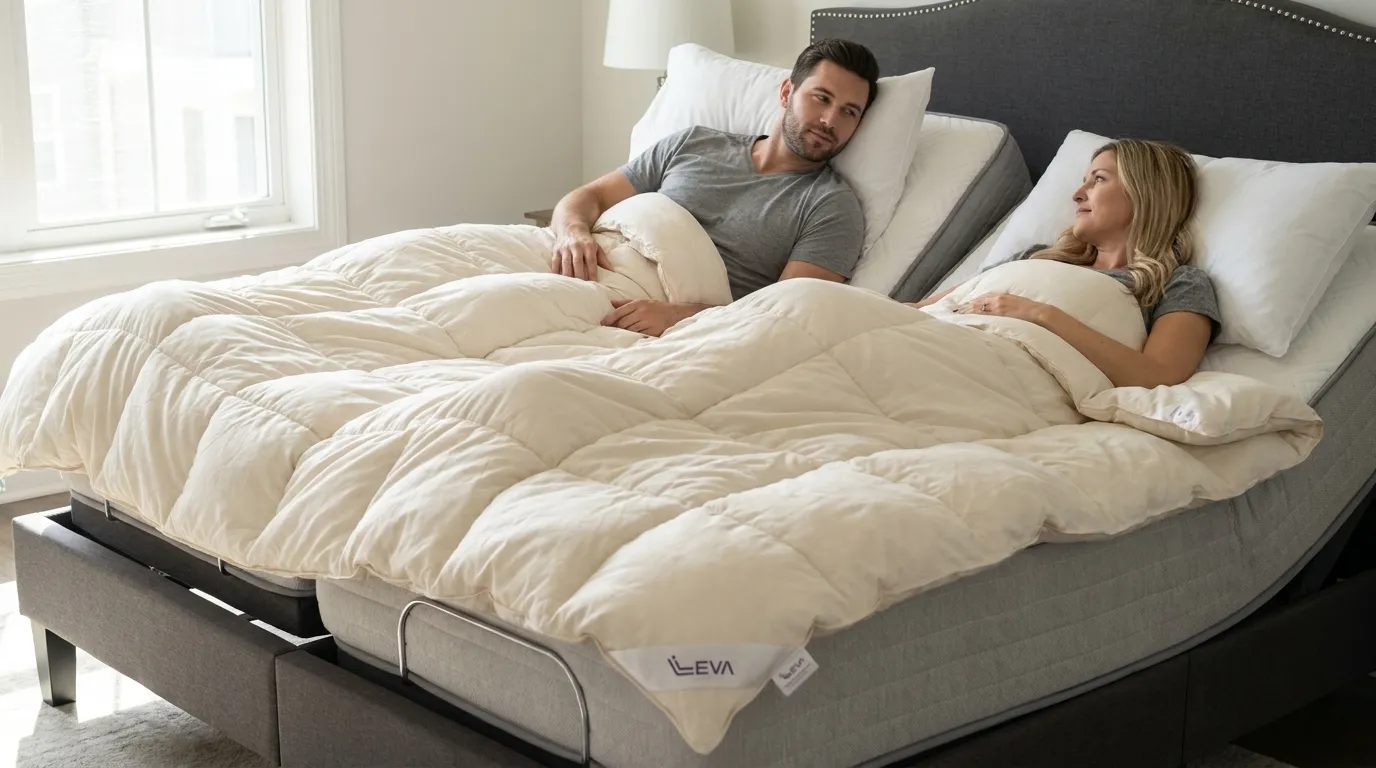
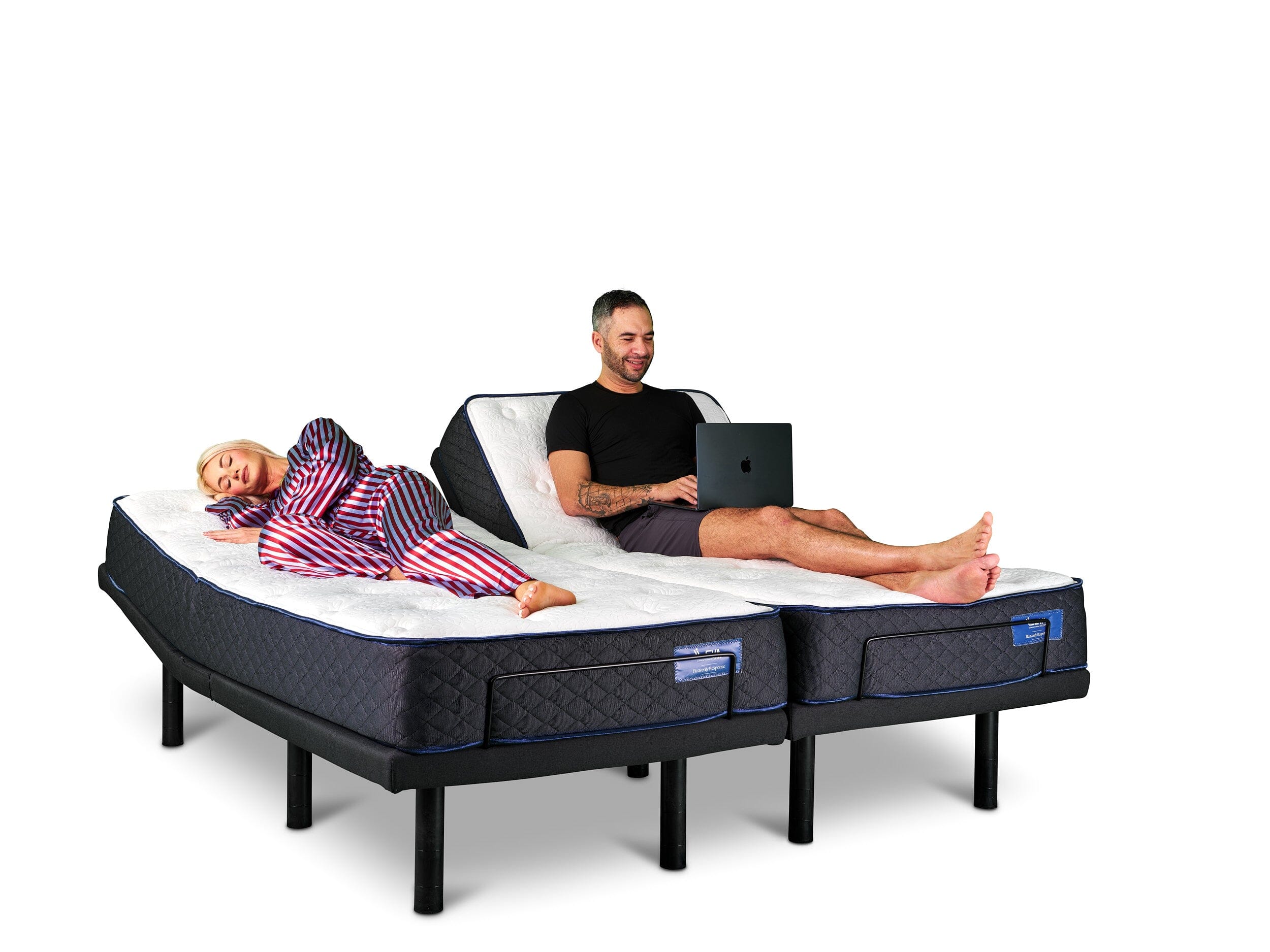
Standard comforters are engineered for flat-bed geometry. When a split adjustable base elevates one side independently, the comforter shifts toward the raised edge and pulls coverage away from the partner on the flat side. Temperature incompatibility is the most cited cause of co-sleeping disruption, with motion transfer a close second, and a sliding comforter amplifies both problems at once.
Two accessories resolve this on Leva Sleep’s split bases. Extra-elastic fitted sheets grip the mattress through the full range of head and foot elevation, which prevents the sheet from popping off at the corners. Duvet clips anchor the comforter at the corners of each side independently, so when one base raises to an anti-snore or zero-gravity position, the comforter moves with that side instead of dragging across both. Corner loops on all four corners of a comforter allow it to be secured to the interior ties of a duvet cover so the fill never bunches or shifts, and Leva Sleep’s duvet clips apply the same principle directly to the base.
Shop Leva Sleep’s adjustable beds. Each package addresses split-base slippage by pairing the base with clip-compatible accessories and extra-elastic fitted sheets.
Comforter Features That Work on Adjustable Beds
Four construction features determine whether a down-alternative comforter performs reliably on a split base.
- Baffle-box construction: Baffle-box construction uses vertical fabric walls inside the comforter to prevent fill from shifting and clumping, maintaining even coverage without cold spots. This structure matters on adjustable beds because articulation repeatedly compresses and releases the comforter.
- Percale or Tencel shell: Percale weave shell fabrics breathe better than sateen for hot sleepers. Eucalyptus-derived Tencel lyocell provides temperature regulation and moisture-wicking properties that suit elevated sleeping positions, where heat tends to trap against the body.
- Corner loops: Some models offer up to 12 loops including ties at the top and bottom in addition to the four corners. These extra loops create more anchor points for duvet clips along the full length of a split base.
- Gel-fibre or Primaloft fill: Adjustable bed users often wash bedding more frequently because elevated positions increase perspiration. Primaloft synthetic fill retains insulating value when wet, so it holds warmth and loft more reliably than standard polyester across many wash cycles.
Fill-Weight Guide for Different Sleeper Types
Fill weight in GSM (grams per square metre) is the main lever for matching a down-alternative comforter to each partner’s thermal needs. A 300–400 GSM down-alternative comforter provides all-season warmth suitable for most Canadian bedrooms kept between 16–20°C.
- Hot sleepers (160–200 GSM): A 160 GSM microfiber fill with box-stitching creates a breathable summer-weight layer that stays airy on warm nights.
- All-season use (300–400 GSM): Within that range, 300 GSM often serves as the sweet spot, balancing insulation with breathability for most couples.
- Cold sleepers or winter use (500+ GSM): Silk & Snow Down Alternative Comforter offers three weights, including a winter option for partners who sleep cold even in elevated positions.
- Ontario winter rooms below 18°C: Cold sleepers or rooms of 16–18 °C should use an all-season duvet (approximately 10.5 TOG) with 700–1000 g fill weight for queen size.
On a split base, the Scandinavian sleep method, using separate duvets, eliminates blanket tug-of-war and lets each partner select bedding weight and warmth independently. Without anchoring, separate comforters still slide during elevation just like a shared one. Leva Sleep’s duvet clips solve this by anchoring each comforter to its own side of the base so the method works as intended.
Care, Cleaning & Comforter Lifespan
Washing frequency directly affects how long a down-alternative comforter retains its loft. Down alternative comforters should be washed every 2–3 months when used with a duvet cover to maintain hygiene.
The correct wash process protects the fill structure. Machine wash on a gentle cold cycle in a front-loading or agitator-free machine using mild liquid detergent at half dose, then dry on low heat with dryer balls. Avoid hot water, fabric softener, and high-spin cycles to prevent damage.
Fill type determines how well the comforter survives ongoing laundering. Standard polyester cluster fill can lose loft over time, which leads to clumping after a few years. By contrast, gel-fibre fill maintains loft retention well across dozens of washes, and Primaloft-filled comforters are machine-washable without leaving the fill flat or lumpy.
Canadian Pricing and Value for Money
Down-alternative comforters for queen sizes in Canada in 2026 are priced from around CA$100 to CA$285 depending on the retailer. Within that range, pricing varies by weight, construction, and brand.
Leva Sleep’s vertically integrated, direct-to-consumer model delivers 30–50% savings versus comparable luxury sleep brands by removing retail markups. White-glove delivery, available in Ontario and Alberta, includes setup, product tutorials, and old-bed removal, so the full sleep system arrives ready to use instead of requiring self-assembly. Shop Leva Sleep’s adjustable beds to see current package pricing in CAD.
Why Hotels Prefer Down-Alternative Inserts
Hotels favour down-alternative comforters for the same reasons Canadian couples on adjustable beds do. They need machine washability at commercial scale, consistent loft across hundreds of wash cycles, and hypoallergenic performance for guests with sensitivities. Down alternative survives regular commercial washing without special handling, while down requires front-loading machines, cold water, gentle cycles, and extended drying. For home use, the closest equivalent is a gel-fibre or Primaloft fill in a baffle-box construction with a percale or Tencel shell, which is the same combination that performs well on split adjustable bases.
Health-Focused Choices for Allergy Sufferers
The OEKO-TEX Standard 100 certification mentioned earlier provides the most reliable verification for allergy-conscious shoppers. For dust mite allergies specifically, down alternative fill does not reduce dust mite exposure compared to real down; the effective intervention is a dust-mite-proof cover woven at 6 microns or below, regardless of fill type. The 60°C wash temperature referenced earlier delivers the key practical advantage for allergy sufferers, since most down comforters cannot safely reach that setting.
Costco-Level Comforters and Trade-Offs
Warehouse-retail comforters at Costco typically use standard polyester cluster fill at entry-level GSM weights. These options offer low upfront cost, but standard polyester cluster fill can lose loft with repeated washing, so a Costco-tier comforter on a split adjustable base will likely require replacement within 1–2 years. For couples who wash bedding frequently, as elevated sleeping positions increase perspiration, a siliconised polyester or lyocell-blend insert lasting 0.5–2 years often delivers better total value than multiple replacements of budget fills, even with a higher initial price.
Frequently Asked Questions
What fill weight should a hot sleeper choose for a split adjustable bed in Canada?
Hot sleepers on split adjustable bases usually do well with 160–200 GSM for summer use or 300 GSM for all-season performance in Canadian bedrooms kept between 16–20°C. Gel-fibre fills with hollow-core structure allow more airflow than dense microfiber packing and run measurably cooler at equilibrium surface temperature. The percale or Tencel shell mentioned earlier provides the breathability hot sleepers need. On a split base, each partner can use a separate comforter at their preferred weight, and Leva Sleep’s duvet clips anchor each side independently so elevation changes do not disturb the other partner’s coverage.
How do duvet clips work with a down-alternative comforter on a split base?
Duvet clips attach to the corner loops sewn into the comforter and anchor it to the base or duvet cover ties at each corner. When one side of a split adjustable base raises for anti-snore mode or zero-gravity positioning, the clip holds the comforter against that side instead of allowing it to slide toward the stationary side. Comforters with more than four corner loops provide additional anchor points along the length of the base, which helps when the foot section elevates. Leva Sleep designs its duvet clips for this specific use, pairing them with extra-elastic fitted sheets that grip the mattress through the full articulation range.
How often should a down-alternative comforter be washed when used on an adjustable bed?
With a duvet cover in place, wash the comforter every 2–3 months. Without a duvet cover, washing every 2–4 weeks maintains hygiene. Adjustable bed users who sleep in elevated positions tend to perspire more against the comforter, so the duvet cover becomes a practical necessity rather than a nice-to-have accessory. It protects the fill from body oils and abrasion, which extends the comforter’s usable life. Wash on a gentle cold cycle in a front-loading machine using mild liquid detergent at half dose, then dry on low heat with dryer balls to restore loft.
Is a down-alternative comforter compatible with Leva Sleep’s split queen adjustable base?
Any down-alternative comforter with corner loops is compatible with Leva Sleep’s duvet clips on a split queen or split king base. The key selection criteria are baffle-box construction to prevent fill migration during articulation, a breathable percale or Tencel shell to manage heat at elevated positions, and a fill weight matched to each partner’s thermal preference. Leva Sleep’s split queen is a unique configuration in the Canadian market, since most competitors offer only split king, and the accessory ecosystem, including duvet clips and extra-elastic fitted sheets, is designed specifically for independent-side movement on both configurations.
Decision Guide for Choosing a Comforter
The choice between fill types, weights, and construction features for a down-alternative comforter on a split adjustable base comes down to four practical trade-offs.
- Fill durability vs upfront cost: Standard polyester cluster fills cost less but compress within 3–5 years. Gel-fibre and Primaloft fills cost more but retain 89–96% loft after 50 wash cycles and last 5–10 years.
- Warmth vs breathability: Higher GSM delivers more warmth but traps more heat at elevated sleeping positions. A 300 GSM all-season fill balances both for most Canadian bedrooms.
- Shared vs separate comforters: The Scandinavian method, one comforter per partner, eliminates blanket competition on split bases and allows each partner to select a preferred fill weight independently.
- Shell fabric: Percale and Tencel lyocell shells outperform sateen and standard polyester for hot sleepers and elevated sleeping positions, and OEKO-TEX certification provides verified chemical safety beyond marketing claims.
For Canadian couples on split adjustable bases, a gel-fibre or Primaloft fill in a baffle-box comforter with corner loops, paired with Leva Sleep’s duvet clips and extra-elastic fitted sheets, solves the slippage, heat retention, and coverage issues that standard comforters cannot handle. Leva Sleep’s white-glove delivery in Ontario and Alberta ensures the full system, including base, mattress, and accessories, is set up correctly from the first night. Shop Leva Sleep’s adjustable beds to explore split queen and split king packages with integrated bedding accessories.