
Written by: Matthew Timmins, Founder and Managing Director, Leva Sleep | Last updated: August 6, 2026
Key Takeaways for Elevated Sleep as a Couple
- Head and leg elevation can ease acid reflux, snoring, sleep apnea, and joint pain by reducing pressure and opening airways.
- Full wedge pillows and half wedges disrupt mattress level and intimacy, while split adjustable bases let each partner move independently.
- Leva Sleep’s quiet motors, anti-slide sheets, and direct pricing make split adjustable bases a practical option for many Canadian couples.
- Correct setup with deep-pocket sheets, gradual angle changes, and duvet clips improves comfort and prevents sliding or sheet slippage.
- Explore Leva Sleep’s adjustable bed packages to choose a Split Queen or Split King that keeps both partners together and elevated.
Phase 1: Why Elevation Helps and How Each Setup Works
Sleeping with the head and torso raised reduces the gravitational pull that allows stomach acid to travel upward into the oesophagus. Many clinicians recommend inclined sleep as a non-drug strategy for managing gastroesophageal reflux disease. The same positional shift opens the upper airway, which is why sleep specialists recommend head elevation as a first-line behavioural step for snoring and mild obstructive sleep apnea. For joint pain, elevating the legs reduces pressure on the hips and knees by offloading weight from inflamed joints.
Couples can reach these elevation angles in three main ways.
- Full wedge pillow: A foam triangle sits under the torso of one partner. It has a low upfront cost and raises a single zone, yet it also shifts the entire mattress surface unevenly.
- Half wedge or bolster: A narrower foam insert sits under one side of the mattress. It feels slightly less disruptive than a full wedge, but it still creates a slope that affects the non-elevated partner.
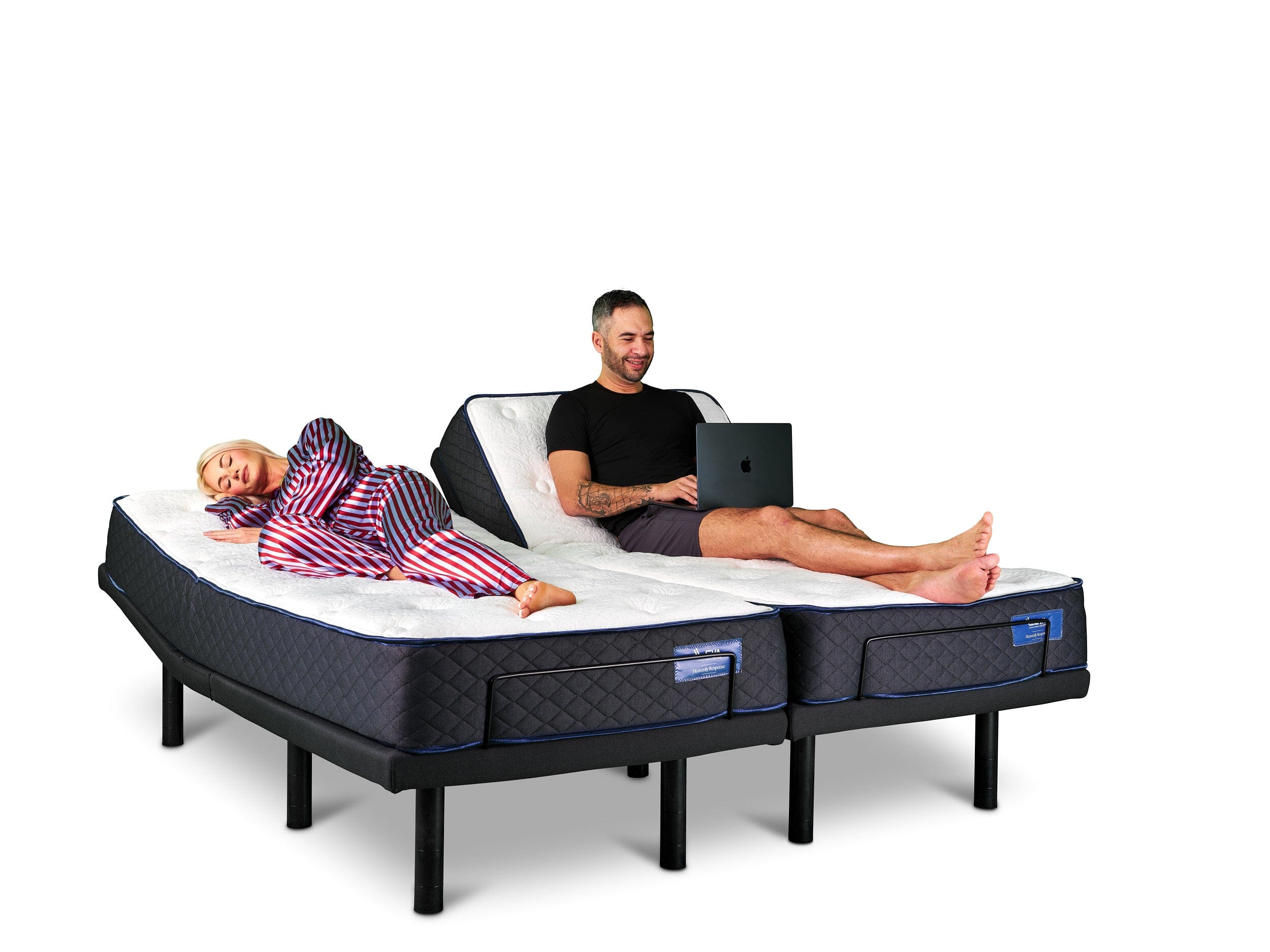
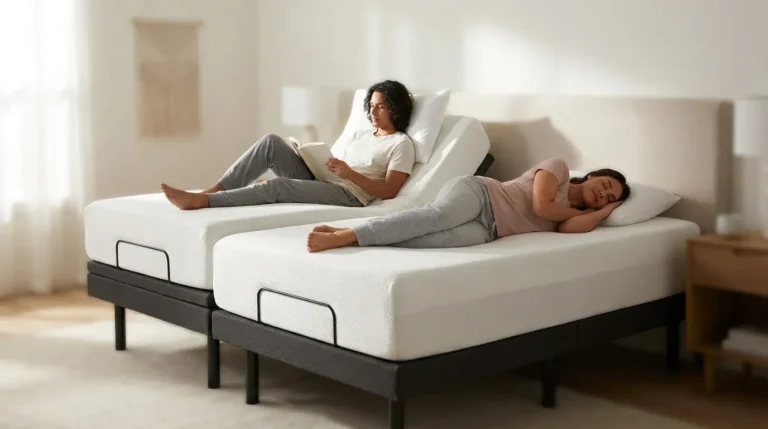
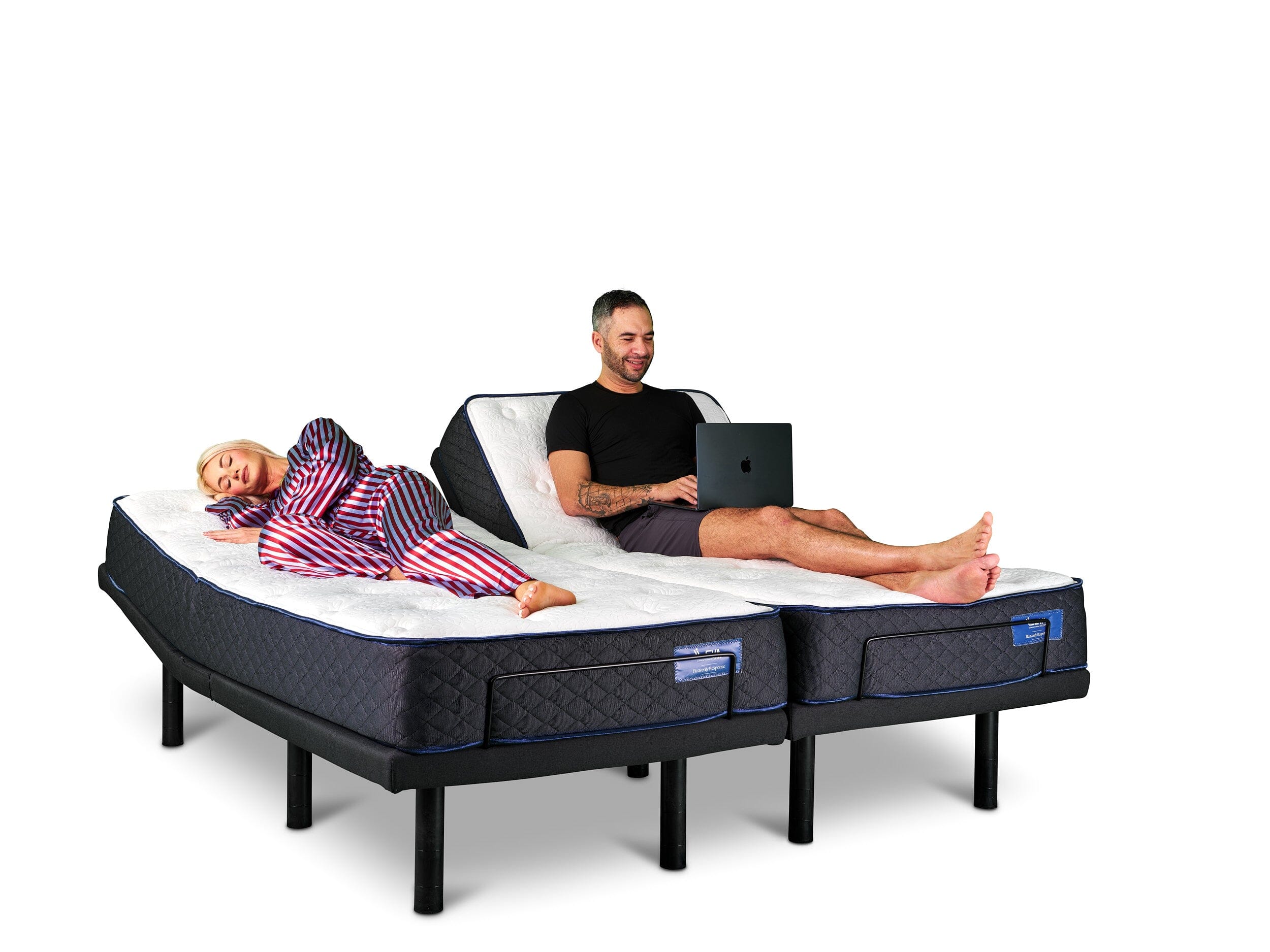
- Split adjustable base: Two independent motorized bases, such as a Split Queen or Split King, let each partner set their own head and foot elevation. One side moves without changing the mechanics of the other side.
Phase 2: Match Your Needs to the Right Elevation Setup
Couples can compare these three setups using four practical criteria: intimacy preservation, motor noise, sliding risk, and Canadian pricing. Each factor influences long-term comfort and relationship dynamics in a different way.
Intimacy preservation: A full wedge creates a height difference of 15–30 cm between partners, which makes side-by-side contact awkward. A split adjustable base raises only the elevated partner’s side of the mattress while keeping both partners on the same shared surface at the same baseline height. One side angles upward, yet physical closeness such as touching, hand-holding, and leg contact remains possible.
Motor noise: Wedges stay silent but require manual repositioning. Entry-level adjustable bases can create noticeable motor noise during movement. Leva Sleep’s bases use quiet German motors, so most couples can adjust positions at night without waking the other partner.
Sliding risk: Any incline increases the chance of sliding downward during sleep. Wedges do not include anti-slide features. Adjustable bases paired with Leva’s fitted sheets, which have deep pockets and extra elastic, help anchor the mattress and reduce body sliding.
Canadian pricing: A Split Queen adjustable base package from Leva Sleep is priced competitively against similar luxury models. It remains a premium yet realistic investment for many upper-middle-income Canadian couples in Ontario and Alberta. Leva Sleep’s direct-to-consumer model removes retailer markups that often raise prices at general furniture chains.
For couples where one partner has a medically advised elevation need and both partners want to share the same bed long-term, a split adjustable base is the only option that meets all four criteria at once.
Compare Leva Sleep’s adjustable beds and review Split Queen and Split King packages for Canadian delivery.
Phase 3: Set Up Wedges and Split Bases for Everyday Comfort
Correct installation determines whether an elevated setup feels comfortable and remains sustainable over months and years.
For a wedge pillow: Place the wedge with the thick end at the head of the bed, directly under the torso of the partner who needs elevation. The wedge should extend from the hips to the shoulders. A wedge that ends at the lower back creates a pressure point and can worsen discomfort. Add a standard pillow on top of the wedge to keep the head at a neutral cervical angle.
For a split adjustable base: Confirm mattress compatibility before purchase. Leva Sleep designs its own mattresses specifically for use with adjustable bases. After installation, follow a simple sequence.
- Start by fitting sheets with deep pockets and extra elastic on all four corners, which helps prevent the sheet from pulling free when the head section rises.
- Once the mattress and sheets feel secure, add duvet clips to keep the shared duvet from bunching on the elevated side.
- On bases with a pillow tilt motor, use this feature to raise the pillow section independently of the head section and maintain cervical alignment at steeper inclines.
- Finish by setting head elevation gradually. Begin at 15–20 degrees and adjust upward over one to two weeks so the body can adapt.
Common mistakes to avoid:
- Using standard fitted sheets that pop off the mattress corners when the base moves.
- Jumping straight to maximum elevation, which often causes discomfort and sliding before the body adjusts.
- Placing the base on a frame that is not rated for motorized weight, which can create instability and extra noise.
Phase 4: Maintain Intimacy When One Partner Sleeps Inclined
Elevation can support health without ending physical closeness at night. Three simple positions work well when one partner’s head section is raised.
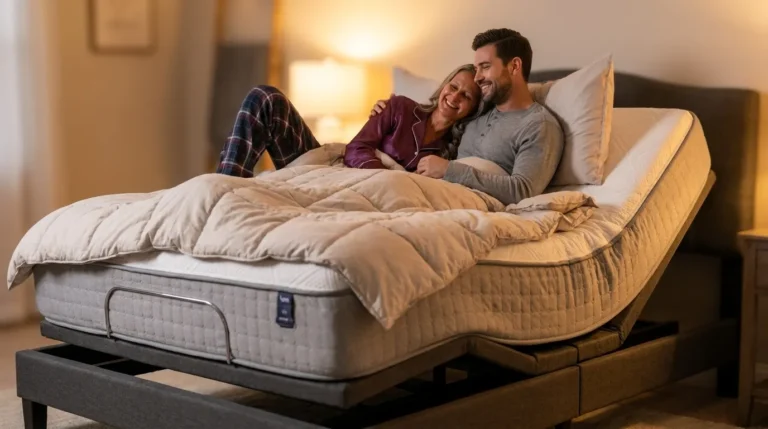
The Half Spoon: The elevated partner lies on their back at their chosen incline. The flat-sleeping partner turns onto their side and rests their head on the elevated partner’s shoulder or upper chest. The angle of the inclined torso absorbs the height difference and allows full upper-body contact.
The Leg Hug: Both partners keep their preferred sleep positions, with one inclined and one flat, and interlock their legs or feet at the centre of the bed. Upper-body posture stays unchanged, and connection continues through the lower body. Many couples find this especially helpful when one partner sleeps on their back and the other on their side.
Face-to-Face Proximity: The flat-sleeping partner uses a standard pillow to approximate the elevated partner’s head height. Both partners face each other and can talk, maintain eye contact, and hold hands. This position works best at moderate elevation angles between 15 and 25 degrees rather than at very steep inclines.
All three positions work well with a split adjustable base because the flat partner’s side of the bed stays level. These positions rarely feel stable with a full wedge, which tilts the entire shared mattress surface.
Find a Leva Sleep Split Queen or Split King that matches your bedroom and intimacy preferences.
Phase 5: Delivery, Setup, and Choice in Ontario and Alberta
Leva Sleep’s white-glove delivery service supports customers in Ontario and Alberta from arrival to full setup. Trained delivery professionals bring the base and mattress to the bedroom, assemble the frame, set the leg height to the customer’s preference, connect the app controls, and walk through a product tutorial before leaving. The team also removes old beds and arranges donation or recycling.
This experience differs from general mattress retailers and many bed-in-a-box brands, where components arrive at the front door and customers handle assembly alone. A motorized split base with two independent control systems can be complex, and self-assembly increases the risk of incorrect wiring or frame misalignment.
Leva Sleep also offers 15–20 adjustable base models, while many general furniture retailers stock only 3–5. Customers in Ontario and Alberta gain a wider range of elevation features, sizes, and price points instead of a single default option.
What Successful Elevated Sleep Looks Like for Couples
A well-configured elevated sleep setup for couples usually produces clear changes within two to four weeks.
- The partner who needs elevation reports fewer reflux symptoms, less snoring, or reduced joint pain on waking.
- Neither partner reports waking the other during position changes or nighttime adjustments.
- Both partners continue sleeping in the same bed every night without ongoing negotiation or compromise.
- Nightly physical contact through the Leg Hug, Half Spoon, or Face-to-Face Proximity positions feels natural and comfortable.
- Fitted sheets stay anchored throughout the night at all commonly used elevation angles.
Many couples who reach this point say that fear of losing intimacy created the biggest delay in trying elevation. That concern often fades within the first week of using a split adjustable base.
Take the first step toward shared, elevated sleep with Leva Sleep.
Frequently Asked Questions
Is a Split Queen adjustable base suitable for a standard queen-sized bedroom?
A Split Queen uses two narrow twin XL bases placed side by side, which together match the footprint of a standard queen mattress. The combined width and length remain identical to a conventional queen bed, so the setup fits any room that currently accommodates a queen frame. Leva Sleep is one of the few Canadian retailers that builds Split Queen configurations to customer specifications, which makes it a space-conscious choice for couples who want independent elevation without moving to a king-sized room.
How do I maintain a split adjustable base over time?
Routine maintenance involves three simple tasks. First, inspect the fitted sheet elastics every three to six months and replace sheets if the elastic stretches enough that corners lift during movement. Second, check all frame connection points once a year to confirm that bolts remain tight, since motor vibration can gradually loosen hardware. Third, keep the motor housing clear of dust by vacuuming the underside of the base every six months. Leva Sleep’s direct-to-consumer model also keeps replacement parts and support accessible without involving a third-party retailer.
What is Leva Sleep’s return policy for adjustable bases?
Return and trial policies vary by package and appear at the time of purchase. Prospective buyers in Ontario and Alberta can contact Leva Sleep directly to review current trial period terms before ordering. Because white-glove delivery includes full assembly and setup, returns use a scheduled pickup instead of self-managed disassembly, which simplifies the process compared to many bed-in-a-box brands.
What is anti-snore mode and when will it be available?
Anti-snore mode is an automated feature on select Leva Sleep bases that detects snoring through sound or vibration sensors and makes small adjustments to the head section of the bed. These micro-movements shift the snoring partner’s airway position and aim to reduce or eliminate snoring without waking the partner. This feature is scheduled for release in spring 2026 and will appear on compatible Leva Sleep base models. Couples currently managing snoring can use manual head elevation through the Leva Sleep app while they wait for the automated feature.
Can Leva Sleep’s adjustable bases work with mattresses from other brands?
Leva Sleep’s adjustable bases can work with many foam and hybrid mattresses from other manufacturers. The company also carries mattresses from Tempur-Pedic, Simmons, Beautyrest, Serta, and Kingsdown. Customers who want to keep an existing mattress should confirm its construction before purchasing a base. Leva Sleep’s team can advise on compatibility during a pre-purchase consultation.