Written by: Matthew Timmins, Founder and Managing Director, Leva Sleep | Last updated: July 17, 2026
Key Takeaways
- Sleep divorce means couples choose separate beds or rooms to cut down on snoring, movement, and temperature conflicts that build over time.
- Canadian prevalence estimates range from 18% of couples sleeping separately due to snoring to about 31% overall, with the highest rates (39%) among adults aged 35–44.
- Research shows sleep divorce itself does not harm marriages. Outcomes depend on whether the choice is proactive, openly discussed, and paired with continued intimacy.
- Traditional fixes such as separate rooms, basic adjustable bases, CPAP, or dual-duvet methods each carry trade-offs and rarely solve all partner incompatibilities.
- Split adjustable sleep systems let couples stay together while addressing root causes independently. Explore Leva Sleep’s adjustable bed packages to find a setup that supports shared, uninterrupted rest.
Key Canadian Statistics on Sleep Divorce
Published prevalence figures for sleep divorce among Canadian couples vary widely. Differences in methodology, sample, and question wording all affect the numbers. The table below compares the most frequently cited data points.
| Source | Reported Figure | Sample & Methodology | Date |
|---|---|---|---|
| ResMed Global Sleep Survey | 18% of couples reported sleeping in separate rooms due to snoring and restlessness | 30,000+ respondents across 13 countries; self-report survey | 2025 |
| American Academy of Sleep Medicine (AASM) | 31% of U.S. adults have opted for some form of sleep divorce; adults 35–44 highest at 39% | 2,000+ U.S. adults; online survey | 2025 |
| Sleep Foundation | 52.9% of those who tried sleep divorce reported better sleep quality; avg. 37 extra minutes per night | 1,250 U.S. adults; online survey | 2023 |
| National Sleep Foundation | Nearly 1 in 4 couples sleep in separate beds | U.S. national survey; methodology not fully disclosed | 2017 |
Canada-specific breakdowns remain limited in publicly available research. The ResMed figure and the AASM figure together provide credible lower and upper bounds for comparable Western populations. The 35–44 age cohort, which sits within the primary Canadian target demographic, reports the highest rates of sleep divorce at 39% in the AASM survey. This pattern suggests prevalence among Ontario and Alberta couples in this age range may match or exceed the general population average.
How Sleep Divorce Affects Marriages
The relationship between sleep quality and marital satisfaction runs in both directions. A 2024 meta-analysis of 62 studies with more than 43,000 participants found a moderate correlation (r = 0.34) between relationship quality and sleep quality. Daily diary studies show that poor sleep predicts negative partner interactions the next day, and relationship conflict predicts disrupted sleep that same night.
A 2016 Florida State University study of 68 newlywed couples published in the Journal of Family Psychology found that when both partners sleep more than on an average night, they report higher marital satisfaction the following day. Differences in sleep duration between spouses were not associated with differences in marital satisfaction. This pattern indicates that sleep quality, not the specific sleeping arrangement, drives outcomes.
This finding is reinforced by broader research. A 2024 Sleep Medicine Reviews systematic review and meta-analysis of 62 studies also found a moderate correlation between better couple relationship quality and sleep outcomes.
Sleep divorce itself is not inherently harmful to a marriage. AASM spokesperson Dr. Seema Khosla has stated that sleep divorce is not about ending a relationship but about prioritising sleep health and addressing sleep issues. The arrangement becomes risky when it serves as avoidance of unresolved conflict or when couples reduce intentional intimacy without creating new rituals that maintain connection.
Estimated Percentage of Canadians Who Have Tried Sleep Divorce
No large-scale, nationally representative Canadian survey has published a definitive figure. The best available proxies are the ResMed figure of 18% mentioned earlier and the AASM U.S. survey at 31%, with the 35–44 age group reaching 39%. Naomi Doyle, family dispute resolution practitioner at Relationships Australia NSW, notes that separate sleeping is usually a sleep issue first. Snoring, sleep apnoea, restlessness, or differing schedules typically drive the change rather than relationship dissatisfaction, a pattern Canadian sleep experts also describe.
Canadian sleep expert Amanda Jewson describes sleep divorce as a conscious decision to uncouple overnight. She notes that the most common complaint from her clients is a partner who moves excessively during the night. A survey cited in a 2024 discussion of sleep divorce found that 82% of people living with a partner report their partner wakes them up at night. This suggests that disruption is nearly universal, even if formal sleep divorce remains a minority choice.
Does Sleep Divorce Increase the Risk of Divorce?
Current evidence does not support a direct causal link between sleeping separately and marital breakdown. Research suggests that intentional sleep separation with maintained intimacy does not automatically reduce relationship satisfaction. The more meaningful signal is whether couples discuss the arrangement honestly or avoid the conversation.
Some surveys indicate that couples who proactively choose sleep separation report better outcomes on relationship satisfaction, sexual frequency, and communication quality than couples who separate reactively after repeated snoring conflicts. The timing and framing of the decision as a wellness choice rather than a relationship failure can produce very different outcomes.
Broader survey data confirms this complexity. Surveys on the impacts of couples sleeping apart show mixed results in terms of effects on relationships and sex lives. These varied outcomes highlight that results depend heavily on how couples manage connection outside the bedroom, not on the sleeping arrangement alone.
Why Canadian Couples Choose Separate Sleeping
The main drivers of sleep divorce are physical issues. Snoring is common among adults, and bed partners often lose significant sleep due to noise. Partner movement also contributes to nighttime awakenings and lighter sleep.
Additional documented reasons include:
- Temperature incompatibility, where women often prefer warmer sleeping surfaces while men sleep hotter, raising the shared mattress microclimate
- Medical conditions including sleep apnoea, restless legs syndrome, and hormonal changes such as menopausal hot flushes or night sweats
- Mismatched work or sleep schedules, such as shift work or highly irregular hours
- Chronotype incompatibility, where early birds and night owls struggle to agree on bedtimes
Traditional Workarounds and Their Limitations
Couples often try several approaches before moving to separate rooms. Each option carries clear trade-offs.
- Separate rooms: This setup resolves disruption but removes physical proximity and reduces spontaneous intimacy. It can also create feelings of rejection if couples do not discuss it openly.
- Basic adjustable bases: Entry-level models often use loud motors or jerky movements that create new disruptions. Single-base configurations also prevent independent positioning for each partner.
- CPAP therapy: Treating obstructive sleep apnea with CPAP improves both partners’ sleep and the intimate relationship. However, mask discomfort creates compliance challenges that limit effectiveness. Many patients average fewer than four hours of nightly use, and compliance rates are even lower in relationships already experiencing conflict, where partner frustration with the device can further discourage consistent use.
- The Scandinavian sleep method: Using separate duvets eliminates blanket-stealing and temperature conflicts, but this method does not address snoring, movement transfer, or firmness mismatches.
Split Adjustable Sleep Systems for Couples Who Want to Stay Together
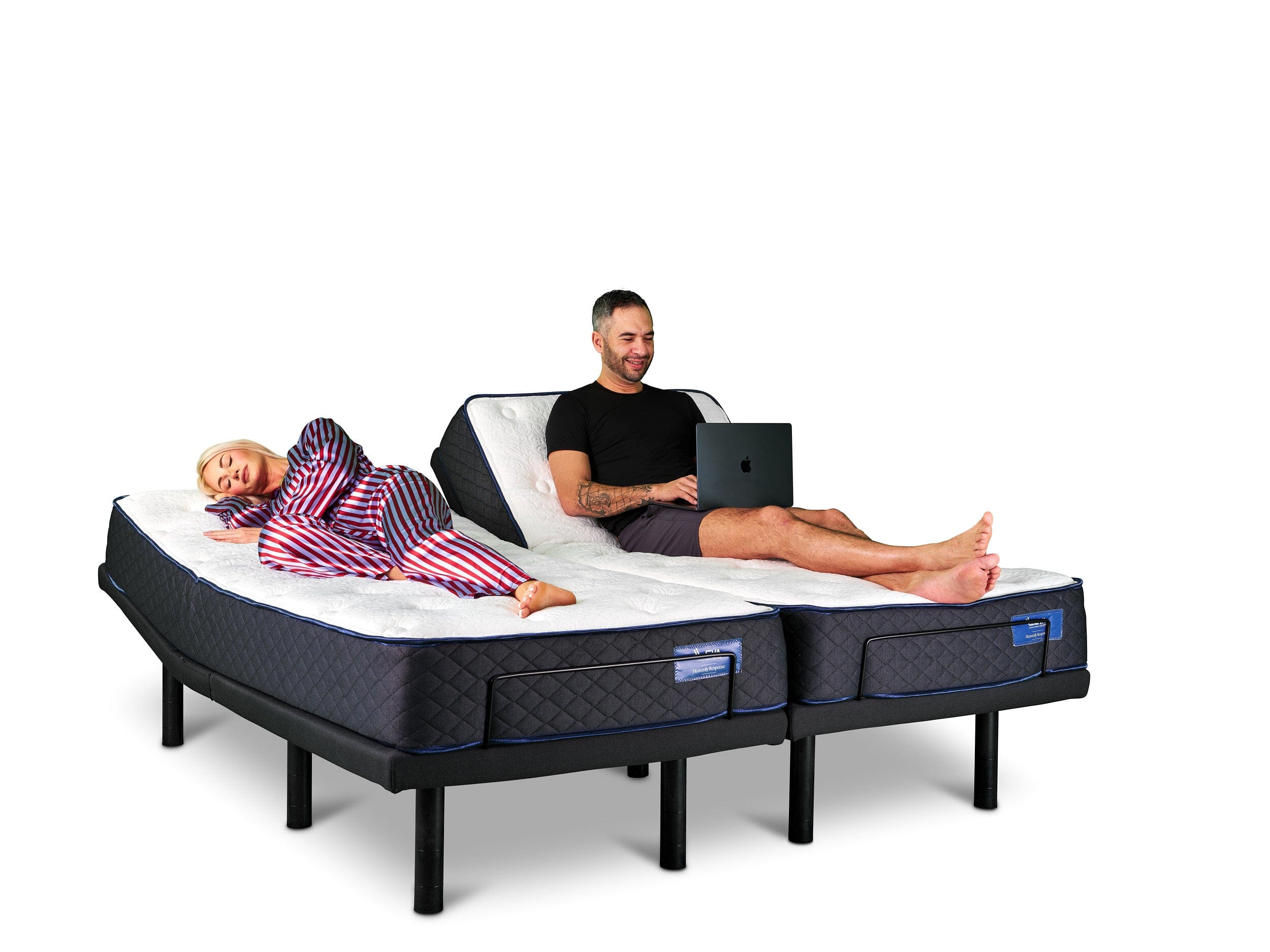
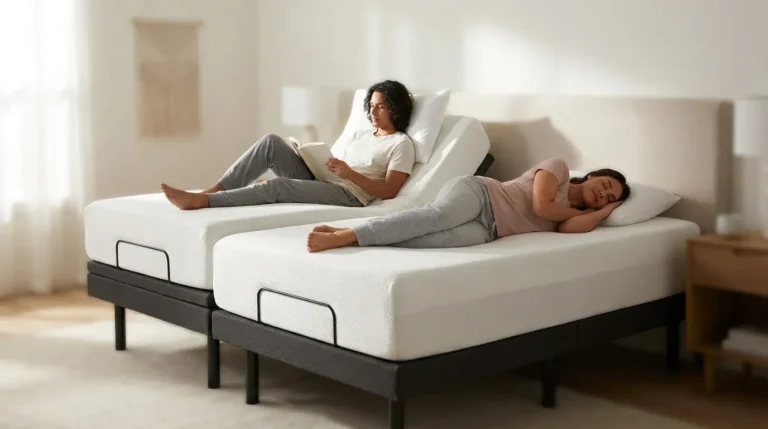
Split adjustable sleep systems tackle the root causes of sleep divorce while allowing couples to keep sharing a bed. A split configuration places two independent bases side by side within a shared frame. Each base has its own controls so partners can adjust head elevation, foot elevation, firmness, and temperature independently.
Key functional attributes include:
- Independent elevation: Elevating the head of the bed can help reduce apnoea events in patients with obstructive sleep apnoea, while the non-snoring partner remains flat.
- Zero motion transfer: Each mattress rests on its own independent base, which eliminates motion transfer between partners.
- Temperature regulation: Dual-zone heating and cooling systems let each partner set their own thermal environment. This feature directly resolves many temperature conflicts that push couples toward separate rooms.
- Whisper-quiet motors: Premium engineering keeps position adjustments quiet so they do not create new noise disruptions.
- Specialized bedding compatibility: Fitted sheets with deep pockets and extra elastic, duvet clips, and mattress protectors designed for adjustable bases help prevent bedding from slipping during elevation.
Leva Sleep’s split queen and split king systems are assembled locally and delivered with in-house white-glove service, including setup, height adjustment, product tutorial, and old bed removal. These packages are typically priced 30–50% below comparable luxury competitors.
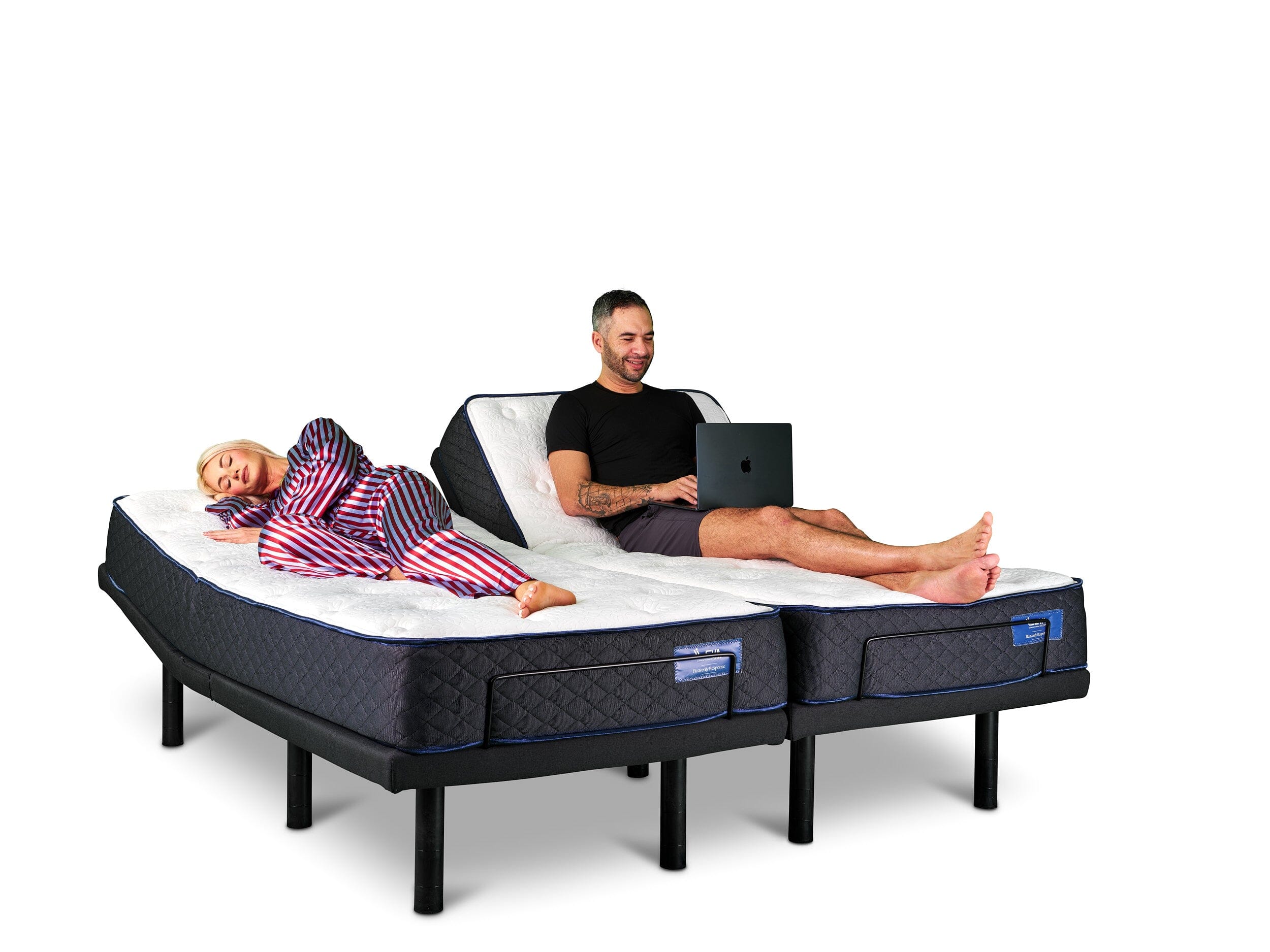
Shop Leva Sleep’s adjustable beds, including split queen and king configurations with independent controls for each partner, available with white-glove delivery across Ontario and Alberta.
Comparing Split Adjustable Bases, Single Bases, and Flat Beds
Couples can compare sleep systems by looking at a few practical criteria. Price ranges vary significantly by brand and configuration, so specific figures should be confirmed directly with retailers before purchase.
| Criterion | Traditional Flat Bed | Single Adjustable Base | Split Adjustable Base |
|---|---|---|---|
| Independent partner positioning | None | None, both partners move together | Full, each side adjusts independently |
| Motion isolation | Depends on mattress type | Depends on mattress type | Complete between bases; mattress-dependent within each side |
| Anti-snore elevation | Not available | Available but affects both partners | Available for one partner only, without disturbing the other |
| Temperature control | Bedding-dependent only | Bedding-dependent or single-zone add-on | Dual-zone independent control available on premium models |
For couples where only one partner requires therapeutic elevation, a single queen base is often simpler and less expensive. A split configuration works best when both partners have distinct positioning, firmness, or temperature needs.
How Couples Regain Shared Sleep Without Separate Rooms
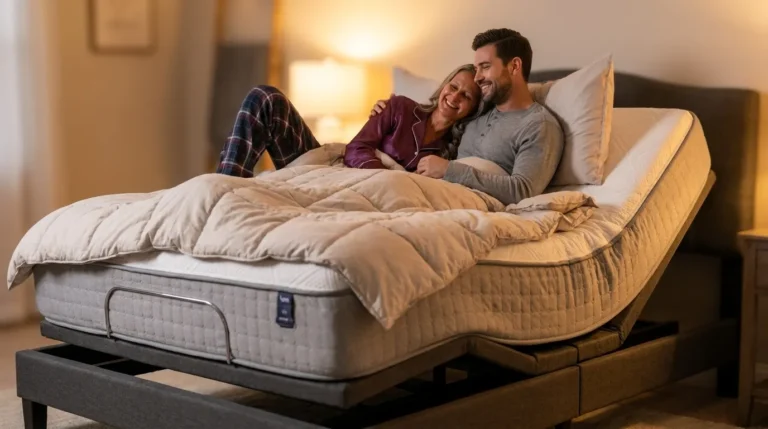
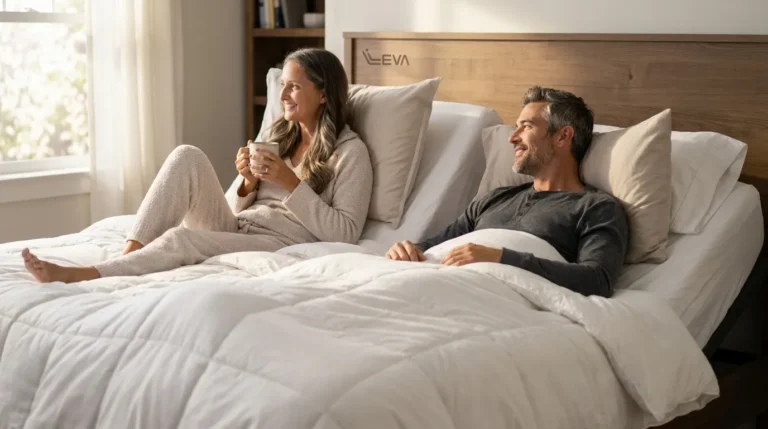
Many people report better sleep quality after adopting separate sleeping arrangements, and some say it improved their relationship. Separate rooms, however, are not the only way to reach those outcomes. When a split adjustable system resolves the underlying physical incompatibilities, couples often report similar gains in mood, patience, and intimacy while still sharing a bed.
Polysomnographic research shows bed-sharing couples synchronize their sleep stages throughout the night, with the degree of synchronization correlating with relationship depth. Preserving shared sleep, rather than only improving individual sleep quality, supports both rest and relational connection at the same time.
Shop Leva Sleep’s adjustable beds. Leva Sleep brings over eight years of expertise, more than 25,000 Canadian customers, and split systems designed for couples who want to stay together and sleep better.
Frequently Asked Questions
What should couples consider when setting up a split adjustable bed system?
Couples should first confirm that the bed frame accommodates two independent bases side by side and that the combined width fits the room. A split king measures 76 by 80 inches, which matches a standard king. A foam gap filler or bed bridge placed between the two mattresses removes the centre seam, which matters most for couples who sleep near the middle.
Bedding should be chosen specifically for adjustable bases. Fitted sheets with deep pockets and reinforced elastic help prevent slippage during elevation, and duvet clips maintain separation when each side is positioned differently. Leva Sleep’s white-glove delivery service manages setup, leg-height adjustment, and a full product tutorial, which removes the complexity of self-assembly.
Are split adjustable beds suitable for couples with very different comfort needs?
Split configurations suit couples whose firmness, elevation, and temperature preferences differ significantly. Each partner selects their own mattress, such as all-foam or hybrid pocket coil, and controls their own base independently via app or remote. One partner can sleep flat on a firm surface while the other elevates the head for reflux or snoring relief on a softer mattress, with no mechanical or positional compromise.
Leva Sleep offers both split queen and split king configurations. The split queen suits couples who want independent control in a more space-conscious footprint.
Can an adjustable bed help with snoring or sleep apnea?
Head elevation on an adjustable base repositions the airway and is recognized by the Canadian Sleep Society’s 2022 Clinical Practice Guidelines as an effective complementary approach for positional snoring and mild obstructive sleep apnea. Elevating the head 15 to 30 degrees reduces the gravitational collapse of soft tissue that causes snoring. Leva Sleep’s anti-snore mode detects snoring and makes automatic micro-adjustments to the head of the bed.
An adjustable base does not replace CPAP therapy in moderate to severe obstructive sleep apnea. Individuals with a confirmed diagnosis should consult their physician about the appropriate role of positional therapy alongside or instead of PAP treatment.
What maintenance does a split adjustable bed system require?
Adjustable bases with whisper-quiet motors require minimal routine maintenance. The main tasks include keeping the area beneath the base clear to allow full range of motion and periodically checking that connector straps between the two bases remain secure. Users should also ensure the app or remote firmware is updated when prompted.
Mattresses on adjustable bases should be rotated according to the manufacturer’s schedule, typically every three to six months, to maintain even wear. They should not be flipped unless the manufacturer specifies a double-sided design. Leva Sleep’s specialized bedding accessories, including mattress protectors designed for adjustable bases, extend mattress life by protecting against moisture and wear during repeated flexion.
Conclusion
Sleep divorce affects a meaningful share of Canadian couples, with credible estimates ranging from 18% to 31% in comparable Western populations and the highest rates around 39% among adults aged 35–44. The primary drivers are physical issues such as snoring, movement, temperature mismatches, and schedule incompatibility. Evidence does not support sleep divorce as a reliable predictor of marital dissolution. Outcomes depend on whether the arrangement is proactive, openly discussed, and paired with maintained intimacy rituals.
Couples weighing their options can first assess whether the underlying disruptions, including snoring frequency, firmness mismatch, temperature difference, and movement sensitivity, can be addressed through independent positional and thermal control. Split adjustable sleep systems give each partner individual control over these variables. Key evaluation criteria include motor noise level, range of head and foot elevation, dual-zone temperature capability, mattress compatibility with the base, and the quality of delivery and setup support. Leva Sleep’s direct-to-consumer model, local assembly, and 15–20 adjustable models provide a broader selection than the limited options typically available at general mattress retailers.