
Written by: Matthew Timmins, Founder and Managing Director, Leva Sleep | Last updated: July 12, 2026
Key Takeaways
- Most mattresses in Canada last 7–10 years. Natural latex often reaches 15–20 years, while innerspring models average 5–10 years.
- Canada’s dry winters and humid summers can shorten mattress life unless you keep bedroom humidity between 40–60% year-round.
- Adjustable bases support mattress longevity when paired with compatible materials like memory foam, latex, or pocket-coil hybrids. Traditional innersprings wear faster and are not suitable.
- Plan to replace your mattress if you see sagging over 1.5 inches, wake with pain that eases within an hour, sleep better elsewhere, feel more partner movement, or notice worsening allergies.
- Leva Sleep offers adjustable bed packages built for long-term compatibility and independent comfort. Shop now to upgrade your sleep system.
How Long Different Mattress Types Really Last
Mattress lifespan depends heavily on construction and materials. Natural latex mattresses typically last 15–20 years with proper care, and some premium builds reach up to 25 years. Dunlop-process latex cores usually outlast Talalay cores because their higher density resists wear.
Memory foam mattresses average 7–10 years. Innerspring models usually last 5–10 years, while hybrids fall in the 8–12 year range, with latex hybrids at the upper end.
Canada’s climate adds another layer to this picture. Forced-air heating can drop indoor humidity to 20–30% in winter, which makes memory foam noticeably stiffer below 15°C. Ontario summers often bring 60–80% humidity that speeds up oxidation and moisture buildup inside foam layers.
Health Canada recommends keeping indoor relative humidity below 50% in summer and between 30–35% in winter. Levels above 50% encourage mould growth inside mattresses and accelerate foam breakdown. Natural materials such as natural latex handle these swings better than most synthetic foams.
Mattress Lifespan on Adjustable Bases
An adjustable base can help a mattress last longer when the materials are compatible. Adjustable bases do not damage mattresses that are designed to flex, and many models are built specifically for this use.
Memory foam, latex, and pocket-coil hybrids usually pair well with adjustable bases. Memory foam flexes easily and adapts to changing positions without stressing the structure. Natural and synthetic latex handle repeated bending especially well because the elastic material springs back when the base lies flat. Hybrid mattresses with pocketed coils often work too, although very thick coil units may not bend enough and should be checked with the manufacturer.
Incompatible mattresses wear out faster on adjustable bases. Traditional innerspring mattresses that use Bonnell coils are not suitable, because the grid of connected coils resists bending and repeated flexing can permanently damage the coil system.
A quick at-home check helps confirm compatibility. Fold one corner of the mattress upward to about 45 degrees by hand. Smooth bending without resistance or creaking suggests it is suitable. Noticeable stiffness or noise suggests it is not.
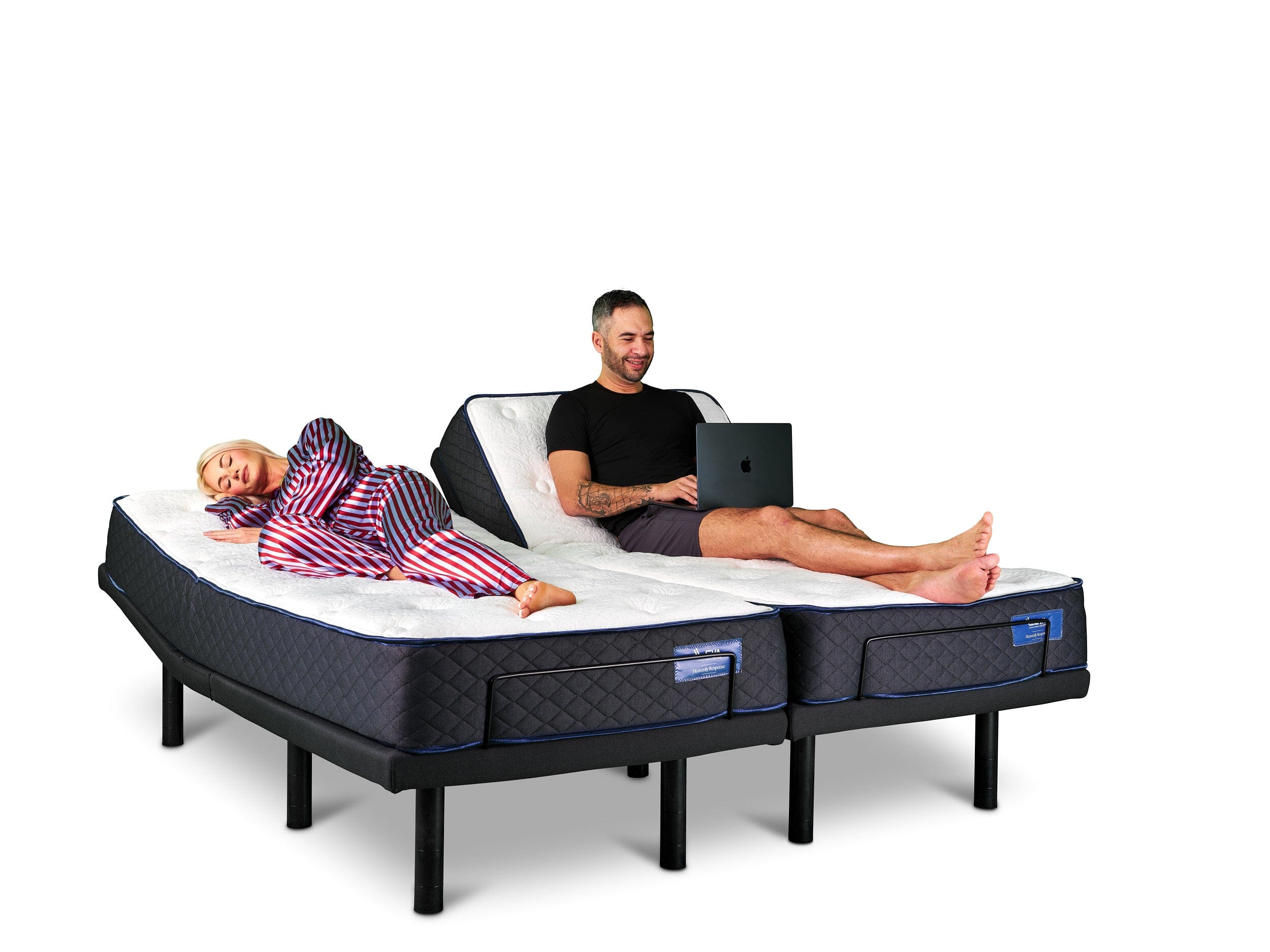
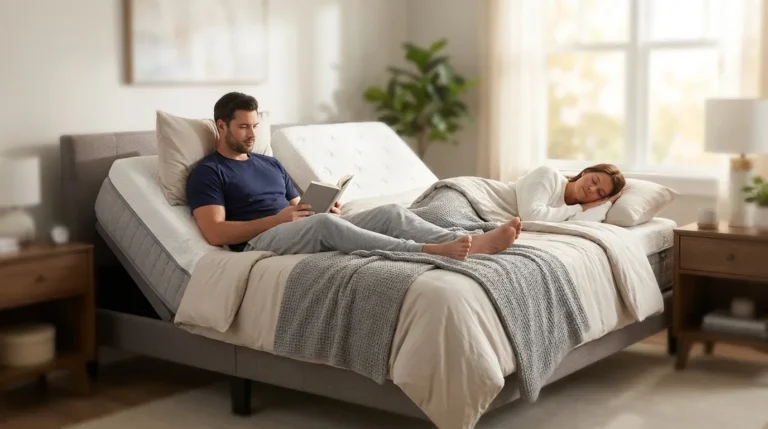
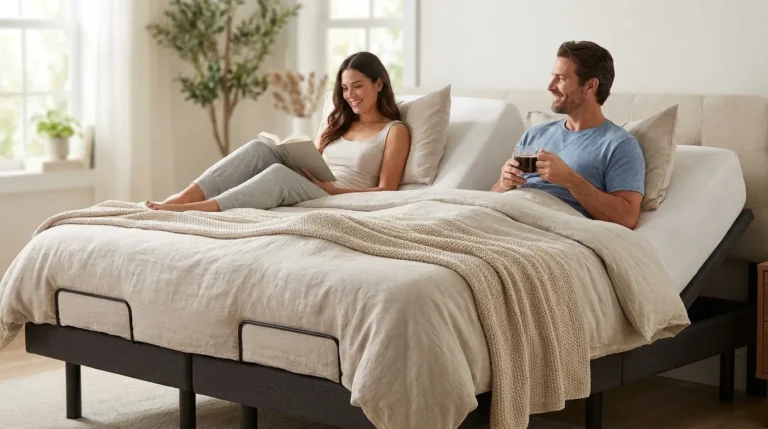
For couples using a split adjustable system, starting with a compatible mattress protects both comfort and budget. Leva Sleep designs its all-foam and hybrid pocket-coil mattresses specifically for adjustable bases. Split Queen and Split King setups let each partner adjust elevation, firmness, and position independently without putting extra strain on the other side.
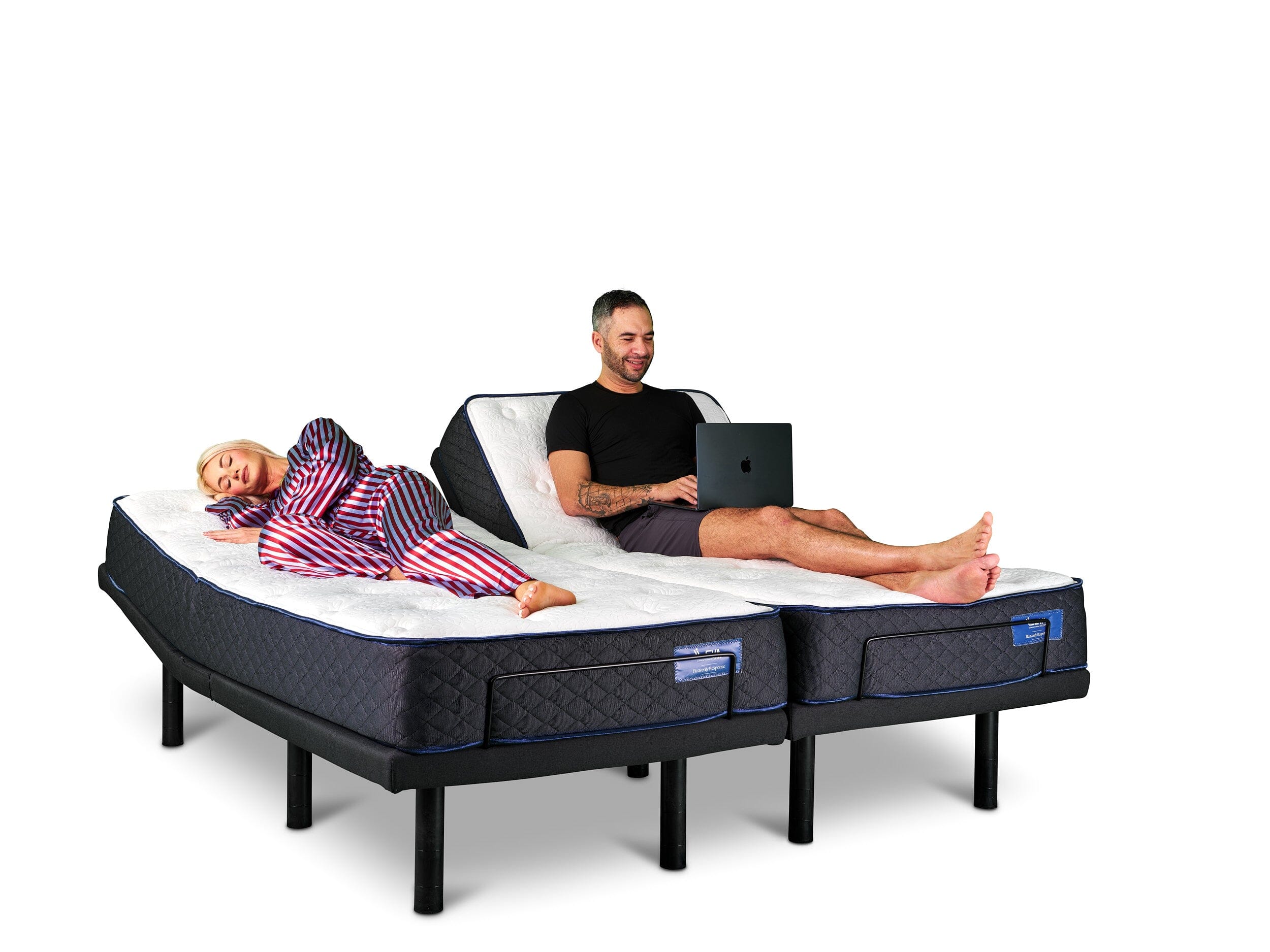
Explore Leva’s Split Queen and Split King packages for independent partner control.
Clear Signs You Need a New Mattress
Several physical, pain-related, and sleep-quality signals point to replacement time. Couples also need to watch for partner disturbance and changing comfort needs.
- Visible sagging exceeding 1.5 inches: Lay a straightedge across the mattress and measure from the straightedge to the deepest point of any dip. Indentations over 1.5 inches disrupt spinal alignment and can trigger chronic pain. Depressions beyond 2 inches call for replacement regardless of age.
- Morning pain that eases within an hour: Pain in the back, hips, or shoulders that fades within an hour of getting up, especially on a mattress older than 7 years, strongly suggests the mattress is a key contributor rather than injury or arthritis alone.
- Better sleep on other surfaces: Sleeping noticeably better in hotel beds or guest rooms than at home is one of the clearest signs that your current mattress is the main problem.
- Partner disturbance and motion transfer: More tossing and turning, rolling toward a sagging centre, or waking whenever a partner moves all suggest that the support layer has permanently deformed.
- Worsening allergies: A typical mattress can hold 100,000 to 10 million dust mites after several years, which can worsen allergy or asthma symptoms at night.
- Audible squeaking or creaking: Squeaks from innerspring or hybrid mattresses during normal movement signal coil tension loss and usually mean visible sagging is only 1–2 years away.
- Edge collapse: Sit on the side of the mattress. If it feels like it is folding or lacks structure, edge support has failed and rolling off the bed becomes a real risk.
Sleeping on a 20-Year-Old Mattress
A hospital-based study of 130 patients with low back pain found a link between how long a mattress had been used and pain severity. A 2009 study in the Journal of Chiropractic Medicine reported that replacing mattresses older than 9 years with new medium-firm models led to statistically significant reductions in morning back pain within 28 days.
A 20-year-old mattress sits a decade or more beyond the usual 7–10 year replacement window for most types. Even natural latex, the most durable option, is typically rated for 15–20 years under ideal conditions. By year 20, most mattresses show permanent body impressions, weakened support layers, and heavy allergen buildup, regardless of how carefully they were maintained.
What Sleepers Report in Real Life
US consumers replace mattresses after roughly 8–10 years on average. This aligns closely with the 7–10 year guideline from sleep researchers and manufacturers. Many couples notice a clear drop in comfort between years 5 and 8, especially around the hips and shoulders where weight concentrates every night.
A 5-year-old mattress can already feel worn out, while a 12-year-old one may still feel supportive if usage has been gentle. Body weight, whether two people share the bed, and whether the mattress sits on a compatible base all shape the real-world timeline. Shoppers considering hybrids should note documented cases where visible sagging appeared after only 3.5 years under test conditions, which shows that calendar age alone does not tell the full story.
Simple Maintenance Habits That Add Years
This routine suits memory foam, latex, and pocket-coil hybrid mattresses on adjustable bases. Avoid rotating zoned mattresses, because rotation disrupts their built-in support zones.
- Rotate 180° every 3–6 months: Rotating a mattress 180 degrees every 3–6 months spreads wear more evenly and can add years of use by limiting deep body impressions. Quarterly rotation works especially well for latex and hybrid mattresses. Heavier sleepers or couples benefit from rotating every 2–3 months.
- Use a breathable waterproof protector from night one: A waterproof protector is one of the most effective tools for extending mattress life. It shields against spills, sweat, body oils, and other contaminants that break down materials from the inside.
- Air the mattress every 2–3 months: Strip all bedding and leave the mattress bare for 3–4 hours every 2–3 months, or monthly in humid regions. This improves ventilation, limits moisture buildup, and gives you a chance to check for early impressions or mould.
- Vacuum and spot-clean every 3–6 months: Vacuum the surface with an upholstery attachment, then spot-clean stains with mild soap and water without soaking the foam. Let the mattress dry fully. Avoid harsh chemicals on natural latex and organic cotton.
- Control bedroom humidity: Aim for 40–60% relative humidity. Use a dehumidifier during Ontario’s humid summer months and a humidifier during dry winter heating season.
- Verify base compatibility and slat spacing: Wooden slat gaps wider than 8 cm allow foam to bow downward, which creates soft spots that rotation cannot fix. For adjustable bases, confirm that the mattress is rated for flexing before use.
- Wash the mattress protector every 1–2 months and sheets weekly: Wash sheets and pillowcases weekly and the mattress protector every 1–2 months to support both hygiene and lifespan.
Comparison Table: Typical Lifespan Ranges
The table below compares lifespan, climate considerations, and annual cost so you can judge long-term value when choosing a mattress for an adjustable base.
| Mattress Type | Typical Lifespan | Canada Climate / Warranty Notes | Annual Ownership Cost (Queen) |
|---|---|---|---|
| Innerspring | 5–10 years | Not suitable for adjustable bases. Bonnell coils resist bending and can be permanently damaged by repeated flexing. | $100–$200 |
| Memory Foam | 7–10 years | Stiffens in dry Canadian winters. Ontario summer humidity speeds oxidation. Maintain 40–60% indoor humidity. | $150–$250 |
| Hybrid (Pocket Coil) | 8–12 years | Generally compatible with adjustable bases. Confirm coil thickness with the manufacturer. Latex hybrids usually reach the upper end of the range. | $150–$250 |
| Natural Latex | 15–20 years | Most resistant to Canadian humidity and temperature swings. Offers excellent adjustable-base compatibility because of strong elastic recovery. | $125–$175 |
How to Decide When to Replace and What to Buy
Mattress replacement makes sense when three or more warning signs appear at the same time, because that pattern points to overall failure rather than one small fixable issue. Age over 7 years suggests material breakdown. Morning pain that eases within an hour points to poor spinal support during sleep. Visible sagging over 1 inch at sleeping positions confirms structural collapse.
Consistently better sleep on other surfaces shows that your current mattress is the limiting factor. Regular waking from a partner’s movement signals that motion isolation has broken down. Worsening allergies or odours point to allergen buildup. Major life changes such as weight shifts, surgery, or a new sleep condition can also push support needs beyond what your current mattress can provide.
For couples, the stakes feel even higher. A sagging centre pulls both partners toward the same dip, removes independent positioning, and makes elevation for snoring or sleep apnea difficult on a flat base. Choosing a complete sleep system that includes a compatible mattress, an adjustable base, and matching accessories solves these problems at purchase instead of through repeated trial-and-error replacements.
Leva Sleep focuses on this type of setup. With over 8 years of experience, $50M in lifetime sales, and 25,000+ customers across Ontario and Alberta, Leva designs all-foam and hybrid pocket-coil mattresses that flex on adjustable bases without wearing out early. Split Queen and Split King options give each partner independent control over elevation, firmness, and position, which helps address snoring, different comfort preferences, and sleep apnea positioning without compromise. In-house white-glove delivery covers setup, removal of the old bed, and product guidance so the switch feels easy. Direct-to-consumer pricing usually runs 30–50% below similar luxury competitors.
Get white-glove delivery and setup across Ontario and Alberta — browse packages now.
Frequently Asked Questions
How long do hybrid mattresses last on an adjustable base?
Hybrid mattresses with pocketed coils usually last 8–12 years under normal use, and this range remains realistic on adjustable bases when the mattress is rated for flexing. Pocket coils move independently, so the mattress bends with the base instead of fighting it, which avoids the structural damage seen in Bonnell innerspring designs. Thicker coil units may not flex well, so confirm compatibility with the manufacturer before pairing. Leva Sleep’s hybrid mattresses are engineered specifically for adjustable-base use, which protects both the mattress and the base over time.
Do Canadian winters and summers shorten mattress lifespan?
Canada’s seasonal humidity swings can shorten mattress life if you do not manage the bedroom environment. Forced-air heating in winter often drops indoor humidity to 20–30%, which stiffens memory foam and stresses foam cells through repeated temperature changes. Ontario summers can push indoor humidity above 60% without air conditioning, which speeds oxidation and encourages mould growth inside mattresses. Keeping bedroom humidity in a moderate range with a humidifier or dehumidifier helps limit this wear. Natural latex handles these swings better than standard memory foam, which is more vulnerable.
What is the best mattress type for a split adjustable bed for couples?
Memory foam, natural latex, and pocket-coil hybrids all have strong track records on adjustable bases. For couples with different firmness preferences, a split setup lets each side act as its own mattress on its own base, so each partner can choose a feel that suits them. Natural latex offers the longest lifespan and the best elastic recovery after repeated flexing, which makes it a strong long-term choice. Pocket-coil hybrids balance support, airflow, and price. Leva Sleep offers both all-foam and hybrid options in Split Queen and Split King layouts, with each side controlled independently through the Leva Sleep app.
How do I know if my mattress is causing my back pain or if it is something else?
Timing offers the clearest clue. Pain in the back, hips, or shoulders that appears on waking but fades within about an hour usually points to the mattress rather than a structural injury or arthritis. Context helps too. If you sleep noticeably better on hotel beds or other surfaces than at home, your current mattress is likely the main issue. Measuring sagging with a straightedge gives a physical check. Depressions deeper than 1.5 inches suggest the support layer has permanently deformed and is pushing your spine out of alignment. Clinical research shows that switching from an old mattress to a new one reduces back pain, with improvement building over the first four weeks.
How often should I rotate a mattress on an adjustable base?
For memory foam and pocket-coil hybrid mattresses on adjustable bases, rotating 180 degrees every 3–6 months works well. Couples put more combined pressure on the mattress than solo sleepers, so rotating every 3 months instead of every 6 is a safer bet. Zoned mattresses with distinct head-to-toe support zones should not be rotated, because rotation scrambles the intended pattern. Most modern foam and hybrid mattresses are one-sided, so flipping is not appropriate. Pairing rotation with a breathable waterproof protector and regular airing gives a complete maintenance routine for adjustable-base setups.