Written by: Matthew Timmins, Founder and Managing Director, Leva Sleep | Last updated: July 16, 2026
Key Takeaways
- Sleep divorce affects many Canadian couples, with 31% having tried sleeping apart to protect sleep quality due to snoring, motion, or temperature issues.
- Separate sleeping can improve rest but risks reduced intimacy and may mask serious conditions like obstructive sleep apnea.
- Identifying root causes such as snoring, motion transfer, temperature differences, or medical needs is the first step to staying in the same bed.
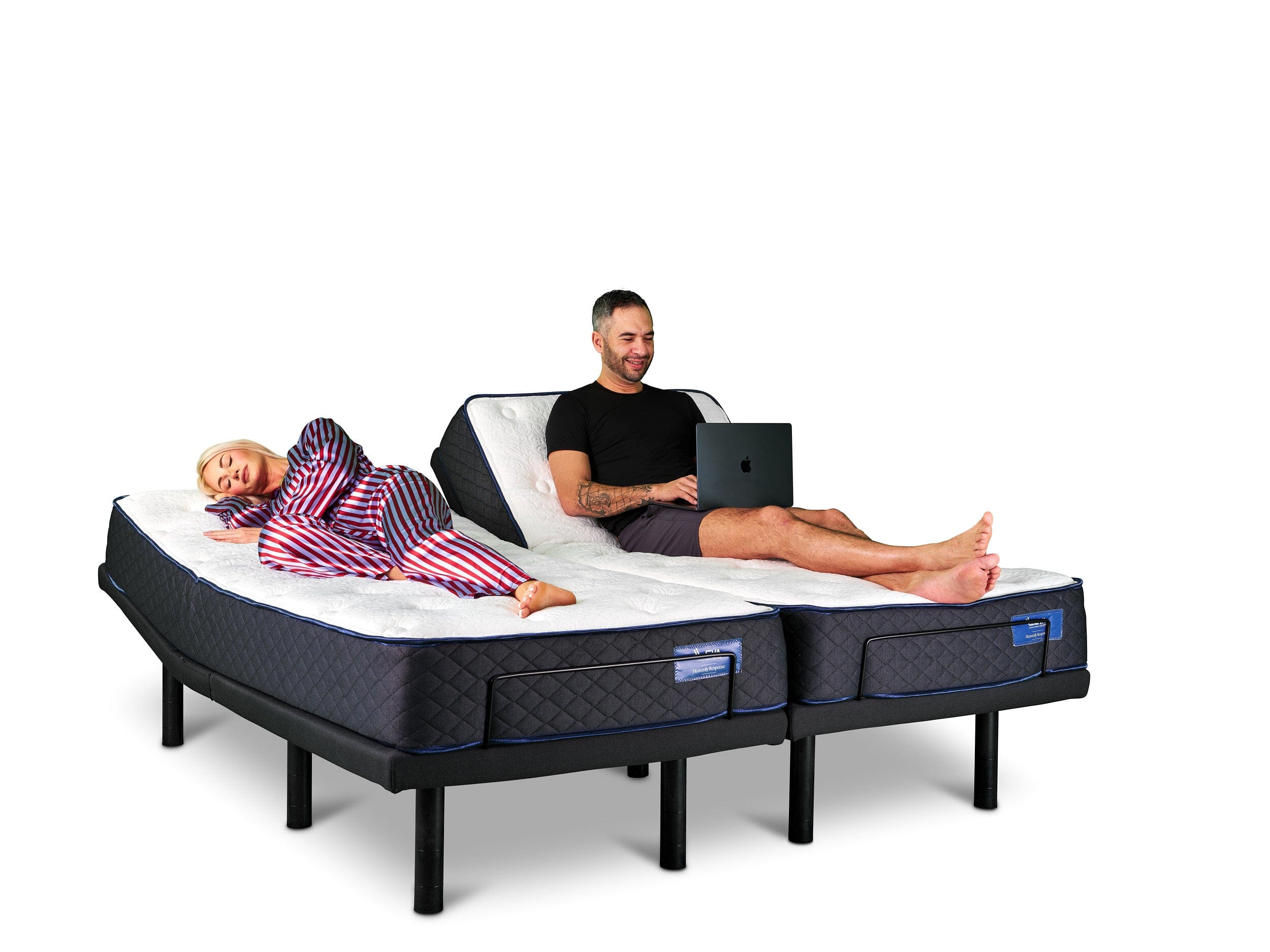
- Split adjustable bases with independent controls and anti-snore mode provide a mechanical solution that resolves most partner-related sleep disruptions without requiring separate rooms.
- Leva Sleep’s Split Queen and Split King adjustable beds provide independent positioning, whisper-quiet motors, and white-glove delivery across Ontario and Alberta. Explore split bed options to stay together and sleep better.
What Is Sleep Divorce and Why It Matters in Canada
Sleep divorce describes a deliberate arrangement where partners sleep apart, in separate beds, separate rooms, or with significant physical barriers, specifically to reduce nighttime disruptions. The Cleveland Clinic defines it as couples consciously choosing sleep separation to improve sleep quality and overall wellbeing, and notes it does not necessarily signal relationship problems.
The triggers are well documented. Eighteen percent of couples reported sleeping in separate rooms due to snoring and restlessness, according to ResMed’s Fifth Annual Global Sleep Survey of 30,026 respondents across 13 markets, with bed partners of snorers losing up to one hour of sleep per night. Adults aged 35–44 are the most affected demographic, with 39% sleeping apart, the highest rate of any age group in the 2025 AASM survey.
Sleep restriction reduces positive relationship behaviours and increases negative interactions. A poll of 2,000 recently divorced Britons found that 47% identified their partner’s snoring or sleep apnea as a contributing factor to their divorce.
Is Sleep Divorce Healthy?
The evidence on sleep divorce is genuinely mixed, and the outcome depends heavily on context and communication.
On the benefit side, the Sleep Foundation reports that separate sleeping provides an average of 37 extra minutes of sleep per night and improves sleep quality for 53% of couples. A 2017 Journal of Family Psychology study of 68 newlywed couples found that better sleep improves marital evaluations.
On the risk side, National Sleep Foundation reporting notes couples who sleep apart can experience less frequent sex, lower relationship satisfaction, and reduced emotional connection. Sleeping apart can also mask undiagnosed obstructive sleep apnea in the snorer, which carries documented cardiovascular and metabolic risks.
Sleep divorce becomes most harmful when it functions as avoidance rather than a deliberate wellness decision. A February 2025 Sleep Foundation survey of 3,200 U.S. adults found that couples who proactively chose sleep separation as a wellness decision reported significantly better outcomes on relationship satisfaction, sexual frequency, and communication quality than those who separated reactively due to conflict. For most couples, the long-term goal is to resolve the root cause and return to the same bed.
Step 1: Identify the Root Cause of Your Sleep Divorce
Partner-related sleep disruptions fall into four main categories, and each category points to different solutions.
- Snoring and breathing: a common trigger for couples who sleep apart.
- Motion transfer: adults who share a bed experience 50% more sleep disturbances than solo sleepers.
- Temperature differences: one partner sleeps hot while the other sleeps cold.
- Medical needs: sleep apnea, hip or knee pain, acid reflux, or post-surgery recovery that requires elevated positioning.
Step 2: Rule Out Medical Issues and Try Positional Therapy
About half of people who snore loudly have obstructive sleep apnea. A snoring partner should receive a medical evaluation before any major bed changes. Dr. Harneet Walia of Baptist Health Medical Group states, “If it’s to the point that you need a sleep divorce, then that is the opportunity to encourage your partner to be evaluated.”
Side sleeping works as a validated first-line intervention for position-dependent snorers. Side sleeping reduces snoring compared with lying flat on the back. Elevating the head of the bed at 30 to 45 degrees also reduces snoring by changing the gravitational orientation of the throat, and it works better than stacking multiple pillows, which can narrow the airway.
If positional changes and medical interventions do not fully resolve the disruption, or if motion transfer and temperature differences add to the problem, a mechanical solution that addresses several factors at once becomes the next logical step.
Step 3: Choose a Split Adjustable Base with Anti-Snore Mode
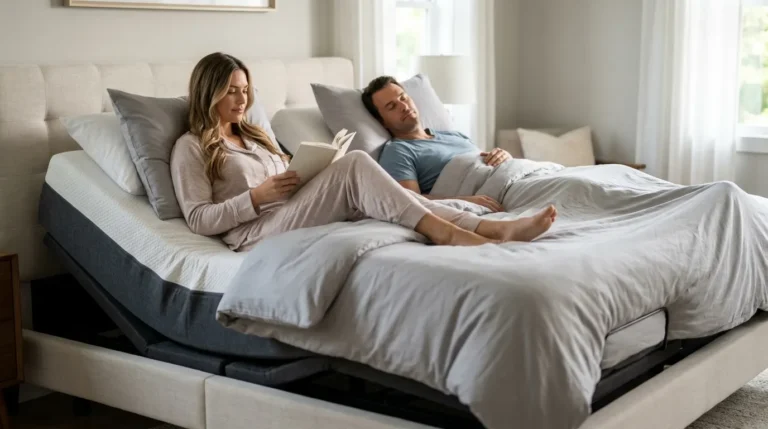
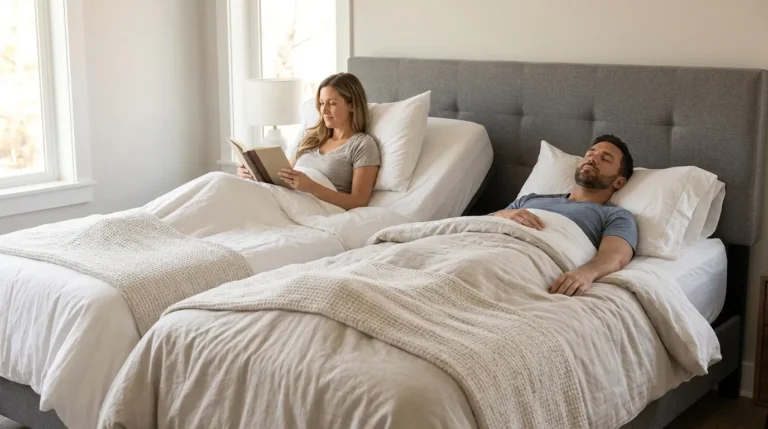
Split king beds improve sleep quality for many couples without requiring sleep divorce. A split adjustable base addresses snoring, motion, and medical positioning at the same time while both partners stay in one bed.
Leva Sleep’s Split King and Split Queen adjustable systems use whisper-quiet German motors and independent app controls so each partner sets their own head elevation, foot elevation, massage, and temperature settings. The anti-snore mode detects snoring and makes small head adjustments to open the airway, which creates a passive mechanical solution that works through the night. With 15–20 adjustable models available and pricing 30–50% below luxury competitors like Tempur-Pedic, Leva offers one of the most comprehensive split-bed selections in Canada, including the rare Split Queen configuration for smaller rooms.
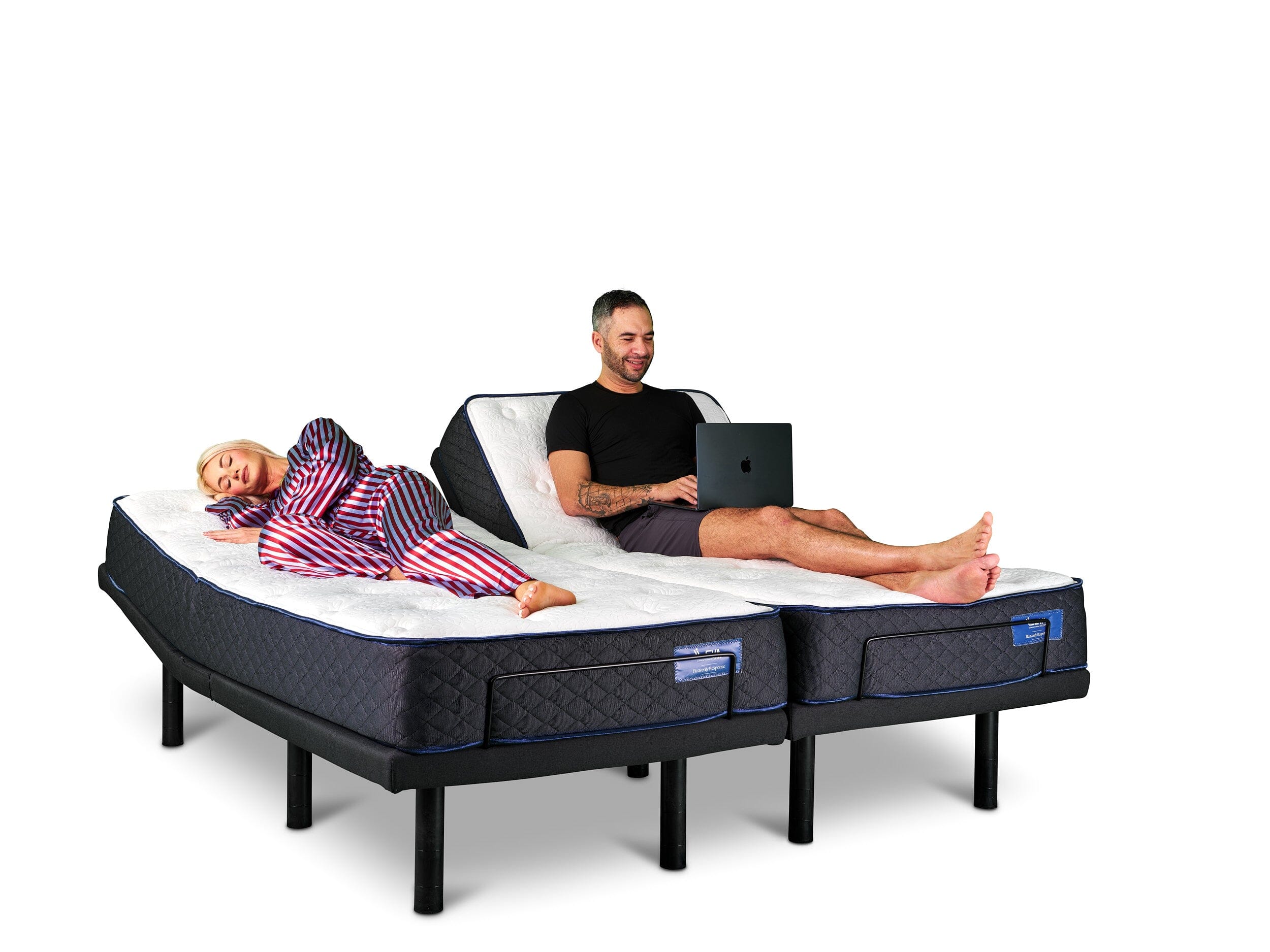
Expert tip: Use the Leva Sleep app to pre-set a pillow tilt position for the snoring partner before bed. Even a 7–15 degree head elevation can meaningfully reduce airway obstruction without waking either partner.
Browse Canada’s largest split-bed selection, backed by 25,000+ customers and in-house white-glove delivery.
Step 4: Protect and Rebuild Connection in the Same Bed
Starting and ending the day with a partner feels deeply bonding, and sleep divorce removes opportunities for closeness, intimacy, spontaneous conversations, and connection. When couples move to separate rooms, Estes Therapy notes that sleep divorce forces couples to prioritize emotional and sexual intimacy intentionally by creating moments such as drinking coffee together in the morning and establishing nighttime connection rituals.
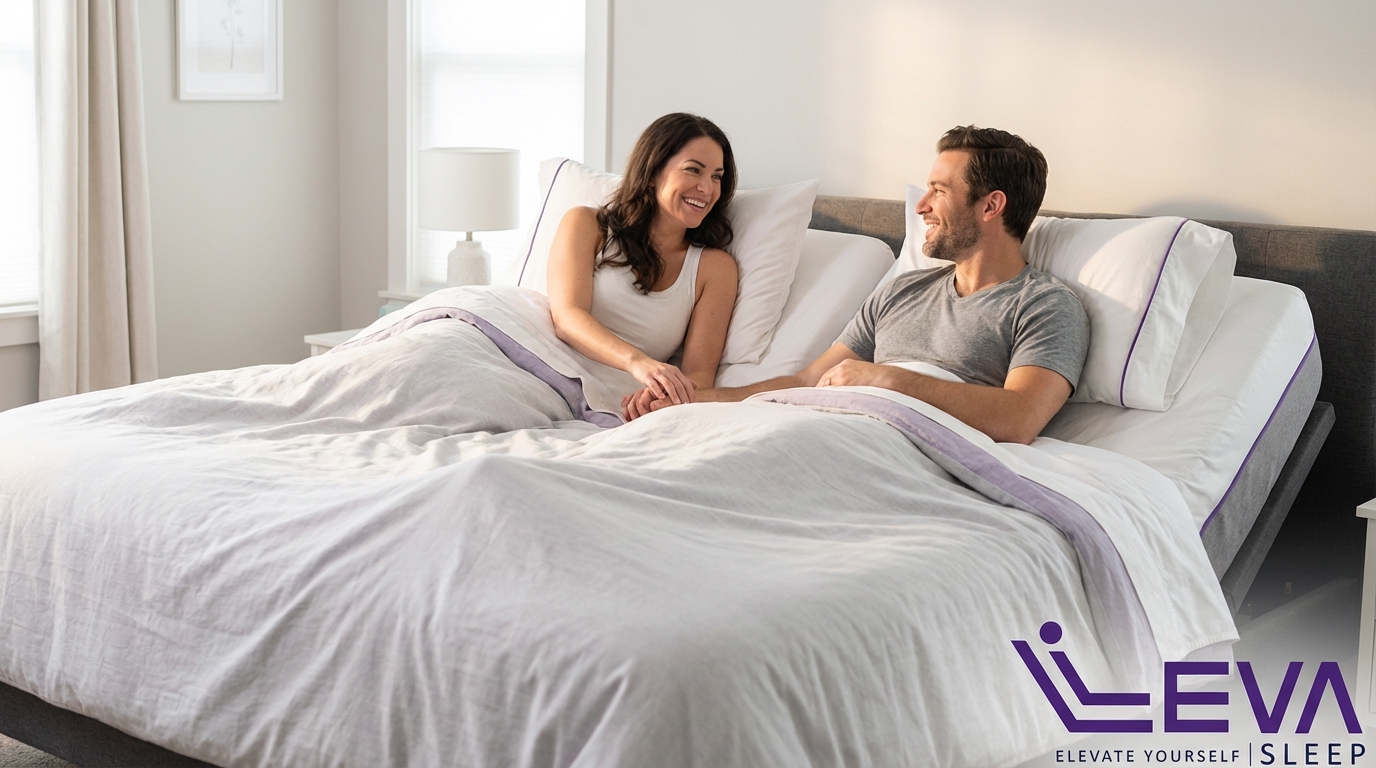
Couples who stay in the same bed with a split adjustable system can keep many of these moments organic. Scheduling 15–20 minutes of shared time in bed before each partner adjusts to their preferred position preserves the physical closeness that anchors long-term relationships. Bed-sharing is associated with increased and stabilized REM sleep and greater sleep-stage synchronization compared with sleeping apart.
Step 5: Compare Separate Duvets with Split Adjustable Systems
The Scandinavian sleep method, where each partner uses a twin duvet on a shared bed, offers a low-cost first step. This approach resolves about 33% of movement disruptions caused by blanket sharing while preserving co-sleeping benefits like stress reduction and oxytocin release. It only requires a second duvet and can start the same night.
A split adjustable base covers a broader range of problems at once. The table below outlines which solution fits which problem.
Problem Scandinavian Method Split Adjustable Base Temperature difference Partial, each partner chooses duvet weight Full, dual-zone temperature pads per side Blanket tugging Resolved Resolved with Leva’s duvet clips Snoring No effect Anti-snore head elevation mode Motion transfer No effect Independent bases, zero cross-transfer Medical positioning (apnea, reflux, pain) No effect Independent head and foot elevation per side Upfront cost Low Higher, with pricing at Leva below typical luxury competitors Couples whose only issue involves temperature or blanket conflict can reasonably start with the Scandinavian method. Couples dealing with snoring, motion, or medical needs usually need a split adjustable base to resolve all issues while staying in the same room.
Common mistake: Many couples buy a basic adjustable base with a noisy motor that wakes the non-adjusting partner. Leva’s whisper-quiet German motors and independent controls let one partner raise their head section at 2 a.m. without disturbing the other side.
Step 6: Add Temperature Regulation and Noise Masking
Dual-zone mattress pads such as ChiliSleep or Eight Sleep provide independent temperature control per side and carry Grade B evidence as an intervention to try before sleep separation. Paired with a split adjustable base, they give each partner complete thermal independence.
Noise control also matters. Pink noise carries Grade B evidence for increasing slow-wave sleep depth and offers stronger masking for snoring than white noise, with devices like the LectroFan Classic masking 50–70 dB snoring sounds. Keeping bedroom temperature between 65–68°F further supports sleep efficiency for both partners.
Step 7: Track Outcomes and Maintain Habits
Couples should evaluate outcomes over a 30-day period after they set up a split adjustable system. Tracking works best when each metric connects directly to a main sleep or relationship concern.
- Start with objective sleep quality measures and track the number of nighttime wake-ups per partner. Wearables like Oura Ring or Apple Watch provide independent data for each person.
- Layer in snoring frequency data using audio-based apps. These tools detect snoring events, although they cannot always attribute sounds to a specific partner in a shared bed.
- Monitor subjective mood and conflict frequency during waking hours, because sleep quality strongly affects emotional regulation and patience.
- Track intimacy frequency and quality informally, since one major goal of staying in the same bed involves preserving physical connection.
When Separate Rooms Still Make Sense
A split adjustable base resolves most partner-related sleep disruptions, but separate rooms remain appropriate in specific situations.
- Severe, untreated obstructive sleep apnea where CPAP compliance is still being established and snoring exceeds 70–80 dB.
- Shift work schedules with more than four hours difference in sleep timing, where one partner’s entry and exit repeatedly fragments the other’s sleep architecture.
- Cases where sleep divorce acts as emotional armour from unresolved conflict, where couples therapy addresses the underlying issue more effectively than any bed configuration.
- Post-surgical recovery that requires specialized positioning equipment that a shared bed cannot accommodate.
In most other cases, a split adjustable system with independent controls offers a more sustainable solution because it preserves the physical proximity that supports relationship health.
What Success Looks Like with a Split Adjustable System
Couples who resolve sleep divorce through a split adjustable system usually see a clear pattern of improvements within four to eight weeks.
- Uninterrupted sleep for both partners, with fewer than three wake-ups per night, which stabilizes energy and mood.
- Reduced morning irritability and fewer conflicts during the day as both partners feel more rested.
- Maintained or improved physical intimacy, supported by higher energy and less resentment about disrupted sleep.
- Relief from the guilt-resentment cycle. Sleepopolis research found that 94% of people who disrupt their partner’s sleep feel guilt about it, which blocks productive problem-solving.
Leva Sleep’s 25,000+ customers include many couples who had been sleeping in separate rooms due to snoring or differing sleep needs and now share a bed again. Sleep apnea clinics in Ontario and Alberta actively refer patients to Leva’s adjustable systems as a complement to or alternative for mild apnea management.
Frequently Asked Questions About Leva Sleep Systems
Is a split adjustable bed suitable for someone with sleep apnea or hip and knee pain?
Yes. Adjustable bases allow independent head and foot elevation, which opens the airway for mild sleep apnea and reduces pressure on hips and knees by letting each partner find a supported, elevated position. Leva Sleep’s systems are used by customers referred directly from sleep apnea clinics in Ontario and Alberta. For diagnosed moderate-to-severe sleep apnea, CPAP therapy remains the clinical standard, and an adjustable base can complement rather than replace it.
How long does setup take, and what does white-glove delivery include?
Leva Sleep’s in-house white-glove delivery team handles the full process. They deliver to the bedroom, assemble the base and mattress, adjust leg height, provide a product tutorial covering the app and all features, and remove the old bed through donation or recycling. Most setups finish in under two hours. White-glove delivery is available across Ontario and Alberta for a fee, and all systems are locally assembled in the regions Leva serves.
What mattresses are compatible with Leva’s split adjustable bases?
Leva designs its own all-foam and hybrid pocket coil mattresses to flex with adjustable bases at significant elevation angles without bunching or losing support. Leva also pairs its bases with Tempur-Pedic, Simmons, Beautyrest, Serta, and Kingsdown mattresses. Standard mattresses from other brands may work at low elevation angles but can degrade faster or lose comfort at higher head positions. A Leva Sleep specialist can advise on compatibility before purchase.
Does Leva offer a Split Queen, and why does it matter?
Yes. Leva Sleep is one of the few Canadian providers offering a Split Queen adjustable bed built to customer specifications. A Split Queen provides the same independent control benefits as a Split King, including separate head elevation, foot elevation, massage, and temperature settings per side, in a smaller footprint suited to bedrooms that cannot accommodate a king-size frame. This size works well for couples in condos or older homes with smaller primary bedrooms.
How does Leva Sleep’s pricing compare to Tempur-Pedic and other luxury brands?
Leva Sleep’s direct-to-consumer model, local assembly, and vertical integration allow it to offer comparable or superior adjustable bed features at significantly less than top-tier competitors. Rather than selling through third-party retailers with markup, Leva designs, assembles, and delivers its systems in-house, passing the cost savings directly to the customer. Couples who search for Tempur-Pedic adjustable bases and find the price prohibitive often choose Leva as the specialist alternative with equivalent or greater adjustability and a broader model selection.
Ready to Stop Sleep Divorce?
Sleep divorce does not have to be permanent. The root causes, including snoring, motion transfer, temperature differences, and medical positioning needs, can be addressed with the right bed system. Leva Sleep’s Split Queen and Split King adjustable bases give each partner independent control of their sleep environment while keeping couples in the same bed, with anti-snore mode, whisper-quiet motors, app control, and white-glove delivery across Ontario and Alberta. With over eight years in business, $50M in lifetime sales, and 25,000+ customers, Leva is Canada’s adjustable bed specialist and offers the pricing advantage mentioned earlier without the luxury markup.
Find your split system and sleep better together.