Written by: Matthew Timmins, Founder and Managing Director, Leva Sleep | Last updated: July 15, 2026
Key Takeaways for Canadian Couples
- Low profile bed frames sit 4–12 inches from floor to platform and usually create a 15–20 inch sleep surface with a 10–12 inch mattress.
- Correct slat spacing and centre support protect mattress warranties and prevent sagging, especially for foam, latex, and hybrid beds.
- These frames work well for couples without mobility concerns who want a minimalist look and less motion transfer, but they do not support head elevation or split firmness.
- Most Canadian low profile frames cost $200–$800 CAD, with the best deals during major sales and white-glove delivery worth considering in Ontario and Alberta.
- If snoring, sleep apnea, or elevation needs are present, an adjustable foundation from Leva Sleep offers targeted positioning and comfort.
Quick-Read Overview: Fit, Function, and Budget
Several core factors decide whether a low profile frame will work for your household before you compare brands.
- Height categories: Low profile frames usually measure 4–12 inches. Floor beds sit 0–3 inches. Standard platforms often reach 8–14 inches.
- Total sleep surface: A 4–8 inch frame with a 10–12 inch mattress typically lands around 15–20 inches, which feels noticeably lower than a standard bed height.
- Couple weight capacity: The frame must safely support both partners, the mattress, and movement during sleep and intimacy.
- Slat spacing: Proper spacing, explained in the technical section below, keeps foam and hybrid mattresses supported and within warranty guidelines.
- Static limitation: Low profile platforms do not provide head or foot elevation, anti-snore adjustments, or split-side firmness control.
- Canadian pricing: Quality low profile frames in Canada usually range from about $200–$800 CAD, depending on size and materials.
Category Overview: How Frame Height Changes Storage and Feel
This comparison shows how different frame types affect under-bed storage, room feel, and typical weight capacity for couples.
| Frame Type | Frame Height (in) | Typical Weight Capacity | Under-Bed Clearance |
|---|---|---|---|
| Low Profile Platform (4–8 in) | 4–8 | Sufficient for couples | 4–8 in |
| Low Profile Platform (8–12 in) | 8–12 | Sufficient for couples | 8–12 in |
| Standard Platform | 10–14 | 350–400 lb standard, heavy-duty up to 1,100 lb | 10–14 in |
| Traditional Frame + Box Spring | 14–18 | Varies by frame construction | 14–18 in |
How It Works: Slats, Centre Support, and Mattress Compatibility
A low profile platform frame supports the mattress directly on a slatted or solid surface and removes the need for a box spring. Slat spacing is the most critical technical detail. Wider gaps let foam sink between slats, which can void warranties and cause early sagging.
Slat thickness also affects long-term support. Slats should be at least 2 inches wide and about ¾ inch thick, with 1 inch preferred. Solid woods such as beech or spruce handle Canadian humidity better than pine, which warps more easily. Thin slats flex too much under adult weight and wear out faster.
Centre support becomes essential for larger sizes. Queen and king platform beds need a centre rail that runs head to foot with legs touching the floor. Most queen and king frames require at least two centre legs, especially for heavier sleepers or couples.
Each mattress type interacts differently with a low profile frame.
- Memory foam: Performs best on solid platforms or very closely spaced slats that keep the foam evenly supported.
- Hybrid / pocket coil: Works well with moderately spaced slats because the coil core adds structure and airflow.
- Latex: Pairs well with slatted frames, and increased airflow supports the naturally breathable material.
- Innerspring: Tolerates wider gaps due to coil load distribution, although closer spacing still improves comfort and durability.
These technical requirements interact with your household's needs. The next section shows which couples benefit most from low profile frames and who should consider other options.
Who This Is For: Real-World Couple Scenarios
Use this table to match your situation to the strengths and limits of low profile frames before you shop specific models.
| Couple Scenario | Low Profile Frame Suitability | Key Consideration |
|---|---|---|
| Both partners under 50, no mobility issues | Well suited | Lower centre of gravity reduces motion transfer for light sleepers |
| One or both partners with knee or hip concerns | Limited suitability | Getting up from 16–18 inches demands more knee and hip strength |
| Partner with snoring or sleep apnea requiring head elevation | Not suitable | Static frames do not provide head elevation or anti-snore micro-adjustments |
| Differing firmness preferences | Not suitable | A single platform cannot offer split-side firmness control |
| Restless sleeper sharing bed | Suitable | Lower centre of gravity produces less sway and fewer squeaks under movement |
Key Considerations Before Choosing a Low Profile Frame
The following factors shape day-to-day comfort, durability, and delivery experience for Canadian couples.
| Factor | Specification or Guidance |
|---|---|
| Slat spacing | Follow the spacing rules described in the technical section above to protect foam and latex mattresses. |
| Mattress thickness | Eight to twelve inches usually works best on low profile frames without a box spring. |
| Weight capacity (couples) | Choose a rating that comfortably covers both sleepers, the mattress, and regular movement. |
| Noise potential | Solid hardwood and powder-coated steel tend to stay quieter than MDF or particleboard. |
| Ontario and Alberta delivery | Confirm in-stock Canadian inventory and white-glove delivery options, since lead times vary by retailer and region. |
| Centre support (queen and king) | See the centre support requirements described earlier for larger sizes. |
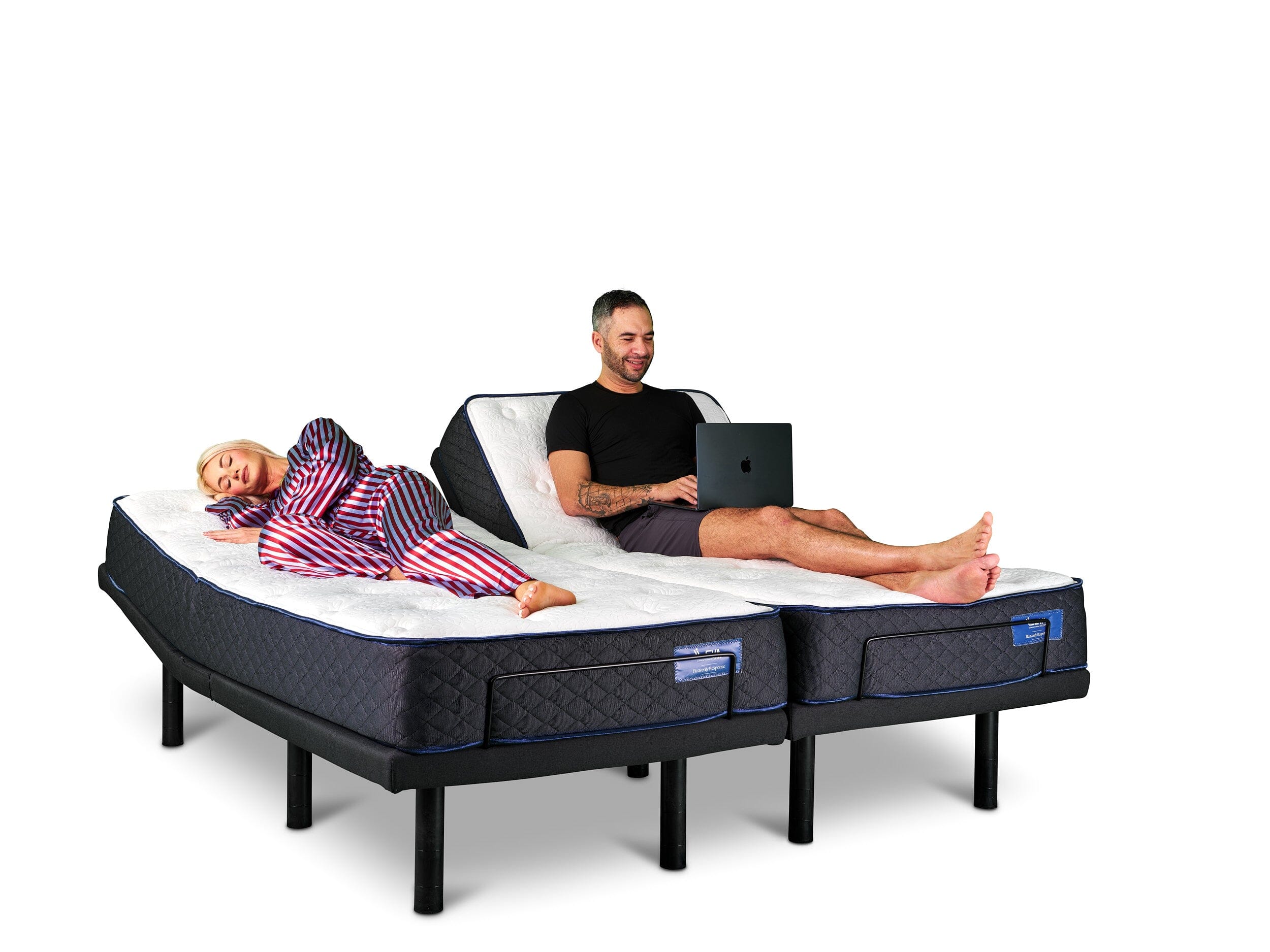
Shop Leva Sleep's adjustable beds if a partner needs elevation or anti-snore positioning that a static frame cannot provide.
Trade-offs and Limitations for Low Profile Frames
Low profile frames change how your bedroom looks and how your bed functions. This table highlights the main advantages and what you give up in return.
| Advantage | Limitation |
|---|---|
| Rooms feel 10–15% more open in standard Canadian ceiling heights | Only 4–8 inches of under-bed clearance, so storage space stays limited |
| Lower centre of gravity reduces motion transfer for couples | Cleaning underneath is harder, and dust and allergens build up |
| Eliminates box spring cost ($150–$400 CAD savings) | The air near the floor can be 2–4°C cooler in winter in many Canadian homes |
| Reduces fall risk and injury severity for restless sleepers | Standing up requires more knee and hip strength, which challenges people with reduced mobility |
| Modern, minimalist aesthetic suits contemporary Canadian interiors | Static construction does not allow head or foot elevation or split-side firmness control |
Setup, Ownership, and Practical Planning for Canadians
Price, timing, and delivery shape the overall value of a low profile frame. In Canada, most quality low profile frames cost between $200 and $800 CAD, with $200–$400 covering many solid wood or strong engineered wood options. Canadian-made hardwood queen frames, including low-profile designs, typically start from $800–$1,295 CAD and can exceed $6,000 for premium or custom pieces as of 2026.
Sale timing can reduce that cost. In Ontario and Alberta, Boxing Day, Victoria Day, Canada Day, Labour Day, and Black Friday often bring 15–40% discounts. Buying a mattress and frame together can save another 10–15% when the frame still meets the slat spacing and centre support requirements described earlier.
Assembly usually feels manageable for most couples. Low profile frames often have fewer parts than taller designs, which shortens setup time. Check whether the retailer offers white-glove delivery to your postal code in Ontario or Alberta, since service areas differ. Couples planning a future upgrade can also look at adjustable foundations, which replace both frame and box spring in one unit for queen sizes and above.
Common Mistakes to Avoid
- Choosing a frame based only on price can backfire if slat spacing or centre support fails to meet your mattress warranty. When specs fall short, premature sagging becomes your cost to cover.
- Overlooking future mobility needs can create problems later. Many low profile setups sit below the healthiest transfer height discussed in the health section, which makes standing up harder with age or injury.
- Purchasing from a retailer without confirmed Canadian stock and delivery to your province often leads to long waits. Availability and lead times differ significantly between Ontario and Alberta.
- Selecting a low profile frame when one partner has a condition that requires head or foot elevation, such as sleep apnea or acid reflux, removes access to helpful positioning features.
- Ignoring weight capacity puts both comfort and safety at risk. Standard frames often rate around 400 lb, and many couples need higher limits.
Are Low Profile Bed Frames Better?
Low profile bed frames work best for people who want a modern, minimalist look, have no major mobility limitations, and do not rely on under-bed storage. They are not universally better or worse than standard frames, because the right choice depends on height, age, mobility, medical needs, and bedroom size. Research in Applied Ergonomics found that the ideal sitting height for getting in and out of bed is roughly knee height, around 20–23 inches for most Canadian adults, and many low profile setups fall below that range.
What Are Low Bed Frames Called?
Low bed frames are most often called low profile bed frames or low platform bed frames. Retailers also use terms such as platform beds, floor beds, Japanese-style beds, or tatami beds. In Canadian retail, the terms "low profile" and "low platform" usually describe frames sitting 6–10 inches off the ground. Floor or tatami beds form the lowest category, sitting 0–3 inches off the ground.
What Is a Low Profile Bed?
A low profile bed is a sleep setup where the frame typically measures between 4 and 12 inches from the floor to the top of the platform surface. Many sources describe ranges such as 5–12 inches or under 12 inches, which usually creates a total mattress height of about 15–20 inches with a 10–12 inch mattress. Industry standards treat any frame under 12 inches as low profile. This design removes the need for a box spring and often appears in contemporary, Japanese-inspired, and Scandinavian interiors.
What Is the Lowest Bed Frame You Can Get?
The lowest bed frame category uses a floor or tatami-style base that sits 0–3 inches off the ground. With a 10-inch mattress, this design usually creates a 12–14 inch sleep surface. One Canadian example is the Resthouse Magic Low Bed Frame, handmade in Duncan, BC, which comes in 2.25 or 3.75 inch heights from floor to slat top and is priced at $599 CAD. At this level, ventilation under the mattress stays limited, and moisture buildup becomes a documented concern in humid regions such as coastal BC and southern Ontario.
What Are the Disadvantages of a Low Bed?
Low beds introduce several consistent drawbacks that couples should weigh against the aesthetic benefits.
- Standing up requires more knee and hip strength, which creates a real safety concern for people with reduced mobility.
- Under-bed storage space is minimal or nonexistent.
- Cleaning underneath is difficult, so dust, allergens, and debris collect near the floor.
- In Canadian homes without radiant floor heating, the bottom 12 inches of air can be 2–4°C cooler during winter.
- Static construction prevents head or foot elevation, which limits options for managing snoring, sleep apnea, or acid reflux.
What Is the Healthiest Type of Bed to Sleep On?
Changes in mattress support can significantly affect back pain and sleep quality, as shown in the Journal of Chiropractic Medicine. No single frame style is healthiest for everyone. The Journal of Physiotherapy identifies 18–22 inches as the optimal bed height for independent sit-to-stand transfers, where knees form a 90-degree angle with feet flat on the floor. For people with sleep apnea, acid reflux, or snoring, adjustable foundations that elevate the head and reduce lower-back pressure are associated with symptom improvement. A static low profile frame cannot provide these positional benefits.
What Are the Disadvantages of a Low Profile Bed Frame?
Low profile frames share the general drawbacks of low beds and add a few couple-specific limitations.
- They do not allow independent head or foot elevation on either side of the bed.
- They do not offer anti-snore positioning or helpful angles for sleep apnea management.
- They may not suit taller users or people recovering from surgery who need easier bed entry and exit.
- Minimal clearance makes vacuuming underneath difficult or impossible, which allows dust to collect on carpeted floors common in Canadian homes.
- MDF or particleboard models can squeak more due to hollow construction and loosening hardware.
Why Do People Like Low Profile Beds?
Low bed frames have become a popular choice in Canada because they blend design appeal with practical benefits in smaller spaces. Japanese minimalist influences and compact condos in cities like Toronto and Vancouver both support this trend.
- Rooms feel 10–15% more open, which helps in homes with 8-foot ceilings.
- A lower centre of gravity reduces lateral sway and motion transfer, which benefits couples sharing a bed.
- Eliminating the box spring saves about $150–$400 CAD.
- The clean, ground-hugging silhouette fits contemporary, Scandinavian, and Japanese-inspired interiors.
- Reduced height lowers fall risk for restless sleepers.