
Written by: Matthew Timmins, Founder and Managing Director, Leva Sleep | Last updated: July 16, 2026
Key Takeaways for Better Sleep Together
- Sleep divorce affects 31% of U.S. adults and 17% of coupled Canadians, often due to snoring, firmness clashes, temperature differences, and chronic pain.
- Split adjustable beds give each partner independent head, foot, and temperature controls so couples can stay in the same bed without compromise.
- Key features to compare include whisper-quiet brushless motors, motion-isolating pocket-coil or all-foam mattresses, and app-based anti-snore automation.
- Leva Sleep provides white-glove delivery and setup in Ontario and Alberta plus bedding that stays in place during elevation changes.
- Explore complete shared-sleep solutions at Leva Sleep’s adjustable bed packages.
The Problem: Rising Sleep Divorce Among Couples
A June 2025 American Academy of Sleep Medicine survey found that 31% of U.S. adults currently practice sleep divorce, up from 29% in 2024. Adults aged 35–44 show the highest rate at 39%, which overlaps with peak years for career pressure, parenting demands, and early age-related sleep changes. In Canada, 17% of coupled Canadians already sleep in separate beds or rooms, and 38% have considered it.
The contributing factors are well-documented and often occur together. Approximately 90 million Americans snore, causing the bed partner to lose an average of one to two hours of sleep per night. Even when snoring is not an issue, many couples disagree about mattress comfort and firmness. Temperature adds another layer of mismatch: research shows men and women prefer different bedroom sleep temperatures on average, which can impair sleep onset for one or both partners. Medical conditions compound these mechanical and environmental gaps. Sleep apnea is common among Canadian adults with prevalence increasing with age, and roughly 89% of people with chronic back pain report less pain on adjustable beds.
A new bed becomes necessary when disturbances happen most nights, when one partner needs positional therapy, or when sleep divorce has already occurred. At that point, couples need a solution that supports both partners at the same time rather than forcing one person to adapt.
Mattresses That Reduce Partner Disturbance
Mattress construction strongly affects how much movement transfers across the bed. Pocketed coil systems isolate motion because each spring sits in its own fabric pocket with no direct mechanical connection to adjacent coils, unlike Bonnell or continuous coil systems where a single wire carries movement across the mattress. All-foam mattresses absorb motion at the source through high-density layers that dampen energy.
When you compare mattresses for motion isolation, focus on these points:
- Whether the coil system uses individually wrapped pockets or a connected Bonnell or continuous wire design
- Whether the comfort layers use high-density foam or gel-infused foam that absorbs rather than transfers movement
- Whether the mattress is certified compatible with an adjustable base, since traditional innerspring models with rigid border rods resist bending and may break
- Whether a split configuration is available so each partner’s surface remains physically independent
Explore adjustable beds compatible with motion-isolating mattresses
Split Adjustable Sleep Systems Explained
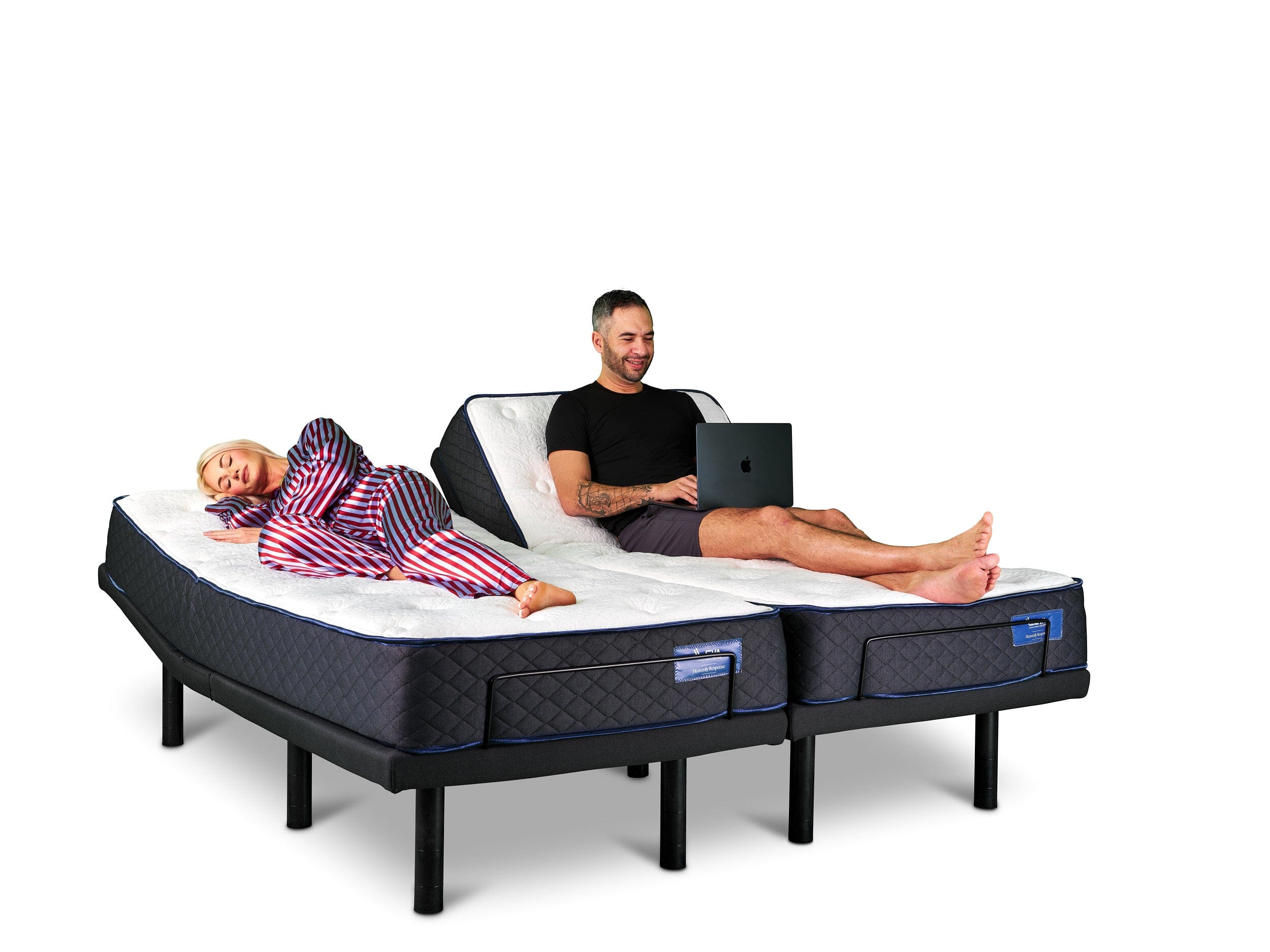
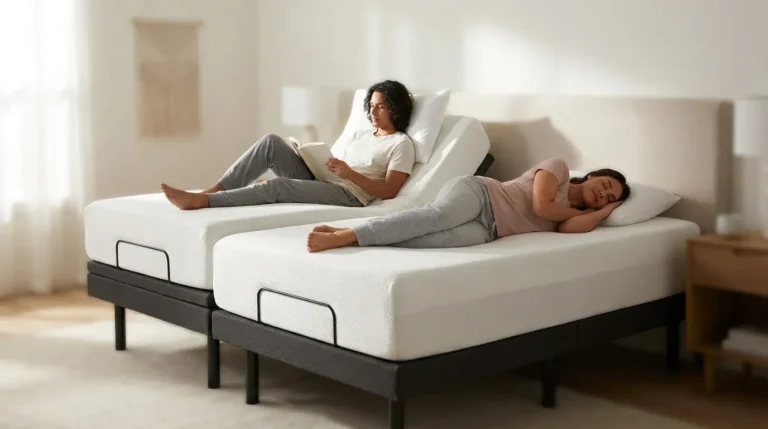
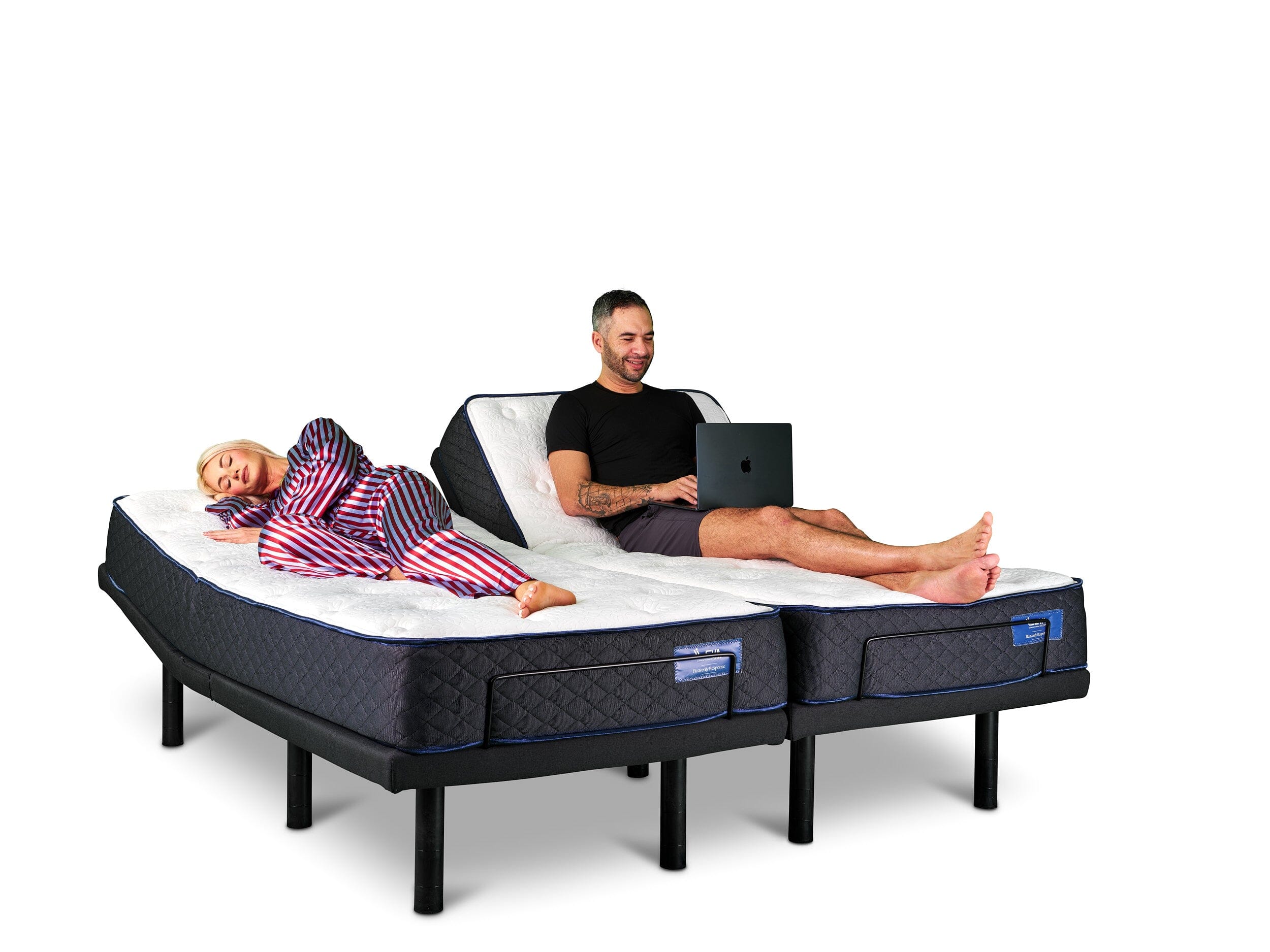
A split adjustable sleep system combines two independent bases inside one bed frame. Each base has its own motor, remote, and app connection. Each partner controls head elevation, foot elevation, lumbar support, massage intensity, and temperature without any mechanical link to the other side.
Zero-gravity positioning, which raises both the head and feet slightly above the heart, reduces pressure on the lower back, joints, and sciatic nerve. This setting works well as a default therapeutic preset when one or both partners have back or joint pain. App control adds custom position memory, vibrating alarms, and subtle snore-response adjustments that keep the other sleeper undisturbed.
| Feature | Traditional Flat Bed | Basic Single Adjustable Base | Split Adjustable System |
|---|---|---|---|
| Motion isolation | Low, depends entirely on mattress construction. Couples report more frequent partner disturbances on innerspring beds than on foam hybrids. | Moderate and mattress-dependent, with no physical separation between partners. | High, because physically separate mattresses prevent motion transfer across the centre seam. |
| Motor noise during adjustment | Not applicable | Budget AC motors reach 50–60 dB, which is loud enough to wake a sleeping partner. | Brushless DC motors operate at 30–40 dB, roughly the volume of a whisper. |
| Independent per-partner control | None | None, both partners move together. | Full, with each side adjusting independently via remote or app. |
Compare split king and split queen packages
Key Split Adjustable Features for Couples
Independent Adjustability for Each Sleeper
Split king setups are essential for couples who need different sleeping positions or firmness levels, because a solid king mattress on a single adjustable base forces both partners into the same position and removes independent customization. Leva Sleep’s Split King and Split Queen systems give each partner fully independent elevation, firmness, massage, and temperature settings through the Leva Sleep app. This configuration resolves differing needs without asking either person to sacrifice comfort.
Anti-Snore and Medical Elevation Support
Most sleep specialists recommend an elevation of 10–30 degrees for snoring relief, with 20–30 degrees as the target range for moderate to heavy snorers. Souza et al. (2017) tested the effects of 7.5° head-of-bed elevation on obstructive sleep apnea severity. Leva Sleep’s 2026 anti-snore AI mode detects snoring and makes micro-adjustments to the head of the bed automatically so the snoring partner does not need to wake or adjust the bed manually.
Whisper-Quiet Motors and Motion Isolation
Research in the Journal of Physiological Anthropology shows sounds as low as 40 decibels can disturb sleep in sensitive individuals. Quiet operation becomes especially important when anti-snore or medical adjustments occur during the night. During a showroom demo, listen to the motor with no weight on the base. If it whines or strains when unloaded, it will sound louder under two adults after years of use. Leva Sleep uses whisper-quiet motors that operate below the level that typically wakes a partner.
Mattress and Bedding Compatibility
Standard fitted sheets often pop off adjustable bases during elevation because they lack the depth and elasticity to handle articulation. Leva Sleep designs all bedding accessories for adjustable bases, including fitted sheets with extra-deep pockets and reinforced elastic, duvet clips that keep sides separate when positions differ, and mattress protectors that flex cleanly. Compatible mattress types include all-foam, latex, and hybrid pocket-coil constructions, avoiding the traditional innerspring incompatibility noted earlier.
Temperature Regulation for Each Partner
The temperature mismatch mentioned earlier, where partners prefer different bedroom climates, can disrupt sleep for one or both people. Leva Sleep’s integrated heating and cooling pad gives each partner an independent temperature zone. This setup removes one of the most common non-mechanical triggers of sleep divorce.
Delivery and Setup Realities in Canada
Adjustable bases weigh more than flat frames and require careful assembly, leg-height calibration, and app pairing. Leva Sleep offers white-glove delivery and setup in Ontario and Alberta. The service includes old-bed removal, full assembly, a product tutorial, and real-time height adjustments, which removes the installation burden that many bed-in-a-box brands leave to the customer.
Long-Term Service and Value
Leva Sleep has operated for over 8 years and designs, assembles, and delivers its systems in-house. This approach produces a luxury-grade sleep system with competitive pricing. Leva Sleep offers approximately 6 adjustable bed packages across its collections.
Realistic Downsides of Adjustable Beds
Adjustable beds involve real trade-offs that buyers should weigh before ordering:
- Centre gap: The 2–4 inch gap between split mattresses is the most common complaint, with 60% of couples finding it problematic for physical closeness. A mattress bridge or thick topper reduces the gap but does not remove it completely.
- Bedding complexity: Standard sheets and duvets rarely fit well, so purpose-built bedding becomes a necessary extra purchase.
- Motor noise over time: Brushed DC motors can grow louder as components wear. Brushless DC motors avoid most of this long-term degradation.
- Mattress compatibility: Not all mattresses flex safely on an adjustable base, so buyers must confirm compatibility before purchase.
- Anti-snore limitations: Benefits drop sharply for non-positional snorers whose snoring occurs in every sleep position. A sleep study is wise before relying on elevation alone for suspected sleep apnea.
The German Bed Method and Split Systems
The German bed method describes the Scandinavian and Central European habit of each partner using a separate duvet instead of sharing one. Each person has a single-size duvet sized to their half of the bed. This arrangement removes tug-of-war over covers and reduces temperature compromise.
The method pairs naturally with split adjustable systems. When each side of the bed already operates independently for elevation and firmness, separate duvets complete the individualization without requiring separate rooms. Leva Sleep’s duvet clips keep each duvet anchored to its own side during elevation changes.
Real-World Outcomes for Couples
Consider a couple in their mid-50s in Ontario. One partner has mild positional sleep apnea and needs head elevation. The other has hip pain and benefits from zero-gravity positioning with feet raised. On a flat bed, both needs cannot be met at once. On a split adjustable system, each side is set independently, with the apnea side at 20–25 degrees head elevation and the hip-pain side in zero-gravity, so both partners sleep through the night in the same bed.
In a second scenario, one partner runs warm and wakes repeatedly from overheating. The other is a light sleeper disturbed by movement. Independent temperature zones on each side address the thermal mismatch. The physically separate Twin XL mattresses on a split king base also reduce motion transfer. Bed partner movements can cause repeated arousals per night, and that number drops sharply when motion cannot cross a physical seam.
Find the right split adjustable system for your needs
Split King vs. Split Queen: Decision Checklist
| Consideration | Split King | Split Queen |
|---|---|---|
| Footprint | 76″ × 80″ and identical to a standard king | 60″ × 80″ and identical to a standard queen |
| Per-side width | 38″ (Twin XL) | 30″ |
| Independent control | Full, with separate bases and separate motors. | Full, with separate bases and separate motors. |
| Room size requirement | Works best in a larger bedroom. | Suitable for standard queen-size rooms. |
| Availability | Widely available from multiple brands. | More limited, with Leva Sleep as a specialist provider of Split Queen configurations built to customer specifications. |
| Price range (base + mattresses) | $4,599–$10,000 USD for comparable luxury split-king adjustable bed configurations, with Leva Sleep offering competitive pricing. | Queen adjustable bed bases in Canada typically range from about $895 to $3,700 CAD according to 2025–2026 retailer and specialist data. Split queen pricing varies by configuration. |
Frequently Asked Questions
Is a split adjustable bed suitable for couples, or does the gap between mattresses cause problems?
Split adjustable beds are built for couples with different sleep needs. The centre gap between the two mattresses, typically 2–4 inches on a split king, is the most frequently cited drawback. A mattress bridge, gap filler, or thick mattress topper reduces its impact for many couples. Most people who prioritize uninterrupted sleep over a seamless centre surface consider the trade-off worthwhile, especially when snoring, pain, or temperature differences already disrupt shared sleep. The Split Queen configuration from Leva Sleep offers the same independent control in a narrower 60-inch footprint, which some couples feel reduces the perceived gap.
Can a split adjustable bed be used with a CPAP machine?
Yes. Head elevation on an adjustable base can reduce the severity of positional sleep apnea by opening the airway through gravity. This change may lower the pressure settings required by a CPAP machine or make the device more comfortable. The two approaches work together rather than replacing each other. Anyone using a CPAP should consult their sleep physician before changing elevation settings, because the ideal angle varies by individual. Leva Sleep’s anti-snore AI mode provides automated micro-adjustments that support, but do not replace, prescribed medical therapy.
What maintenance does a split adjustable bed require?
Routine maintenance stays simple for most owners. The main tasks include keeping the base mechanism clear of debris that could block movement, checking that the mattress retention bar at the foot of the base remains secure, and confirming that the app firmware updates when prompted. Motor quality has the greatest long-term impact. Brushless DC motors maintain consistent noise levels and performance, while brushed motors can grow louder after several years. Leva Sleep’s in-house assembly and white-glove setup in Ontario and Alberta include a product tutorial that covers maintenance steps for the specific model purchased.
Who benefits most from a split adjustable bed?
Couples benefit most when at least one of several conditions applies. One partner may snore or have diagnosed positional sleep apnea. One or both partners may have chronic back, hip, or knee pain that responds to positional therapy. The partners may have firmness preferences that differ by two or more steps. Body weights may differ by roughly 40 pounds or more, which calls for different foam densities for proper support. One partner may also need to get in or out of bed at different times without waking the other. The benefits add up, so couples with several mismatches across these areas usually see the largest improvement in shared sleep quality.
Does Leva Sleep deliver and set up adjustable beds across Canada?
Leva Sleep’s white-glove delivery and setup service currently operates in Ontario and Alberta. The service includes delivery to the bedroom, full assembly, leg-height adjustment, old-bed removal with donation or recycling, and a complete product tutorial. This service has a separate fee from standard delivery. Customers outside Ontario and Alberta can contact Leva Sleep directly to discuss options for their location.
Conclusion: A Shared Bed Without Compromise
Sleep divorce has become a common response to shared beds that cannot support two people with different bodies, conditions, and preferences. A separate room is not the only path forward. A sleep system designed from the start for two independent sleepers sharing one frame offers a more connected alternative.
Split adjustable systems with independent elevation, whisper-quiet motors, app control, and purpose-built bedding address every major driver of partner disturbance at the same time. Leva Sleep’s Split King and Split Queen packages deliver this system with over 8 years of Canadian expertise, white-glove delivery in Ontario and Alberta, and competitive pricing.