
Written by: Matthew Timmins, Founder and Managing Director, Leva Sleep | Last updated: July 15, 2026
Key Takeaways: Adjustable Bases, Back Pain, and Leva Sleep
- Adjustable bases pair best with flexible mattresses such as memory foam, pocket-coil hybrids, and latex that bend safely without damage.
- Traditional innerspring mattresses are incompatible because their rigid coil grids resist bending and can void both mattress and base warranties.
- Core compatibility factors include mattress thickness between 8–14 inches, pocket-coil construction, and foam-encased edge support.
- Independent lumbar control and gradual angle changes help prevent back pain when you sleep on an adjustable base.
- Leva Sleep offers split queen and split king adjustable bed packages with white-glove delivery to Ontario and Alberta. Explore Leva Sleep’s adjustable bed packages today.
Mattress Compatibility: Which Types Work on Adjustable Bases?
Adjustable bases require mattresses that meet two criteria: physical flexibility to bend repeatedly at hinge points without cracking or delaminating, and sufficient internal structure to return flat without permanent distortion. Not every mattress qualifies.
Three mechanical thresholds determine long-term compatibility.
- Thickness: 8–14 inches is the ideal range, since mattresses under 8 inches may allow articulation points to be felt through the surface, while those over 14 inches create pressure ridges at hinge points and strain motors.
- Coil architecture: Only individually pocketed coils flex safely, while Bonnell, offset, and continuous coil grids are engineered for stability, not repeated articulation.
- Edge support construction: Foam-encased perimeters handle repeated bending better than steel-rod borders, which can dig into base mechanisms during articulation.
To test a mattress before purchasing, fold one corner to approximately 45 degrees by hand. Smooth bending without resistance or creaking indicates likely compatibility. Stiffness or internal straining sounds signal incompatibility. Always verify the manufacturer’s explicit adjustable-base certification in the product specifications.
Back Pain on an Adjustable Bed: Main Causes
Back pain while using an adjustable base typically results from an angle that is too steep, a mattress that is incompatible with the base, or the need for repositioning during the night. Three causes account for most cases.
- Overly steep elevation: Jumping immediately to a high head angle places the lumbar in an unsupported flexed position. Begin with gentle head and knee elevation and increase the angle gradually over several nights so the body can adapt.
- Incompatible mattress: A traditional innerspring or overly rigid foam mattress does not conform to the base’s curve, which creates pressure points at the lumbar and hip.
- Absent lumbar control: Entry-level bases raise the head and foot but offer no independent lumbar zone adjustment. A base with a dedicated lumbar support motor allows fine-tuning of the lower-back curve independently of overall head elevation.
Adjustable bases are not medical devices and do not treat underlying spinal conditions. Patients should consult a doctor or physiotherapist before using one for back pain management.
Mattress Types for Older Adults with Back Pain
For disc herniations, sciatica, and spinal stenosis, adjustable bases allow elevation of the knees or head to reduce pressure on specific spinal structures and can be more impactful than the mattress itself for these conditions. For older adults, the mattress choice usually narrows to two constructions.
- Medium-firm memory foam: Conforms to the body’s contours in elevated positions, distributes pressure evenly across the lumbar and hips, and contains no rigid components that resist articulation.
- Pocket-coil hybrid (medium-firm): Offers faster response than memory foam for combination sleepers who reposition during the night to manage pain, while still flexing safely through the base’s full range of motion.
Orthopedic physical therapist Karena Wu, P.T., D.P.T. recommends the zero-gravity position, a 120-degree angle between thighs and torso, to reduce pressure on the lower back and pelvis. Either mattress type supports this position safely when paired with a compatible base.
Memory Foam vs Hybrid on Adjustable Bases
Memory foam has excellent compatibility with adjustable bases because the material is inherently flexible and conforms readily to changing positions without stressing the foam structure. Pocket-coil hybrids match that compatibility rating and add faster surface response.
The practical differences between the two constructions on an adjustable base are straightforward.
- Contouring response: Memory foam provides deeper, slower contouring that cradles pressure points during prolonged zero-gravity positioning. Hybrids respond faster, which suits sleepers who shift positions frequently through the night.
- Edge support: Pocket-coil hybrids generally maintain firmer edges during elevation, which makes it easier to sit up and transfer out of bed, an advantage for older adults or post-surgical recovery.
- Motion isolation: Split adjustable bases reduce motion transfer because each side operates with independent motors. Memory foam adds a second layer of isolation at the mattress surface, while hybrids transmit slightly more movement through the coil layer.
Latex Mattresses on Adjustable Bases
Latex mattresses, both Talalay and Dunlop, are as compatible with adjustable bases as memory foam and are arguably more durable because natural resilience allows flexing and recovery thousands of times without breaking down.
One structural consideration affects thick latex cores. A single molded 100% natural latex core 12 inches or thicker can resist bending and stress the motor. A split-layer latex construction solves this problem. Two or more separate stacked pieces allow each layer to articulate cleanly at the hinge points instead of fighting a single monolithic core. Latex within the 8–14 inch thickness range in a split-layer format performs reliably across the full articulation arc of any quality adjustable base.
Why Traditional Innerspring Mattresses Fail on Adjustable Bases
Traditional innerspring mattresses using interconnected coil systems such as Bonnell, offset, or continuous coils are broadly incompatible with adjustable bases, because their rigid coil grids are engineered for stability rather than repeated articulation. Three failure modes appear when innerspring mattresses are forced onto adjustable bases.
- Permanent coil deformation: The connected grid of coils resists bending and can be permanently damaged by forcing flexion.
- Motor strain and premature wear: Extra-firm mattresses with reinforced structures cause base motors to work harder and wear faster over time.
- Dual warranty voidance: Using an incompatible mattress on an adjustable base can void warranties from both the mattress manufacturer and the base manufacturer.
Pillow-top innerspring models carry the same risks. The thick pillow-top layer combined with connected coils does not flex well and can bunch or separate from the coil unit.
Canadian Pricing: How Leva Sleep Compares
Queen-size adjustable bases in Canada range from approximately $800–$1,200 CAD for entry-level models to $2,500–$3,500+ CAD for luxury models with advanced features. Leva Sleep’s direct-to-consumer model delivers comparable or superior feature sets at 30–50% below the prices of major competitors. The table below shows how Leva Sleep’s pricing compares to typical market tiers across entry, mid-range, and premium segments, and Leva Sleep spans all three tiers while maintaining that discount across the range.
| Brand / Retailer | Tier | Approx. Queen Base Price (CAD) | White-Glove Delivery (ON/AB) |
|---|---|---|---|
| Leva Sleep | Entry–Premium | 30–50% below comparable competitors | Available for a fee; includes setup, old-bed removal, and tutorial |
| Market entry-level (head/foot + remote) | Entry | $800–$1,200 | Varies by retailer |
| Market mid-range (massage + presets) | Mid | $1,200–$1,800 | Varies by retailer |
| Market premium (wall-hugger + advanced features) | Premium | $1,800–$3,500+ | Varies by retailer |
Tempur-Pedic, Saatva, GhostBed, and Sleep Country all operate through retail or wholesale channels that add margin at each step. Leva Sleep designs, assembles, and delivers its systems in-house, which passes those savings directly to the customer.
Split Queen and Split King Options for Couples
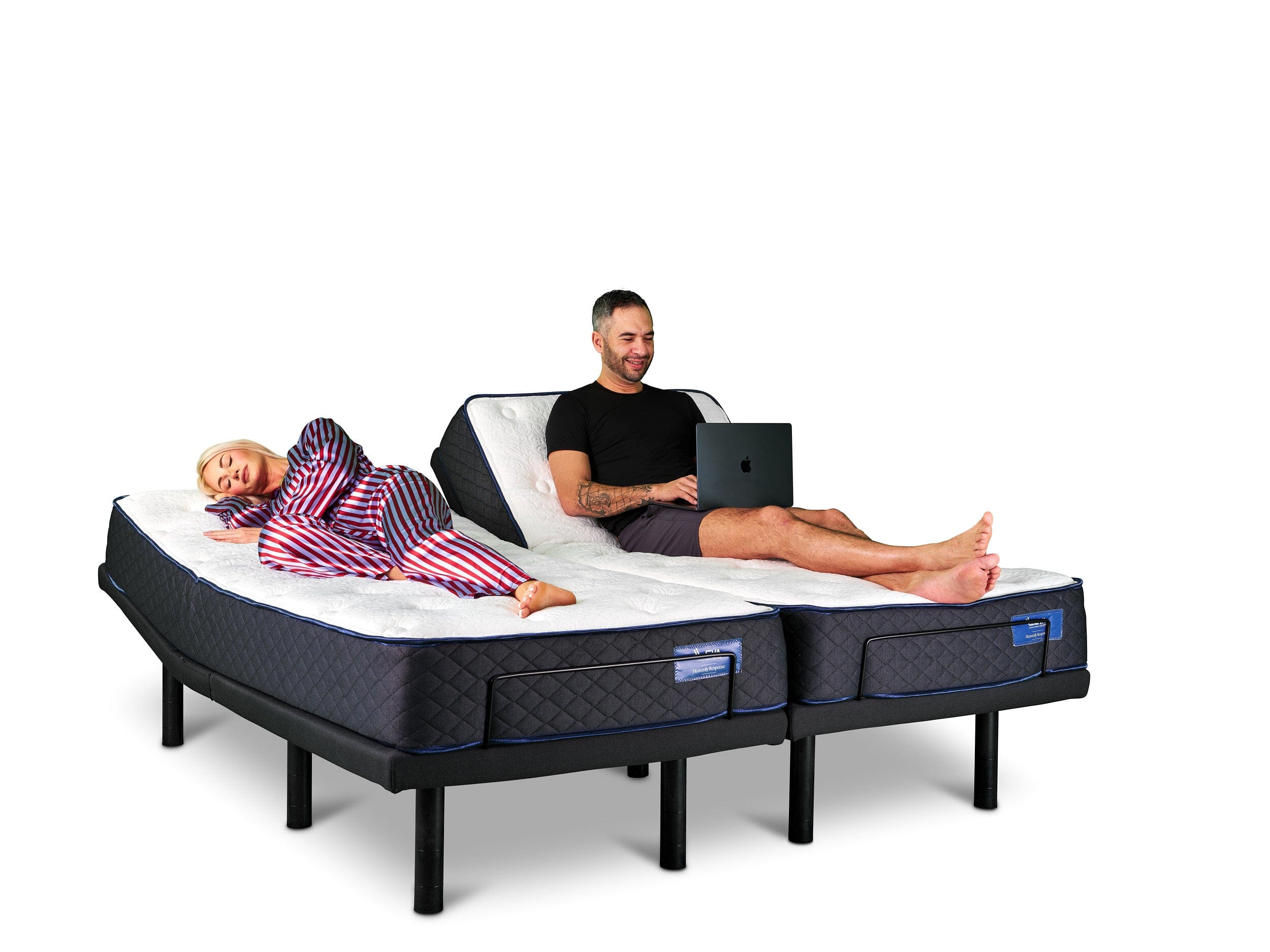
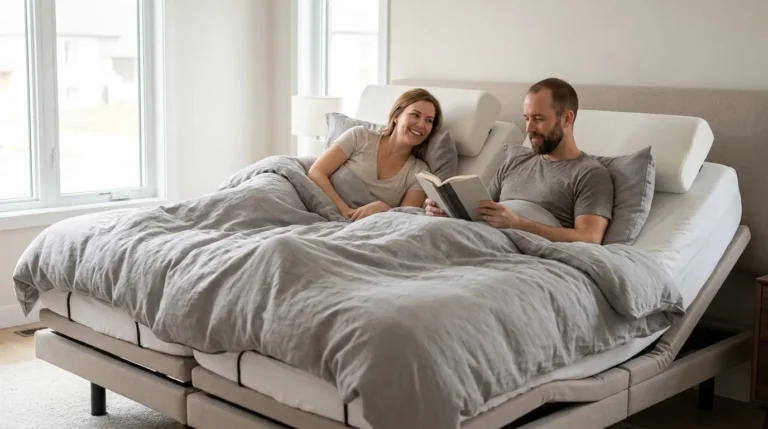
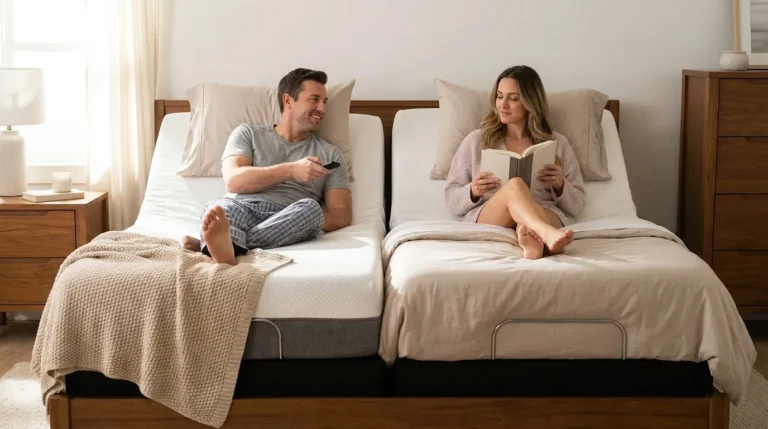
Split adjustable bases allow zero-compromise positions for couples with differing needs, such as one partner elevated 15 degrees to reduce snoring while the other remains completely flat. Independent adjustment on each side provides targeted relief for conditions such as GERD, obstructive sleep apnea, or back pain while preserving the other partner’s preferred sleep environment.
Leva Sleep offers both Split King, which uses two Twin XL bases, and the less common Split Queen configuration, which suits couples who want independent control in a more space-conscious footprint. Each side operates with its own whisper-quiet motor, lumbar control, and pillow tilt. Modern split adjustable bases include a sync function that lets couples operate both sides together for activities like watching TV, then unsync for independent positioning. Anti-snore mode, which detects snoring and makes micro-adjustments to the head of the bed, is available on Leva Sleep’s higher-end bases as of spring 2026.
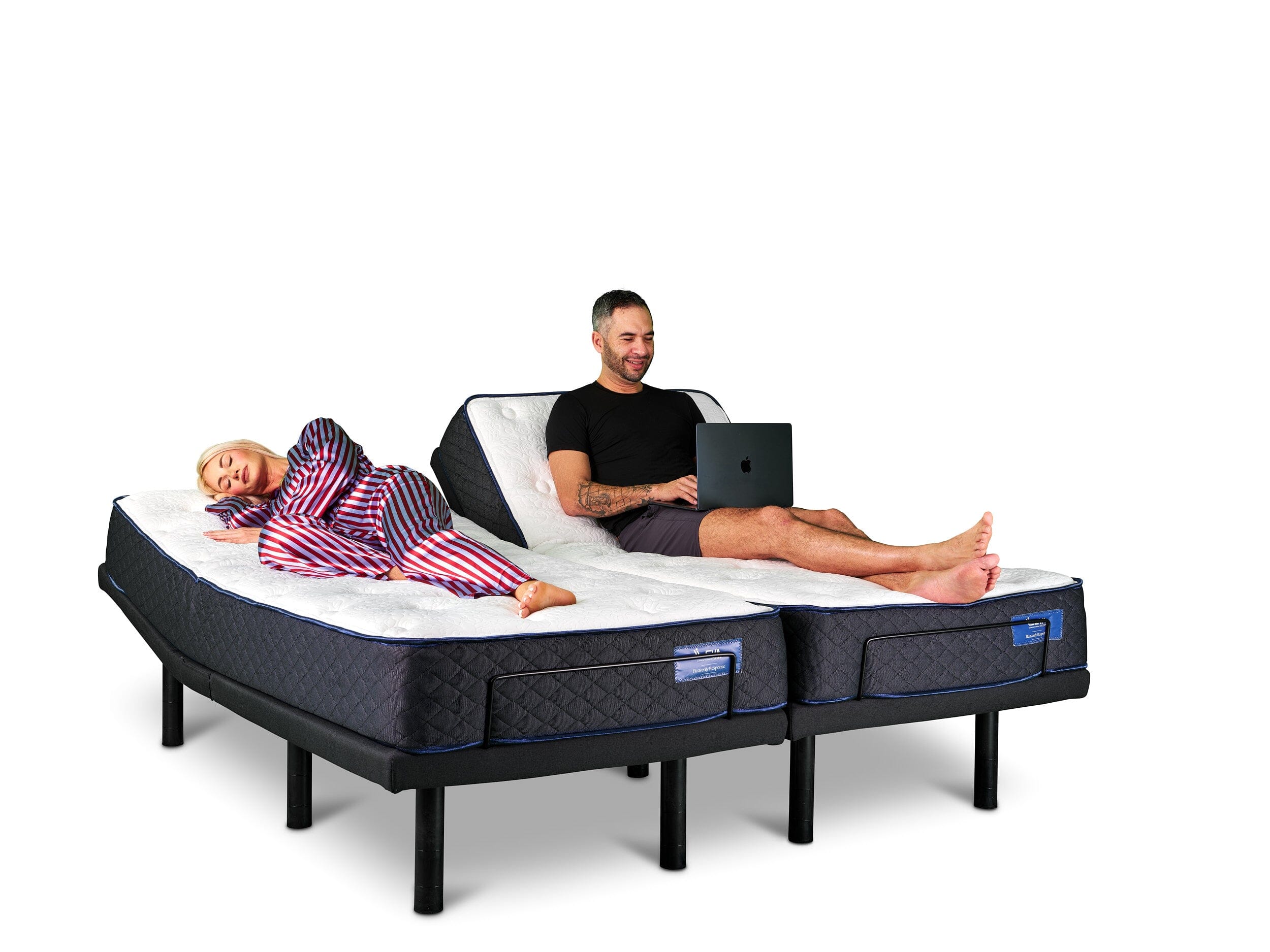
Browse Leva Sleep’s split queen and split king configurations, Canada’s split queen specialty lineup with 15–20 adjustable models and over 25,000 customers served.
Common Adjustable Base Issues and Helpful Accessories
Three practical problems arise with adjustable bases regardless of mattress type, and each has a straightforward solution. The first two, mattress sliding and sheet slippage, come from standard bedding that is not designed for articulation. The third, motor noise, relates to base component quality rather than accessories.
- Mattress sliding: True compatibility requires dimensional stability so the mattress does not migrate across the articulating frame during use, preserving spinal alignment. A non-slip pad or retainer bar at the foot of the base prevents migration during elevation.
- Sheet slippage: Standard fitted sheets lack the depth and elasticity to stay anchored when the base articulates. Leva Sleep designs fitted sheets with deep pockets and extra elastic specifically for adjustable bases.
- Motor noise: Basic adjustable bases use lower-grade actuators that produce audible noise during adjustment. Leva Sleep’s whisper-quiet German motors operate without disrupting a sleeping partner.
Additional accessories that improve the adjustable base experience include duvet clips that maintain separation when each side is at a different angle, mattress protectors cut to split-base dimensions, and remote pockets that attach to the side rail for easy access without reaching across the bed.
Decision Framework: Matching Your Base and Mattress
Use this framework to evaluate any adjustable base and mattress combination before you buy.
- Confirm the mattress carries explicit manufacturer certification for adjustable base use and falls within the thickness range discussed earlier (8–14 inches).
- Check the coil architecture next and choose pocket coils only, since Bonnell, offset, or continuous coil systems cannot flex safely.
- Match base features to specific conditions. Lumbar control supports lower back pain, head elevation helps with sleep apnea or acid reflux, and leg elevation improves circulation or reduces joint swelling. Orthopedic spine surgeon Nitin Bhatia, M.D. advises matching features to specific conditions rather than paying for unused extras.
- For couples with differing pain levels or sleep schedules, prioritize a split configuration with independent per-side motors instead of a single linked base.
- Confirm the base’s total weight rating accommodates both the mattress and sleepers. Most adjustable bases carry ratings of 600–850 lbs total.
- Include delivery and setup in your decision. White-glove service that covers assembly, height adjustment, and a product tutorial prevents improper installation that can accelerate motor wear.
Leva Sleep’s direct-to-consumer model covers every step of this framework with compatible mattresses, both all-foam and pocket-coil hybrid, 15–20 adjustable base models including split queen and split king, purpose-built accessories, and in-house white-glove delivery to Ontario and Alberta.
Configure your split system at Leva Sleep and create a setup that gives each partner independent lumbar support, zero-gravity positioning, and whisper-quiet adjustment at the savings detailed in the pricing section above.
Frequently Asked Questions
Can I use my existing mattress with a new adjustable base?
Compatibility depends on the mattress construction. Memory foam, latex, and pocket-coil hybrid mattresses within the 8–14 inch thickness range are generally compatible. The simplest field test is to fold one corner of the mattress to approximately 45 degrees by hand. Smooth, resistance-free bending indicates likely compatibility, while stiffness or internal creaking indicates the mattress will stress the base motors and may deform permanently. Traditional innerspring mattresses with Bonnell or continuous coils are not compatible and should not be used on an adjustable base regardless of age or condition. Always check the mattress manufacturer’s specifications for explicit adjustable-base certification before pairing.
What is the zero-gravity position, and how does it relieve back pain?
The zero-gravity position elevates the head and feet, which creates a posture where body weight is distributed across the torso and thighs rather than concentrated at the lumbar segments. This reduces intervertebral disc loading and can relieve nerve compression for people with spinal stenosis, disc herniation, or sciatica. Physiotherapists often recommend this position for patients who cannot tolerate lying fully flat. It is not a medical treatment and does not address the underlying cause of spinal conditions, so a doctor or physiotherapist should be consulted before using elevation positioning for pain management.
What makes Leva Sleep’s split queen different from a standard split king?
A standard split king uses two Twin XL mattresses, each 38 × 80 inches, on two independent bases, totalling a 76 × 80 inch footprint that matches a standard king. As discussed in the configurations section above, Leva Sleep’s split queen delivers independent per-side control in a queen footprint, 60 × 80 inches, rather than the larger king footprint required for a standard split king. This makes it the only practical split option for couples in smaller master bedrooms. Each side has its own motor, lumbar control, pillow tilt, and app connectivity, so both partners retain full independent adjustability without needing the larger king size. This configuration remains rare in the Canadian market, and Leva Sleep is one of the few retailers that builds split queen systems to customer specifications.
Why does my adjustable bed cause back pain, and how do I fix it?
The three most common causes are an angle that is too steep for the body’s current adaptation level, an incompatible mattress that does not conform to the base’s curve, and the absence of independent lumbar control. To address steep angles, reduce the head elevation and increase it gradually over several nights. To address mattress incompatibility, verify that the mattress meets the flexibility and thickness criteria described above. If it does not, replacing the mattress is the correct solution rather than adjusting the base settings. To address lumbar support, upgrade to a base with a dedicated lumbar motor that adjusts the lower-back zone independently of overall head and foot elevation. If pain persists after these adjustments, consult a physiotherapist or physician.
Does Leva Sleep deliver and set up adjustable beds in Ontario and Alberta?
Leva Sleep offers in-house white-glove delivery to Ontario and Alberta for a fee. The service includes delivery to the bedroom, full assembly of the base and mattress, leg height adjustment, removal and donation or recycling of the old bed, and a hands-on product tutorial covering app setup, preset positions, and accessory installation. This service differs from the drop-ship or “bed in a box” model used by many online retailers, where the customer is responsible for assembly. The white-glove service is particularly relevant for adjustable bases because improper assembly, such as incorrect leg height, loose motor connections, or misaligned retainer bars, can affect both comfort and long-term motor performance.