Written by: Matthew Timmins, Founder and Managing Director, Leva Sleep | Last updated: June 17, 2026
Key Takeaways for Couples
- Couples often disagree on mattress firmness because of different sleep positions, body weights, and medical needs, which can cause sleep disruption and even sleep divorce.
- A five-step framework helps you map individual needs, compare compromise options, and decide when a split adjustable system is the only way both partners sleep well.
- Matching the Canadian firmness scale to sleep position and weight reduces costly mattress mistakes and prevents ongoing pressure points and back pain.
- True split adjustable bases with independent mattresses give each partner full control over elevation, lumbar support, and anti-snore features instead of forcing a single compromise setting.
- Leva Sleep provides premium split adjustable bed packages with white-glove delivery in Ontario and Alberta, helping Canadian couples create personalized sleep on each side of the bed. Explore split adjustable bed packages for Canadian couples.
Step 1: Map Each Partner’s Sleep Position and Weight
Start by recording each partner’s dominant sleep position and weight category separately. The table below gives you a simple structure.
| Partner | Primary Sleep Position | Weight Category | Starting Firmness Range |
|---|---|---|---|
| Partner A | Side / Back / Stomach / Combo | Under 130 lbs / 130–230 lbs / Over 230 lbs | Fill in after Step 2 |
| Partner B | Side / Back / Stomach / Combo | Under 130 lbs / 130–230 lbs / Over 230 lbs | Fill in after Step 2 |
Accurate mapping prevents the most expensive mistake in mattress buying. Many couples purchase a medium-firm mattress assuming it will satisfy both partners, discover it does not, and then repeat the cycle. Many US adults report mattress-related pain on waking, and that number rises when a shared mattress does not match one partner’s body mechanics.
Common Pitfall: Assuming one medium-firm mattress works for both partners. A medium-firm rating of approximately 6.5/10 is the industry average for online models and suits a broad range of sleepers in isolation, but a medium-firm compromise typically leaves both partners dissatisfied because firmness needs are driven by individual body weight, sleep position, and body type rather than a universal middle ground.
Step 2: Match the Firmness Scale to Your Positions
Once you have mapped positions and weight, you can translate those details into firmness targets. The standard 1–10 firmness scale runs from ultra-soft at 1–2 through medium at 5 to extra-firm at 9–10. Expert guidelines map positions to ranges as follows.
- Side sleepers: generally prefer softer mattresses in the 5–6 range so shoulders and hips can contour for neutral spinal alignment.
- Back sleepers: do well with medium-firm 6 to firm 7 mattresses, which support the lumbar area without creating a hammock effect.
- Stomach sleepers: require firm 7 to extra-firm 8 mattresses to prevent excessive sinking of the torso that exaggerates the lower back arch.
- Combination sleepers: usually sleep well on medium-firm 6 mattresses that balance cushioning and support across changing positions.
Body weight shifts these ranges by one level in either direction. Lighter individuals under 130 lbs may need a firmness score about one point softer than the position-based recommendation, while heavier individuals over 230 lbs often require a score one to two points firmer.
Tip: Test firmness with your current sheets and sleepwear on, not just on a showroom mattress with no bedding. Fabric layers add a small amount of cushioning that can shift perceived firmness by half a point, which matters when you compare a 6 with a 6.5.
Step 3: Decide on Compromise or Independent Firmness
After you calculate both partners’ firmness ranges from Steps 1 and 2, compare the gap. When couples disagree on firmness by two or more levels, a split setup with two mattresses of differing firmness provides individualized support without compromise.
If the gap is one level or less, a single medium-firm mattress with strong motion isolation can work as a starting point. Evaluate any shared mattress on two practical criteria before purchasing: motion isolation and edge support. For couples, strong motion isolation and edge support are important because shared sleep can amplify disturbance and reduce usable surface area. When motion isolation is weak, every position change ripples across the mattress surface. That disturbance compounds existing discomfort if one partner already sleeps lightly because of a firmness mismatch.
Common Pitfall: Assuming all adjustable bases are noisy. Older or entry-level adjustable bases can have loud motors or jerky movements that create new disturbances even after the firmness problem is solved. Leva Sleep’s systems use whisper-quiet German motors specifically to eliminate this issue.
Step 4: Compare Dual-Firmness Mattresses and True Split Systems
Two categories address a firmness gap of two or more levels. The first is a dual-firmness or zip-and-link mattress, which places two different firmness zones side by side on a flat base. This setup solves the firmness mismatch but does not address elevation, snoring, or position-based medical needs.
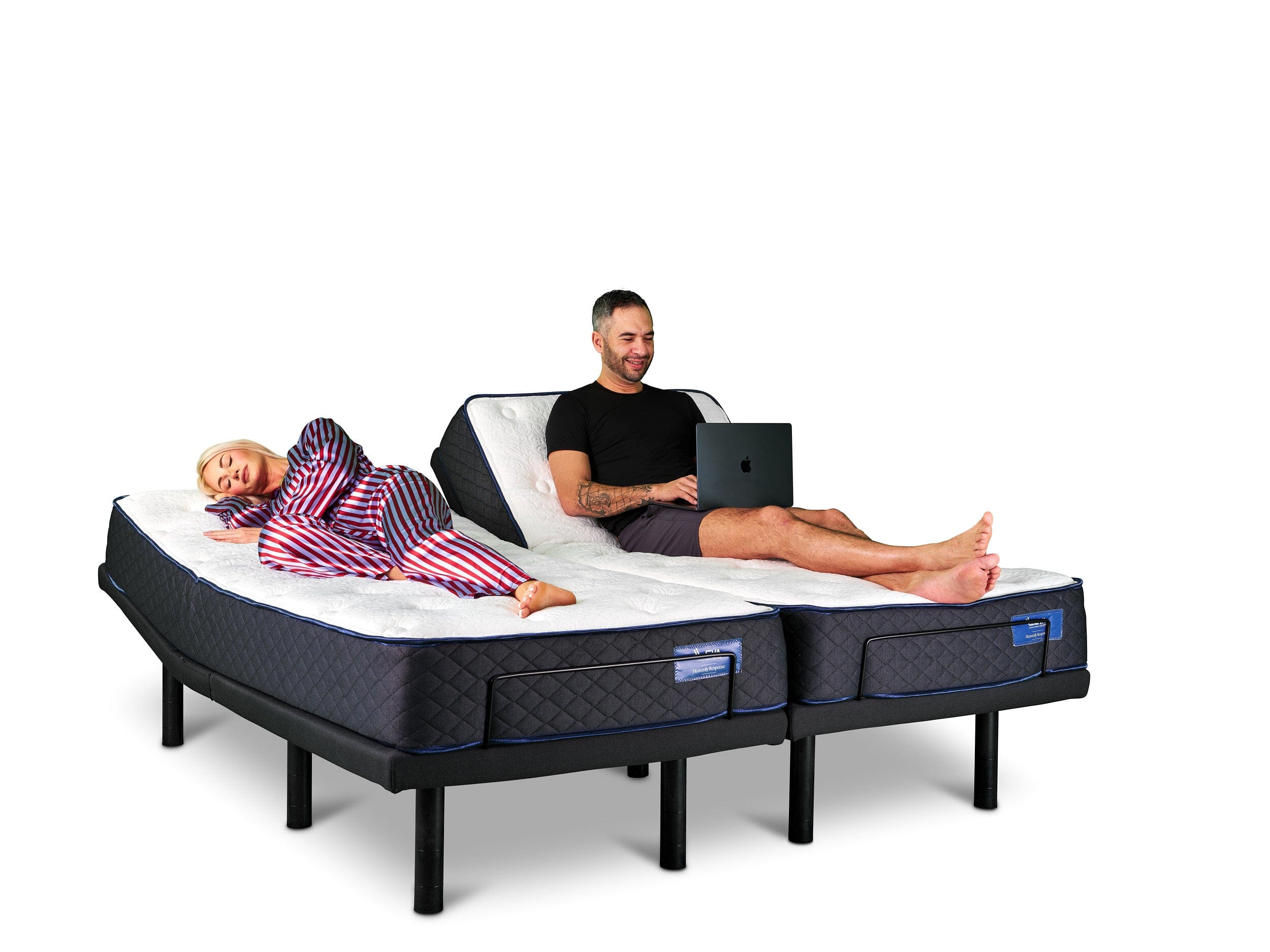
The second category is a true split adjustable base paired with two independent mattresses. This configuration provides fully independent head and foot elevation alongside independent firmness selection, which tackles the core mismatch. Leva Sleep’s higher-end models add independent lumbar support and pillow tilt to fine-tune spinal alignment in any position. Anti-snore mode, arriving spring 2026, detects snoring and makes micro-adjustments to the head of the bed to reduce or eliminate it. Because all motors use whisper-quiet German engineering, these adjustments happen without the loud, jerky movements that basic adjustable bases often create.
Leva Sleep offers Split Queen and Split King configurations, including the Split Queen, a size most Canadian retailers do not carry, at 30–50% less than comparable luxury competitors. That price advantage comes from a vertically integrated, direct-to-consumer model. Leva designs, assembles, and delivers its systems in-house, which removes the retail markup entirely.
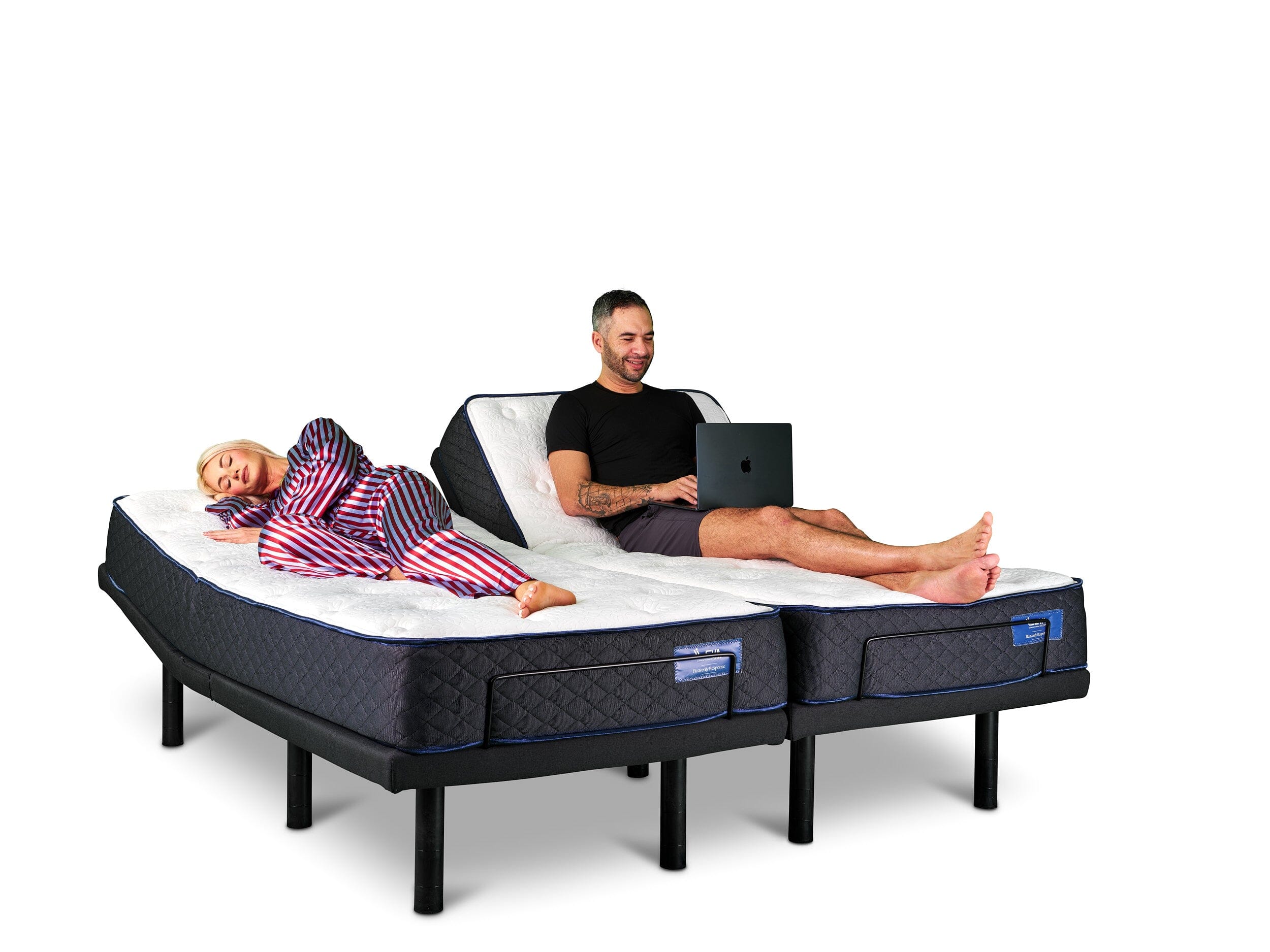
Compare Split Queen and Split King systems in a white-glove consultation to find the configuration that fits your bedroom and budget.
Step 5: Check Trial Periods, Delivery, and Canadian Setup
A trial period only helps when delivery and setup go smoothly. Bed-in-a-box models ship compressed mattresses to your door and leave assembly, old-bed disposal, and height adjustment to you. For a split adjustable base with two independent motorized frames, two mattresses, and accessories, that process becomes genuinely complex.
Leva Sleep’s white-glove delivery service, available in Ontario and Alberta, sends trained professionals to your bedroom. They assemble the full system, adjust leg heights to your preference, provide a product tutorial, and remove the old bed for donation or recycling. The 100-night trial period begins after the system is fully operational, not from the shipping date.
Tip: Standard fitted sheets do not stay on adjustable bases at elevation. Leva Sleep designs its own fitted sheets with deep pockets and extra elastic specifically for adjustable bases, which prevents the common frustration of sheets pulling loose mid-sleep. Confirm sheet compatibility before purchasing bedding from a third party.
What Successful Shared Sleep Looks Like
When each partner’s firmness and elevation needs are met independently, results show up quickly. Couples report reduced morning pain, fewer overnight wake-ups from partner movement, and fewer snoring-related disturbances. Micro-adjustments replace the need for separate bedrooms. Many people who adopt sleep divorce report improved sleep quality, and a split adjustable base delivers similar gains while both partners remain in the same room.
Advanced Features for Long-Term Comfort
Beyond firmness and elevation, Leva Sleep’s higher-end split systems address other common disruptors of shared sleep. App-controlled AI sleep tracking monitors each partner’s sleep patterns and makes real-time micro-adjustments to improve comfort through the night. Heating and cooling pads provide independent temperature control on each side, which resolves the too-hot or too-cold conflict.
Lumbar control motors deliver precise lower back support, while pillow tilt motors adjust head and neck positioning to reduce strain. All functions are accessible through the Leva Sleep app via Bluetooth, including custom saved positions, vibrating alarms, and snore-response automation. These features address the full spectrum of sleep disruption that a firmness-only solution cannot reach.
Ready to Stop Compromising on Sleep?
Choosing mattress firmness as a couple works best when you treat it as a two-person engineering problem instead of a negotiation. When individual firmness ranges diverge by two or more levels, or when snoring, elevation needs, or temperature differences compound the mismatch, a single shared mattress cannot satisfy both partners. Leva Sleep’s Split Queen and Split King adjustable systems provide fully independent control over every variable that affects sleep quality, at 30–50% less than comparable luxury competitors, with white-glove delivery across Ontario and Alberta.
Map your firmness needs and explore split adjustable bed packages in a personalized consultation and stop compromising on sleep.
Frequently Asked Questions
How do I figure out the right mattress firmness for my sleep position and body weight?
Start with your dominant sleep position. Side sleepers generally need a softer surface in the 5–6 range on a 10-point scale so the shoulders and hips can sink enough for neutral spinal alignment. Back sleepers typically need medium-firm to firm 6–7 to support the lumbar curve without excessive sinkage. Stomach sleepers need firm to extra-firm 7–8 to prevent the torso from sinking and arching the lower back. Combination sleepers usually do well at medium-firm 6 as a balance across positions.
Once you have a position-based starting point, adjust for body weight. If you weigh under 130 lbs, move one level softer. If you weigh over 230 lbs, move one to two levels firmer. Record both partners’ results separately before you evaluate any shared mattress.
When does a single-mattress compromise stop working for couples?
A single shared mattress becomes insufficient when the two partners’ individual firmness ranges differ by two or more levels on the 1–10 scale. At that gap, a medium-firm compromise will be too firm for the partner who needs a softer surface, which creates pressure points at the hips and shoulders. It will also be too soft for the partner who needs firmer support, allowing the hips to sink and misaligning the spine.
The problem grows when weight differences are significant, because a heavier partner sinks deeper into the same comfort layer and effectively experiences a softer feel than a lighter partner on the identical mattress. Additional factors that push couples past the compromise threshold include snoring, elevation needs for conditions like sleep apnea or acid reflux, and temperature regulation differences. A single flat mattress cannot address those variables independently for each partner.
What are the practical advantages of a split adjustable base over a dual-firmness mattress for Canadian couples?
A dual-firmness or zip-and-link mattress on a flat base solves the firmness mismatch but leaves every other variable, such as head and foot elevation, lumbar support, snore response, and temperature, shared or fixed. A split adjustable base with two independent mattresses gives each partner full control over firmness selection, elevation angle, lumbar positioning, and, on advanced models like Leva Sleep’s systems, anti-snore micro-adjustments and heating or cooling.
For couples in Ontario and Alberta, Leva Sleep’s white-glove delivery service handles the full setup, including old-bed removal, which removes the logistical barrier that makes split systems feel complicated. The price point is 30–50% below comparable luxury competitors due to Leva’s direct-to-consumer model described in Step 4. The Split Queen configuration is also available through Leva (see Step 4 for size details), which makes independent sleep control accessible in smaller master bedrooms.