Written by: Matthew Timmins, Founder and Managing Director, Leva Sleep | Last updated: July 3, 2026
Key Takeaways for Canadian Couples
-
Memory foam excels at pressure relief and motion isolation for side-sleeping couples but often runs warm and locks both partners into one firmness on a flat mattress.
-
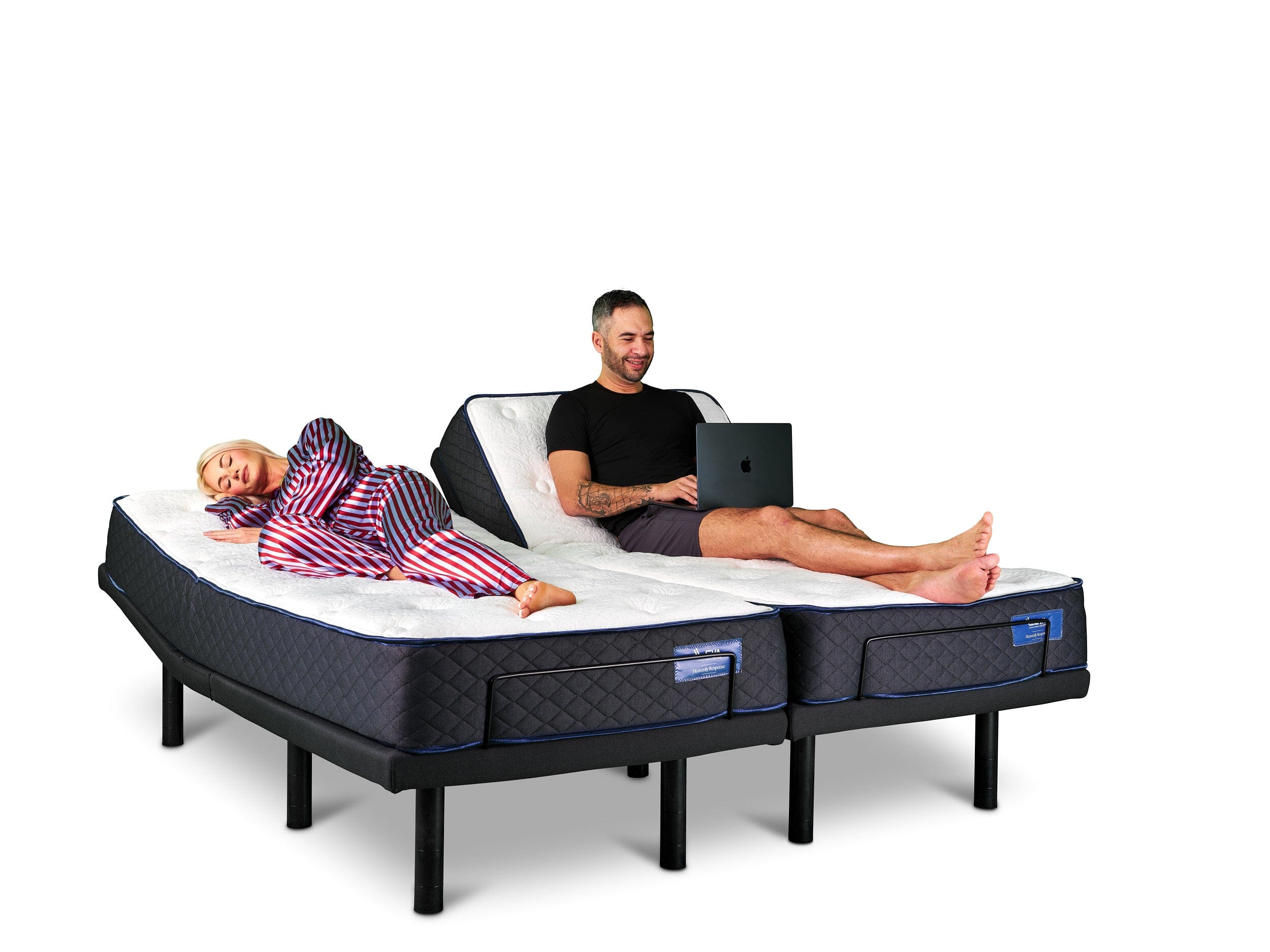
Pairing memory foam with a split adjustable base lets each partner choose their own firmness, elevation, and temperature settings.
-
Hybrid mattresses with pocket coils usually suit hot sleepers better and provide stronger edge support and a quicker surface response than all-foam models.
-
Key Canadian buying factors include CertiPUR-US certification, 100–365 night trials, 10–20 year warranties, and bedding that fits adjustable bases.
-
Couples ready to upgrade can explore Leva Sleep’s complete adjustable bed packages built specifically for Canadian sleepers.
How Memory Foam Mattresses Help Side-Sleeping Couples
Memory foam is a viscoelastic polyurethane material that softens with body heat and pressure, then contours closely to the sleeper’s shape before slowly recovering when weight is removed. NASA developed it in the 1960s for aircraft seat cushioning, and it entered the consumer mattress market in the 1990s.
The material works especially well for side sleepers who need consistent pressure relief at the hips and shoulders. It spreads weight across a larger surface area instead of concentrating load at a few contact points. This distribution reduces the pressure that can cause numbness or joint discomfort overnight. Couples who both sleep on their sides and share similar temperature preferences usually get the most from a standard memory foam mattress.
Density, measured in pounds per cubic foot (lb/ft³), affects durability and support. Consumer-grade memory foam comfort layers typically range from 3 to 5 lb/ft³ (PCF). Higher-density foams last longer and contour more precisely but also retain more heat. ILD (Indentation Load Deflection) measures firmness. Lower ILD values (15–25) feel plush, while higher values (30–45) feel firm. Most couples need different ILD values, and a single flat mattress cannot meet both needs at once.
Comparing Memory Foam, Hybrids, Latex, and Innerspring on Adjustable Bases
Some mattress types flex and perform better than others on adjustable bases. The table below compares key characteristics that matter for adjustable-base use. No third-party quantitative benchmarks were available for this comparison, so the ratings reflect widely reported material properties rather than proprietary test scores.
|
Mattress Type |
Adjustable-Base Flexibility |
Motion Isolation |
Heat Retention |
|---|---|---|---|
|
All-Foam Memory Foam |
High, bends freely with articulation |
High, absorbs movement effectively |
Higher, dense foam traps heat |
|
Hybrid (Foam + Pocket Coils) |
Moderate-High, depends on coil gauge and foam thickness |
Moderate, pocket coils reduce but do not eliminate transfer |
Lower, coil layer promotes airflow |
|
Latex |
Moderate, natural latex can crack under repeated flexion |
Moderate, more responsive than absorptive |
Moderate, open-cell structure helps |
|
Traditional Innerspring |
Low, interconnected coils resist bending |
Low, coil movement transfers across the surface |
Low, high airflow |
For couples using a split adjustable base, all-foam and hybrid constructions are the most practical choices. Traditional innerspring mattresses are generally incompatible with significant head or foot elevation. Leva Sleep designs both all-foam and hybrid pocket-coil mattresses to articulate with adjustable frames while maintaining structural integrity over time.
How Memory Foam Responds to Heat, Pressure, and Movement
Viscoelastic foam responds to two main inputs: heat and pressure. Body warmth softens the polymer structure, which allows the foam to deform and cradle the sleeper. When the sleeper shifts position, the foam gradually returns to its original shape. This recovery time for memory foam is typically around 5–10 seconds on average.
This slow recovery creates both benefits and drawbacks. It reduces motion transfer because movement energy dissipates into the foam instead of travelling across the surface. It also means the mattress does not respond quickly when a sleeper repositions. Some people find this restrictive, especially combination sleepers who move frequently.
Layer configuration plays a major role. A typical memory foam mattress uses a comfort layer of 2–4 inches of viscoelastic foam over a denser polyfoam support core. Higher-end designs add transition layers to prevent the “bottoming out” sensation where a lighter sleeper sinks through the comfort layer into the firmer base. When evaluating a memory foam mattress, ask the retailer for the density and ILD of each individual layer, not just a single overall firmness rating. These specifications matter even more once you start thinking about how different couples’ needs show up in real bedrooms.
Real-World Adjustable Bed Scenarios in Ontario and Alberta
The scenarios below reflect common situations where couples in Ontario and Alberta move from a flat mattress to a split adjustable system.
Differing firmness preferences: One partner needs a firmer surface for back support, while the other needs a softer feel for hip and shoulder pressure relief. A single flat memory foam mattress cannot satisfy both at once. A split adjustable system with independently configured firmness zones solves this without forcing separate bedrooms.
One partner sleeps hot: Dense memory foam retains body heat, which often bothers warmer sleepers. Hybrid constructions with pocket-coil layers improve airflow and feel cooler. Leva Sleep’s systems also integrate a heating and cooling pad for individual temperature control on each side of the bed.
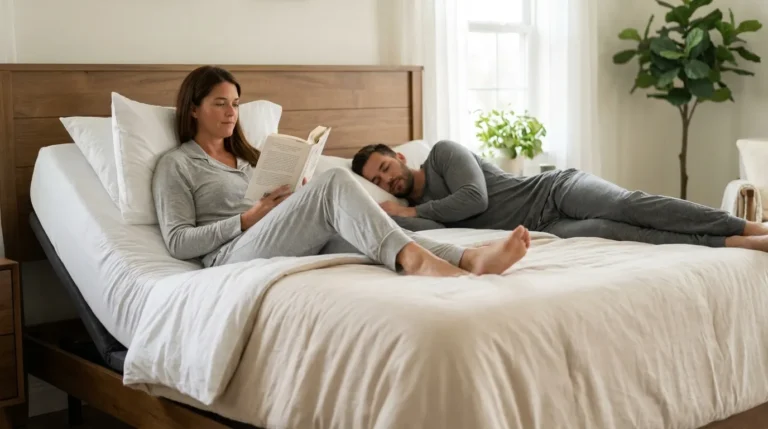
Hip and knee pain: Memory foam’s pressure-distributing properties reduce load on painful joints. Elevating the foot of the bed slightly can further reduce pressure on the knees. An adjustable base lets you set this elevation precisely instead of relying on stacked pillows.
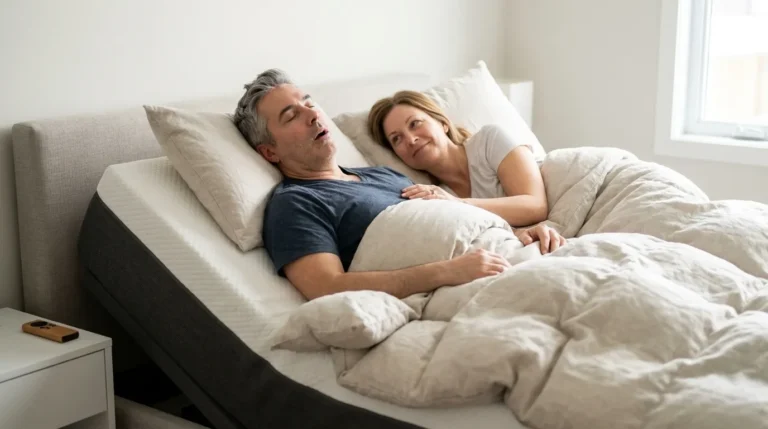
Mild sleep apnea and snoring: Head elevation can reduce airway obstruction (see the FAQ on sleep apnea for more detail). A flat mattress cannot maintain this position through the night. Leva Sleep’s adjustable bases allow continuous head elevation.
Motion transfer: A partner who wakes frequently or shifts positions often disrupts the other’s sleep on a traditional innerspring. Memory foam absorbs much of this movement. On a split adjustable base, each side operates independently, so one partner changing elevation does not move the other side.
Decision Checklist for Canadian Memory Foam Buyers
Use the following criteria when evaluating any memory foam mattress purchase in Canada.
Size and split configuration: A Split Queen, which uses two 30-inch mattresses on independent bases, suits couples in smaller bedrooms where space is tight. If you have more room and want maximum personal space, a Split King with two Twin XL mattresses gives each partner 8 inches more width than a Split Queen. Leva Sleep is one of the few Canadian retailers offering Split Queen configurations built to specification.
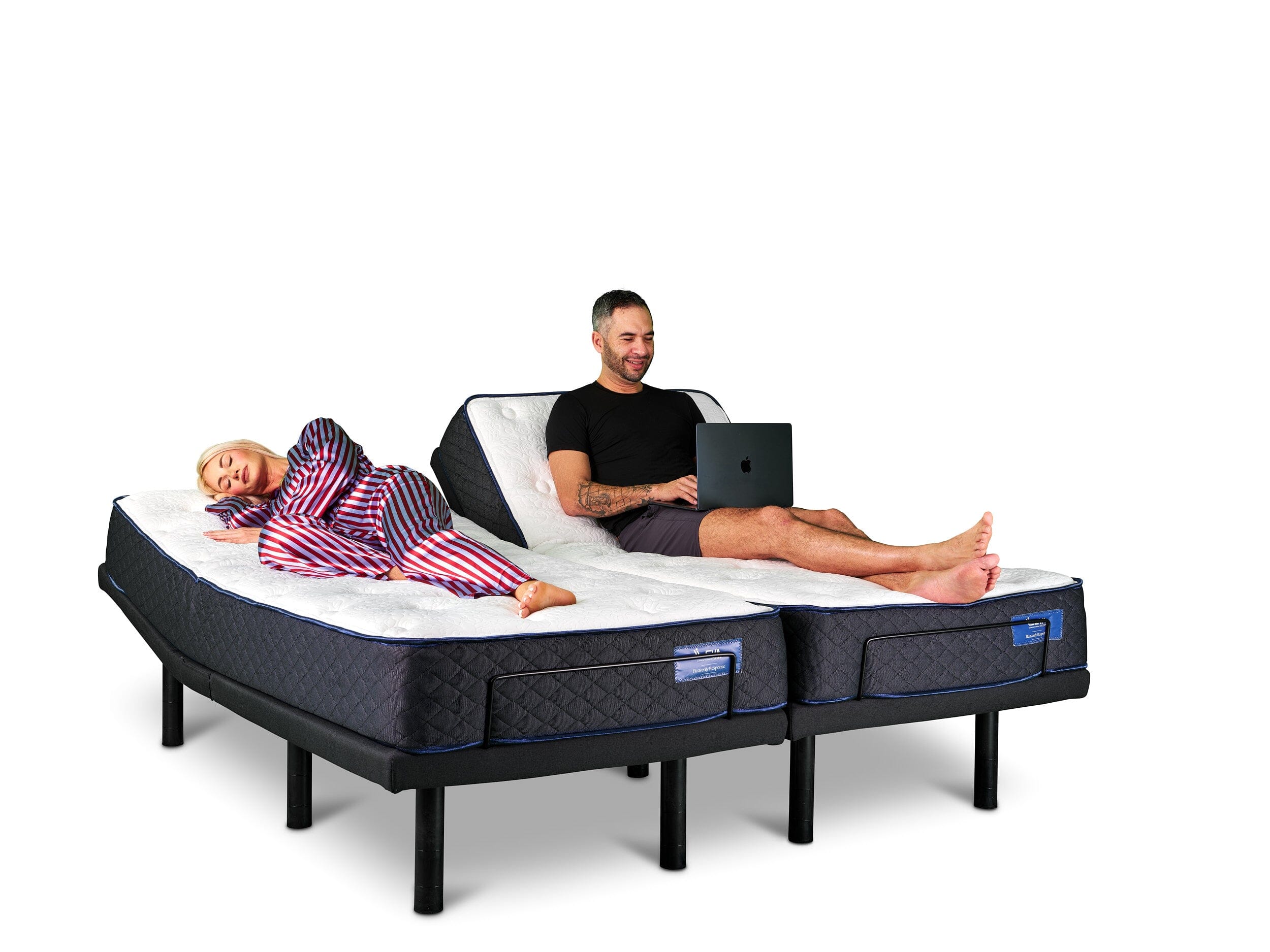
Firmness per sleeper: Match firmness to sleep position and body weight instead of relying on a single label. Side sleepers under 130 lbs usually need a softer ILD. Back sleepers over 200 lbs usually need a firmer one. On a split system, each side can be specified independently.
Edge support: Memory foam compresses more at the perimeter, which can make sitting on the edge harder and reduce the feeling of security near the border. Hybrids with reinforced edge coils perform better in this area. If edge support matters to you, ask directly about perimeter reinforcement.
Certifications: Look for CertiPUR-US certification, which confirms the foam has been tested for harmful chemical emissions, heavy metals, and formaldehyde. OEKO-TEX Standard 100 covers fabric covers and other materials.
Trial period and warranty: Most Canadian online mattress brands offer trial periods from 100 to 365 nights. Warranties for quality constructions often range from 10 to 20 years. Read the fine print on what counts as a defect, since sagging depth thresholds vary by brand.
Canadian pricing: Quality all-foam memory foam mattresses in Canada typically range from $800 to $1,800 for a Queen, depending on density, layer count, and brand. Leva Sleep’s vertically integrated model positions its systems at 30–50% below comparable luxury competitors by removing retail markup.
Honest Trade-Offs With Memory Foam Mattresses
Memory foam offers clear benefits, but it also has limitations that buyers should weigh carefully.
Heat retention: Dense viscoelastic foam traps more body heat than open-cell foams, latex, or coil-based constructions. Gel infusions and open-cell processing can reduce heat buildup but do not remove it entirely. Sleepers who already run warm should focus on hybrid constructions or systems with active temperature regulation.
Off-gassing: New memory foam mattresses release a chemical odour that typically fades within a few days in a well-ventilated room. CertiPUR-US certified foams, discussed earlier, limit VOC emissions, although sensitive individuals may still notice the smell for longer. Unboxing in a ventilated space and waiting about 48 hours before sleeping on the mattress is a practical precaution.
Durability: Lower-density foams under 3 lb/ft³ develop body impressions more quickly, often within 3–5 years. Higher-density foams in the 4–5 lb/ft³ range maintain their structure longer but cost more. A sagging comfort layer that exceeds the warranty threshold, often 1–1.5 inches, is the most common failure mode.
Response time: Slow-recovery foam does not suit combination sleepers or people who need to reposition frequently due to pain. A hybrid with a more responsive comfort layer over a memory foam transition layer can blend pressure relief with a faster surface feel.
Hybrid designs often work better for couples where one or both partners sleep hot, for combination sleepers who change positions frequently, and for anyone who values edge support or a quicker response over a deeply conforming feel.
Owning a Split Adjustable Bed in Canada
Buying a split adjustable system in Ontario or Alberta involves a few extra logistics compared with a standard mattress purchase.
Delivery: Split adjustable bases use two independent frames plus two mattresses, which require coordinated delivery and in-room assembly. Standard courier delivery leaves components at the door. Leva Sleep’s white-glove delivery service, available for a fee, brings the system to the bedroom, assembles the frames, adjusts leg heights, connects the app, and removes the old bed, donating or recycling it when possible.
Sheets and bedding: Standard fitted sheets often pop off adjustable bases when the head or foot is elevated. Sheets need deep pockets of at least 15 inches and reinforced elastic around the full perimeter. Leva Sleep designs fitted sheets specifically for adjustable bases to prevent this sheet-popping issue.
Mattress protectors: A waterproof, adjustable-base-compatible protector is essential for warranty coverage and hygiene. Confirm that the protector is labelled as suitable for articulating bases. Rigid protectors can crack or restrict movement.
Rotation: Most memory foam mattresses use no-flip, single-sided constructions. Rotating the mattress head-to-foot every 3–6 months spreads wear more evenly. On a split adjustable base, rotation is easier because each mattress is lighter and handled separately.
Common mistakes to avoid: Placing a memory foam mattress on a solid platform without ventilation increases heat retention and can encourage moisture buildup. Slatted bases or adjustable frames with open surfaces allow airflow beneath the mattress. View complete packages that include the base, mattress, and adjustable-base-specific bedding accessories.
Frequently Asked Questions
What are the downsides of a memory foam mattress?
The main downsides are heat retention, slow response time, limited edge support, and off-gassing when new. Dense memory foam traps more body heat than hybrid or innerspring constructions, which can bother warmer sleepers. The slow recovery that makes memory foam effective at motion isolation also makes repositioning feel sluggish, which frustrates some combination sleepers. Edge support is usually weaker than in hybrid mattresses with reinforced perimeter coils. New mattresses emit a chemical odour from manufacturing that fades within a few days in a ventilated room. For couples, a single flat memory foam mattress also cannot handle two different firmness preferences at once, which a split adjustable system solves by letting each side be configured independently.
Are memory foam mattresses suitable for sleep apnea?
Memory foam alone does not treat sleep apnea. The material provides pressure relief and motion isolation, but it cannot elevate the head to open the airway. Head elevation is the positional change most often recommended for mild obstructive sleep apnea. Pairing a memory foam mattress with an adjustable base that allows head elevation is the relevant combination. Elevating the head of the bed reduces the gravitational collapse of soft tissue in the throat that contributes to airway obstruction. Leva Sleep’s adjustable bases allow precise head elevation. For diagnosed sleep apnea, follow the guidance of a sleep physician. Positional therapy usually suits mild cases and can complement other treatments.
Do memory foam mattresses sleep hot?
Traditional dense memory foam retains more heat than open-cell foam, latex, or coil-based constructions because the closed-cell structure limits airflow. Manufacturers address this with gel infusions, open-cell processing, copper infusions, and phase-change material covers. These features reduce heat retention to varying degrees but do not remove it completely. Sleepers who already run warm are more likely to notice the difference. Hybrid constructions with a pocket-coil support layer allow more airflow beneath the comfort layer and usually sleep cooler. For couples where one partner is heat-sensitive, Leva Sleep’s systems offer an integrated heating and cooling pad that regulates temperature independently on each side of the bed, which tackles the issue more directly than foam chemistry alone.
How long does memory foam off-gas?
Off-gassing refers to the release of volatile organic compounds (VOCs) from the foam’s manufacturing process. The noticeable chemical odour usually dissipates within a few days when the mattress is unpacked in a well-ventilated room. In enclosed spaces with limited airflow, the smell can last up to a week. CertiPUR-US certified foams are independently tested to confirm that VOC emissions fall below established safety thresholds, which gives health-conscious buyers a useful baseline. Allowing the mattress to air out for at least 48 hours before sleeping on it is a sensible precaution, especially for people with chemical sensitivities or respiratory conditions.
Can memory foam work on an adjustable base?
All-foam memory foam mattresses are among the most compatible constructions for adjustable bases because they bend freely without much resistance. The mattress must not contain rigid internal components, such as interconnected coil systems or solid foam borders, that would block articulation. Hybrid mattresses with individually wrapped pocket coils are also generally compatible, as long as the coil gauge and foam layer thickness allow enough flex. Traditional innerspring mattresses with interconnected Bonnell coils do not suit adjustable bases. When purchasing, confirm with the retailer that the specific mattress is rated for adjustable-base use. Leva Sleep designs all of its mattresses, both all-foam and hybrid, to articulate with its adjustable frames, and the mattresses are sold as integrated packages to ensure compatibility.
Conclusion: Matching Memory Foam and Adjustable Bases to Your Relationship
Memory foam provides strong pressure relief and motion isolation, especially for side-sleeping couples. Its limitations include heat retention, slow response, weaker edge support, and the inability to support two different firmness preferences on a single flat surface.
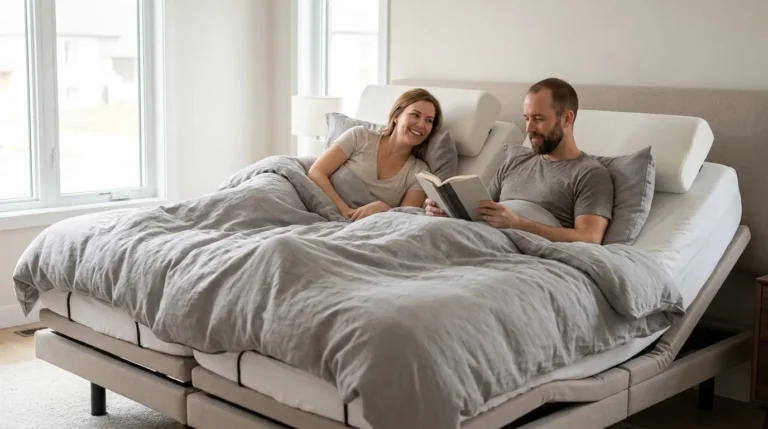
For many couples in Ontario and Alberta, the real decision is not only which memory foam mattress to buy, but whether any flat mattress format fits their needs. A split adjustable base with independently specified mattresses on each side removes the firmness compromise, adds elevation for snoring and sleep apnea management, and cuts motion transfer at the base level as well as at the foam level.
Before purchasing, review your sleep positions, temperature preferences, any medical advice about elevated sleeping, and whether your current setup forces either partner to compromise. If more than one of these factors is in play, a split adjustable system deserves serious consideration over a standalone flat mattress.
Leva Sleep has served over 25,000 Canadian customers across more than eight years, with split Queen and King configurations, in-house white-glove delivery in Ontario and Alberta, and pricing 30–50% below comparable luxury competitors. Explore complete packages designed to work together from the first night.