Written by: Matthew Timmins, Founder and Managing Director, Leva Sleep | Last updated: June 19, 2026
Key Takeaways for Canadian Couples
- Motion isolation is the top priority for couples who want uninterrupted sleep, because partner movement often triggers nighttime awakenings.
- Traditional innerspring and basic hybrid mattresses allow noticeable motion transfer. All-foam memory foam reduces transfer at first but usually degrades over 7–10 years.
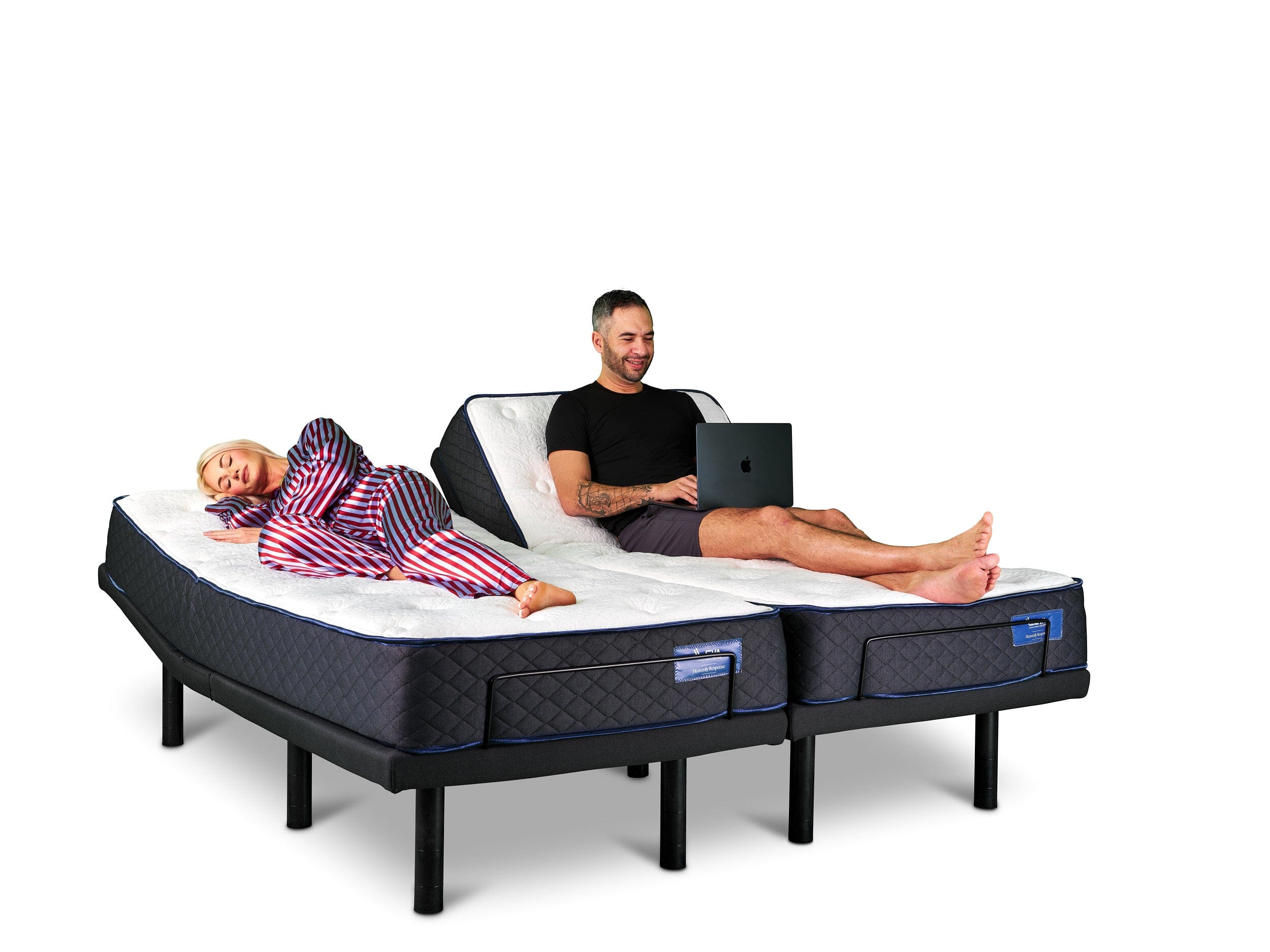
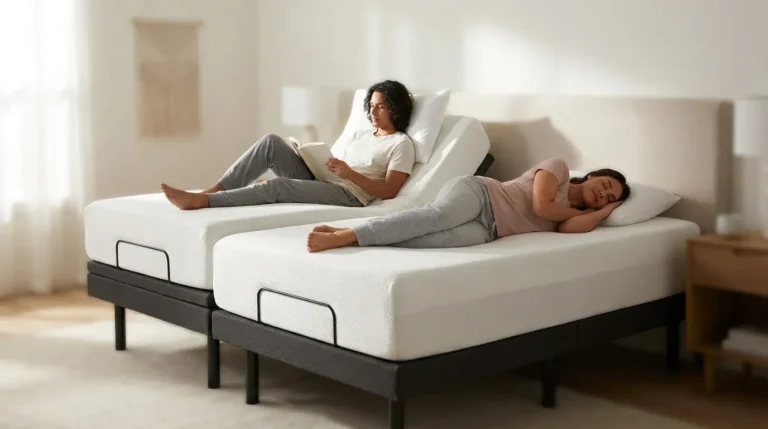
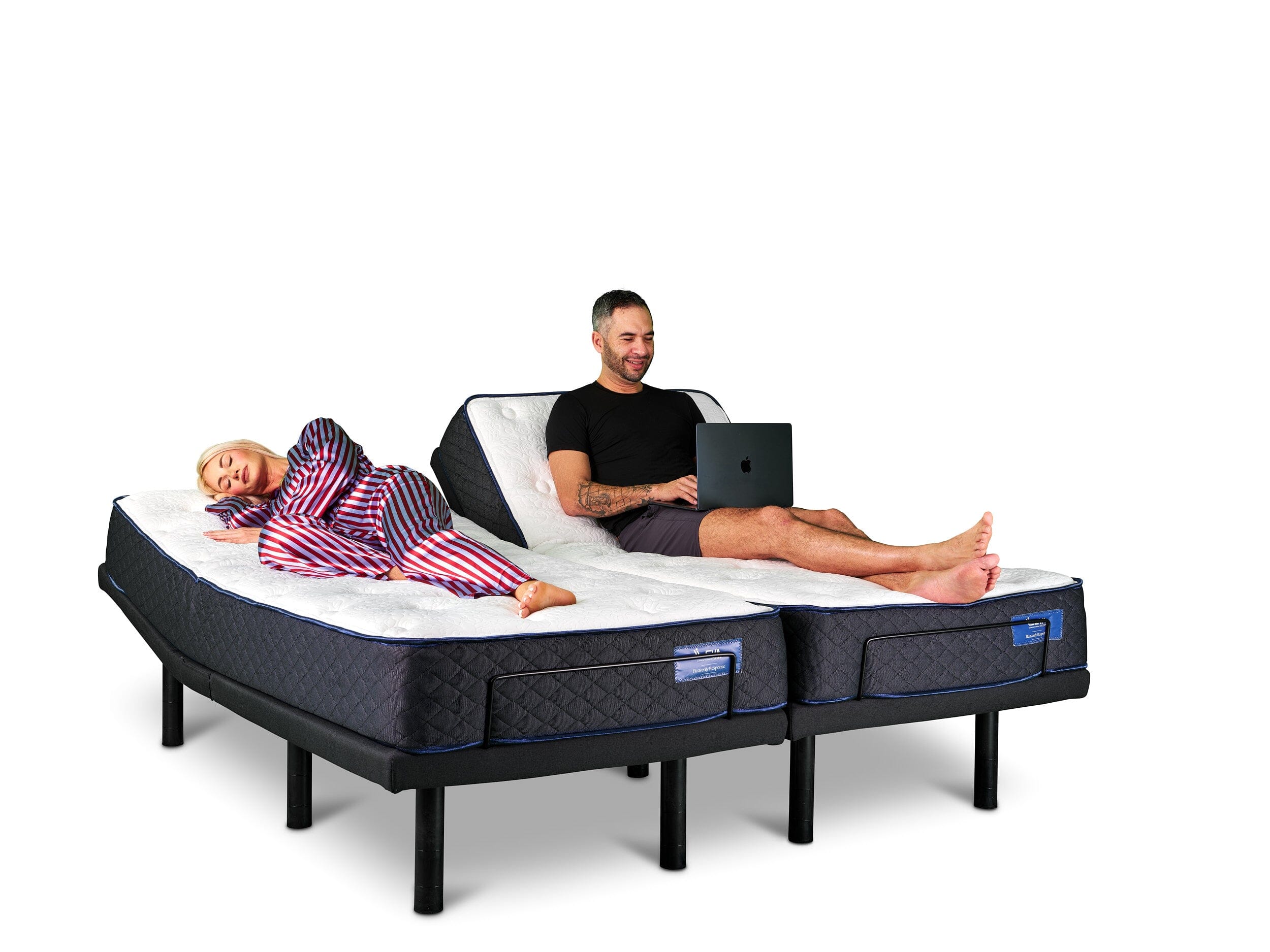
- Split adjustable sleep systems use a physical gap between mattresses to stop motion transfer and give each partner independent head, foot, and lumbar control.
- Quiet motors, app controls, and Leva Sleep’s upcoming anti-snore mode help with snoring, temperature, and medical needs that foam alone cannot address.
- Canadian couples in Ontario and Alberta can explore Leva Sleep’s adjustable bed packages for split configurations, white-glove delivery, and long-term motion isolation.
Motion Isolation Basics and When Couples Need a Change
Motion isolation describes how well a mattress or sleep system absorbs movement so that activity on one side does not disturb the other side. Labs measure this with accelerometer-based seismograph tests. A weighted object drops on one side of the mattress while sensors track vibration on the opposite side. The glass-of-water test offers a simpler version, where minimal ripple in the water signals strong motion control.
Understanding how motion isolation works helps couples notice when their current bed no longer supports restful sleep. Couples usually reach a tipping point when one or more issues become constant. These include chronic snoring or diagnosed sleep apnea, restless legs, very different firmness or position preferences, recovery that requires elevation, or recurring hip, knee, or back pain. Many people feel partner movement several nights a week. When that disturbance becomes nightly, couples start looking seriously at new solutions.
Why Traditional Mattresses and Basic Adjustable Bases Fall Short
Not all sleep surfaces handle motion the same way. Traditional innerspring mattresses with interconnected coils rate lowest for motion isolation because movement travels easily through the linked coil network. Hybrid mattresses with pocketed coils improve performance, yet hybrids like the Leesa Sapira Chill and Helix Midnight Luxe often score lower for motion isolation than all-foam designs.
All-foam mattresses usually perform best in passive isolation tests. Memory foam often produces lower motion transfer than pocketed coils. However, memory foam that isolates motion well when new loses effectiveness as the material compresses, and most mattresses provide 7–10 years of strong isolation before compression reduces performance.
Basic adjustable bases introduce different limits. A single adjustable frame with one shared surface still passes movement across the bed when one partner changes position. Older or entry-level motors can be loud enough to wake a light sleeper. Foam mattresses and basic adjustable bases also do not solve independent elevation, temperature differences, or snoring, which are common pain points for couples.
| Feature | Traditional Innerspring | All-Foam Memory Foam | Split Adjustable System |
|---|---|---|---|
| Motion isolation (measured) | Lowest rated (1/5 stars) | Up to 5/5 (Mattress Clarity 2026) | Physical separation eliminates transfer entirely |
| Independent elevation per partner | None | None | Full independent control per side |
| Long-term isolation durability | 6–8 years before degradation | ~10 years; degrades with compression | Physical gap is permanent, mattress lifespan applies per side |
| Snoring or apnea support | None | None | Head elevation and anti-snore mode available |
How Split Adjustable Sleep Systems Solve Motion Transfer
Split king setups use two Twin XL mattresses on separate bases, and the physical break between them stops motion transfer entirely. Split frames now hold a meaningful share of the adjustable bed market. The same idea applies to Split Queen layouts, which deliver independent control in a smaller footprint.
In a split adjustable system, each side of the bed runs on its own controls. Each partner manages head and foot elevation, massage intensity, and, in advanced models, lumbar support and temperature features. Whisper-quiet motors allow position changes without waking the other person. App controls store favourite positions, enable vibrating alarms, and support small mid-night adjustments.
Leva Sleep’s anti-snore mode, scheduled for spring 2026, will detect snoring and make small head adjustments that may reduce or stop it. This active response goes beyond foam mattresses, which only soften motion and do not address the cause of disruption. Leva also offers a Split Queen configuration for couples who want independent control without needing a king-sized room.
How to Evaluate Split Adjustable Systems Before You Buy
Independent Adjustability Features
- Confirm that each side uses its own motor and controller, not a shared mechanism, because shared motors limit true independence.
- After confirming independence, check that each side offers separate head elevation, foot elevation, and lumbar zones instead of a single hinge point.
- Verify that the app includes position memory and a quiet mode so you can save settings and adjust positions without waking your partner.
Mattress Compatibility and Foam Quality
- Ask whether the mattress is built for adjustable bases, since standard mattresses can crack or delaminate under repeated bending.
- Confirm the foam density. Densities of at least 4–5 lb per cubic foot usually support stronger, longer-lasting motion isolation.
- Consider both all-foam and hybrid pocket-coil options, then choose based on feel preference and how much isolation you need.
Noise Levels and Structural Stability
- Request motor noise specifications or a live demo. Louder actuators can undermine the benefit of quiet repositioning.
- Confirm that the foundation feels rigid. Weak or sagging foundations pass movement and create extra noise, which reduces isolation.
Bedding Fit for Split and Adjustable Beds
- Choose deep-pocket sheets with strong elastic or split-top designs, since standard fitted sheets often pop off during elevation.
- Use duvet clips or split duvets so the shared top layer does not pull when one partner raises their side.
Delivery, Setup, and Local Service
- Confirm whether delivery includes in-room setup, leg-height adjustment, and a walkthrough, or if it is curbside only.
- For buyers in Ontario and Alberta, check that the retailer offers local assembly and old-bed removal instead of a self-assembly box drop.
Real-World Results Couples Can Expect
A 2020 actigraphy study from Monash University followed 55 couples and found that wake transmissions from a partner’s movement contributed to nighttime awakenings. Physical separation, as in a split system, removes those transmissions and reduces awakenings without forcing either partner to change habits.
Independent elevation also supports health needs that foam alone cannot handle. Raising the head of the bed can open the airway for mild sleep apnea or chronic snoring. Elevating the feet can ease pressure on knees and hips for people recovering from surgery or living with joint pain.
When each partner controls their own side, neither person has to compromise on position. Couples who moved from separate rooms back to a shared bed after adopting split adjustable systems often credit the combination of zero motion transfer and independent positioning, rather than foam density alone.
Decision Guide: Foam Mattress or Split Adjustable System?
Use these criteria to choose the right path for your shared bed.
- Motion isolation longevity: As noted earlier, foam isolation performance usually declines over a 7–10 year lifespan, while the split system’s physical gap remains constant and only the mattress materials age.
- Independent control: If both partners share similar firmness preferences and sleep positions, a high-density foam mattress may work. If you differ on elevation, firmness, temperature, or snoring needs, a split system is the only option that manages all of these at once.
- Total cost of ownership: A premium all-foam mattress comparable to Tempur-Pedic needs replacement every 7–10 years and still cannot elevate or reduce snoring. A split adjustable system from a direct-to-consumer specialist often costs 30–50% less than luxury brands and functions as a complete sleep platform.
- Medical needs: If a doctor recommends sleeping elevated for sleep apnea, acid reflux, recovery, or joint pain, a flat mattress cannot meet that advice, regardless of foam quality.
- Space constraints: Split King requires a king-sized footprint. Split Queen delivers the same independent control in a smaller size and is currently available from Leva Sleep, while many general retailers do not offer it.
Frequently Asked Questions
How do independent tests measure motion isolation?
Labs rely on two main methods. The glass-of-water test places a full glass on one side of the mattress while a person moves on the other side. Minimal ripple or no spill suggests strong isolation. The more precise method uses an accelerometer or seismograph. A weighted object drops on one side while sensors on the other side record vibration in metres per second squared. Lower readings show better containment.
Some labs also run human-partner tests, where a light sleeper reports disturbance while a restless partner moves. Results change with mattress construction, density, and age, so comparisons work best within the same testing method.
Do memory foam mattresses keep their isolation over time?
Memory foam usually delivers strong motion isolation when new, especially at densities of 4–5 lb per cubic foot or higher. Foam compresses with use, though, and body impressions reduce its ability to absorb movement. Most memory foam mattresses keep acceptable isolation for about 7–10 years before many people notice a decline. Lower-density foams often wear out faster.
The physical separation in a split adjustable system does not compress, so the gap between the two halves stays the same over time. The mattresses still age normally, but the structural barrier that blocks motion remains.
What delivery options are available for adjustable beds in Canada?
Delivery varies by retailer. Bed-in-a-box brands usually provide curbside or threshold delivery and leave assembly to the customer. Many furniture stores offer room-of-choice delivery but may not have staff trained on adjustable bases. Specialist retailers such as Leva Sleep provide white-glove delivery for a fee, which includes in-room placement, full assembly, leg-height setup, removal of the old bed through donation or recycling, and a short tutorial.
Adjustable bases involve motors, app pairing, and careful height calibration, so professional setup can make a clear difference. Leva Sleep currently offers this in-house service across Ontario and Alberta.
Can split adjustable beds support sleep apnea or recovery needs?
Head elevation can reduce airway collapse in mild obstructive sleep apnea by using gravity to keep the tongue and soft palate from blocking the throat. This does not replace CPAP therapy, which uses pressurized air, but it often works as a helpful complement. For post-surgical recovery, especially hip, knee, or abdominal procedures, raising the head or feet can reduce swelling, ease pressure, and make getting in and out of bed easier.
A split adjustable system lets the recovering partner stay elevated all night without forcing the other partner into the same position. Leva Sleep’s anti-snore mode, arriving in 2026, will add automated micro-adjustments that respond to snoring in real time and extend the system’s usefulness.
Conclusion: Choosing Better Sleep for Two
Partner movement ranks among the most common and fixable causes of disrupted shared sleep. Dense memory foam can reduce passive motion transfer when new, yet it cannot provide independent elevation, cannot fully support differing medical needs, and loses performance as it compresses. Split adjustable systems solve motion transfer with a permanent physical gap and give each partner control over elevation, firmness, temperature tools, and snoring response.
For couples in Ontario and Alberta, Leva Sleep offers 15–20 adjustable models, including the hard-to-find Split Queen, with quiet motors, app control, tailored bedding, and in-house white-glove delivery at prices often 30–50% below comparable luxury brands.