Assuming tolerance eliminates the problem. Even regular daily caffeine consumers experience delayed REM sleep onset and reduced subjective sleep quality, so tolerance never fully develops for caffeine’s sleep-disrupting effects.
Step 2: Use the 4–6 Hour Alcohol Rule to Protect REM Sleep
The Ebrahim et al. (2013) review found that moderate and high doses decrease total-night REM sleep percentage and increase sleep disruption in the second half of the night. Alcohol consumed at bedtime can suppress REM sleep and fragment the later part of the night. The goal is to reach a BAC below 0.05 before sleep onset, which usually takes 4–5 hours after four standard drinks and 2–3 hours after two drinks.
Women often experience greater sleep disruption from alcohol than men, so the 6-hour end of the range is the safer target for most women aged 35–55.
Step 4: Swap Evening Habits with Three Sleep-Friendly Rituals
Evening caffeine and alcohol often act as decompression rituals after a long day. Replacing the ritual, not just the drink, keeps the new habit sustainable.
Morning or afternoon sunshine break: A bedtime ritual that aligns with circadian rhythms should start about one hour before regular bedtime. Anchoring that rhythm with morning light exposure strengthens the circadian signal and makes evening wind-down easier.
For someone currently consuming about 400 mg daily, roughly four cups of coffee, a 14-day schedule might look like this:
Days 1–4: Reduce to about 300 mg, approximately three cups of coffee. Shift the last cup 30 minutes earlier than your current habit.
Days 5–9: Reduce to about 200 mg, approximately two cups. Enforce the 8-hour cutoff strictly.
Days 10–14: Reduce to about 100 mg, approximately one cup. Use the 10-hour cutoff if sleep still feels fragmented.
The same gradual approach also helps with alcohol and keeps the new timing realistic. Reduce by one standard drink per occasion every 3–4 days, and move the last drink progressively earlier until you consistently meet the 4–6 hour window. This parallel taper lets you adjust both substances at once without overwhelming your routine.
Step 6: Use the 14-Day Sleep and Substance Log
Copy this table into a notes app, spreadsheet, or print it out. Fill it in each morning within five minutes of waking so the details stay accurate.
Day & Date
Last Caffeine (time + mg)
Last Alcohol (time + drinks)
Sleep Notes (bedtime, wake time, quality 1–5)
Day 1 — ___/___
Day 2 — ___/___
Day 3 — ___/___
Day 4 — ___/___
Day 5 — ___/___
Day 6 — ___/___
Day 7 — ___/___
Day 8 — ___/___
Day 9 — ___/___
Day 10 — ___/___
Day 11 — ___/___
Day 12 — ___/___
Day 13 — ___/___
Day 14 — ___/___
After 14 days, compare your Day 1–3 average quality score with your Day 12–14 average. A gain of 1 or more points, or fewer 3 AM wake-ups, confirms that the protocol is working. If scores remain flat, move on to Step 7.
Step 7: Upgrade the Sleep Environment When Habits Are Not Enough
Caffeine and alcohol timing improvements address biochemical disruption to sleep architecture. These changes fix how your body processes sleep, not where your body sleeps. They do not resolve structural issues such as a partner’s snoring that wakes you repeatedly, incompatible firmness preferences that leave one person in pain, or the need for elevated positioning due to sleep apnea, acid reflux, or hip and knee pain. When the 14-day log shows strong substance timing but your sleep still feels fragmented, the sleep environment itself becomes the key variable.
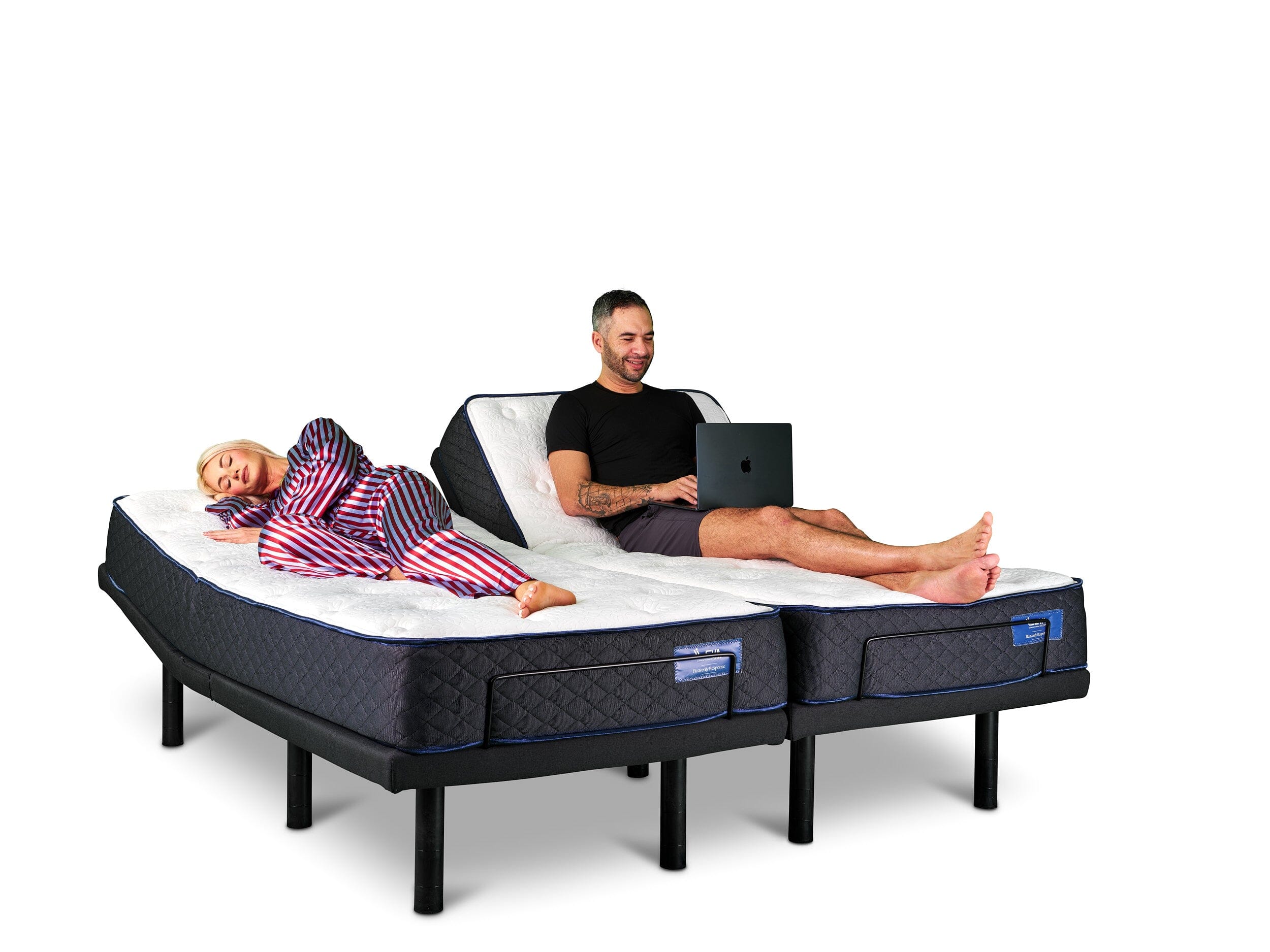
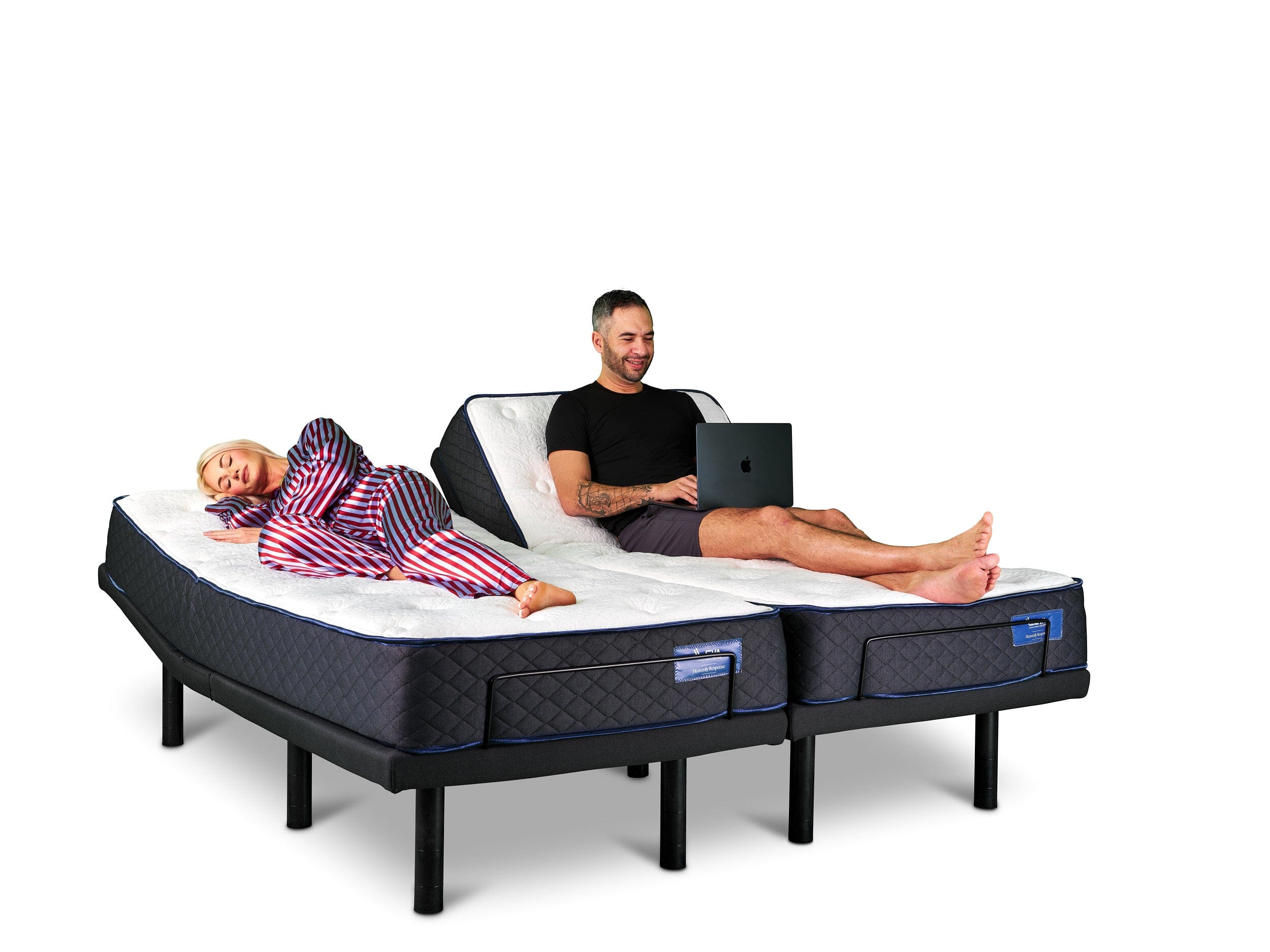
Leva Sleep’s Split Queen and Split King adjustable bases give each partner independent control over head and foot elevation, massage intensity, and, with the anti-snore mode arriving spring 2026, automatic micro-adjustments that respond to detected snoring. Whisper-quiet German motors keep position changes smooth so one partner’s movement does not wake the other. Because Leva designs, assembles, and delivers its systems in-house across Ontario and Alberta, prices run about 30–50% below comparable luxury competitors. White-glove delivery includes bedroom setup, old-bed removal, and a full product tutorial.
Leva Sleep Split Queen Bed
Couples who have tried lifestyle tactics and still face sleep divorce often need a structural solution. A split adjustable base offers that next step, giving both partners personalised support while staying in the same bed.
How long does it take to see sleep improvements after cutting evening caffeine and alcohol?
Most adults notice measurable changes within the first week. Caffeine withdrawal symptoms such as headache and mild fatigue typically peak around day 2 and resolve within 2–9 days. Once the taper is complete and the 8–10 hour cutoff is consistently applied, sleep latency and deep sleep duration usually begin to normalise. Alcohol-related improvements often arrive faster, since even a single night of observing the 4–6 hour rule can reduce the characteristic 3 AM wakeup. The 14-day tracker above lets you measure the change objectively instead of relying only on memory.
Is the 8–10 hour caffeine cutoff the same for everyone?
The 8–10 hour window works as a population-level starting point, not a fixed rule for every person. Individual metabolism is governed largely by the CYP1A2 gene: approximately 40% of people are fast metabolisers who may tolerate a 6–8 hour cutoff, while roughly 10% are slow metabolisers who may need 12 or more hours. Age also matters, because adults over 40 metabolise caffeine more slowly on average. Oral contraceptive use roughly doubles caffeine half-life. The practical approach is to start with the 8-hour rule, track sleep quality in the log, and extend the cutoff by 30–60 minutes every 3–4 days until quality scores stabilise. Wearable sleep trackers that report deep sleep and REM duration can speed up this personalisation.
Does the type of alcohol matter, or is the timing rule the same for wine, beer, and spirits?
The timing rule applies to total ethanol consumed, not the specific beverage. One standard Canadian drink, which is 341 mL of 5% beer, 142 mL of 12% wine, or 43 mL of 40% spirits, delivers approximately 13.6 g of ethanol and produces a similar rise in blood alcohol concentration. What changes is how quickly BAC rises. Carbonated mixers accelerate absorption, and drinking on an empty stomach raises peak BAC faster. The 4–6 hour window is calculated from the last drink. For three or more drinks, the 6-hour end of the range is more appropriate regardless of beverage type. Women should default to the 6-hour rule because of documented differences in alcohol metabolism.
What should couples do when one partner follows the protocol but the other does not?
Mismatched habits are common, and one partner can still benefit even if the other does not change. The partner applying the protocol will see personal sleep improvements regardless. However, if the non-participating partner’s snoring, restlessness, or late-night activity continues to fragment the other person’s sleep, lifestyle changes alone have a ceiling. This situation calls for a structural fix. A split adjustable base addresses that problem through independent elevation, independent massage, and independent positioning so one partner’s habits do not dictate the other’s sleep quality. Leva Sleep’s Split Queen is particularly helpful for couples in standard queen-sized rooms who want split adjustability without moving up to a king.
Conclusion: Your 14-Day Recap and Next Step Decision Guide
The protocol stays simple when you focus on timing and tracking. Apply the 8–10 hour caffeine cutoff starting today. For a 10:30 PM bedtime in Toronto or Calgary, that means no caffeine after 2:30 PM at the latest, and noon if you suspect slow-metaboliser status. Delay your first morning coffee by 90 minutes to match the cortisol awakening response. Finish alcohol at least 4–6 hours before bed and replace the evening ritual with herbal tea, a tart-cherry mocktail, or a 10-minute breathing routine. Taper both substances gradually over 14 days while using the log above to track objective progress.
At day 14, review your log. If quality scores have improved by at least one point and 3 AM wake-ups have decreased, the protocol is working, so keep going. If scores remain flat despite consistent effort, the sleep environment is likely the remaining variable. A split adjustable base with independent controls, anti-snore technology, and whisper-quiet motors can address what caffeine and alcohol timing cannot.