Written by: Matthew Timmins, Founder and Managing Director, Leva Sleep | Last updated: July 17, 2026
Key Takeaways for Canadian Couples
- Sleep divorce can protect sleep when snoring and movement are severe, but it often reduces intimacy and nightly closeness.
- Traditional mattresses and single adjustable bases cannot support two very different sleep needs at the same time.
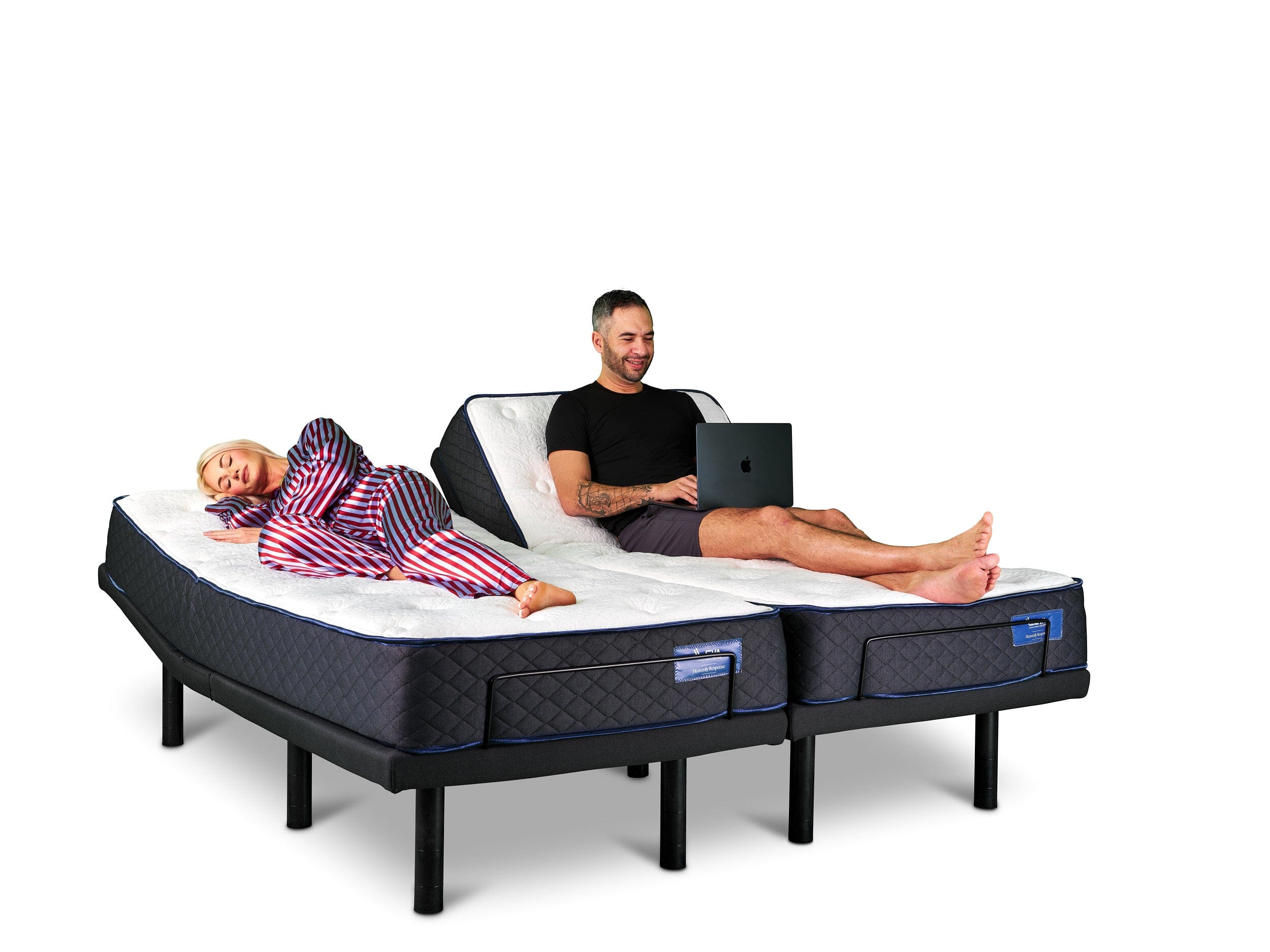
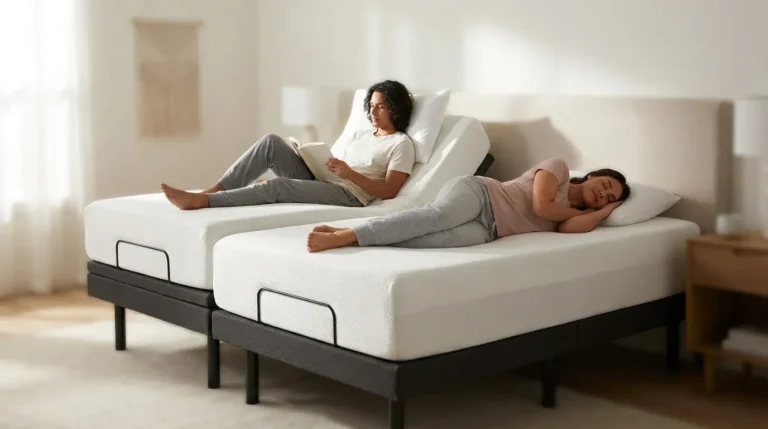
- Split adjustable beds give each partner independent control of elevation, firmness, and features without disturbing the other side.
- Head elevation on adjustable beds can reduce snoring, mild sleep apnea symptoms, and acid reflux for many sleepers.
- Leva Sleep offers Split Queen and Split King adjustable bed packages designed for Canadian couples who want better rest together. Compare Leva Sleep’s adjustable bed packages.
Why Traditional Beds and Separate Rooms Let Couples Down
A standard flat mattress cannot support two people with very different sleep needs. Traditional open-coil and innerspring mattresses transfer motion easily because interconnected springs send vibrations across the entire surface. Seventy-five percent of people who share a bed with a snorer say the snoring affects their sleep, which shows how disruptive this can be.
Basic adjustable bases sold as add-ons at general furniture stores create a different compromise. A standard King adjustable base moves as one unit. If one partner needs head elevation for snoring or acid reflux while the other prefers to sleep flat, the single base forces a shared position. Older or entry-level bases can also produce noticeable mechanical noise during adjustment, which interrupts sleep instead of protecting it.
Separate rooms remove noise and movement but introduce a real intimacy cost. Over one-quarter of couples who try a sleep divorce eventually return to sharing a bed, and more than one-third of those returns happen because they miss physical closeness. Co-sleeping reduces stress and increases oxytocin, which supports emotional connection. Losing that nightly proximity is a meaningful trade-off. The real challenge is finding a way to solve the mechanical sleep problems without forcing couples into separate rooms.
How Split Adjustable Beds Support Two Different Sleepers
A Split King adjustable bed uses two Twin XL mattresses, each 38″ × 80″, on two independent adjustable bases placed side by side. Together they create the same 76″ × 80″ footprint as a standard King mattress while allowing each side to move separately. A Split Queen follows the same idea in a smaller format, using two 30″ × 80″ halves. This size is designed for adjustable beds so each side can move independently.
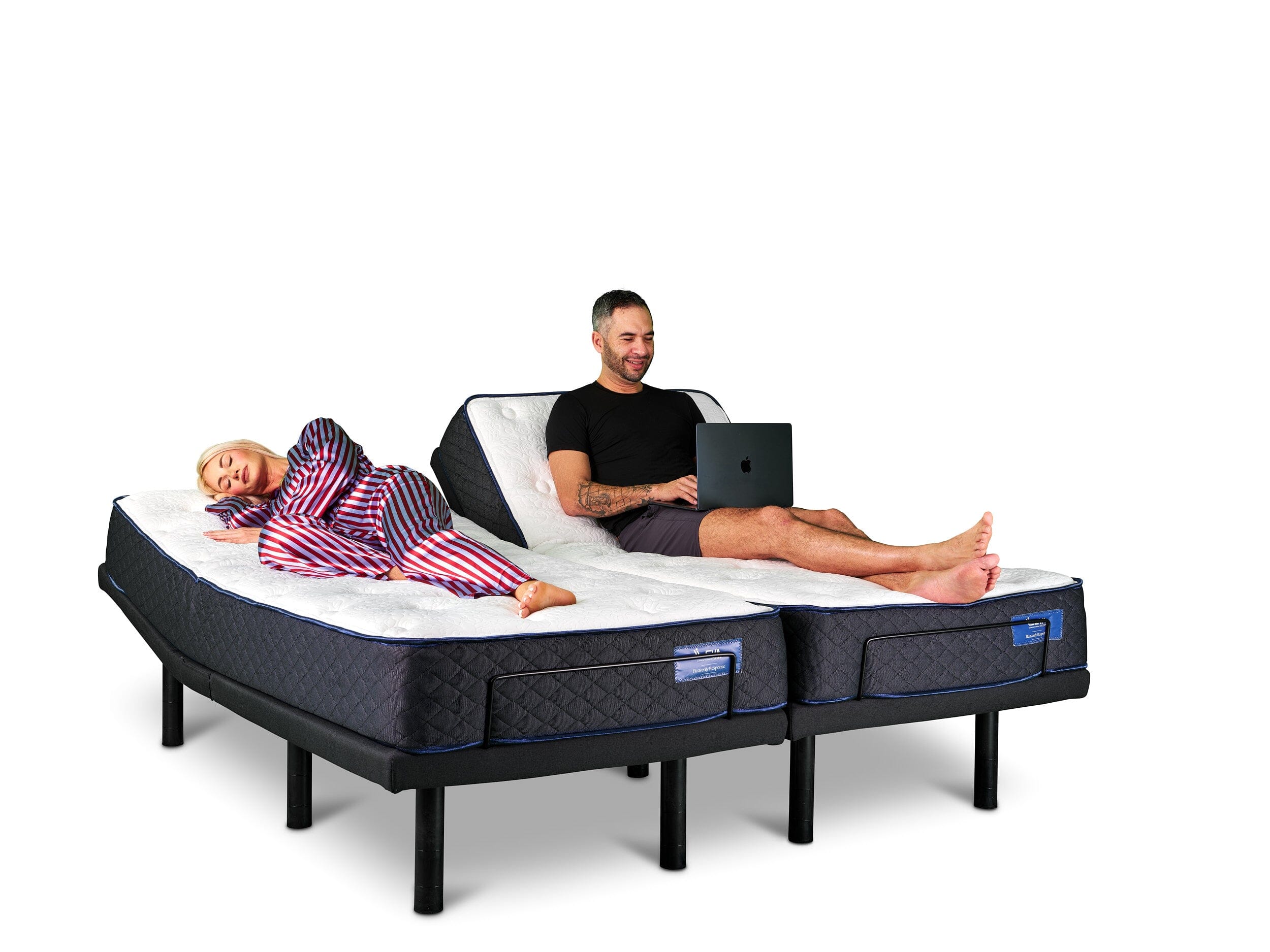
The clinical case for head elevation is strong. A 2017 study of 52 patients with mild to moderate obstructive sleep apnea found that 7.5-degree head-of-bed elevation reduced the apnea-hypopnea index. Positional therapy that includes head elevation can reduce apnea episodes. For acid reflux, a 1981 study using prolonged pH monitoring found that elevating the head of the bed improved acid clearance time but did not change how often reflux episodes occurred. This finding matters for the estimated 5 million Canadians who experience heartburn at least once a week.
Leva Sleep’s Split Queen and Split King systems are built for couples facing these issues. Each base runs on its own whisper-quiet German motor, so a 2 a.m. adjustment on one side does not disturb the other. The Leva Sleep app gives full independent control over each side, including custom saved positions, vibrating alarms, and the 2026 anti-snore mode. This feature detects snoring and makes small head adjustments to reduce airway obstruction without waking either partner. A 2022 SLEEP abstract on a comforter, not an adjustable base, reported increases of 21 minutes total sleep time and 5 minutes REM sleep versus baseline. Participants also reported higher comfort, which supports the value of thoughtful sleep technology.
Key Split Adjustable Bed Features That Matter for Couples
Split adjustable systems vary widely, so couples need a clear checklist. The criteria below work together as a complete evaluation framework, not a set of isolated features.
- Independent controls per side: Each base needs its own motor and remote or app control. A single-base King that moves as one unit does not solve the core couple problem of different sleep needs.
- Anti-snore mode and head elevation range: Raising the head of an adjustable bed 4–6 inches usually reduces snoring, and 20–30 degrees offers the strongest relief for moderate to heavy snorers. Confirm the base can reach this range and that the anti-snore preset activates automatically.
- Motor noise levels: Quiet motors protect both partners’ sleep. Ask for decibel ratings or read verified owner reviews that mention nighttime adjustments specifically.
- Mattress compatibility: Memory foam, latex, and most modern hybrid mattresses with pocketed coils work well on adjustable bases. Traditional innerspring mattresses with interconnected coils are too rigid and can be damaged by repeated movement. Leva Sleep designs its all-foam and hybrid pocket-coil mattresses to flex safely with its adjustable bases.
- Specialized bedding fit: Standard fitted sheets often pop off during elevation. Leva Sleep designs bedding accessories such as deep-pocket fitted sheets with extra elastic, duvet clips, mattress protectors, and remote pockets specifically for adjustable base use.
- Delivery and setup: A queen adjustable base typically weighs 50 to 136 kilograms, or 110 to 300 pounds. Professional white-glove delivery and setup are especially helpful for split configurations with two bases. Leva Sleep offers in-house white-glove delivery across Ontario and Alberta for a fee, including bedroom-level setup, leg height adjustment, a product tutorial, and removal of the old bed.
- Wall-hugger technology: Split King adjustable systems benefit from wall-hugger technology, which keeps users close to their nightstands during head elevation.
Costs, Room Size, and the Real Price of Sleep Divorce
In Canada, a complete Split King adjustable setup with two bases and two mattresses typically costs $2,000 to $6,000 CAD as of 2026. Leva Sleep’s direct-to-consumer model and vertical integration keep pricing roughly 30–50% below comparable luxury competitors while maintaining engineering quality and durable materials.
Space needs match a standard King or Queen. A Split King uses two Twin XL mattresses on separate bases to create a 76″ × 80″ surface, identical in floor space to a standard King. A standard King mattress works best in a room that is at least 10 × 12 feet, with 12 × 12 feet recommended. Couples can remove the small centre gap between the two Twin XL mattresses by using a foam bed bridge, a king-size mattress topper, or non-slip pads.
Sleep divorce carries its own financial and emotional costs. A second bedroom requires extra space or renovation, and the loss of nightly intimacy rarely appears in a budget. When a split adjustable bed addresses the root cause, such as snoring, reflux, pain, or temperature, the argument for separate rooms becomes much weaker.
Staying Close on a Split System: Intimacy Strategies That Work Together
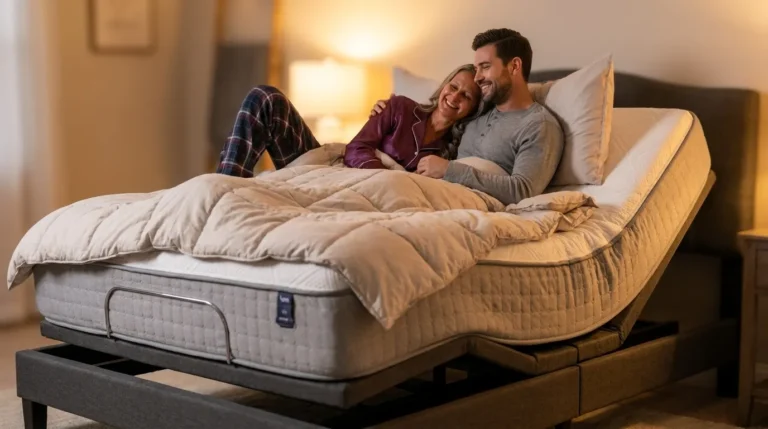
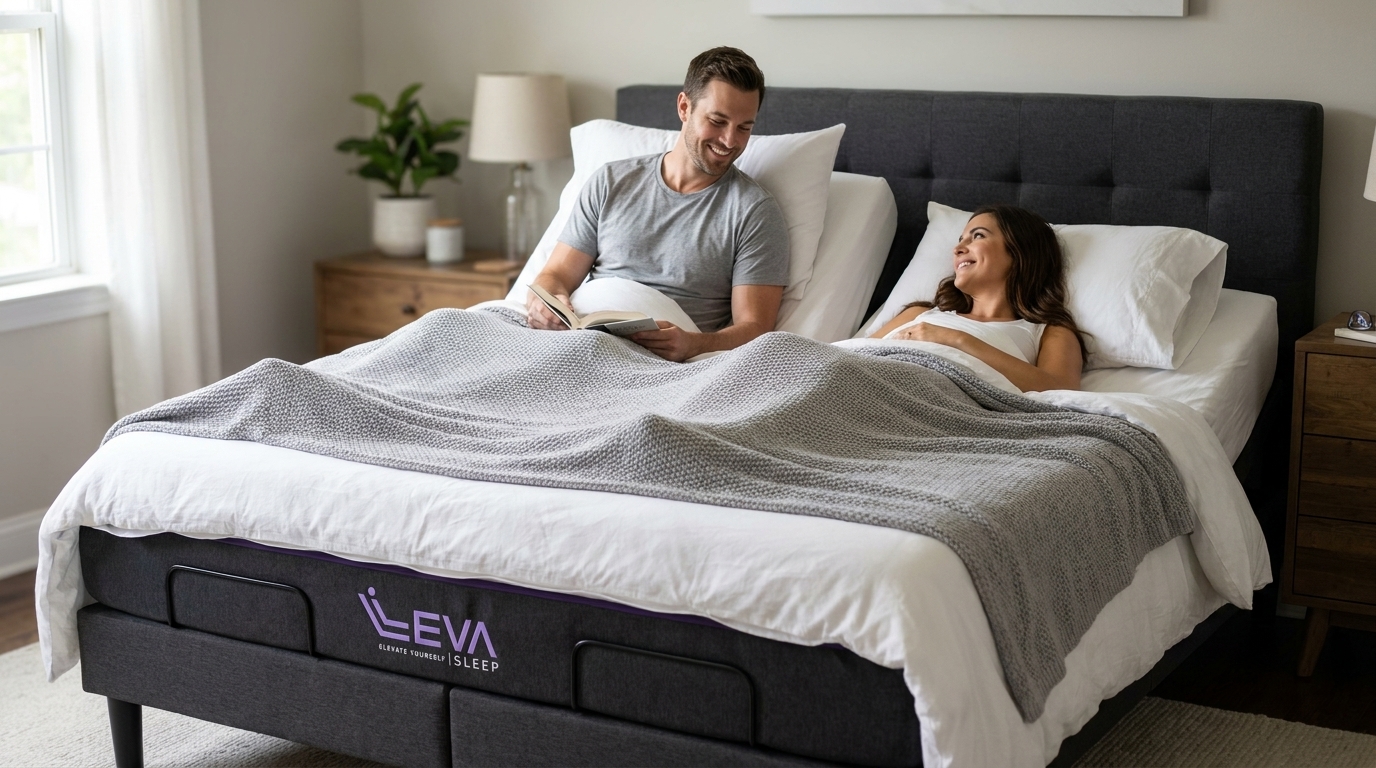
A split adjustable bed keeps both partners in the same room and on the same overall bed. Closeness then depends on habits and intention, not just physical distance. The strategies below work together across the evening and morning to maintain connection while each partner sleeps on their own side.
- Establish a shared wind-down ritual before sleep, such as a short conversation, a show, or a few screen-free minutes, before adjusting to individual positions.
- Use a gap-filler or mattress topper across the centre seam to create a continuous surface for cuddling before sleep, then move to separate positions when ready to rest.
- Synchronize wake-up times when possible by using the app’s vibrating alarm feature, which wakes one partner without disturbing the other and protects morning connection time.
- Treat the split configuration as a tool for better rest rather than a barrier. Couples therapist and sexologist Isiah McKimmie notes that sleeping separately works best when couples still spend time in the same bed before sleep or in the morning and prioritize sexual intimacy at other times. The same principle applies to split systems within one shared bed.
- Address the root cause directly. When snoring improves through head elevation, anti-snore mode, or CPAP, treating underlying obstructive sleep apnea improves both partners’ sleep and the relationship more reliably than separate rooms.
When Sleep Divorce Still Makes Sense
A split adjustable bed solves most mechanical causes of sleep disruption, but not every situation. Separate sleeping arrangements remain appropriate in the scenarios below.
- Severe, untreated sleep apnea: An adjustable bed can support CPAP treatment but cannot replace a prescribed CPAP machine. If CPAP equipment noise or mask use is the main disruptor, separate rooms may be needed until treatment is stable.
- Radically mismatched schedules: When one partner works overnight shifts and the other follows a standard day schedule, the timing of entering and leaving the bedroom can exceed what any bed configuration can handle.
- Infant care: When one partner manages nighttime feeds and the other needs uninterrupted sleep for work or health, temporary separate sleeping is a practical choice that sits outside bed technology.
- Medical contraindications: People with spinal fusion or osteoporosis should avoid adjustable beds because poor positioning can worsen these conditions. Anyone with heart or respiratory issues should speak with a doctor before using an adjustable base.
In these cases, sleep divorce becomes a health decision rather than a relationship failure. The goal is to choose separate rooms only when they are truly necessary, not because couples lacked access to a workable shared solution.
Will a Split King Prevent Sleep Divorce? Root-Cause Guidance
Different sleep problems respond to different solutions. The sections below explain how a flat mattress, sleep divorce, and a split adjustable bed each address common root causes, using the same research cited earlier.
For snoring and mild obstructive sleep apnea, a flat mattress offers no positional help, so the partner absorbs the full disruption. Mayo Clinic research found that bed partners of people with sleep apnea lose about one hour of sleep per night due to snoring. Sleep divorce removes the partner’s exposure to noise but does not treat the snorer’s airway. A split adjustable bed uses head elevation, which can reduce the apnea-hypopnea index in a multicentre OSA study, and anti-snore mode adjusts only the snorer’s side without waking the other partner.
For acid reflux and GERD, a flat position allows stomach acid to travel up the esophagus, and stacked pillows often shift during the night. Separate rooms protect the partner’s sleep but do not improve the reflux sufferer’s symptoms. A split adjustable bed elevates one side independently. Head elevation improves acid clearance time, as shown in the 1981 pH monitoring study mentioned earlier, which supports better comfort for the person with reflux.
For hip, knee, or back pain, a fixed mattress cannot adapt to changing pain levels or recommended elevated positions. Sleep divorce allows each person to choose their own mattress but removes shared sleep benefits such as oxytocin production and heart rate synchronization. A split adjustable bed offers a Zero Gravity position that provides spinal decompression and reduces pressure on the lumbar region, and each partner can set their own elevation.
For temperature differences, a traditional mattress cannot fully resolve incompatibility. Dense foam traps heat, while breathable hybrids may leave cold sleepers wanting more warmth. Sleep divorce lets each partner control room temperature but removes shared proximity. A split adjustable bed paired with Leva Sleep’s heating and cooling pad gives independent temperature control on each side. Separate duvets per side also remove the nightly blanket tug-of-war.
For motion transfer and restlessness, shared beds on traditional mattresses can increase wake-ups compared with solo sleeping. Studies have linked shared beds to more awakenings. Sleep divorce eliminates motion transfer but also removes nightly physical closeness. A split adjustable bed with a Split King mattress delivers strong motion isolation. Bryte reports 74–82% better motion isolation than a single King, and two independent bases prevent one partner’s movement from shifting the other.
The practical takeaway is clear. When the root cause is positional, such as snoring, reflux, or pain, or mechanical, such as motion transfer or temperature, a split adjustable bed usually solves it within a shared sleep space. When the root cause involves schedules, medical equipment, or a contraindicated condition, separate rooms remain the right answer. Technology cannot fix every scenario, but for most Canadian couples with the issues described above, it removes the need to choose between rest and togetherness.
Find the Split Queen or Split King package that matches your main sleep challenge.
Frequently Asked Questions
Is a split adjustable bed only for couples with health issues?
A split adjustable bed helps any couple with meaningfully different sleep preferences, including firmness, elevation, temperature, or schedule. Health conditions such as snoring, acid reflux, sleep apnea, and joint pain make the case stronger, but couples without diagnoses still benefit from motion isolation and personalized positioning. Both partners simply need to feel comfortable with the slight centre gap between the two mattresses, which a foam bridge or mattress topper can minimize.
Can I use a CPAP machine with a Leva Sleep adjustable bed?
CPAP therapy works well with an adjustable base. Head elevation can further reduce airway obstruction and improve comfort. Head elevation does not replace a prescribed CPAP machine, so any prescription should still be followed. The two approaches work together, and an adjustable base can also reduce the severity of mild positional sleep apnea in people who are not CPAP candidates yet. A sleep physician can advise on the right elevation angle for a specific diagnosis.
How loud are the motors during nighttime adjustments?
Motor noise often separates entry-level bases from premium systems. Basic models can create a mechanical hum loud enough to wake a light sleeper. Leva Sleep uses whisper-quiet German motors that are engineered to minimize sound during movement. When evaluating any adjustable base, ask the retailer to show the motor at its slowest adjustment speed, which is the speed most likely used during anti-snore adjustments, and decide whether that sound level would wake your partner.
What bedding fits a split adjustable bed?
Standard fitted sheets usually do not stay on during elevation. A Split King needs two Twin XL fitted sheets and two Twin XL mattress protectors, one for each side. A single standard King flat sheet, duvet cover, or comforter can cover the full surface when the bed is flat. Leva Sleep offers bedding accessories made for adjustable bases, including deep-pocket fitted sheets with extra elastic, duvet clips that keep separate duvets in place when the sides sit at different angles, and integrated remote pockets. Purpose-built bedding removes one of the most common frustrations owners report.
Who benefits most from a Split Queen versus a Split King?
A Split King, which uses two Twin XL bases for a total size of 76″ × 80″, suits couples who want maximum personal space and full independent adjustability. It works best in bedrooms that are at least 12 × 12 feet. A Split Queen is Leva Sleep’s option for smaller rooms or couples upgrading from a standard Queen. It offers the same independent control per side in a more compact footprint. Couples managing snoring, reflux, or pain who currently sleep on a Queen often find the Split Queen ideal because it delivers clinical benefits without requiring a larger bedroom. Couples with bigger rooms and larger differences in preferences, including firmness, usually prefer the extra width of a Split King.
Choosing to Stay Together When Technology Solves the Problem
Sleep divorce can be a reasonable response to chronic disruption, and for some couples it remains the right long-term setup. For most Canadian couples whose sleep suffers because of snoring, acid reflux, pain, motion transfer, or temperature differences, a split adjustable bed addresses the root cause while keeping both partners in the same room.
Research on sleep divorce outcomes remains limited. The ResMed 2024 Global Sleep Survey did not report whether sleeping apart improved or worsened relationships. A split adjustable bed does not function as a compromise where both partners give something up. Each side receives its own tailored setup, and the bed stays shared.
Leva Sleep has spent more than eight years and over $50 million in sales refining this solution for Canadian couples. With more than 25,000 customers, 15–20 adjustable models, in-house white-glove delivery across Ontario and Alberta, and pricing about 30–50% below similar luxury competitors, many couples find the barrier to solving their sleep problems lower than expected.