Written by: Matthew Timmins, Founder and Managing Director, Leva Sleep | Last updated: July 15, 2026
Key Takeaways
- Fix your wake time first every day, including weekends, to anchor your circadian rhythm and lower long-term health risk.
- Shift bedtime gradually by 15–30 minutes every few days instead of making large, abrupt changes.
- Control evening light, meals, stimulants, and movement using the 3-3-3 rule so your body gets a clear “time for sleep” signal.
- Optimize the shared sleep surface with independent temperature, firmness, and position controls so one partner’s needs do not disrupt the other.
- Independent sleep surface controls, including temperature, firmness, and position, prevent one partner’s adjustments from disrupting the other’s sleep.
Step 1: Anchor Your Wake Time Every Day, Including Weekends
Helen Burgess, co-director of the Sleep and Circadian Research Laboratory at the University of Michigan, prioritizes fixing wake time over bedtime because a consistent wake time anchors the circadian clock. You cannot directly control when you fall asleep, but you can control when you get up.
The evidence for consistency is substantial. A 2024 analysis of more than 60,000 UK Biobank participants found that sleep regularity was a stronger predictor of all-cause mortality than average sleep duration. A review led by Dr. Alexandros Kalkanis at KU Leuven linked regular sleep timing to better mental and physical health outcomes.
Set the alarm for the same time seven days a week. This consistency trains your internal clock, so many people begin waking naturally before the alarm after a few weeks of steady practice. Weekends are where this pattern often breaks, so limit sleeping in to no more than 30 minutes past your target time to avoid social jet lag undoing your progress.
Step 2: Shift Bedtime Gradually Using the 15–30 Minute Rule
Move the target bedtime 15–30 minutes earlier every two to three days rather than all at once. This gradual approach works because shifts larger than an hour overwhelm your circadian system and tend to be less effective. Using this incremental method combined with morning light, most people can achieve a one-to-two hour schedule correction within one week.
Step 3: Apply the 3-3-3 Rule for Light, Meals, and Movement
The 3-3-3 rule structures the three hours before bed around three environmental levers: light reduction, meal cutoff, and movement timing. Together, these levers send a clear, coordinated message that night is approaching. Each one targets a different part of your circadian system so your brain and body wind down on schedule.
- Light: Harvard Medical School researcher Charles Czeisler has shown that evening light exposure sufficient to suppress melatonin can delay sleep onset. Dim overhead lights and switch screens to night mode at least two hours before bed.
- Meals: Johns Hopkins Medicine identifies meal timing as a key environmental cue that resets the internal clock. Finishing dinner at least two to three hours before your target bedtime reinforces the schedule shift.
- Movement: Exercise performed in the morning or early afternoon advances the body’s melatonin cycle, whereas evening exercise at 7 p.m. or later delays it. Plan intense workouts earlier in the day and keep late-evening activity gentle.
Step 4: Manage Stimulants and Build an Evening Wind-Down
Caffeine should be delayed until 90 minutes after waking and cut off by 1–3 PM to avoid interfering with adenosine-mediated sleep pressure buildup. Caffeine equivalent to a double espresso consumed three hours before bedtime delays the circadian melatonin rhythm by approximately 40 minutes.
Alcohol deserves equal attention. Avoiding alcohol within three hours of sleep reduces snoring significantly by preventing muscle relaxation that worsens airway obstruction, which directly benefits couples sharing a bed.
A consistent 30-minute wind-down ritual with dim lighting, light reading, or a warm shower signals the brain that sleep is approaching. If you include a warm bath in this routine, timing it about 90 minutes before bed maximizes its effect because the rapid core body temperature drop that follows naturally promotes sleep onset.
Step 5: Troubleshoot When You Cannot Fall Asleep
Lying awake in bed trains the brain to associate the mattress with wakefulness. Cognitive Behavioural Therapy for Insomnia (CBT-I) stimulus control recommends getting out of bed after 15–20 minutes of wakefulness and doing a quiet, dimly lit activity until you feel sleepy again.
Keep the wake time fixed regardless of how much sleep you got the previous night. The resulting mild sleep pressure will naturally pull bedtime earlier over the next few nights. If sleep onset remains hours later than desired despite weeks of consistent light timing, you may be dealing with delayed sleep-wake phase disorder (DSWPD) rather than simple misalignment, which warrants evaluation by a board-certified sleep physician.
Step 6: Fine-Tune the Bedroom Environment for Two Sleepers
The bedroom environment is where schedule consistency either holds or collapses for couples. Four variables matter most and each one can be adjusted without forcing one partner to compromise.
- Temperature: The Sleep Foundation recommends a bedroom temperature between 60–67°F (15.5–19.4°C), with many researchers considering about 65°F (18.3°C) as optimal. When partners run at different temperatures, independent thermal control on each side of the bed resolves the conflict without a thermostat war.
- Darkness: A 2022 Northwestern University study found that moderate light exposure of 100 lux during sleep increased heart rate, impaired glucose metabolism, and activated the sympathetic nervous system. Blackout curtains and covered LED indicators keep the room below 3 lux.
- Sound: Acoustic change is more disruptive to sleep than steady volume, and consistent background sound allows habituation while masking unpredictable noises such as a snoring partner. A fan or white-noise machine can smooth out those spikes.
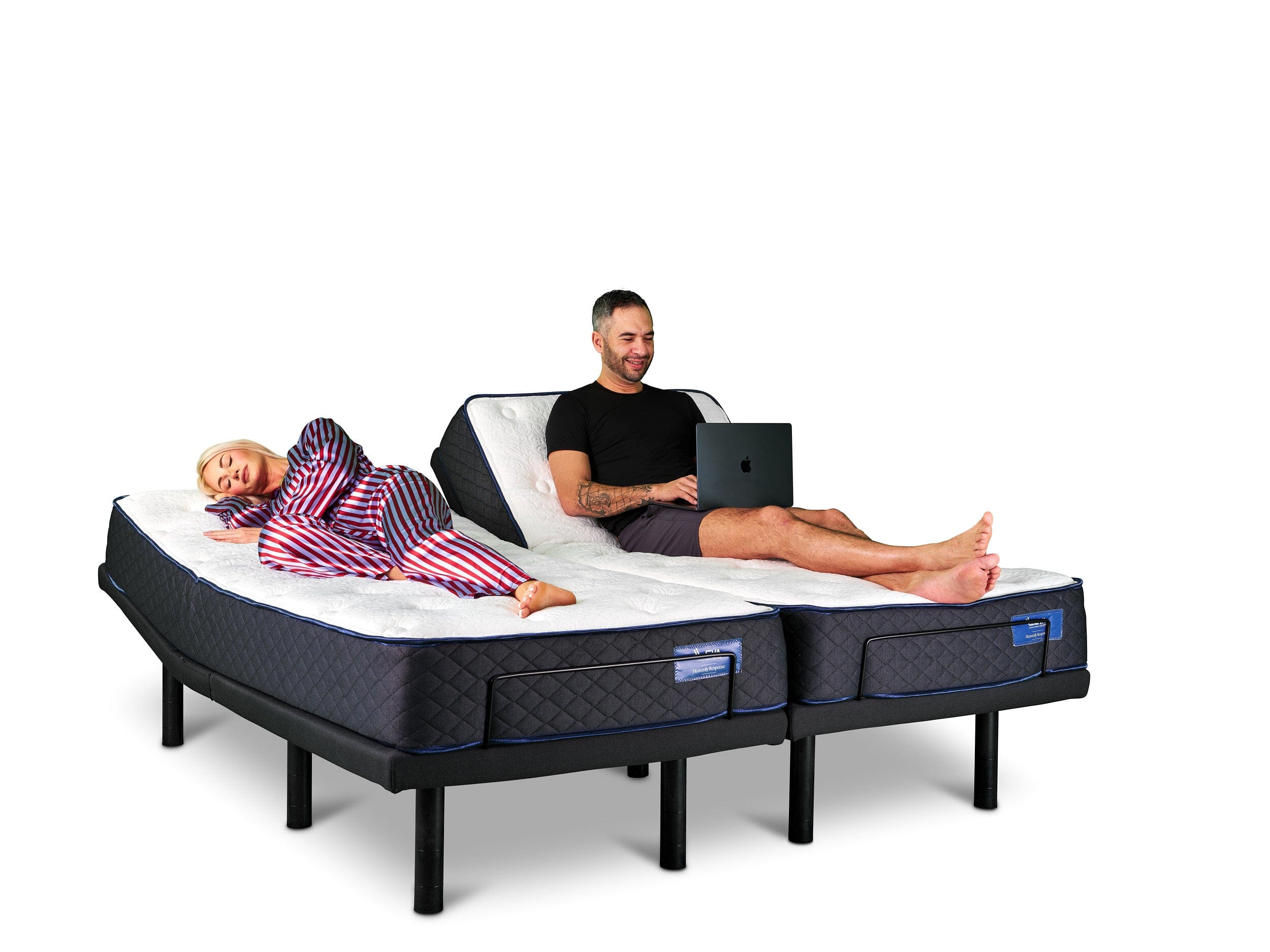
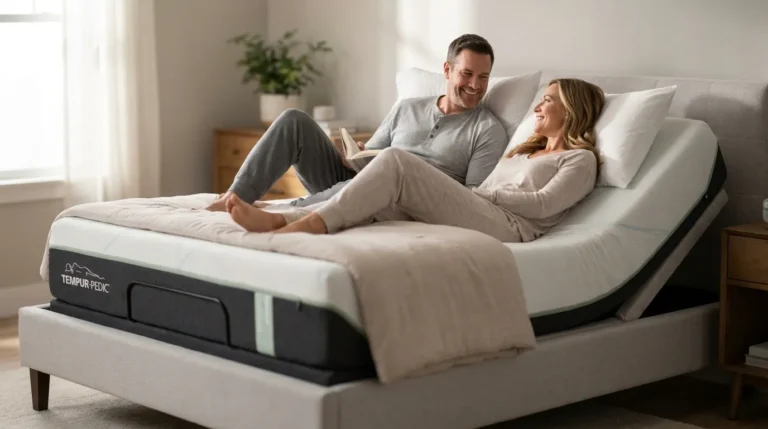
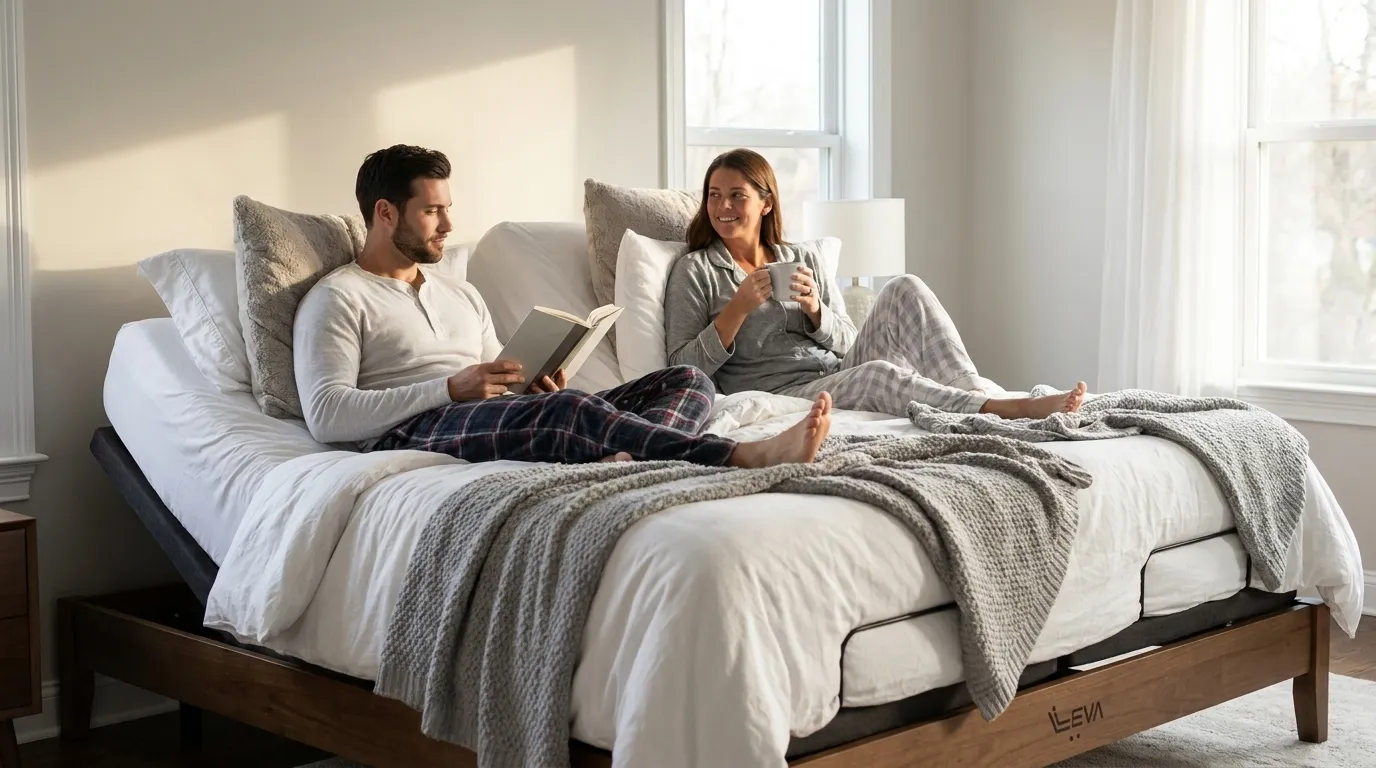
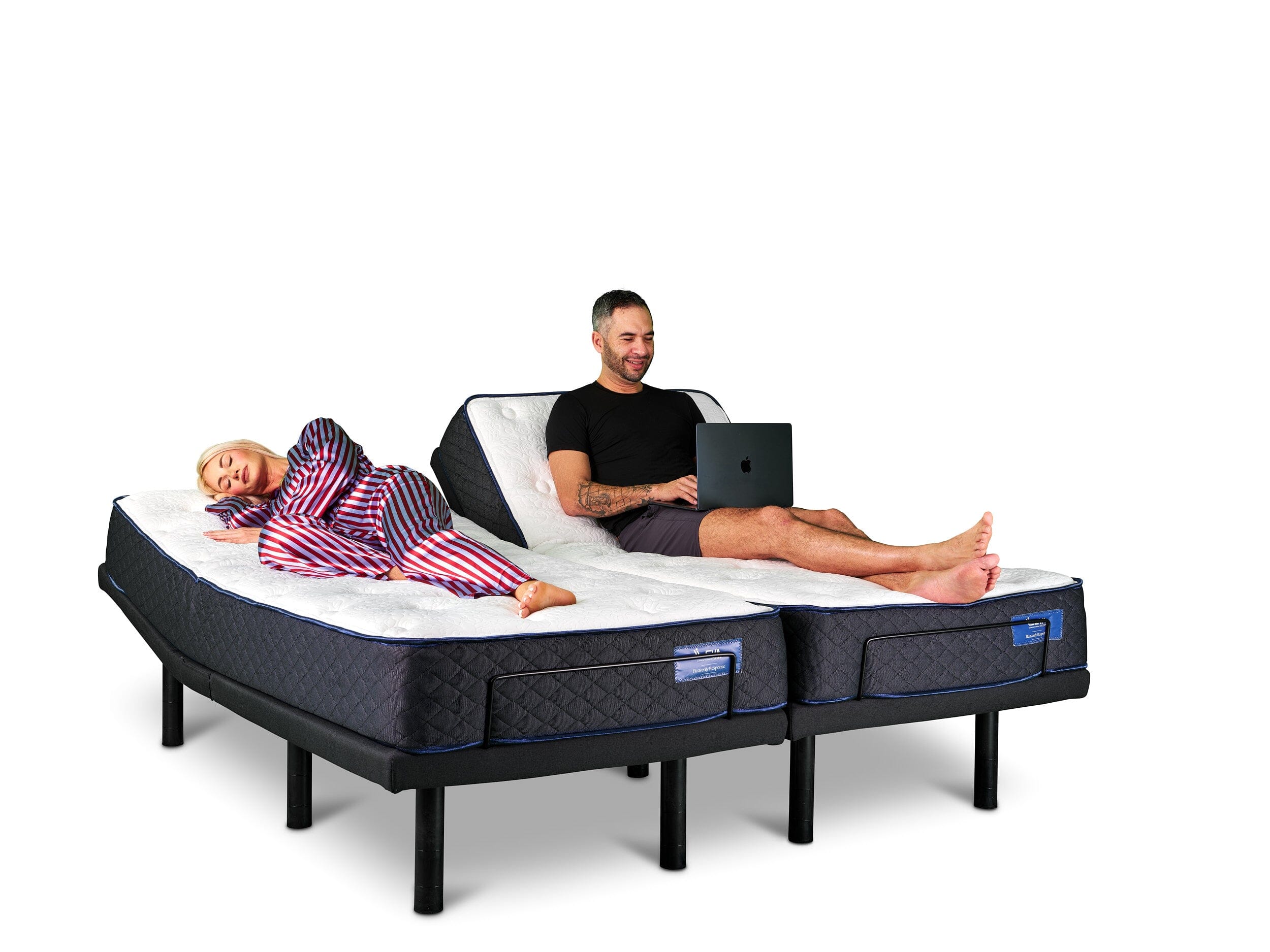
- The sleep surface: The physical sleep surface is another environmental factor that either supports or undermines schedule consistency for couples. This is where Leva Sleep’s Split Queen and Split King adjustable bases become a practical enabler. Each side operates independently for head and foot elevation, lumbar control, whisper-quiet motors, and temperature regulation, so one partner’s position changes do not disturb the other. With 15–20 models assembled locally in Ontario and Alberta and priced 30–50% below comparable luxury competitors through vertical integration, Leva provides a white-glove setup experience that includes old bed removal, height adjustment, and a full product tutorial.
Compare Split Queen and Split King configurations, both with independent controls for different couple needs.
Step 7: Solve Partner-Specific Disruptions like Snoring, Temperature, and Firmness
Snoring prevalence estimates vary widely by study and definition, typically ranging 24–50% in men and 14–30% in women, with no data available on typical volume in dB, and this noise causes measurable sleep fragmentation and daytime fatigue for the non-snoring partner. Studies suggest the bed partner of a snorer can lose about an hour of sleep per night due to noise disruption.
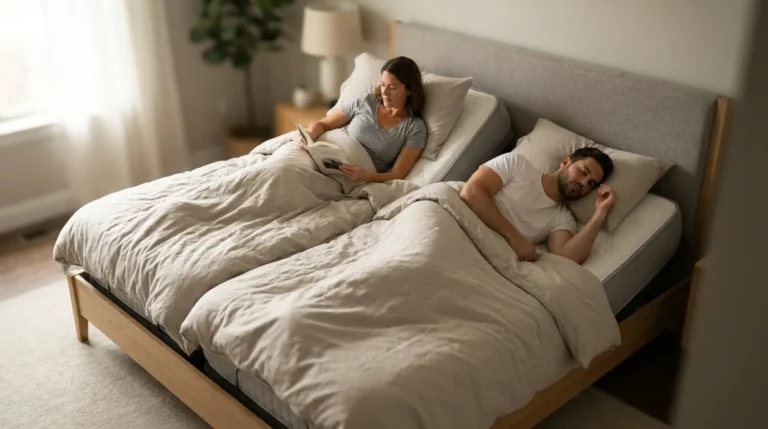
Snoring scenario: A couple in Mississauga, one partner with mild sleep apnea and the other a light sleeper, found that elevating the head of the snoring partner’s side by 7–15 degrees opened the airway and reduced snoring without waking the other side. Leva Sleep’s anti-snore mode detects snoring and makes micro-adjustments to the head of the bed automatically, so no one has to wake up and intervene at 2 a.m.
Firmness scenario: Mismatched chronotypes and differing firmness preferences can compound disruption. Leva’s Split Queen configuration, a unique offering in the Canadian market, gives each partner an independently adjustable surface in a space-conscious footprint. This setup removes the need to compromise or move to separate rooms.
Temperature scenario: Individual temperature preferences often differ between couples, and a cooler room with a heavier blanket for the cold-running partner is more effective than a warmer room with a lighter blanket for the warm-running partner. Leva’s integrated heating and cooling pad provides independent per-side temperature regulation, which resolves this tension without separate duvets or thermostat conflict.
Step 8: Track Progress and Reset After Life Events
Adjust one or two practices at a time and track current patterns for two to four weeks before evaluating impact so you do not abandon changes prematurely. Meaningful improvement in sleep timing typically appears within the one-week window mentioned earlier, and full circadian stabilization takes the two to four weeks of consistent timing discussed in Step 1.
Life events such as travel, shift changes, illness, or a new baby will disrupt the schedule. When that happens, return to Step 1, anchor the wake time again, and rebuild from there. Approximately 30% of employed Canadians work shifts or non-standard hours, so periodic resets are a normal part of long-term sleep management rather than a sign of failure.
What Success Looks Like for Couples Using This Protocol
After you follow the protocol outlined in Steps 1–6 consistently, the measurable outcomes align with the research. Regular sleepers carry a 38% lower risk of developing depression and a 33% lower risk of developing anxiety compared with irregular sleepers. Higher sleep consistency is also associated with feeling more rested and energized.
For couples, success means both partners waking at the same time without one having sacrificed sleep quality to accommodate the other. That outcome requires behavioural consistency and a sleep surface that supports independent needs, which is precisely the problem Leva Sleep was built to solve. See delivery options and available models, including the full-service setup described earlier and 15–20 configurations to match different couple preferences.
Frequently Asked Questions
Are Leva Sleep adjustable beds suitable for someone with sleep apnea?
Leva Sleep’s adjustable bases are designed to gently elevate the head of the bed, which can help open the airway and reduce the severity of mild to moderate sleep apnea without requiring a mask. The head elevation range and the anti-snore mode (arriving spring 2026), which detects snoring and makes automatic micro-adjustments, make Leva bases a practical complement to medical guidance. Sleep apnea clinics have referred patients to Leva Sleep for this reason. Anyone with diagnosed sleep apnea should continue to follow their physician’s treatment plan, because an adjustable base is a supportive tool, not a replacement for medical care.
Which Canadian provinces does Leva Sleep deliver to?
Leva Sleep currently offers in-house white-glove delivery in Ontario and Alberta. This service is handled by trained Leva professionals who deliver to the bedroom, assemble the base, adjust leg heights, provide a full product tutorial, and remove the old bed through donation or recycling. Customers outside these provinces should contact Leva Sleep directly to discuss available options.
Will a Leva Sleep adjustable base work with my existing mattress?
Leva Sleep designs its own all-foam and hybrid pocket coil mattresses specifically to flex and perform with adjustable bases. While some existing mattresses, particularly all-foam and certain hybrid models, are compatible with adjustable bases, traditional innerspring mattresses with connected coils are generally not. Leva Sleep specialists can assess compatibility during the purchase consultation. For the best performance, pairing a Leva base with a Leva-designed mattress or one of the brand-name mattresses Leva carries (including Tempur-Pedic, Simmons, Beautyrest, Serta, and Kingsdown) is recommended. Leva also designs purpose-built bedding accessories such as fitted sheets with deep pockets and extra elastic, duvet clips, and mattress protectors that are engineered to stay in place even at significant elevation angles.
What maintenance does a Leva Sleep adjustable base require?
Leva Sleep bases use whisper-quiet German motors engineered for long-term reliability with minimal maintenance. Routine care involves keeping the base clear of obstructions that could interfere with the articulation mechanism, periodically checking that all connections remain secure, and using the Leva Sleep app to run position checks. The white-glove delivery team walks every customer through the full operation of the base at setup, including app pairing, custom position saving, and vibrating alarm configuration. For any mechanical concerns after delivery, Leva Sleep’s in-house support team handles service directly, consistent with its vertically integrated model.